Hobonishi Castle (Yokkaichi City, Mie Prefecture) Complete Guide | History, Remains, and Access Information
What is Hobonishi Castle?
Hobonishi Castle is a medieval hilltop castle located in Nishimura-cho, Yokkaichi City, Mie Prefecture. Also known as Asakura Castle or Hobonishimura Castle, it is a significant historical site in the northern Ise region.
Currently, the eastern part of the castle site is maintained as “Hobonishiyama Park,” and the remains, including the main keep, a folding earthen rampart, a dry moat approximately 8 meters deep, and a square-shaped gate, are well-preserved. It is highly regarded by castle researchers and history enthusiasts as a valuable castle ruin that conveys the unique “main enclosure + residential complex” structure of northern Ise.
The castle was built on the tip of a plateau approximately 20 meters high, situated at a strategic transportation hub where the Happo Road leading to Kuwana passed. This location speaks to the strategic importance of Hoho-Nishi Castle.
History of Hoho-Nishi Castle
Construction and the Asakura Clan
Hoho-Nishi Castle is believed to have been built during the Muromachi period by Asakura Bizen-no-kami. The Asakura clan was related to a branch of the Echizen Asakura clan and was a lineage descended from Asakura Akimasa, who served as a magistrate for the Muromachi Shogunate.
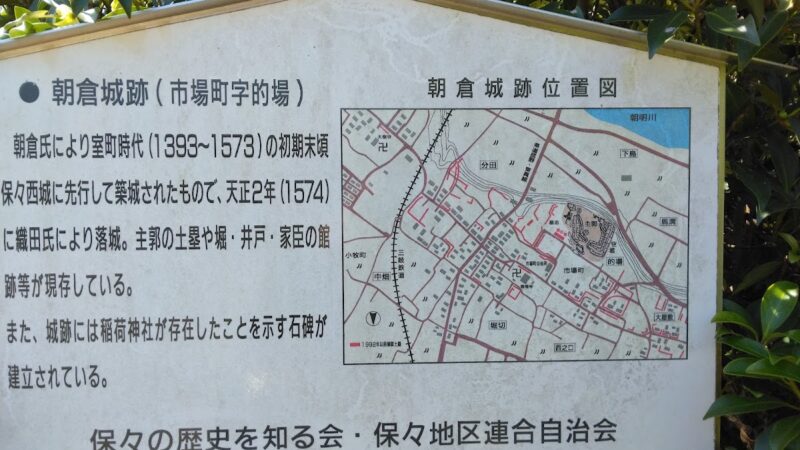
The Asakura clan expanded their power in the northern Ise region, using Hoho-Nishi Castle as their base and controlling the surrounding area. Branch castles such as Ichiba Castle, Shigefuku Castle, and Nakano Castle were also built, forming the Asakura clan’s sphere of influence.
Oda Nobunaga’s Invasion of Ise and the Fall of Hoho-Nishi Castle
The fate of Hoho-Nishi Castle was sealed by Oda Nobunaga’s invasion of Ise in 1568 (Eiroku 11). During this period, Oda Nobunaga, aiming to march on Kyoto with Ashikaga Yoshiaki, embarked on the pacification of Ise Province in the process.
Nobunaga appointed his fierce general, Takigawa Kazumasu, as the commander-in-chief of the Ise campaign. Takigawa Kazumasu’s forces successively captured castles in northern Ise, and Hoho-nishi Castle also became a target. After fierce fighting, Hoho-nishi Castle fell along with Shigefuku Castle and Nakano Castle, and the Asakura clan, the castle’s lords, are said to have been destroyed.
However, there are various theories regarding the timing of the Asakura clan’s downfall, and debate continues among researchers. Some historical sources suggest the possibility that some members of the Asakura clan survived and migrated to other regions.
Hoho-nishi Castle After its Fall
After Oda Nobunaga’s invasion of Ise, Hoho-nishi Castle is believed to have been abandoned. Although it lost its function as a castle, its remains were relatively well preserved. Since the modern era, the area surrounding the castle ruins has been used as farmland and forest, but the main remains have escaped destruction and remain to this day.
Structure and Layout of Hoho-Nishi Castle
A Typical Example of a Northern Ise-Type Castle
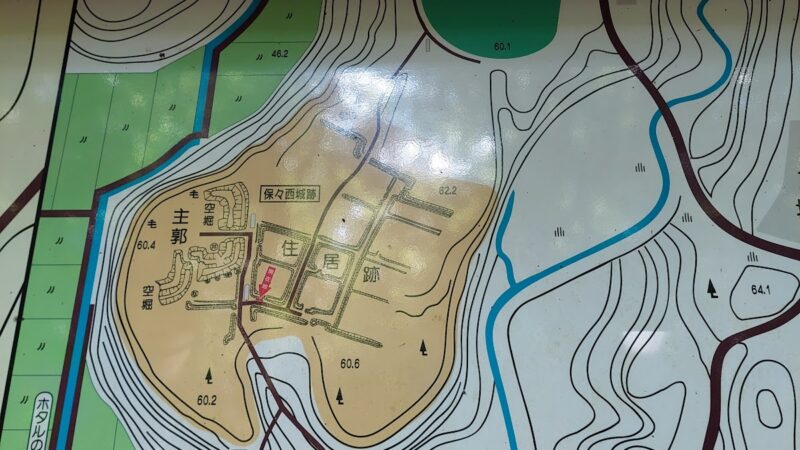
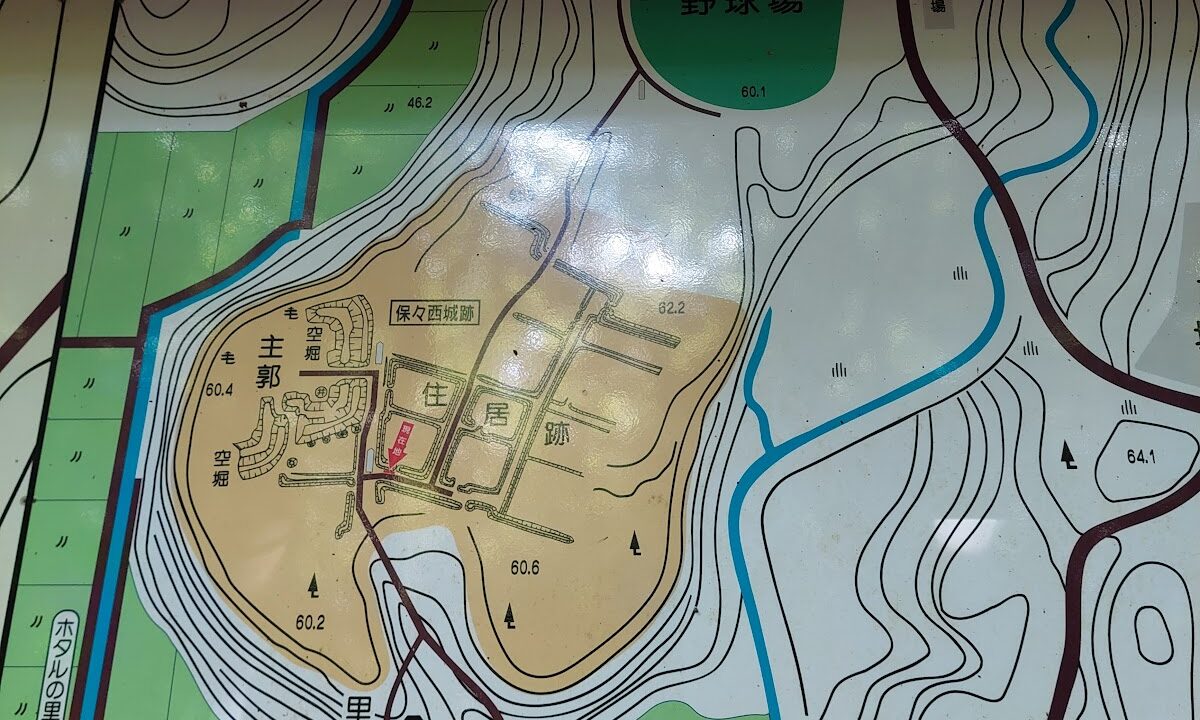
Hoho-Nishi Castle is a castle with a “main enclosure + residential complex” structure characteristic of the Northern Ise region. This structure consists of a main enclosure (honmaru) that serves as the core of the defense, and multiple residential complexes arranged around it.
While several castles with similar structures existed in Northern Ise, many have lost their remains due to development and destruction. Examples like Hoho-Nishi Castle, where the remains of the residential complex are almost completely preserved, are extremely valuable. It is an important resource for understanding the reality of Northern Ise-type castles in castle research.
Structure of the Main Enclosure (Honmaru)
The main enclosure is located at the highest point of the plateau and is heavily defended by earthworks and dry moats. Of particular note is the folding screen-style earthen rampart, which, instead of a straight rampart, incorporates a bend to enhance its defensive capabilities. This technique reflects the castle-building techniques of the late Sengoku period and provides a clue to estimating the period of the castle’s renovations.
The remains of a well have also been confirmed within the main enclosure, indicating that water supply was considered during sieges. Furthermore, several flat areas believed to be the remains of buildings exist, suggesting the presence of the lord’s residence or soldiers’ quarters.
Dry Moat and Earthen Bridge
One of the greatest highlights of Hoho-Nishi Castle is the dry moat, reaching a depth of approximately 8 meters. This dry moat surrounds the main enclosure, forming a strong defensive line to prevent enemy intrusion. Even today, one can look down into the deep moat, appreciating the advanced castle-building techniques of the time.
An earthen bridge spans a portion of the dry moat, functioning as an entrance and exit to the castle. The earthen bridge was a passage created by leaving a section of the moat unexcavated, and it is believed to have been designed to be easily destroyed in times of emergency.
Masugata Koguchi (Square Enclosure)
A masugata koguchi is provided at the entrance to the main enclosure. A masugata koguchi is a structure designed to prevent enemy intrusion, with an entrance bent in a “U” or “L” shape. It was intended to lure invading enemies into a narrow space, allowing for attacks from three sides.
The masugata koguchi at Hoho-Nishi Castle is relatively well-preserved, allowing observation of the earthwork arrangement and the shape of the entrance. It is a very educational remains for understanding the castle defense system of the Sengoku period.
Arrangement of Residences
Around the main enclosure, several flat areas are arranged in a stepped pattern. These are believed to have been used as residences for retainers or garrisons for soldiers. Each flat area was demarcated by small earthworks or steps, forming an independent defensive unit.
The remains of the residential complex are buried within bamboo groves and thickets, but careful observation reveals traces of earthworks and elevation changes. The existence of these residential complexes is essential for understanding the overall structure of the North Ise-type castle.
Highlights of Hoho-Nishi Castle (Castle Notes)
1. Folding Screen Earthworks
The earthworks surrounding the main enclosure are not straight but shaped like folding screens. This “folding screen” design was a clever technique to facilitate attacks on the enemy’s flanks, demonstrating the advanced castle-building techniques of the late Sengoku period. The height of the earthworks varies depending on the location, but the highest points reach over 3 meters.
Standing on top of the earthworks, you can enjoy a panoramic view of the surrounding terrain and appreciate the castle’s advantageous location. There are also places where you can observe the cross-section of the earthworks, confirming traces of rammed earth construction (a method of compacting soil).
2. The 8-Meter Deep Dry Moat
The dry moat of Hoho-Nishi Castle is a massive structure, approximately 8 meters deep and over 10 meters wide. While it’s impossible to descend to the bottom of the moat, its sheer size is awe-inspiring even from above.
The dry moat is particularly deep on the north and east sides of the main enclosure, indicating a strong emphasis on defense against attacks from the most vulnerable directions. The moat walls are steeply sloped, suggesting that climbing would have been extremely difficult.
3. The Structure of the Masugata Koguchi (Square Enclosure)
The Masugata Koguchi, located at the entrance to the main enclosure, is the core of Hoho-Nishi Castle’s defensive system. Earthen ramparts are positioned before and after the entrance, creating a structure designed to lure intruders into a narrow space.
Observing the structure of the entrance on-site reveals meticulous design details, including the placement of the earthen ramparts and the width of the passageways. This is a must-see point for anyone interested in castle architecture.
4. Well Remains
The remains of a well are still visible within the main enclosure. Although currently filled in, the depression retains its shape. Securing a water source was crucial for a castle designed for siege warfare. The existence of this well indicates that Hoho-Nishi Castle was designed to withstand prolonged sieges.
5. Castle Site Monument and Information Board
An information board marking the castle site is located along a farm road in the rice paddy area on the south side of the castle site. Additionally, a castle site monument is located near the backstop of the baseball field in Hokusei Central Park, and a path leading to the castle grounds is maintained from here.
The information board contains detailed explanations of the history and structure of Hoho-Nishi Castle; it is recommended to read it before visiting.
Access to Hoho Nishi Castle
Using Public Transportation
Nearest Station: Hoho Station, Sangi Railway Sangi Line
It’s approximately a 20-25 minute walk from Hoho Station to Hoho Nishi Castle Ruins (Hokusei Central Park). Exit the station and head west, then take the prefectural road towards Hokusei Central Park. There aren’t many signs along the way, so it’s recommended to check the route beforehand using a map app.
If using a taxi, it’s about a 5-minute ride from Hoho Station, costing around 1,000 yen.
Using a Car
Approximately 15 minutes from Yokkaichi East IC on the Tomeihan Expressway
Exit the Yokkaichi East IC and head north on National Route 477, then take the prefectural road towards Hokusei Central Park. Entering “Hokusei Central Park” or “Hoho Satoyama Park” into your car navigation system is convenient.
Parking: Parking is available at Hokusei Central Park (free). The castle ruins are just a few minutes’ walk from the parking lot.
Approach to the Castle Ruins
Upon arriving at Hokusei Central Park, head towards the baseball field within the park. A castle ruins monument is located near the backstop of the baseball field, and a path leading to the castle grounds is maintained from there. The path is relatively well-maintained, but there are some steep slopes and slippery sections, so comfortable walking shoes are recommended.
Notes and Recommended Time of Visit
Clothing and Equipment
- Comfortable Walking Shoes: There are slopes and uneven terrain within the castle grounds. Sneakers or light hiking boots are suitable.
- Long Sleeves and Long Pants: Recommended for insect repellent in summer and for warmth in winter.
- Hat and Drinking Water: Essential, especially when visiting in summer.
- Camera: A DSLR or mirrorless camera is recommended for photographing the ruins, but a smartphone is sufficient.
Recommended Visiting Season
Spring (March-May) and Autumn (October-November) are the most suitable times to visit. The weather is mild, making it easier to observe the ruins. Autumn, in particular, offers beautiful autumn foliage.
Summer (June-September) is overgrown with vegetation, which may make the ruins difficult to see. Also, there are many insects, so carrying insect repellent is recommended.
Winter (December-February) is better as the vegetation withers, making the ruins easier to see, but cold weather precautions are necessary.
Estimated Visiting Time
If you want to thoroughly explore the entire castle site, allow approximately 1-1.5 hours. If you only want to visit the area around the main enclosure, 30-40 minutes is sufficient.
If you plan to take photographs or conduct detailed observations, it’s best to allow about 2 hours.
Related Historical Sites in the Surrounding Area
Ichiba Castle
Located approximately 2 kilometers southeast of Hoho-Nishi Castle, Ichiba Castle was built by Asakura Akimasa and later functioned as a subsidiary castle of Hoho-Nishi Castle. It fell along with Hoho-Nishi Castle during Oda Nobunaga’s invasion of Ise Province in 1568.
Currently, the castle site is a bamboo grove, but the earthworks and dry moats remain well-preserved, and a castle site monument stands on the eastern earthwork. Visiting both Hoho-Nishi Castle and Ichiba Castle provides insight into the Asakura clan’s castle network.
Shigefuku Castle
Located west of Hoho-Nishi Castle, Shigefuku Castle was also one of the Asakura clan’s subsidiary castles. It fell during the Ise invasion in 1568, and although only some remains exist today, it is an important historical site for understanding the Asakura clan’s sphere of influence.
Nakano Castle
Nakano Castle, a branch castle of the Asakura clan, fell to an attack by Takigawa Kazumasu, along with Hoho-nishi Castle. Currently, due to residential development, most of the remains have been lost, but some traces of earthworks remain.
Oida Castle
Numerous other medieval castles exist within Yokkaichi City, and Oida Castle is one of them. Visiting these castles will allow for a deeper understanding of the medieval history of the northern Ise region.
Hoho-nishi Castle and the Historical Background of Ise
The Sengoku Period in Northern Ise
During the Sengoku period, the northern Ise region was in a complex political situation with multiple powers vying for power. Besides the Asakura clan, local forces such as the Nagano, Kambe, and Chigusa clans existed, maintaining their power through alliances and conflicts.
The area from Kuwana to Yokkaichi, in particular, was a crucial transportation hub through which major roads such as the Tokaido and Happo Kaido passed, making it an economically and militarily important region. Hoho-Nishi Castle was situated at this crucial point, making it a strategic base that controlled the highway.
Significance of Oda Nobunaga’s Invasion of Ise
Oda Nobunaga’s invasion of Ise in 1568 had a strategic objective: stabilizing his rear in preparation for his march to Kyoto. By pacifying Ise Province, he strengthened his power base in the Tokai region, allowing him to march safely to Kyoto.
Takigawa Kazumasu’s conquest of northern Ise was an important part of Nobunaga’s pacification of Ise, and the fall of Hoho-Nishi Castle was a symbolic event. After this, Takigawa Kazumasu was entrusted with the rule of northern Ise and would later play an important role as a general in the Oda regime.
Genealogy of the Asakura Clan
The Asakura clan, the lords of Hoho-Nishi Castle, are said to have had a relationship with the Echizen Asakura clan. The Echizen Asakura clan was a Sengoku daimyo based in Fukui Prefecture, producing famous generals such as Asakura Takakage and Asakura Yoshikage. While historical records are limited and many aspects remain unclear regarding the exact period when the Asakura clan of northern Ise migrated from Echizen and the degree of their close relationship, they are believed to be descended from Asakura Akimasa, who served as a magistrate in the Muromachi Shogunate.
Research and Preservation Activities of Hoho-Nishi Castle
Importance in Castle Research
Hoho-Nishi Castle is highly regarded in castle research as a typical example of a northern Ise-type castle. Its well-preserved “main enclosure + residential complex” structure is particularly noteworthy, attracting numerous researchers for investigation.
Multiple castle layout maps (design plans) have been created, and detailed research reports by castle researchers, including Koichi Yogo, have been published. These research findings are valuable resources for understanding castle construction techniques and defensive systems of the Sengoku period.
Preservation Status and Future Challenges
While the remains of Hoho-Nishi Castle are relatively well-preserved, signs of deterioration over time and the effects of overgrown vegetation are also visible. In particular, some parts of the earthworks are at risk of collapse, requiring continuous preservation and management.
While the eastern section, which is developed as Hokusei Central Park, is well-maintained, the western section, which is the site of the former residences, is covered with thickets of trees and bamboo groves, making detailed observation of the remains difficult. Further appropriate maintenance and public access are hoped for in the future.
Engagement with the Local Community
The local Yokkaichi City and Hobo district consider Hobo Nishijo Castle to be a significant historical heritage site, and preservation and awareness-raising activities are underway. Regular cleaning activities and guided tours are held by local history enthusiast groups, contributing to raising the historical awareness of local residents.
Furthermore, the city’s board of education is installing information boards, and the site is being utilized as teaching material for local history education in schools.
Model Itinerary for Visiting Hoho Nishi Castle
Half-Day Course (Morning)
9:00 Arrive at Hoho Station, walk to Hokusei Central Park
9:30 Arrive at Hokusei Central Park parking lot, check the castle ruins monument
9:45 Begin visiting the main enclosure (observe the earthworks, dry moat, and masugata gate)
10:45 Stroll around the residential area
11:30 Check the information board on the south side
12:00 End of visit, go for lunch
Full-Day Course (Visiting Surrounding Castles)
9:00 Visit Hoho Nishi Castle (as in the half-day course above)
12:00 Lunch
13:30 Move to Ichiba Castle (approx. 10 minutes by car)
14:00 Visit Ichiba Castle
15:00 Move to Shigefuku Castle or Nakano Castle 15:30 Tour
16:30 End of Tour
This course provides a comprehensive understanding of the Asakura clan’s castle network.
Nearby Tourist Facilities and Accommodation Information
Nearby Tourist Attractions
Yokkaichi City Museum: A museum showcasing the history and culture of Yokkaichi. It also features exhibits on medieval castles in the city, including Hohosai Castle.
Yunoyama Onsen: A hot spring resort located at the foot of the Suzuka Mountains in western Yokkaichi City. Perfect for relaxing after visiting Hohosai Castle.
Gozaisho Ropeway: A ropeway from Yunoyama Onsen to the summit of Mount Gozaisho. From the summit, you can enjoy a panoramic view of Ise Bay.
Accommodation
Aqua Ignis Kataoka Onsen: A luxury hot spring resort in Yokkaichi City. Enjoy high-quality hot springs and cuisine.
Aqua Ignis Annex Yunoyama Onsen Sosuikyo: A relaxing inn in the tranquil setting of Yunoyama Onsen.
Yunoyama Onsen Yumoto Green Hotel: An inn where you can enjoy hot springs at a reasonable price.
Yokkaichi Onsen Ofuro Café Yumoriza: A new style facility that combines hot springs and a café. Day-use bathing is also available.
Local Cuisine
Yokkaichi City is famous for “Yokkaichi Tonteki.” This dish features thick-cut pork grilled with garlic and a rich sauce, and is served at many restaurants in the city. Be sure to try it after visiting Hohosai Castle.
Summary
Hohosai Castle is a valuable medieval castle ruin remaining in Yokkaichi City, Mie Prefecture. It fell during the historical turning point of Oda Nobunaga’s invasion of Ise Province, and its remains are a valuable historical site that conveys the characteristics of a North Ise-type castle.
With its 8-meter-deep dry moat, folding earthen ramparts, and square-shaped gate, Hoho-Nishi Castle offers plenty to see and enjoy, even for those who aren’t castle enthusiasts. Because it’s developed as part of Hokusei Central Park, it’s easily accessible and a historical site that’s convenient for families.
Nearby, there are several other castles related to the Asakura clan, including Ichiba Castle. Visiting these together will give you a deeper understanding of the history of the northern Ise region during the Sengoku period. Furthermore, tourist facilities such as Yunoyama Onsen are nearby, allowing you to create a fulfilling travel plan that combines historical exploration with sightseeing.
Hoho-Nishi Castle is a valuable place where you can experience the history of Ise. When you visit Mie Prefecture, be sure to stop by. You’ll have a precious experience of feeling the spirit of the Sengoku period and reflecting on the lives of those who came before us.