Takeshima Clan Castle (Iga City, Mie Prefecture) Complete Guide | History, Remains, and Access Information
Located in Aida, Iga City, Mie Prefecture, Takeshima Clan Castle is one of over 500 medieval castle sites scattered throughout the Iga region, a valuable historical site that conveys the history of Iga during the Sengoku period. This article comprehensively provides information useful for castle enthusiasts and history lovers, from the historical background of Takeshima Clan Castle to the remains that can be seen on site, access methods, and information on surrounding castles.
What is Takeshima Clan Castle?
Takeshima Clan Castle is a medieval flatland castle located in Koya, Aida, Iga City, Mie Prefecture. Built utilizing the hilly terrain unique to the Iga region, this castle functioned as the residence of the local powerful Takeshima clan. Even today, remains such as earthworks and moats remain in good condition around the main enclosure, making it an important historical site for understanding the castle architecture of Iga during the Sengoku period.
Basic Information about the Castle
- Location: Aida, Iga City, Mie Prefecture
- Castle Type: Hilltop Castle
- Construction Period: Muromachi period (details unknown)
- Builder: Takeshima Kageyoshi
- Main Remains: Enclosures, earthworks, moats
- Designation: Iga City Historic Site
History of Takeshima Castle
Construction and Origins of the Takeshima Clan
While there are no clear records of the construction date of Takeshima Castle, it is believed to have been built by Takeshima Kageyoshi during the Muromachi period. The Takeshima clan is considered a branch of the Hioki clan and were local samurai of Iga who served the Kitabatake clan for generations.
The Hioki clan was a powerful family within Iga Province, and the Takeshima clan, a branch of the Hioki clan, also maintained a certain level of influence within Iga Province. It is believed that the Takeshima clan was based in Aida and exerted influence over the surrounding areas. ### Relationship with the Kitabatake Clan
The Takeshima clan served the Kitabatake clan, which held power primarily in Ise Province from the Nanboku-cho period to the Sengoku period, for generations. The Kitabatake clan also exerted influence in Iga Province, bringing the local lords of Iga under their control. It is presumed that the Takeshima clan played a part in this, supporting a portion of the Kitabatake clan’s rule over Iga.
The Tensho Iga Rebellion and the Fate of the Takeshima Clan
The most important event in the history of Takeshima Castle was the “Second Tensho Iga Rebellion,” which occurred in 1581 (Tensho 9). This war was a large-scale invasion launched by Oda Nobuo, the second son of Oda Nobunaga, to seize control of Iga Province.
The Battle of Kasugamiyayama
During the Second Tensho Iga Rebellion, the castle lord, Takeshima Uemon, participated in the “Battle of Kasugamiyayama.” This battle was one of the fiercest fought between the Iga local lords and the Oda army, and it is recorded that Takeshima Uemon was killed in this battle.
The Battle of Kasugamiyayama was one of the battles in which the Iga local lords united to resist the Oda army, but ultimately they suffered defeat at the hands of the Oda army, which boasted overwhelming numbers. Takeshima Uemon’s death can be seen as a symbolic event demonstrating the unwavering resistance of the Iga local samurai to the very end.
The Takeshima Clan in the Edo Period
After the Tensho Iga Rebellion, Iga Province came under the control of the Oda clan, and then the Toyotomi clan. In the Edo period, Todo Takatora became the lord of Iga Ueno Castle. Records show that some members of the Takeshima clan served the Todo domain as Iga ninja.
In particular, records show that Takeshima Santayu, as an Iga ninja, suppressed the Ise Rebellion and searched for foreign ships, indicating that the Takeshima clan played an important role in the Todo domain even during the Edo period.
An Unexpected Connection to Matsuo Basho
Interestingly, the Takeshima clan also has ties to the haiku master Matsuo Basho. Records show that Basho’s sister married into the Takeshima clan, suggesting a marital relationship between Basho and the Takeshima family. This fact is valuable information indicating that Basho, who hailed from Iga-Ueno, had deep connections with influential local families.
Structure and Remains of Takeshima Castle
Castle Layout
Takeshima Castle is a flatland castle utilizing the top of a hill. While relatively small, it retains many characteristics of Iga castles from the Sengoku period. The basic structure of the castle is as follows:
Main Enclosure (Honmaru)
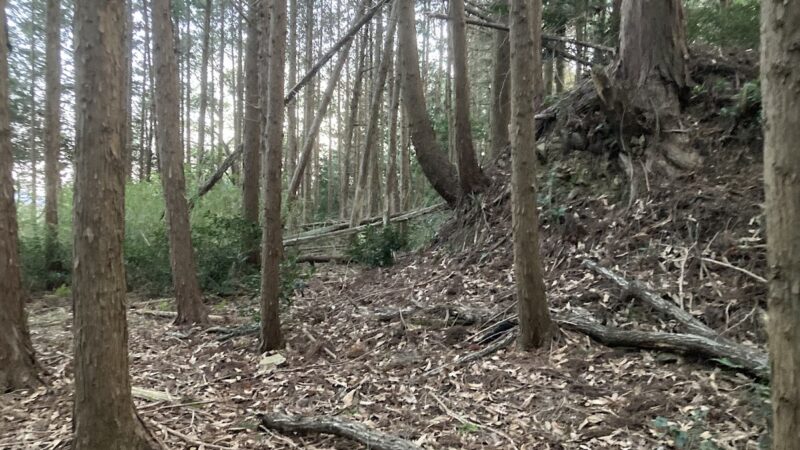
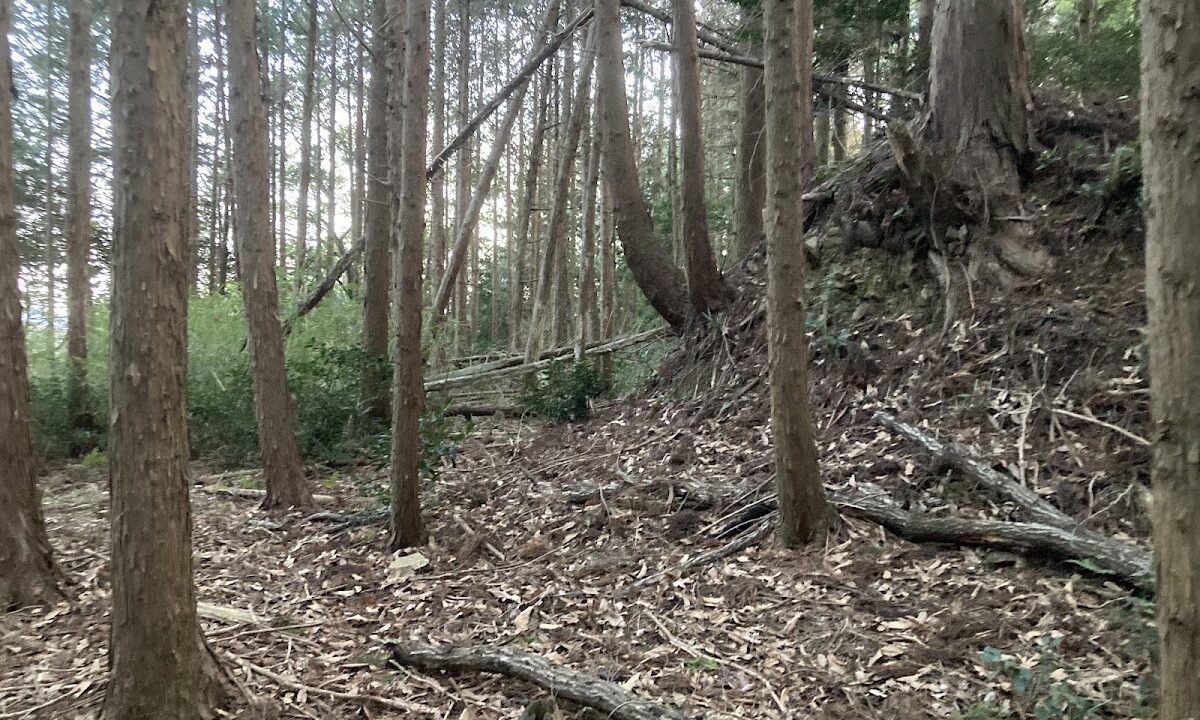
The main enclosure, the center of the castle, is surrounded on three sides (excluding the west) by low earthen ramparts. These ramparts are still clearly visible today and are estimated to be around 1 meter high. The main enclosure is relatively small, suggesting it served more as a wartime outpost than as a residential area.
The earthworks are well-preserved, with continuous earthwork lines visible, particularly on the east and north sides. The absence of earthworks on the west side is likely due to the steep slope, providing strong natural defenses.
Moat
To the east of the main enclosure, a moat cuts across the ridge. This moat was a crucial defensive feature to prevent enemy intrusion and is still clearly visible today. Estimated to be 2-3 meters deep, it effectively blocked enemy attacks along the ridge.
Moats are a common defensive feature found in mountain castles in the Iga region, and the moat at Takeshima Castle exemplifies typical Iga castle construction techniques.
Enclosure Layout
While it is believed that multiple enclosures (flat areas) were arranged around the main enclosure, current vegetation and changes in topography limit the number of enclosures that can be clearly identified. Below the main enclosure, traces of smaller enclosures can be seen, which are presumed to have been used as lookout posts or troop garrisons.
Preservation of the Remains
The remains of Takeshima Castle are relatively well-preserved compared to other medieval castle sites in the Iga region. The earthworks and moats around the main enclosure are particularly clearly visible, making it a worthwhile historical site for castle enthusiasts.
However, the castle site is located in a forest, and maintenance is minimal. Visitors should be careful of their footing while exploring.
Castle Site Monument and Information Board
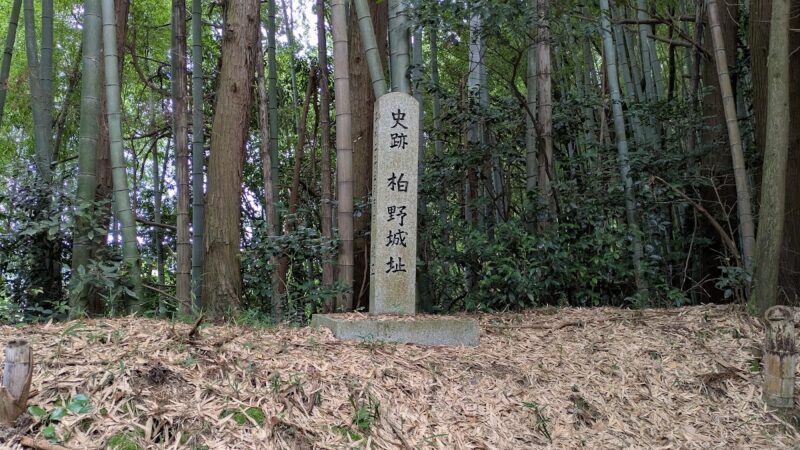
Currently, a castle site monument stands at the site, indicating the location of Takeshima Castle. This monument was erected as part of local historical preservation efforts and serves as an important landmark for visitors to identify the castle site.
Regarding the information board, detailed explanations are not provided, so it is recommended to research the historical background and location of the remains before visiting.
Highlights of Takeshima Castle
Earthworks of the Main Enclosure
The most noteworthy remains when visiting Takeshima Castle are the earthworks surrounding the main enclosure. These earthworks, encircling the castle on three sides, are a valuable historical site that directly demonstrates the castle-building techniques of the Sengoku period. Walking along the earthworks allows one to imagine how the castle lord and soldiers defended the castle at that time.
Eastern Moat
The moat located on the east side of the main enclosure is valuable as a typical defensive structure of Iga mountain castles. This moat, dug to cut across the ridge, is thought to have not only physically prevented enemy incursions but also had a psychological intimidating effect.
View
From the castle ruins, you can see the surrounding Iga Basin. During the Sengoku period, the Takeshima clan likely monitored the surrounding area and protected their territory from this point. Even today, the view visible through the trees speaks to the castle’s excellent location at the time.
Access Information
Location
518-0002 Aida, Koya, Iga City, Mie Prefecture
Access by Public Transportation
Access to Takeshima Castle by public transportation is difficult. The nearest stations are “Kayacho Station” or “Kuwamachi Station” on the Iga Railway, but it takes more than an hour to walk from the station to the castle ruins. If using public transportation, we recommend taking a taxi.
Access by Car
Access by car is the most convenient.
- From Nakase IC on the Meihan Expressway: Approximately 15 minutes
- From Ueno IC on the Meihan Expressway: Approximately 20 minutes
There is no dedicated parking lot around the castle ruins, but it is possible to park in wide areas on the roadside. However, care must be taken not to obstruct other traffic.
Ascent Route
Since there are no clear signs for the ascent route to the castle ruins, we recommend preparing a map or GPS device in advance. Climb the mountain path using the castle ruins monument as a landmark. The path is not well-maintained, so please wear comfortable shoes and clothing.
Estimated Visiting Time
Allow 30 minutes to 1 hour to visit the castle ruins. If you want to carefully observe the remains around the main enclosure and take photographs, 1 hour is appropriate.
Points to Note When Visiting
- Season: Spring to autumn is the best time to visit, but due to the overgrown vegetation in summer, spring or autumn is recommended.
- Clothing: Since you will be walking through a forest, long sleeves, long pants, and comfortable walking shoes are essential.
- Insect Repellent: Especially in summer, there are many mosquitoes and horseflies, so please bring insect repellent spray.
- Weather: It is best to avoid visiting during or after rain, as the ground can become slippery.
Nearby Castles and Tourist Spots
Besides Takeshima Castle, Iga City has numerous other medieval castle ruins. This section introduces nearby castles and tourist spots that can be visited in conjunction with Takeshima Castle.
Iga Ueno Castle
A representative castle of the Iga region, this is a modern castle built by Todo Takatora. Known for its high stone walls and beautiful keep (a replica), it offers a contrasting example of a modern castle compared to Takeshima Castle. It is approximately a 15-minute drive from Takeshima Castle.
Fukuchi Castle
Like Takeshima Castle, this is another medieval castle ruin in Iga, and was the residence of the Fukuchi clan. Similar to Takeshima Castle, remnants such as earthworks and moats remain, making it an interesting historical site for comparative research of Iga castles.
Kashiwano Castle
Located within Iga City, this medieval castle ruin was the residence of the Kashiwano clan, one of the local lords of Iga. As a castle that functioned at the same time as Takeshima Castle, it is worth visiting together. ### Takigawa Clan Castle
This is the site of a medieval castle known as the residence of the Takigawa clan. As part of the Iga region’s castle network, it shares a similar structure with the Takeshima Clan Castle.
Iga-ryu Ninja Museum
Located near Iga Ueno Castle, this museum allows visitors to learn about the history and techniques of Iga ninjas. Considering the Takeshima clan’s active role as Iga ninjas during the Edo period, a visit to this museum is beneficial for deepening one’s understanding of the history of the Takeshima Clan Castle.
Danjiri Hall
This facility exhibits the danjiri floats used in the “Ueno Tenjin Festival,” a traditional event of Iga Ueno. It is worth visiting for understanding Iga culture.
Research and Study of the Takeshima Clan Castle
Archaeological Excavation
No full-scale archaeological excavation has been conducted at the Takeshima Clan Castle to date. Therefore, the detailed structure and age of the castle are limited to estimations based on surface observations and documentary records. It is hoped that further academic research will reveal more about the true nature of the Takeshima Clan Castle. ### Documentary Materials
While documentary materials concerning Takeshima Castle are limited, the death of Takeshima Uemon is recorded in historical documents related to the Tensho Iga Rebellion. Furthermore, records of the Todo Domain from the Edo period describe the activities of Takeshima Santayu, allowing us to gain fragmentary insights into the history of the Takeshima clan.
Castle Layout Map
Castle layout maps have been created by castle researchers, illustrating the arrangement of the main enclosure, earthworks, and moats. These maps can be viewed in specialized books on castle research and on castle-related websites.
Iga Castle Culture and Takeshima Castle
Characteristics of Iga Castles
It is said that there are over 500 medieval castle sites in the Iga region, a remarkably high density even by national standards. This is attributed to Iga’s strategic location as a transportation hub connecting Kyoto and Ise, the mountainous terrain suitable for the construction of small castles, and the strong sense of autonomy among the Iga local lords.
Takeshima Castle is a typical medieval mountain castle built within the Iga castle culture. Though small in scale, it was a practical fortress equipped with defensive structures such as earthworks and moats.
The Sōkoku Ikki and Castles
During the Sengoku period, a self-governing organization called the “Sōkoku Ikki” (national uprising) was formed in Iga Province by local lords. It is believed that the Takeshima clan played a role in protecting Iga’s autonomy as a member of this Sōkoku Ikki.
Small castles like Takeshima Castle functioned more as bases for local lords to protect their territories than as residences of daimyo (feudal lords). During the Tenshō Iga Rebellion, these small castles were scattered throughout Iga, becoming strongholds of resistance against the Oda army.
Advice for Castle Enthusiasts
Recommended Photography Spots
The following are recommended photography spots for Takeshima Castle:
- Castle Site Monument: Taking a photo of the castle site monument is a must as a memento of your visit to Takeshima Castle.
- Main Enclosure Earthworks: Photographing the continuous earthworks from different angles will give you a good understanding of the castle’s defensive structure.
- Moat: Take a photo from an angle that shows the depth and shape of the moat.
- View: The view from the main enclosure is also a valuable photograph that shows the castle’s location.
Recording Your Castle Visit
Among castle enthusiasts, it’s common to record visits to castles as “castle visits.” When visiting Takeshima Castle, recording the date, weather, time of visit, and any confirmed remains will be helpful for later review.
Castle information websites such as Kojodan allow you to post visit records and view information from other visitors. Utilizing these communities will allow you to enjoy castles more deeply.
A Tour of Iga Castles
While visiting Takeshima Castle alone is worthwhile, combining it with other castles in the Iga region will allow for a deeper understanding of Iga’s castle culture. Planning to visit 3-5 castles in one day is an efficient way to experience Iga’s castles.
Recommended Route Example:
- Iga Ueno Castle (Early Modern Castle)
- Fukuchi Castle (Medieval Castle)
- Takeshima Castle (Medieval Castle)
- Kashiwano Castle (Medieval Castle)
- Iga-ryu Ninja Museum (History Learning)
Summary
Takeshima Castle is a valuable medieval castle site remaining in Iga City, Mie Prefecture. Built by Takeshima Kageyoshi during the Muromachi period, this castle has a turbulent history, including the death of its lord, Takeshima Uemon, during the Tensho Iga Rebellion. Even today, its remains, such as earthworks and moats, convey the appearance of Iga during the Sengoku period.
The Iga region boasts over 500 medieval castle ruins, and Takeshima Castle is one of them, a historical site symbolizing the history of autonomy and resistance among the local lords of Iga. Its connection to Matsuo Basho and the history of the Takeshima clan, who were active as Iga warriors during the Edo period, are also fascinating elements.
For castle enthusiasts and history buffs, Takeshima Castle is an essential historical site for understanding Iga’s castle culture. Visiting it along with other famous castles such as Iga Ueno Castle will allow you to experience the evolution of castles from the medieval to the early modern period.
Although minimally maintained, Takeshima Castle retains the atmosphere of the Sengoku period. When visiting Iga, be sure to pay a visit.