Kitabatake Tomochika Castle (Nabari City, Mie Prefecture) Complete Guide | History, Remains, and Access Information
Kitabatake Tomochika Castle is a Sengoku period mountain castle located in the area stretching from Kamiya to Nagase in Nabari City, Mie Prefecture. Also known as Sekioka Castle, Tomochika Castle, Kamiyashiki Castle, and Shiroyama, it is an important historical site that tells the tragic end of the Kitabatake clan in Iga Province. This article comprehensively explains the historical background, layout, highlights, and detailed information for visiting Kitabatake Tomochika Castle.
Historical Background of Kitabatake Tomochika Castle
The Kitabatake Clan and Their Rule of Ise Province
The Kitabatake clan was a prestigious samurai family that ruled southern Ise Province from the Nanboku-cho period. They descended from Kitabatake Akiie and Chikafusa, who played key roles on the Southern Court side, and maintained their power as the provincial governor of Ise Province from the Muromachi period to the Sengoku period. His main castle was Kiriyama Castle (Taki Castle) in Taki District, where he established a strong control over southern Ise Province.
Oda Nobunaga’s Invasion of Ise and the Decline of the Kitabatake Clan
In 1568, Oda Nobunaga launched his invasion of Ise Province, encroaching on the Kitabatake clan’s territory. Initially, Kitabatake Tomonori resisted, but a peace agreement was reached in the Battle of Okawachi Castle in 1569. As a result of this agreement, Nobunaga’s second son, Oda Nobukatsu, was adopted by Kitabatake Tomofusa, renounced his monastic vows, and inherited the headship of the Kitabatake family. This effectively brought the Kitabatake clan under the control of the Oda clan.
The Tragedy of 1576 and the End of Kitabatake Tomochika
On November 25, 1576 (Tensho 4), Nagano Sakyo-no-suke and Hioki Daizen, vassals of Kitabatake Nobuo (Oda Nobuo), carried out the Mitsuse Incident (Gosho Incident). Many members of the Kitabatake family, including Kitabatake Tomonori, were killed in this incident.
Kitabatake Tomochika was Tomonori’s older brother and held territory in Nagaki (present-day Nabari City) in Iga Province at this time. Upon receiving news of the Mitsuse Incident, Tomochika attempted to resist in Iga, but was ultimately killed by the Oda forces. Kitabatake Tomochika Castle was Tomochika’s base and remains a historical site commemorating the tragedy of the Kitabatake clan’s downfall.
The Activities of Kitabatake Tomochika, Tomonori’s Younger Brother
Some historical sources describe Tomochika and Tomonori as brothers. The *Sangoku Chishi* and *Seiyo Zakki* contain records indicating that in 1576 (Tensho 4), Kitabatake Tomonori’s younger brother, Tomonori, sought refuge with the Yoshihara clan of Nagaki, suggesting that he confronted the Oda forces in this area. Tomonori Castle served as his base, becoming the final battleground for the remnants of the Kitabatake clan in Iga.
Layout and Remains of Kitabatake Tomonori Castle
Castle Location and Topography
Kitabatake Tomonori Castle is a mountain castle located in the mountains of Kamiya, Nabari City, Mie Prefecture, built on a hill approximately 60 meters high. A hiking trail extends from the prefectural road, using the former Kunitsu Elementary School and Kunitsuen as landmarks. The castle exhibits the typical form of a medieval mountain castle utilizing the ridge, and defensive structures skillfully utilizing the Iga terrain can be observed.
Main Enclosure and Enclosure Layout
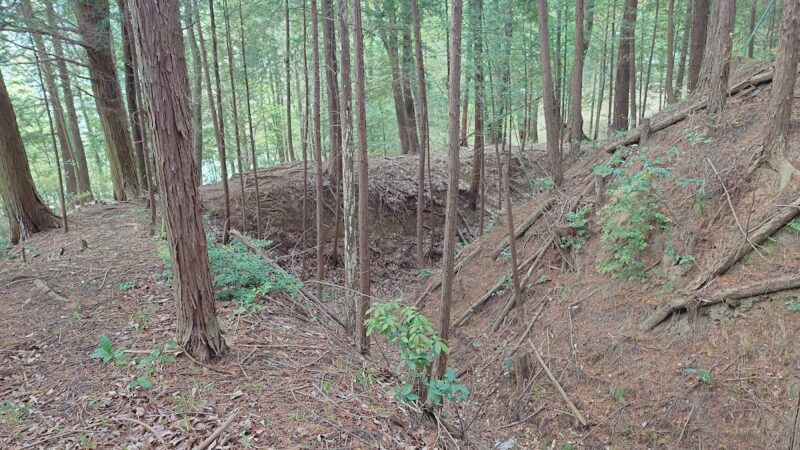
The main enclosure, the heart of the castle, is located at the highest point of the ridge, surrounded by multiple enclosures. A large moat is situated behind the main enclosure (to the north), preventing enemy incursions along the ridge. This moat is impressive in both depth and width, and was a crucial element of Kitabatake Tomochika Castle’s defense.
Moat and Vertical Ditch Defensive System
The greatest highlight of Kitabatake Tomochika Castle is the moat blocking the ridge and the vertical ditches descending the slope. Vertical ditches extend from the large moat behind the main enclosure on both sides, designed to prevent attacks from the enemy’s flanks. This moat and vertical ditch system is highly valuable as a typical example of Sengoku period mountain castle construction techniques and attracts attention from castle researchers.
Earthworks and Cut Slopes
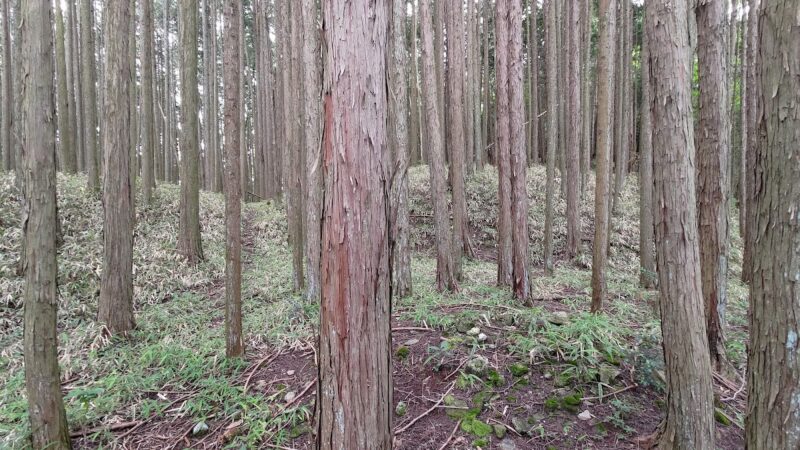
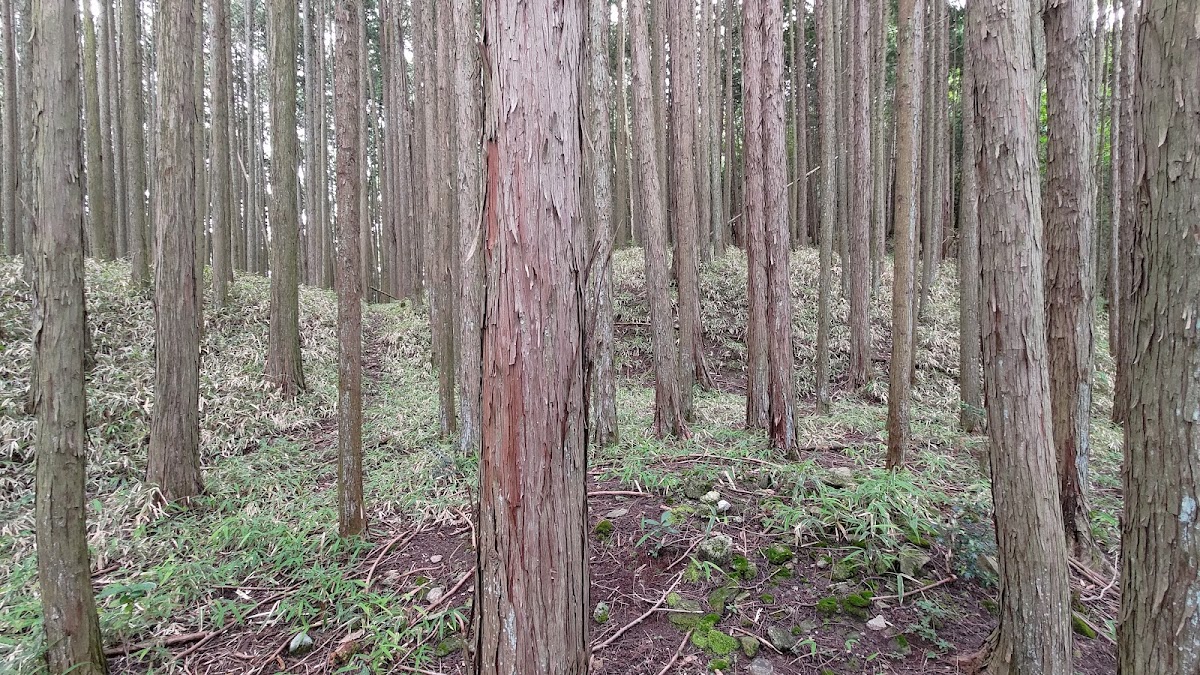
Earthworks surround each enclosure, and the earthworks around the main enclosure, in particular, remain to a height of approximately 1-2 meters. Furthermore, the edges of the enclosures feature cut slopes (artificial steep slopes), demonstrating a design intended to make ascent difficult for enemies. Although these remains are covered by trees, they are relatively well-preserved, allowing us to imagine the original layout.
Castle Area and Surrounding Facilities
The castle area of Kitabatake Tomochika Castle extends approximately 200 meters east-west and 150 meters north-south, centered around the main enclosure. To the east of the castle lies Shimoyama Kai-no-kami Castle, which may have functioned as a subsidiary castle or a related fortification of Kitabatake Tomochika Castle. Additionally, a flat area below the castle, presumed to be the site of a residence, exists, suggesting a holistic defensive system integrated with the castle.
Highlights of Kitabatake Tomochika Castle
The Impressive Moat
The most impressive feature for visitors is the large moat behind the main enclosure. Approximately 5 meters deep and 8 meters wide, this moat completely cuts off the ridge, showcasing the advanced castle-building techniques of the Sengoku period. Standing at the bottom of the moat, you can feel the imposing presence of the cliffs on both sides, and truly grasp the strength of the castle’s defenses.
A Series of Vertical Moats
Multiple parallel vertical moats descend the slope from the large moat, demonstrating the thoroughness of the flank defenses. These vertical moats are still clearly visible today and are a must-see for mountain castle enthusiasts. Following the vertical moats down the slope helps you understand how the castle’s defensive lines were designed.
View from the Main Enclosure
From the main enclosure, you can see the city of Nabari and the surrounding mountains. On a clear day, you can see the vast expanse of the Iga Basin, demonstrating the castle’s ideal location for monitoring and controlling the surrounding area. You can imagine what thoughts were going through Kitabatake Tomochika’s mind as he surveyed the surroundings from this spot during the Sengoku period.
Well-Preserved Earthworks
The earthworks surrounding the main enclosure and each bailey are in good condition overall, although some collapses are visible in places. Walking along the earthworks allows you to experience the shape and scale of the baileys at the time, deepening your understanding of the castle’s structure.
The Atmosphere of the Ascent Path
The current ascent path leads from beside a private house into the mountains, with a small signpost at the entrance. The experience of gradually becoming more immersed in the castle’s atmosphere as you ascend this path is one of the joys of exploring a mountain castle. Along the path, you can see remnants of baileys and cliffs, giving you a sense of how difficult it was to approach the castle.
Access Information and Visitor Guide
Location and Map
Address: Kamiya-Nagase (Nagaki-Murata), Nabari City, Mie Prefecture
Kitabatake Tomochika Castle is located northeast of the city center of Nabari, near the former Kunitsu Elementary School (now Kunitsuen). A sign for “Kitabatake Tomochika Castle” is located along the prefectural road, making it easy to find.
Access by Car
- Approximately 20 minutes from the Hari Interchange on the Meihan Expressway
- Turn onto the prefectural road from National Route 165 and head towards the sign
- There is no designated parking area, so you will need to park in a safe place on the shoulder of the road (please be considerate of local residents)
Access by Public Transportation
- Take a bus or taxi from Nabari Station on the Kintetsu Osaka Line
- Approximately 15 minutes from Nabari Station
- If taking the bus, you will need to walk from the nearest bus stop
Castle Ascent Route and Estimated Time
The entrance to the castle is next to a private house north of the sign along the prefectural road, and there is a small signpost at the entrance. The trail to the castle is an unmaintained mountain path, so the following equipment and precautions are necessary.
- Climbing Time: Approximately 20-25 minutes uphill, approximately 15 minutes downhill
- Visiting Time: Approximately 30-45 minutes touring the castle
- Total Time Required: Approximately 1 hour to 1 hour 30 minutes
Notes for Visitors
- Clothing: Long-sleeved shirt, long pants, trekking shoes or hiking boots are recommended.
- Equipment: Work gloves, drinking water, insect repellent (in summer), bear bell (just in case)
- Season: Spring and autumn are best. In summer, the undergrowth is dense; in winter, the fallen leaves make the ruins easier to see.
- Safety: Avoid visiting alone; visiting in groups is recommended.
- Manners: As you may need to pass through private property, please be considerate of local residents.
Best Time to Visit
- Spring (March-May): Beautiful fresh greenery and mild weather make it ideal for visiting.
- Autumn (October-November): Enjoy the autumn foliage; fewer insects and a more comfortable experience.
- Winter (December-February): The fallen leaves make the ruins easier to see, but warm clothing is necessary.
- Summer (June-September): The undergrowth is dense and there are many insects; this is for experienced visitors only.
Nearby Castle Ruins and Tourist Spots
Nearby Castle Ruins
Many castle ruins that tell the history of Iga Province are scattered around Kitabatake Tomochika Castle.
Shimoyama Kai-no-kami Castle
Located in the mountains east of Kitabatake Tomochika Castle, this castle is thought to be a branch castle of Tomochika Castle. Its location is difficult to find, requiring careful planning for visits, but visiting both together will help you understand the Iga castle network.
Kashiwabara Castle
Located in Kashiwabara, Nabari City, this castle was the residence of the Kashiwabara clan, a powerful local family in Iga Province. It is known for playing an important role during Oda Nobunaga’s invasion of Iga.
Sakuramachi Chujo Castle
A castle ruin located in Sakuramachi, Nabari City, this is one of the castles associated with the Kitabatake clan.
Hinachi Castle
Located in Hinachi, Nabari City, this castle functioned as a strategically important transportation hub in Iga Province.
Tourist Attractions in Nabari City
Akame 48 Waterfalls
A representative tourist attraction in Nabari City, and selected as one of Japan’s Top 100 Waterfalls. Enjoy the natural beauty in conjunction with a visit to Kitabatake Tomochika Castle. The waterfall tour takes approximately 3 hours, so plan accordingly.
Shorenji Lake Tourist Village
Around Shorenji Lake, there are tourist vineyards and strawberry picking facilities, allowing you to enjoy seasonal fruit picking. It’s ideal for family visits.
Nabari Todo Family Residence Ruins
This is the site of the residence of the Nabari Todo family, a branch of the Tsu Domain, where you can experience the atmosphere of an Edo-period samurai residence.
Historical Walking Routes in the Surrounding Area
Besides Kitabatake Tomochika Castle, Nabari City has many other historical sites, allowing you to enjoy a full day of historical exploration. Recommended routes are as follows:
- Morning: Visit Kitabatake Tomochika Castle (1.5 hours)
- Lunch: Enjoy local cuisine in Nabari city center
- Afternoon: Visit Akame Forty-Eight Waterfalls or surrounding castle ruins
- Evening: Relax around Shorenji Lake
Research and Materials on Kitabatake Tomochika Castle
Main References
For those who want to learn more about Kitabatake Tomochika Castle, the following books are helpful.
- *The Japanese Castle System*, Volume 10: Mie, Nara, and Wakayama (Shin Jinbutsu Oraisha)
- *Walking the Best 50 Mountain Castles of Mie* (Sunrise Publishing)
- *Oda Nobunaga’s Invasion of Iga and the Castles of the Iga People* (Ebisu Kosho Publishing)
- *Castles of Iga* (Iga Cultural Industry Association)
- *Sangoku Chishi* (Edo period geographical record)
- *Seiyo Zakki* (History of Ise Province)
These documents provide detailed descriptions of the layout, historical background, and archaeological findings of Kitabatake Tomochika Castle, making them valuable basic resources for castle research.
Evaluation on Castle Research Websites
On the castle enthusiast community site “Kojodan,” Kitabatake Tomochika Castle has an average rating of ★★★★☆ (4.00), with visitors praising its “magnificent moats” and “high historical value.” With only 45 attackers (as of 2023), it is recognized as a hidden gem of a castle known only to a select few.
Local Information Boards and Guides
Since there are no detailed information boards at the site, it is recommended to research materials beforehand. Only signs along the prefectural road and a small signpost at the entrance to the castle serve as guides, so first-time visitors should use a map or GPS app.
Kitabatake Tomochika Castle and Iga in the Sengoku Period
The Uniqueness of Iga Province
During the Sengoku period, Iga Province lacked a powerful daimyo (feudal lord). Instead, small lords known as “jizamurai” (local samurai) formed autonomous organizations called “sōkoku ikki” (national uprisings). This formed the basis for the group later known as the “Iga ninja.” This unique political situation in Iga influenced the construction of Kitabatake Tomochika Castle.
Oda Nobunaga’s Invasion of Iga
Oda Nobunaga invaded Iga Province twice, in 1579 (Tensho 7) and 1581 (Tensho 9). In particular, during the Second Tensho Iga Rebellion in 1581, Oda Nobuo led a large army to suppress Iga, and many Iga warriors were killed. Kitabatake Tomochika Castle must be understood within the context of this series of invasions of Iga.
The Relationship Between the Kitabatake Clan and Iga
The Kitabatake clan, as governors of Ise Province, wielded influence in Iga Province, but their relationship with the local samurai of Iga was complex. Kitabatake Tomochika’s possession of territory in Nagaki, Iga, indicates the Kitabatake clan’s power base in Iga, and simultaneously illustrates the chaos following the Oda clan’s downfall of the Kitabatake clan.
Preservation and Future of Kitabatake Tomochika Castle
Current State of Preservation
While Kitabatake Tomochika Castle has not undergone any special preservation or maintenance, its main remains are in relatively good condition due to its preservation as part of a forest. However, some remains are becoming unclear due to fallen trees and tree growth.
Challenges in Preservation Activities
As it is a minor castle site, organized preservation activities are limited. Further research and preservation activities by local history enthusiasts and castle researchers are hoped for. The first step in preserving the castle site is for each visitor to respect the remains and observe proper etiquette, such as taking their trash with them.
Potential for Utilization
Efforts are needed to introduce Kitabatake Tomochika Castle more widely as a historical tourism resource for Nabari City. Creating an environment where visitors can safely and comfortably enjoy the castle site is expected through measures such as installing explanatory signs, improving the access roads, and creating brochures.
Summary
Kitabatake Tomochika Castle is a Sengoku period mountain castle located in Nabari City, Mie Prefecture. It is an important historical site, the stage for the historical tragedy of the downfall of the Kitabatake clan. Built on a mountain 60 meters above sea level, the castle retains well-preserved defensive structures such as moats, trenches, and earthworks, making it a valuable historical site for learning about Sengoku period castle construction techniques.
After the Kitabatake clan was annihilated in the Mitsuse Incident of 1576, Kitabatake Tomochika fled to Iga and used this castle as a base to resist. This history conveys the harshness of power struggles in the Sengoku period and the sorrow of a dying clan.
While hiking equipment is necessary for a visit, it is a castle site that offers impressive remains and a valuable experience of reflecting on history in a quiet mountain setting, making it a worthwhile destination for mountain castle enthusiasts. When visiting Nabari City, be sure to visit Kitabatake Tomochika Castle along with other tourist attractions such as Akame 48 Waterfalls. You can experience the history of Iga and the romance of the Sengoku period.
Numerous castle ruins that tell the story of Iga’s history are scattered around the area, including Shimoyama Kai-no-kami Castle, Kashiwabara Castle, and Hinachi Castle. Incorporating them into your castle ruins tour route will allow you to gain a deeper understanding of Iga’s Sengoku history. As a hidden gem of Mie Prefecture, Kitabatake Tomochika Castle is sure to attract even more attention in the future.