Iedokoro Castle (Tsu City, Mie Prefecture) Complete Guide | History, Remains, and Access Information
Overview of Iedokoro Castle
Iedokoro Castle is a hilltop castle located in Iedokoro, Misato-cho, Tsu City, Mie Prefecture, and is known as an important historical site of a medieval castle in Ise Province. It is said to have been built by Iedokoro Suketoshi, the third son of Kudo Ujisuke, lord of Nagano Castle, and served as the residence of the Iedokoro clan for approximately 8 generations and 200 years.
The castle ruins are built on an isolated hill (approximately 114 meters above sea level, with a relative height of approximately 36 meters) east of Tatsumizu Elementary School. Even today, the remains, including earthworks, dry moats, and stone walls centered around the main enclosure, are well-preserved. It is designated as a historical site by Tsu City and is a valuable historical resource for the study of medieval castles in Ise Province.
Basic Information on Iesho Castle
Common Name/Alternate Name: Iesho Castle, Iesho Old Castle
Location: Around 2350 Shiroyama, Iesho, Misato-cho, Tsu City, Mie Prefecture
Former Province: Ise Province
Classification/Structure: Hilltop castle, multi-bailey style
Keep Structure: None (No keep existed as it is a medieval castle)
Builder: Iesho Suketoshi
Year of Construction: Late Kamakura period to early Nanboku-cho period (estimated)
Main Lords: Iesho clan (8 generations)
Year of Abandonment: Genki 3 (1572)
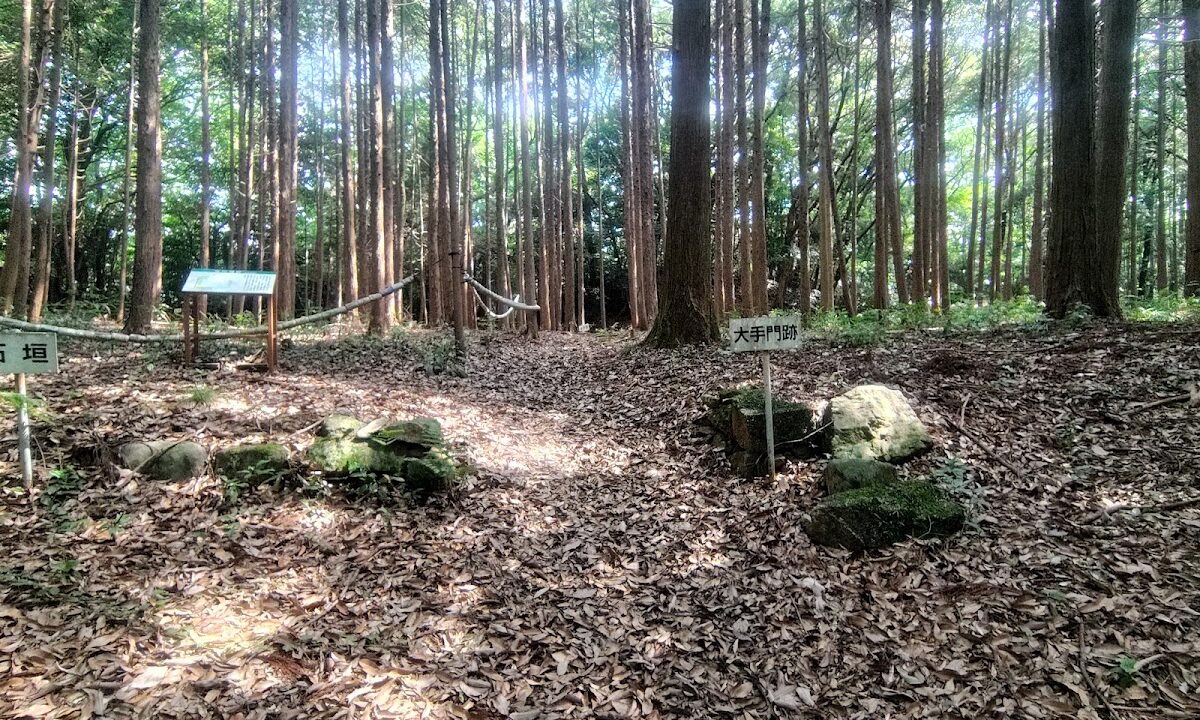
Remains: Earthworks, dry moats, stone walls, baileys, turret bases, well remains, main gate remains
Designated Cultural Property: Tsu City Designated Historic Site
History of Iesho Castle
Construction of the Castle and the Establishment of the Iesho Clan
There are various theories regarding the construction period of Iesho Castle, but it is generally believed to have been built sometime between the late Kamakura period and the early Nanboku-cho period. The castle’s builder, Iesho Suketoshi, was born the third son of Kudo Ujisuke, whose base was Nagano Castle (present-day Nagano, Misato-cho, Tsu City). He was granted land in Iesho, and thus adopted the name Iesho.
The Kudo clan was a family descended from the Ise Taira clan and, as a local lord subordinate to the Kitabatake clan, who were expanding their power in Ise Province, they were entrusted with governing this region. After the castle’s construction, the Iesho clan used it as their residence for approximately 200 years, spanning eight generations, and reigned as a powerful samurai family in the region.
Relationship with the Kitabatake Clan
The Iesho clan was an important retainer group of the Kitabatake clan, who reigned as the governor of Ise Province from the Nanboku-cho period to the Sengoku period. The Kitabatake clan was a central force on the Southern Court side and maintained its power based in Ise Province. The Iesho clan followed this trend, serving as local lords supporting the Kitabatake clan and governing the region.
Iesho Castle was strategically located at a crucial transportation hub connecting Kiriyama Castle (Misugi-cho, Tsu City), the Kitabatake clan’s base, with the Ise Plain, making it a militarily and economically important base. It is believed that the Iesho clan, as the lords of the frontline castle protecting the Kitabatake clan’s sphere of influence, were responsible for the defense and governance of the surrounding area.
Oda Nobunaga’s Invasion of Ise and the Castle’s Demolition
A major turning point in the history of Iesho Castle occurred in 1572, during the late Sengoku period. In that year, Oda Nobunaga launched a full-scale invasion of Ise Province, attacking the Kitabatake clan and their retainers.
The castle lord at the time was Iesho Mikawa-no-kami Fujiyasu (8th generation), who pledged loyalty to the Kitabatake clan and resisted the Oda army, but was defeated by the overwhelming difference in troop numbers and is said to have died in battle. This battle resulted in the fall of Iesho Castle, marking the end of the Iesho clan’s rule. The castle was abandoned and never rebuilt.
After Oda Nobunaga’s conquest of Ise Province, the Kitabatake clan was effectively placed under Oda control and was completely destroyed in 1576. Iesho Castle, one of the castles lost in the preceding stages, remains a historical site that conveys the turbulent times of the Sengoku period.
The Later Life of the Iesho Clan
After the fall of Iesho Castle, it is believed that some members of the Iesho clan dispersed to various locations. According to one theory, a man named Iesho Tatewaki fled to Fukudayama in Hakusan Town and settled there, later adopting the name “Fukudayama Tatewaki.” Furthermore, records indicate that Fukuyama Tatewaki built Mami Castle during the Tensho era (1573-1592), suggesting that descendants of the Iesho clan attempted to maintain their influence in other areas.
Layout and Remains of Iesho Castle
Overall Structure
Iesho Castle is a flatland castle utilizing the entire top of an isolated hill. Its layout is a series of interconnected enclosures centered around the main enclosure. The moderate height of approximately 36 meters is typical of medieval castles, balancing defense and habitability.
The castle grounds are long and narrow from north to south. The main approach road extends from the site of the samurai residences on the south side, suggesting this was the primary entrance to the castle. Clear remains still exist today, making it a valuable example for understanding the structure of medieval castles.
Details of the Main Enclosure (Honmaru)
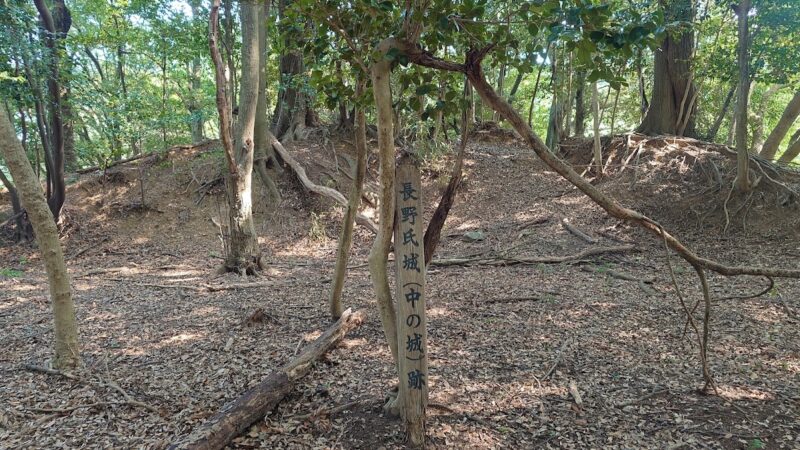
The main enclosure is located in the center of the castle and has a fairly large, flat surface. Earthen ramparts surround it, enhancing its defensive capabilities and likely serving as building foundations. The ramparts remain well-preserved, maintaining a height of approximately 1-2 meters.
A watchtower base is located in the center of the north side of the main enclosure, where a shrine is currently enshrined. From this watchtower base, one can overlook the surrounding area, indicating its military surveillance function. Another watchtower base exists to the east of this one, suggesting the presence of multiple surveillance and defensive positions.
Main Gate Ruins and Stone Walls
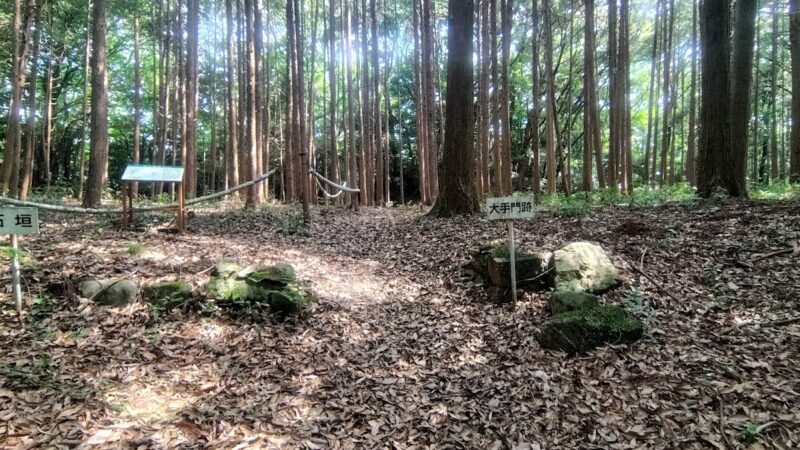
Climbing from the samurai residence ruins on the south side, one reaches the main gate ruins. Here, stones called “tsubute-ishi” (throwing stones) remain, indicating that it was a defensive structure designed for actual combat. These tsubute-ishi were used as weapons to knock down attacking enemies, and are valuable artifacts illustrating the defensive methods of medieval castles.
Stone walls also remain at the main gate ruins, demonstrating its imposing presence as the castle’s main entrance. While the use of stone walls in medieval castles was limited, it can be confirmed that they were used in important locations at Iesho Castle. This suggests the economic power and advanced castle-building techniques of the Iesho clan.
Dry Moats and Moats
Large dry moats remain on the north and east sides of the main enclosure. The dry moat was an important defensive structure designed to prevent enemy intrusion, reaching several meters in depth. The northern dry moat, in particular, is well-preserved, making it a valuable historical site for observing the structure of moats in medieval castles.
Moats were constructed between the baileys, serving to demarcate the castle grounds. These moats not only served a defensive function but also controlled movement within the castle, demonstrating ingenuity in the castle’s layout.
Well Sites and Living Remains
Well sites have also been identified within the castle grounds, indicating the existence of facilities for securing a water source in preparation for sieges. Securing a water source was a matter of life and death for medieval castles, and the technical skill required to excavate wells on an isolated hill is noteworthy.
Furthermore, a flat area known as the samurai residence site remains, suggesting the presence of living quarters for the castle lord and his retainers. While archaeological excavations have been limited, future investigations are expected to shed light on the actual living conditions.
Preservation Status of the Remains
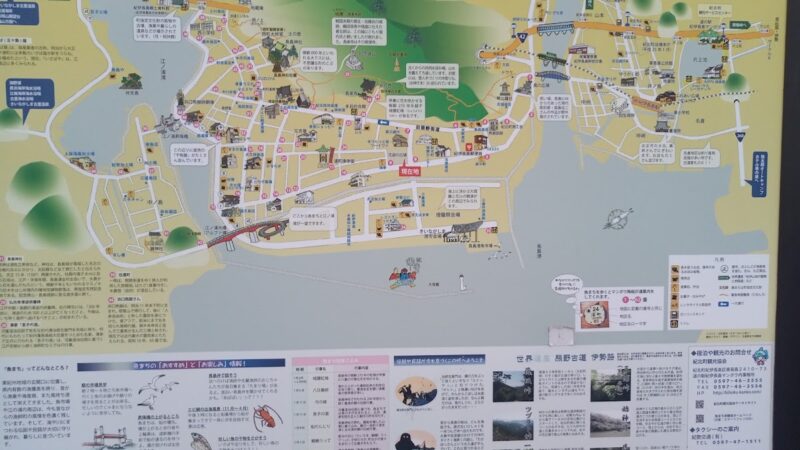
Despite being more than 450 years after its abandonment, the remains of Iesho Castle are preserved in relatively good condition. This is because the castle site was spared from large-scale development and preserved as a forest. Currently, the Tsu City Board of Education has installed information boards to help visitors understand the history and structure of the castle.
Major remains such as earthworks, dry moats, and stone walls are clearly visible, making it a valuable historical site where visitors can experience the structure of a medieval castle. It is a cultural property that requires appropriate preservation and management in the future.
Surrounding Castles and Related Historical Sites
Relationship with Ieki Castle
Ieki Castle is a castle that is often confused with Iesho Castle. Ieki Castle is a mountain castle located in Minami-Ieki, Hakusan-cho, Tsu City, Mie Prefecture, and was the residence of Ieki Shusui-no-kami, a vassal of the Kitabatake clan. Although the names are similar and they are sometimes confused, they are different castles.
Ieshige Castle is a mountain castle built on the top of a hill approximately 140 meters above sea level, and is estimated to have been constructed around the Shochu era (1324-1326). The Ieshige clan was known for their mastery of the spear and were influential vassals of the Kitabatake clan. Like Ieshige Castle, it was a castle within the Kitabatake clan’s sphere of influence and played a part in the regional defense network.
Mami Castle
Mami Castle is positioned as a surrounding castle to Ieshige Castle and is believed to have been built by Fukudayama Tatewaki during the Tensho era (1573-1592). As mentioned above, Fukudayama Tatewaki is believed to be the name adopted by Ieshige Tatewaki after he was expelled from Ieshige Castle and later settled in Fukudayama, Hakusan-cho, suggesting a connection to the Ieshige clan.
The construction of Mami Castle provides important clues to the actions of the Iesho clan after the fall of Iesho Castle, and it is a historical site that tells the story of the dispersal and attempts at restoration of local lords during the Sengoku period.
Nagano Castle
Nagano Castle was the residence of the Kudo clan, the main branch of the Iesho clan, and was located in Nagano, Misato-cho, Tsu City. Kudo Ujisuke, the father of Iesho Suketoshi, the ancestor of the Iesho clan, served as the castle lord, making it an important site as the birthplace of the Iesho clan.
Nagano Castle also functioned as a fortress for the Kitabatake clan’s retainers, and together with Iesho Castle, formed a regional defense network. Although the remaining structures are limited today, it is an indispensable historical site for understanding the origins of the Iesho clan.
Kiriyama Castle
Kiriyama Castle is a mountain castle known as the base of the Kitabatake clan, located in Shimotaki, Misugi-cho, Tsu City. It is a large mountain castle with an elevation of approximately 560 meters and a relative height of approximately 240 meters, and is designated as a national historical site.
The Iesho clan served as vassals of the Kitabatake clan, whose base was Kiriyama Castle, and Iesho Castle played a subsidiary role to Kiriyama Castle. Understanding the relationship between Kiriyama Castle and Iesho Castle is crucial for understanding the structure of the Kitabatake clan’s rule over Ise Province.
Access
Using Public Transportation
Nearest Station: JR Meisho Line “Iesho Station”
The distance from Iesho Station to the Iesho Castle ruins is approximately 5 kilometers, taking about 1 hour on foot. Bus services from the station are limited, so it is recommended to check the timetable in advance.
Using the Bus: If using Mie Kotsu buses, take a bus bound for “Sakakibara Onsen-guchi” from Tsu Station and get off at the “Iesho” bus stop. The castle ruins are about a 15-minute walk from the bus stop. However, bus services are limited to only a few times a day, so checking the timetable is essential.
If traveling by car
From Nagoya:
- Approximately 30 minutes from the Hisai IC on the Ise Expressway via National Route 165
- Approximately 40 minutes from the Geino IC on the Tomeihan Expressway via prefectural roads
From Osaka:
- Approximately 1 hour 30 minutes from the Nishimeihan Expressway via the Meihan National Highway and National Route 165
Car Navigation Settings: Searching for “2350 Iesho, Misato-cho, Tsu City” or “Tatsumi Elementary School” is convenient. The entrance to the castle ruins is on the east side of Tatsumi Elementary School.
Parking: There is no dedicated parking lot for the castle ruins, but there is space for roadside parking around Tatsumi Elementary School. However, consideration is needed if there are school events. Please park respectfully and avoid inconveniencing local residents.
Precautions when visiting the castle
Iesho Castle Ruins are located in a forest and are not a developed tourist facility. Please note the following points when visiting the castle:
- Clothing: Wear appropriate clothing and shoes for mountain hiking (trekking shoes recommended).
- Season: The area is lush with vegetation from spring to autumn, so insect repellent is necessary in summer.
- Weather: The ground can be slippery during and after rain, so caution is advised.
- Time: Allow approximately one hour for the round trip to the castle.
- Items to bring: We recommend bringing drinking water, a towel, insect repellent, and a map.
Nearby Tourist Attractions
Sakakibara Onsen: A historic hot spring resort located about 15 minutes by car from Iesho Castle. Known since ancient times as “Nanaguri no Yu,” it’s perfect for relaxing after a castle tour. Several facilities offer day-use bathing.
Aoyama Plateau: A plateau area spanning Tsu City and Iga City, famous for its landscape of wind turbines. It’s suitable for hiking and driving, and can be visited in conjunction with Iesho Castle.
Misugi Resort: A comprehensive resort facility where you can enjoy outdoor activities and hot springs, suitable for family sightseeing.
Highlights and ways to enjoy Iesho Castle
Points for castle enthusiasts
Iesho Castle has a typical medieval castle structure, and its remains such as earthworks, dry moats, and stone walls are well-preserved, making it a worthwhile historical site for castle research and castle-visiting enthusiasts. The following points are particularly worth seeing:
- Main Enclosure Earthworks: The scale and state of preservation of the surrounding earthworks are magnificent.
- Stone Walls and Stones of the Main Gate: You can learn about the actual defensive structures of the medieval period.
- Northern Dry Moat: Its depth and scale are impressive, and you can truly appreciate its high level of defensive function.
- Watchtower Base: The view from the watchtower base on the north side of the main enclosure allows you to imagine its surveillance function at the time.
Value as a Historical Learning Site
Iesho Castle is a historical site directly related to the important historical event of the Sengoku period: Oda Nobunaga’s invasion of Ise Province. It is a historical site of high educational value where you can learn about the conflict between the Kitabatake and Oda clans, the rise and fall of local lords, and aspects of the transition from the medieval to the early modern period.
The information boards explain the history and structure of the castle, making it easy to understand even for first-time visitors. Learning about the historical background beforehand will lead to a deeper understanding and greater appreciation.
Photography Tips
Iesho Castle Ruins are located in a beautiful natural setting, making them ideal for photography. The following times and locations are especially recommended:
- Spring: The ruins amidst the fresh greenery create a refreshing impression.
- Autumn: The entire castle site is ablaze with autumn colors, creating a beautiful landscape.
- View from the Main Enclosure: You can enjoy views of the surrounding mountains and plains.
- Stone Walls and Earthworks: Photographs capturing the details of the ruins are valuable as historical records.
Castle Stamp Rally
Mie Prefecture is holding the “Mie Prefecture Castle Stamp Rally,” and Iesho Castle is one of the participating locations. By visiting various castle ruins throughout the prefecture and collecting stamps, you can enter to win gourmet prizes. When you visit Iesho Castle, be sure to participate in the stamp rally.
For more details, please check the official Mie Tourism website.
References and Related Materials
For those who wish to learn more about Iesho Castle, we recommend referring to the following literature and materials:
Books and Articles
- “Medieval Castles and Residences in Mie Prefecture,” Mie Prefectural Board of Education
- “History of Tsu City,” Tsu City Board of Education
- “Comprehensive Survey of Japanese Castles, Vol. 10: Mie, Nara, and Wakayama,” Shin Jinbutsu Oraisha
- “Castles and Castle Towns of Ise Province,” Kyodo Shuppansha
Websites
- Kojodan (kojodan.jp): Features numerous visitor reviews and photos.
- Nippon Castle Tour (cmeg.jp): Allows you to check detailed castle information and visit records.
- Castle Wanderings: Features detailed castle layouts and photos.
- Mie Tourism Official Website: Provides comprehensive information on castles and tourism in Mie Prefecture.
Tsu City Board of Education
For the latest information and preservation status regarding Iesho Castle, please contact the Cultural Properties Protection Division of the Tsu City Board of Education. Information on the results of archaeological excavations and preservation activities is also available. ## Summary
Iesho Castle is a medieval hilltop castle located in Misato-cho, Tsu City, Mie Prefecture. It is a historic castle that served as the residence of the Iesho clan for approximately 200 years. Although it fell in 1572 during Oda Nobunaga’s invasion of Ise Province, the remains, such as earthworks, dry moats, and stone walls, are still well-preserved, making it a valuable historical site for learning about the structure of medieval castles.
As a castle involved in the important historical event of the Sengoku period—the conflict between the Kitabatake clan and Oda Nobunaga—and as a clue to understanding the realities of local lords in Ise Province, it is a castle site of high historical and academic value. It is a recommended spot not only for castle enthusiasts but also for those interested in history and hiking.
Nearby attractions include Sakakibara Onsen and Aoyama Plateau, which can be enjoyed in conjunction with a castle tour. Enjoy a journey that evokes the historical romance of the Sengoku period while participating in the Mie Prefecture Castle Stamp Rally.