Kanai Castle (Inabe City, Mie Prefecture) Complete Guide | History, Highlights, and Access Information
Located in Kitakanai, Inabe-cho, Inabe City, Mie Prefecture, Kanai Castle is a representative flatland castle of northern Ise during the Sengoku period. While it flourished as the residence of the Tanemura clan, it is known for its tragic end due to a conflict with Takigawa Kazumasu, a retainer of Oda Nobunaga. Even today, the remains of the castle, such as the high earthworks and dry moats around the main keep, are well-preserved, making it a valuable historical site where one can experience the castle structure of the Sengoku period.
History of Kanai Castle
Establishment of the Tanemura Clan and Construction of Kanai Castle
Kanai Castle is believed to have been built during the Tenbun era (1532-1555) by Tanemura Okura-dayu Takamori. The Tanemura clan’s ancestors were a prestigious family descended from the Sasaki clan of Omi Province. Tanemura Okura-dayu Takamori (originally named Sanetaka), grandson of Sasaki Rokkaku Takanari, moved to this area from Tanemura-go, Kanzaki-gun, Omi Province, and adopted the name Tanemura from the local place name.
Takamori utilized the advantageous location of the riverside hills along the Inabe River to build Kanai Castle, a strategic point in northern Ise. This location was a crucial transportation hub connecting the Tokaido and Nakasendo roads, making it a military and economically important base.
Oda Nobunaga’s Invasion of Northern Ise and the Surrender of the Tanemura Clan
In 1568, when Oda Nobunaga invaded northern Ise, Tanemura Chiyoji Hidenobu, the head of the Tanemura clan, surrendered to Nobunaga and became his subordinate. During this period, many local lords in northern Ise submitted to the Oda family, and the Tanemura clan followed suit. Hidenobu became a vassal of Nobunaga, a decision that would later drastically alter the fate of his family. Nobunaga entrusted the governance of northern Ise to Takigawa Kazumasu, placing Hidenobu under Kazumasu’s supervision.
Conflict with Takigawa Kazumasu and the End of Kanai Castle
In 1576, tragedy struck the Tanemura clan. Takigawa Kazumasu harbored suspicions about Hidenobu and summoned him to Ise Nagashima Castle. This summons was effectively an interrogation, and Hidenobu was ordered to commit suicide at Nagashima Castle without being given a chance to defend himself.
There are various theories as to why Kazumasu harbored suspicions about Hidenobu, but it is thought that he was wary of the Tanemura clan’s growing power, or that it was a pretext to strengthen his own control over northern Ise. It is said that Hidenobu’s death was close to an assassination.
Upon learning of Hidenobu’s suicide, the family of Kanai Castle burned down the castle and dispersed. At this time, the main line of the Tanemura clan died out, and Kanai Castle was abandoned. This event is still recounted today as a symbol of the transience of the Sengoku period.
Structure and Layout of Kanai Castle
Location and Topographical Characteristics
Kanai Castle is a flatland castle built on a riverside hill of the Inabe River. The hill is approximately 20 meters high and is a natural stronghold surrounded by the river and lowlands. The layout, which skillfully utilizes this terrain, demonstrates the high level of castle-building technology of the Sengoku period.
The castle grounds are believed to have consisted of the main keep (Honmaru), with the second bailey (Ninmaru) to the north and the third bailey (Sanmaru) to the south. However, only the remains of the main keep remain in good condition today. The main keep measures approximately 50 meters east-west and 40 meters north-south, and despite its small size, it boasts a robust defensive structure.
High Earthen Embankment of the Main Keep
The greatest highlight of Kanai Castle is the high earthen embankment surrounding the main keep. The earthen ramparts reach a maximum height of approximately 3 to 4 meters and still retain their imposing presence today. These ramparts were not merely defensive structures; they also served as lookout posts, providing visibility from within the castle and allowing for monitoring enemy movements.
The ramparts were constructed using the rammed earth method, revealing multiple layers of soil. This technique, which involves compacting and stacking soil in layers, is highly effective in terms of strength and durability. The fact that they remain intact for nearly 500 years is a testament to this meticulous construction technique.
Walking along the ramparts offers a panoramic view of the surrounding terrain and the Inabe River, allowing one to appreciate the strategic location in which the castle was built.
Structure of the Entrance and Earthen Bridge
The main enclosure has two entrances (koguchi). The primary entrance is on the north side, with an earthen bridge spanning the dry moat. This bridge is approximately 2 meters wide and designed to prevent large numbers of soldiers from passing through at once.
A distinctive feature of the northern gate is that its eastern and western corners, facing the earthen bridge, protrude to the north. This is a defensive technique called “yokoya-gakari,” designed to allow flanking attacks on enemy soldiers approaching the gate. This structure allows for effective defense even with a small number of defenders.
The other gate opens to the west and is thought to have functioned as a rear entrance. It may have been used as an emergency retreat route or a supply route.
Remains of the Dry Moat
The dry moat surrounding the main enclosure is also well-preserved. It is approximately 3-4 meters deep at its deepest point and 5-6 meters wide, forming a strong defensive line in combination with the earthen ramparts.
The dry moat is not merely a ditch; its bottom is leveled, exhibiting elements of a “shoji-bori” (screen-like moat) that restricted the movement of enemy soldiers. Furthermore, the elevation difference from the bottom of the moat to the top of the earthen rampart reaches approximately 7-8 meters, making it extremely difficult to climb.
Even today, standing within the dry moat, you can feel the oppressive atmosphere created by the height of the earthworks and the depth of the moat, giving you a tangible sense of the actual castle defenses of the Sengoku period.
Highlights of Kanai Castle
Well-Preserved Remains
The greatest appeal of Kanai Castle is the excellent state of preservation of its remains. While many castle sites have been lost due to development and weathering, Kanai Castle’s earthworks, dry moats, and gates around the main keep remain almost completely intact.
The preservation of the earthworks, in particular, is outstanding, maintaining almost the same height as when the castle was built. Walking around the top of the earthworks provides a valuable experience for understanding the structure of a Sengoku period castle in three dimensions. Furthermore, the castle ruins, covered in groves of trees, retain a strong atmosphere of the past, giving you the feeling of having traveled back in time.
Castle Site Monument and Information Board
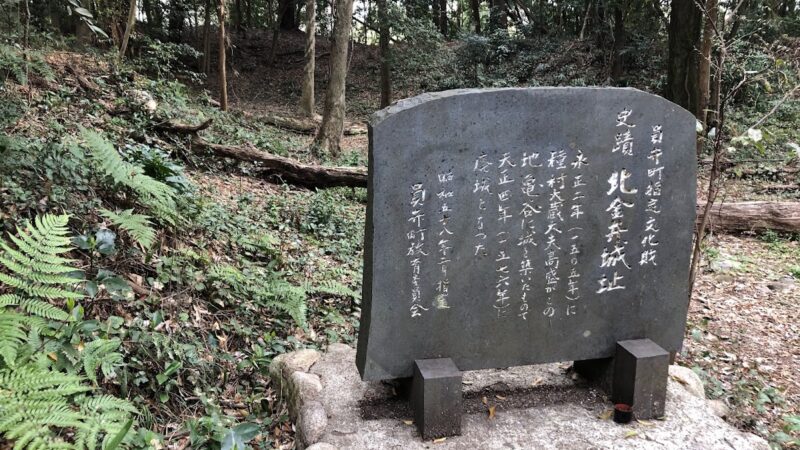
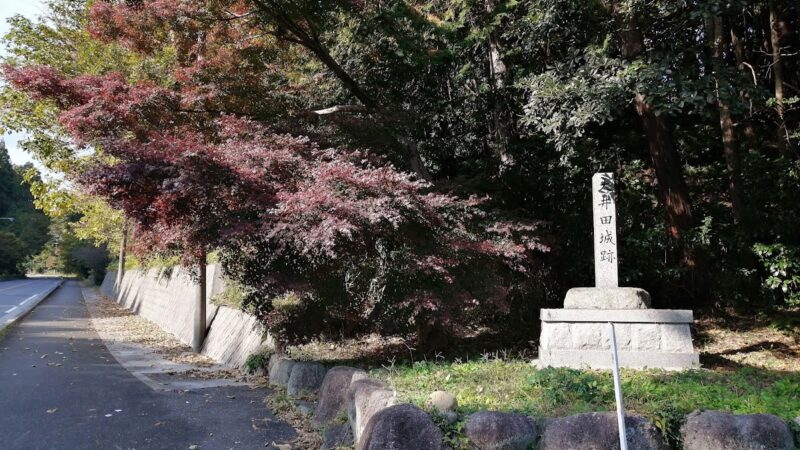
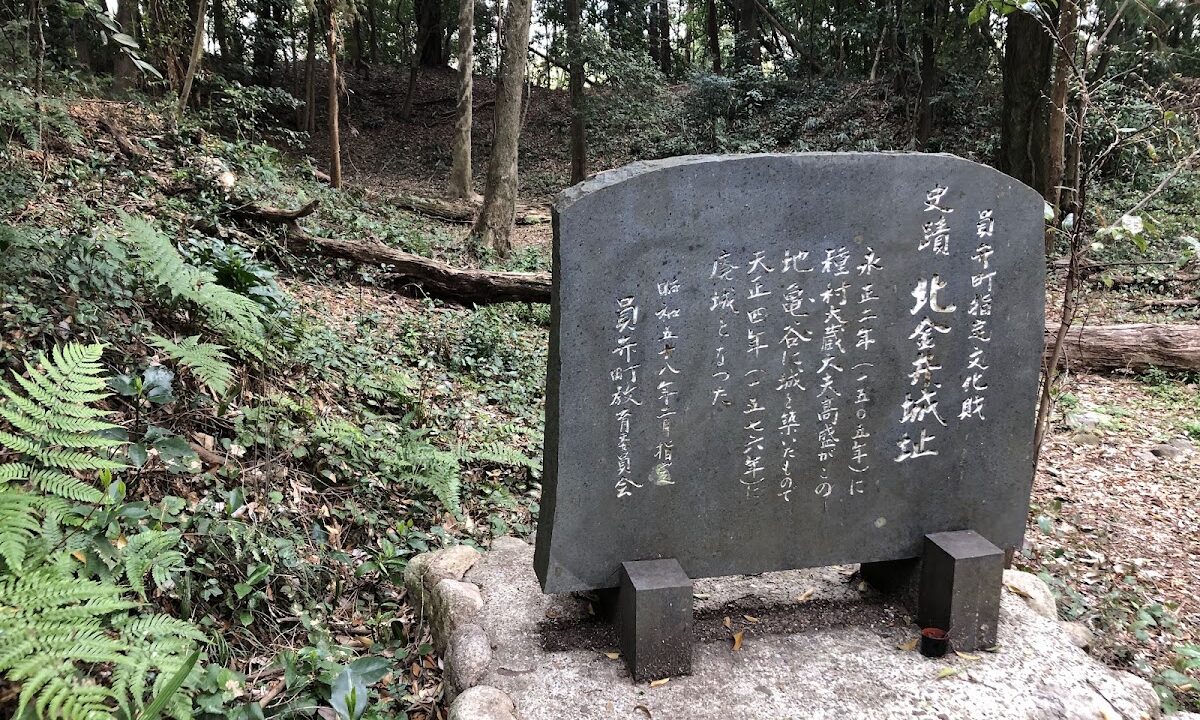
Near the entrance to the main keep, there is a castle site monument and information board where you can learn about the history and structure of Kanai Castle. The information board includes a map of the castle’s layout, which is helpful for understanding the overall structure of the castle while examining the remains on-site.
The castle site monument was erected by local volunteers and plays an important role in passing on the history of the Tanemura clan to future generations. The inscription concisely records the lineage of the Tanemura clan and the history of Kanai Castle.
Seasonal Scenery
Kanai Castle displays different expressions throughout the seasons. In spring, fresh greenery colors the earthworks, and in summer, it is enveloped in deep green. In autumn, the autumn leaves are beautiful, and in winter, the fallen leaves make the outlines of the remains more clearly visible.
Winter, in particular, is an excellent time to observe the details of the remains, as the undergrowth withers and the view opens up. If you want to enjoy photography, winter to early spring, when the remains are clearly visible, is recommended.
Surrounding Historical Landscape
Several historical sites related to the Tanemura clan are scattered around Kanai Castle. The Kitakanai settlement retains the atmosphere of an old town, making it enjoyable for historical walks. Also nearby is Kanai Shrine (Kanou-no-Miya), a well-known ancient shrine that celebrated its 800th anniversary in 2021.
Kanai Shrine is popular for its beautiful goshuin (shrine stamps) and seasonal flower arrangements in its water basin, and many people visit it in conjunction with a visit to the castle ruins. Visiting both the castle ruins and the shrine will allow you to gain a deeper understanding of the history and culture of this region.
Access Information
Access by Public Transportation
By Train:
- Get off at Oizumi Station on the Sangi Railway Hokusei Line, approximately 15 minutes on foot.
- Transfer to the Sangi Railway Hokusei Line from Kuwana Station on the Kintetsu Nagoya Line, approximately 30 minutes.
The Hokusei Line is known as one of Japan’s smallest narrow-gauge (light railway) lines, and you can enjoy a journey on retro trains. From Oizumi Station to the castle ruins, it’s a quiet route through the village of Kitakanai. There are guide signs along the way, so you are unlikely to get lost.
If using the bus:
Public bus services are limited, so using the train is recommended.
Access by car
Route from major roads:
- Approximately 20 minutes from the Kuwana-Higashi Interchange on the Tomeihan Expressway
- Near the Kitakanai intersection on National Route 421
Parking Information:
There is a small parking space dedicated to the castle ruins. This is a handmade parking lot maintained by local residents, and can accommodate 2-3 cars. It is rare to find a parking lot at a castle ruin, demonstrating the enthusiasm of the local community for preserving the site.
However, parking space is limited, so caution is advised if visiting with multiple vehicles. Also, some roads are narrow, so it is best to avoid visiting with large vehicles.
Important Notes for Visitors
Clothing and Equipment:
- Comfortable walking shoes (sneakers or light hiking boots) are recommended.
- Bring insect repellent, a hat, and drinking water during the summer.
- Wear non-slip shoes even in winter for safety.
The castle ruins are not a well-maintained park, but a historical site that preserves the natural terrain. There are no safety features such as fences on the earthworks and moats, so please be careful of your footing while visiting. Especially after rain, the ground becomes slippery, so it is advisable to refrain from visiting or to exercise extreme caution.
Visiting Hours:
The castle ruins are open year-round, but please avoid visiting after sunset as it is dangerous. The visit takes approximately 30 minutes to 1 hour. If you wish to carefully observe the remains, it is recommended to allocate 1 hour or more.
Manners:
- Destroying the ruins or graffiti on the earthworks is strictly prohibited.
- Always take your trash with you.
- No trespassing on private property.
- No open flames.
Nearby Tourist Spots
Kanai Shrine (Kanou-no-Miya)
Kanai Shrine, located about a 5-minute walk from Kanai Castle, is affectionately known as “Kanou-no-Miya.” This historic shrine celebrated its 800th anniversary in 2021, and in recent years, its beautifully designed goshuin (shrine stamps) and seasonally changing flower arrangements in the water basin have gained popularity.
The shrine office is open from 9:00 to 15:00 (closed Wednesdays), and goshuin are also available during these hours. Visiting the shrine in conjunction with a visit to the castle ruins will allow you to experience the history of Kita-Kanai more deeply.
Other Castle Ruins in Inabe City
Besides Kanai Castle, there are several other castle ruins in Inabe City.
Hokusei Castle Ruins:
Located in Hokusei-cho, Inabe City, it was the residence of the Inabe clan. Like Kanai Castle, it is a castle from the Sengoku period, and remains of earthworks and moats still exist.
Haruta Castle Ruins:
Located in Daian-cho, Inabe City, it is believed to be the site of a local lord’s residence. Although small in scale, it provides clues to the lives of local powerful families at the time.
A “Tour of Inabe City Castle Ruins” visiting these castle ruins is extremely valuable for understanding northern Ise during the Sengoku period.
Natural Scenery of the Inabe River
The Inabe River, which Kanai Castle faces, is a spot where you can enjoy the beauty of nature throughout the seasons. In spring, the cherry blossom trees are beautiful, and in summer, you can cool off in the clear stream. A stroll along the river before or after visiting the castle ruins will refresh you.
Current Status and Challenges of Kanai Castle Research
Archaeological Excavations and Research
Regarding Kanai Castle, full-scale archaeological excavations have not yet been conducted. Current knowledge is mainly based on historical documents and surface observations. Further archaeological excavations could reveal new facts, such as the exact construction date, building layout, and details about daily life.
In particular, the relationship between the Tanemura clan and Takigawa Kazumasu, and the truth behind the assassination of Hidenobu, remain largely unknown due to limited historical records. Excavations at Kanai Castle may hold the key to resolving these historical questions.
Preservation and Utilization Efforts
Currently, Kanai Castle ruins are being preserved by local volunteers. These activities are primarily volunteer-based, including undergrowth clearing and the installation of information boards.
The Inabe City Board of Education also recognizes the value of the site as a cultural asset, and future preservation plans are being considered. The challenge going forward is how to balance its use as a tourist resource with the preservation of its academic value.
The Role of Kanai Castle in the Region
Kanai Castle is cherished by local residents as a symbol of the region’s historical identity. The place name Kita-Kanai itself originates from the castle, deeply intertwined with the region’s history.
In recent years, due to the castle boom and the popularity of historical tourism, the number of visitors to Kanai Castle has been increasing. Kanai Castle’s importance is growing as a resource for regional revitalization and as a place for historical education.
The Significance of Visiting Kanai Castle
While Kanai Castle may not be widely known nationwide, it is a valuable historical site where you can experience the structure of a castle from the Sengoku period (Warring States period). Because it hasn’t been heavily commercialized for tourism, it maintains a space where you can quietly contemplate history.
Standing atop the earthen ramparts and looking down at the dry moat, you can feel the weight of history as you reflect on the glory of the Tanemura clan and the tragedy of their assassination by Takigawa Kazumasu. The rise and fall of local powerful families, and the human dramas of the Sengoku period, which are not found in textbooks, are truly etched here.
The real pleasure of visiting castle ruins lies not just in seeing the remains, but in imagining the lives of the people who lived in that place. Kanai Castle is a place where you can fully experience such historical romance.
Summary
Kanai Castle in Inabe City, Mie Prefecture, is a castle ruin from the Sengoku period that flourished as the residence of the Tanemura clan and met a tragic end due to a conflict with Takigawa Kazumasu. Even today, the remains of the castle, such as the high earthworks around the main keep, dry moats, and gate, are well-preserved, making it a valuable historical site for learning about the castle structure of the Sengoku period.
It is easily accessible, about a 15-minute walk from Oizumi Station on the Sangi Railway Hokusei Line, and about a 20-minute drive from the Kuwana-Higashi Interchange on the Tomeihan Expressway. A dedicated parking lot for the castle ruins is also available, making it easy to visit.
Visiting the nearby Kanai Shrine (Kanou-no-Miya) and the natural scenery of the Inabe River in conjunction with the castle ruins will allow you to experience the history and culture of Kita-Kanai more deeply. Please do visit Kanai Castle, where you can feel the spirit of the Sengoku period.