Complete Guide to Oida Castle (Inabe City, Mie Prefecture) – History, Remains, and Access Information
What is Oida Castle?
Oida Castle is a medieval flatland castle located in Oida, Daian-cho, Inabe City, Mie Prefecture. Built on a plateau approximately 20 meters high, south of the current Inabe City Hall Daian Branch, it is known as one of the important strategic points in the Hokusei region during the Sengoku period (Warring States period).
The castle ruins primarily occupy the northern part of the plateau, which is divided into north and south sections. Remains such as earthworks and moats can still be seen today. Locally known as “Oida Castle Ruins,” it is a popular historical site visited by history enthusiasts and castle fans, thanks to the presence of a castle site monument and information boards.
Location and Geographical Characteristics of Oida Castle
The plateau on which Oida Castle was built is a natural stronghold, approximately 20 meters higher than the surrounding plains. This location is not only suitable for defense but also strategically situated overlooking the Hokusei region. It overlooks the plains of the Inabe River basin and is believed to have played a role in monitoring important transportation hubs.
The plateau extends long and narrow from north to south, divided into a main enclosure on the north side and a secondary enclosure on the south side. The layout, skillfully utilizing this terrain, exhibits a typical structure of a medieval castle.
History of Oida Castle
Construction History and Period
Regarding the construction period of Oida Castle, there are no clear records, and many aspects remain unknown. However, based on the structure of the castle and the characteristics of the remains, it is estimated to have been built during the mid-to-late Sengoku period.
During the Sengoku period, the Hokusei region was a battleground for multiple forces, including the Kitabatake clan, the Oda clan, and the Ikko-ikki forces of Ise-Nagashima, all vying for supremacy. Oida Castle is thought to have played an important role as a base for regional control amidst the turmoil of the Sengoku period.
About the Castle Lord, the Kurita Clan
The lord of Oida Castle is said to be Kurita Saemonnosuke. The Kurita clan is believed to have ruled this area as a local powerful family in the Hokusei region.
While historical records are scarce and many aspects of Kurita Saemonnosuke’s life remain unclear, local tradition states that he maintained his power base in Oida. Further research is needed to understand how the Kurita clan came to rule this area and their relationships with other Sengoku daimyo.
Hokusei and Oida Castle in the Sengoku Period
The Hokusei region during the Sengoku period was in a complex political situation. Various forces intersected, including the influence of the Kitabatake clan, which had continued since the Nanboku-cho period, the pressure from the Oda clan advancing from Owari, and the presence of the Ikkō-ikki forces based in Ise-Nagashima.
It is believed that the castles of Inabe County, including Oida Castle, sought to maintain their independent positions amidst these powerful forces. Local lords employed various diplomatic strategies to protect their territories, sometimes forming alliances and sometimes clashing with each other.
The Castle’s Demise
There are no clear records of when or how Oida Castle was abandoned. Generally, it is believed that many medieval castles in this region ceased to exist with the end of the Sengoku period, following Oda Nobunaga’s invasion of Ise and Toyotomi Hideyoshi’s subsequent unification of Japan.
In the Edo period, under the control of the Kuwana Domain, large-scale castles became unnecessary, and it is presumed that Oida Castle was abandoned and subsequently used as farmland.
Structure and Layout of Oida Castle
Overall Castle Structure
Oida Castle is a flatland castle utilizing a plateau extending north-south, with its main section located on the northern plateau. The castle grounds are broadly composed of the main enclosure (Honmaru) and the secondary enclosure (Ninokuruwa), each separated by earthworks and moats.
The layout, which makes maximum use of the plateau’s topography, demonstrates the wisdom of medieval castle construction, achieving efficient defense with limited personnel and resources. The 20-meter elevation difference provided a significant obstacle for attackers and advantageous conditions for defenders to monitor the surroundings.
Characteristics of the Main Enclosure (Honmaru)
The main enclosure is the central part of the castle, believed to be where the lord’s residence and important facilities were located. Traces of earthworks can still be seen today, allowing us to imagine the scale of the castle in its heyday.
Earthworks surround the main enclosure, and there is evidence that higher and thicker earthworks were constructed, especially in directions where enemy incursions were anticipated. These earthworks are thought to have served not only as defensive structures but also as symbolic representations of the castle’s grandeur.
Koguchi (gateway entrance) and Defensive Structures
The koguchi (gateway entrance) is a crucial structure in castle defense. At Oida Castle, the approach to the main enclosure was cleverly designed, and the remains suggest it was a structure that made it difficult to easily attack.
Near the koguchi, the earthworks curve, designed to allow for attacks on intruders from the flank. Furthermore, a moat was positioned in front of the koguchi, serving to hinder enemy advances.
Arrangement of Moats and Earthworks
Moats play a vital role in Oida Castle’s defensive system. They not only separate enclosures but also restrict enemy lateral movement, creating a space where the defenders could fight to their advantage.
The moats visible on-site are positioned along the topography of the plateau, and combined with the natural slope, they form a more effective defensive line. Combined with the earthworks, this would have been an impenetrable obstacle for attackers.
Secondary Enclosure and Outer Enclosure
A secondary enclosure is located south of the main enclosure, also demarcated by earthworks and moats. The secondary enclosure likely served as a forward defensive position for the main enclosure, or, in peacetime, may have housed retainers’ residences or warehouses.
It is presumed that further outer fortifications existed on the edge of the plateau, but many parts have been lost due to later development, and further investigation is needed to fully understand the site.
Remains of Oida Castle
Main Existing Remains
The following remains can still be seen at Oida Castle:
Earthworks: Earthworks remain in good condition, centered around the main enclosure. The height varies depending on the location, but the highest points are over 2 meters high. Walking along the earthworks gives a sense of the castle’s scale at the time.
Horizontal Moats: Horizontal moats separating the enclosures can be seen in multiple locations. While some parts are buried, clearly remaining sections are approximately 2-3 meters deep. Enclosures: The flat areas of the main enclosure and secondary enclosure remain clearly visible, allowing for confirmation of the size and layout of each enclosure.
Gate Entrance: Traces of a gate entrance, believed to be the entrance to the enclosure, are visible. The breaks in the earthworks and the passage-like terrain allow for the imagination of the movement patterns at the time.
Preservation of the Remains
The remains of Oida Castle are preserved in relatively good condition for a medieval castle. While some parts have been affected by development since modern times, the main remains are still clearly recognizable as part of the topography.
In particular, the civil engineering remains such as earthworks and moats have maintained their basic shape despite weathering and vegetation over time. This can be attributed to the local people’s awareness of preservation and the relatively low level of development pressure.
Precautions When Visiting the Remains
When visiting the Oida Castle ruins, please note the following:
- Safety of Footing: The slopes of the earthworks and moats can be slippery. Particular caution is needed during and after rain.
- Bushes and Vegetation: Depending on the season, vegetation may grow thickly, making it difficult to see the remains. Insect repellent is also necessary from spring to autumn.
- Consideration for Private Property: Private property may be included around the castle ruins. Do not enter areas marked as “No Entry.”
- Protection of Remains: Please observe proper visiting etiquette and avoid damaging the earthworks or other remains.
Highlights of Oida Castle
Castle Site Monument and Information Board
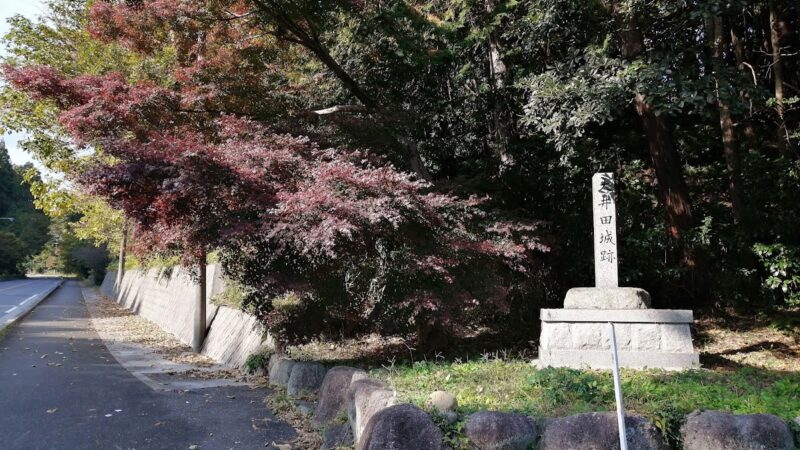
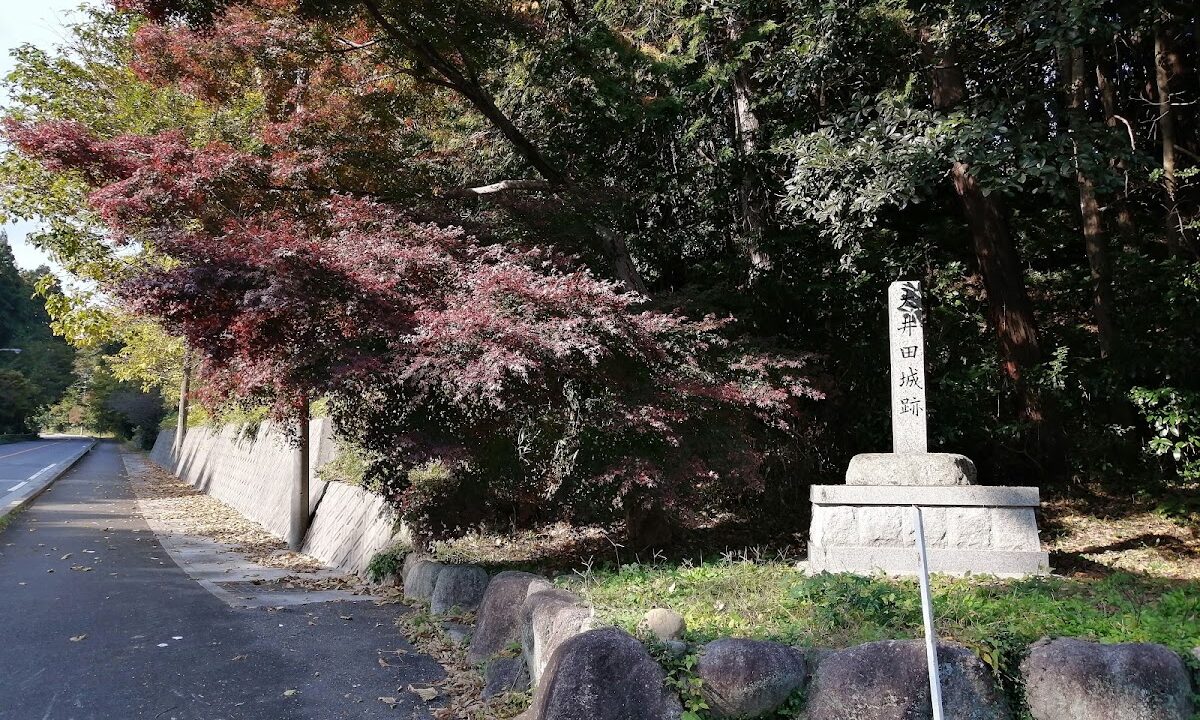
The first thing you’ll see when visiting Oida Castle is the castle site monument and information board. The castle site monument is located southeast of the plateau and is inscribed with the words “Oida Castle Site.” This monument is an important landmark that conveys local history.
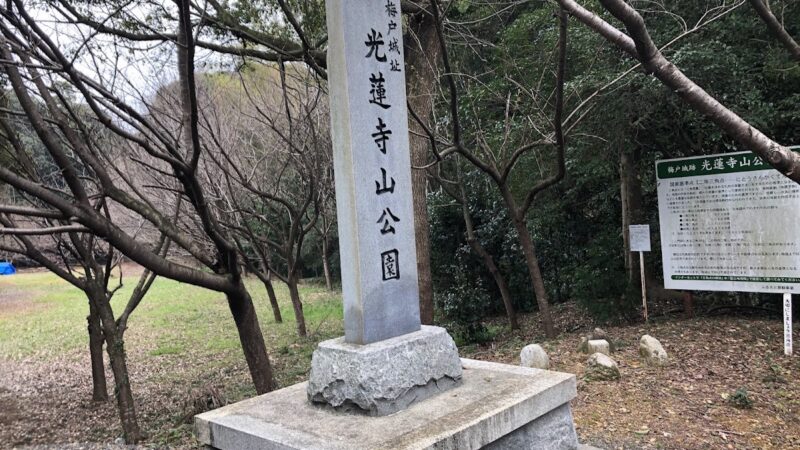
The information board is located southwest and provides a concise explanation of the castle’s history and structure. For first-time visitors, it’s a good idea to start by reading this information board to get an overview of the castle before beginning your exploration.
View from the Main Enclosure
From the main enclosure, you can see the surrounding plains. During the Sengoku period, the castle lords likely viewed their territory from this spot and monitored enemy movements. While much of the area is now urbanized, you can still see the topography of the Inabe River basin and distant mountain ranges.
On clear days, the Suzuka Mountains are also visible, providing a valuable perspective for understanding the geographical features of the region.
Continuous Earthworks and Moats
The greatest highlight of Oida Castle is the well-preserved continuous earthworks and moats. Walking around the main enclosure, you can see how the earthworks surround the enclosure, with moats dug outside of them.
Seeing these remains in person allows you to experience how medieval castles were defended and appreciate the level of castle-building technology of the time. The height of the earthworks and the depth of the moats give a real sense that this castle was a full-fledged military facility.
Seasonal Charms
Oida Castle Ruins show different faces depending on the season:
Spring: The fresh greenery is beautiful, and the outlines of the ruins are clearly visible. The pleasant weather makes it ideal for a stroll.
Summer: The greenery becomes denser, and the ruins may be covered by vegetation, but the shade of the trees is cool, allowing you to enjoy forest bathing.
Autumn: The autumn leaves are beautiful, and the entire castle site is colored. The temperature drops, making it ideal for carefully observing the ruins.
Winter: The shape of the ruins is most easily visible due to the fallen leaves. The air is clear, and the views are excellent.
Access Information
Access by Public Transportation
By Train:
- Get off at Daian Station on the Sangi Railway Hokusei Line, approximately 15 minutes on foot.
- Daian Station also houses the Inabe City Tourism Association, where you can obtain tourist information.
By Bus:
- The Inabe City Community Bus is also available, but since the number of services is limited, it is recommended to check the timetable in advance.
Access by Car
From Expressway:
- Approximately 20 minutes from Kuwana-Higashi IC on the Tomeihan Expressway via National Route 421 and prefectural roads.
- Approximately 10 minutes from Daian IC on the Tokai-Kanjo Expressway.
Setting Your Car Navigation System:
- It is convenient to set “Inabe City Hall Daian Branch” (2705 Oida, Daian-cho, Inabe City, Mie Prefecture) as your destination.
- The castle ruins are located south of the building.
Parking Information
While there is no dedicated parking lot, you may be able to use the parking lot at the Inabe City Hall Daian Branch. However, since the building’s parking lot is for official use, its use may be limited to holidays and outside of regular hours. We recommend checking before your visit.
Please use appropriate parking spaces, as street parking inconveniences local residents.
Estimated Visiting Time
To visit the Oida Castle Ruins, you should allow approximately 30 minutes to 1 hour. If you carefully observe the remains or take photographs, it may take longer.
For those who want to understand the castle’s structure in detail or explore the surrounding terrain, we recommend allowing 1.5 to 2 hours.
Nearby Tourist Attractions
Other Castle Ruins in Inabe City
After visiting Oida Castle, we recommend visiting other castle ruins in Inabe City:
Haruta Castle: A medieval castle located near Oida Castle, also built on a plateau.
Tanabe Castle: A hilltop castle built in the Inabe River basin, forming part of the castle network in the Hokusei region.
Visiting these castle ruins together will allow for a deeper understanding of the castle layout and regional governance in the Hokusei region during the Sengoku period.
Tourist Attractions in Inabe City
Umebayashi Park: Known as one of the largest plum groves in the Tokai region, it boasts approximately 4,000 plum trees of about 100 varieties in spring.
Fujiwara-dake: A famous peak in the Suzuka Mountains, offering opportunities for mountain climbing and hiking. The spring flowers are beautiful, attracting many hikers.
Inabe City Agricultural Park: A facility where visitors can enjoy seasonal flowers and agricultural experiences.
Nearby Historical Facilities
Inabe City Local History Museum: A facility where you can learn about the history and culture of the region (it is recommended to check opening hours in advance).
Kuwana City Museum: The nearby city of Kuwana has a museum showcasing the history of the Kuwana Domain, allowing visitors to deepen their understanding of the Hokusei region during the Edo period.
Points to Note When Visiting Oida Castle
Clothing and Items to Bring
Suitable clothing and items for visiting the castle ruins:
- Clothing: Comfortable clothing and walking shoes (sneakers or trekking shoes)
- Hat: To protect your head from the sun and branches
- Drinks: Essential, especially in summer, to prevent heatstroke
- Insect Repellent: Necessary from spring to autumn
- Camera: For documenting the ruins and taking photos of the scenery
- Notebook: For recording observations
Best Season for Visiting
The best time to visit Oida Castle ruins is from autumn to winter. This time of year:
- The ruins are easier to see due to fallen leaves.
- The temperature is low, making it comfortable for long walks.
- There are fewer insects.
- The air is clear and the views are excellent.
However, the fresh greenery in spring and the autumn foliage are also beautiful, making it worthwhile to visit in each season.
Photography Tips
Points for taking effective photos at Oida Castle Ruins:
- Early morning or evening: The angle of the light is low, and the shadows of the earthworks and moats are beautifully captured.
- Emphasizing the features of the ruins: Include people or trees to create a sense of scale, showing the height of the earthworks and the depth of the moats.
- Information boards and castle site monument: Take photos of these facilities as a memento of your visit.
- Surrounding scenery: The view from the main enclosure is also worth documenting.
Historical Value and Future Challenges of Oida Castle
Importance in Local History
Oida Castle is an important historical site that shows the reality of regional control in the Hokusei region during the Sengoku period. While not the residence of a large-scale Sengoku-period daimyo, it serves as a valuable example for understanding how local lords controlled and defended their territories.
Studying this site in conjunction with other castle ruins in Inabe County may provide a more detailed understanding of the castle network in this region and the political and military situation during the Sengoku period.
Current Status of Preservation and Development
Currently, the Oida Castle ruins have not undergone any large-scale development and are basically preserved in their natural state. While this has the advantage of minimizing alteration of the remains, it also presents challenges in terms of guiding visitors and ensuring safety.
While the castle site monument and information boards provide basic information, more detailed explanations and markers indicating the location of the remains would further enhance visitors’ understanding.
Expectations for the Future
The following initiatives are expected to further utilize the Oida Castle ruins:
- Detailed academic research: To clarify the overall picture of the castle through archaeological excavations and surveys.
- Enhancement of information facilities: To increase the number of explanatory signs on site and provide information using digital technology.
- Preservation and management plan: To develop a plan to improve the viewing environment while appropriately preserving the remains.
- Collaboration with the local community: To utilize the site for local history education in cooperation with local residents and schools.
- Development as a tourism resource: To develop historical sightseeing routes in collaboration with other castle ruins and tourist facilities.
Summary
Oida Castle is a valuable medieval castle ruin remaining in Inabe City, Mie Prefecture. As the residence of Kurita Saemon-no-suke, this castle played an important role in the Hokusei region during the Sengoku period. Even today, the remains such as earthworks and moats remain clearly visible, making it a valuable historical site for understanding the castle structure of the time.
Located near the Inabe City Hall’s Daian branch, Oida Castle boasts a convenient location and is relatively easy to access. It’s within walking distance of Daian Station on the Sangi Railway, and only about 10 minutes by car from the Daian Interchange on the Tokai-Kanjo Expressway.
A visit to the castle ruins takes approximately 30 minutes to an hour, allowing for a thorough observation of the earthworks and moats. Other castle ruins and tourist attractions in Inabe City are also nearby, making for a day of historical exploration and nature enjoyment.
While Oida Castle differs from modern castles with ornate keeps and stone walls, it is a valuable cultural asset that conveys the spirit of the Sengoku period as an earthen castle. Those interested in history or castle enthusiasts should definitely consider visiting. It will be a valuable experience to feel the local history firsthand and reflect on the Sengoku period in the Hokusei region.