Akaomaru Castle (Kumamoto City) Complete Guide | History, Remains, and Access Information
What is Akaomaru Castle?
Akaomaru Castle is a medieval mountain castle located in Kawachi-cho, Nishi-ku, Kumamoto City, Kumamoto Prefecture. Built on a mountaintop approximately 300 meters above sea level, this castle played an important role in the regional control of Higo Province (present-day Kumamoto Prefecture) from the Sengoku period to the Azuchi-Momoyama period.
Currently, some remains of the castle survive and are recognized as a valuable cultural asset in telling the history of Kumamoto City. It is also known locally as “Akaomaru” and is well-known among local history enthusiasts and castle fans.
History of Akaomaru Castle
Background and Period of Construction
While there are various theories regarding the exact construction date of Akaomaru Castle due to limited historical records, it is believed to have been built in the mid-16th century during the Sengoku period. During this period, after the decline of the Kikuchi clan, local lords and powerful families vied for power in Higo Province, establishing castles and residences throughout the region. Akaomaru Castle is also presumed to have been built by a local lord as a base for regional control. The area around Kawachi Town, where it is located, was a crucial transportation hub connecting the Kumamoto Plain and the mountainous region, making it a militarily and economically important location.
Akaomaru Castle in the Sengoku Period
During the Sengoku period (Warring States period), Higo Province became the stage for power struggles between powerful Kyushu daimyo such as the Otomo clan (Bungo Province), the Shimazu clan (Satsuma Province), and the Ryuzoji clan (Hizen Province). The area around Akaomaru Castle was also influenced by these forces and is thought to have been a target of attack and defense at times.
In particular, during the Tensho era (1573-1592), Toyotomi Hideyoshi’s conquest of Kyushu progressed, and the system of governance in Higo Province changed dramatically. In this process, many small and medium-sized castles were abandoned or their roles changed.
Changes Since the Early Modern Period
After Toyotomi Hideyoshi’s conquest of Kyushu in 1587, Sasa Narimasa was appointed to Higo Province, but he was dismissed for his responsibility in a local uprising. Subsequently, Kato Kiyomasa became the lord of the northern half of Higo Province, and a new governing system centered around Kumamoto Castle was established.
During this process, many medieval mountain castles, such as Akaomaru Castle, are thought to have ceased to serve their military purpose and were abandoned. During the Edo period, while remaining in the local memory as castle ruins, the land was used for farming and forestry.
Castle Structure and Characteristics
Location and Layout
Akaomaru Castle is a typical mountain castle, with its main enclosure (honmaru) located on a mountaintop overlooking the surrounding area. This location adheres to the fundamental principles of Sengoku period castle construction, aiming to detect approaching enemies early and gain a defensive advantage.
The castle grounds are presumed to have had a linear structure with multiple enclosures (kuruwa: flat sections) arranged around the main enclosure. A distinctive feature is the clever use of the mountainous terrain, utilizing the natural steep slopes as defensive lines.
Defensive Facilities
To enhance the defensive capabilities of the mountain castle, the following facilities are thought to have been constructed:
Horikiri (Dry Moat) A dry moat dug to cut across a ridge, an important defensive facility to prevent enemy intrusion. Traces of horikiri can be seen along the ridge at Akaomaru Castle.
Dorui (Earthwork) A defensive wall built by piling up earth, surrounding the enclosures to enhance defensive capabilities. Traces of earthworks can still be seen in some areas today.
Kirigishi (Cut Slope) A steep slope cut at a near-vertical angle around the enclosure, serving to make ascent difficult for enemies.
Layout of Enclosures
It is presumed that the main enclosure was located at the highest point, with secondary flat areas such as the second and third enclosures arranged in a stepped pattern around it. Each enclosure is thought to have served different functions, such as observation posts, troop garrisons, and supply storage.
Existing Remains
Remains Visible at the Site
Although the Akaomaru Castle site is currently a forest, careful observation reveals the following remains:
Main Enclosure Site
A relatively flat space remains at the mountaintop, allowing us to imagine the former extent of the main enclosure. While not particularly large, it is clearly recognizable as an artificially flat area.
Traces of a Moat
Clearly artificially excavated depressions remain along the ridge, which can be identified as traces of a moat. While the depth and width have decreased due to burial and weathering, its defensive shape remains.
Remnants of Earthworks
In some areas around the baileys, remnants of earthworks can be seen as slight elevations. While not clearly defined, they can be identified as unnatural undulations in the terrain.
Cut Slopes
Steep slopes are visible at the edges of the baileys, suggesting the possibility of artificially carved cut slopes. Distinguishing them from natural terrain requires expert observation.
Preservation Status of the Remains
Because Akaomaru Castle ruins have not received special protective measures, the clarity of the remains is not always high due to natural weathering and overgrown vegetation. However, the basic layout remains as a topographical feature, making it valuable as a subject for castle research and historical study.
In recent years, investigations and documentation by local history enthusiasts and castle researchers have progressed, and it is being re-evaluated as a valuable example of a medieval mountain castle.
Access to Akaomaru Castle
Location
Address: Kawachi-machi, Nishi-ku, Kumamoto City, Kumamoto Prefecture
Location: Approximately 15 kilometers west of central Kumamoto City
Access by Car
From central Kumamoto City, head west on National Route 501 towards Kawachi-machi. The journey takes approximately 30 minutes.
Using the Kyushu Expressway:
Approximately 20 minutes from Kumamoto IC, or approximately 25 minutes from Ueki IC, to reach the vicinity of Kawachi-machi.
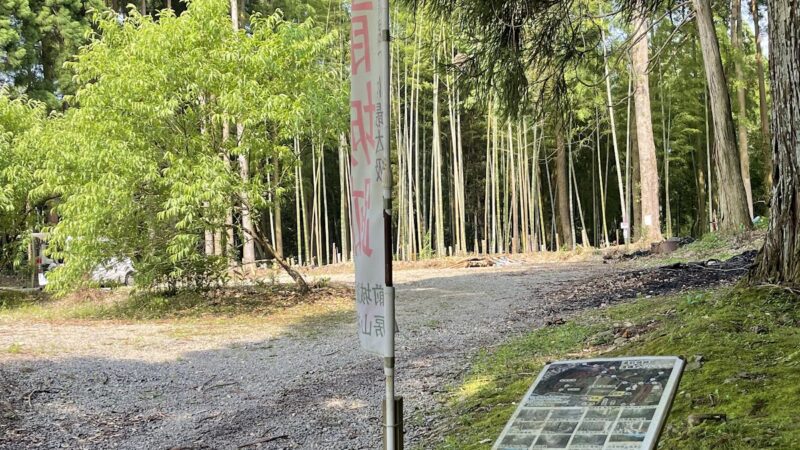
Since the trailhead to the castle ruins may not be clearly marked, it is recommended to inquire with the local tourism association or the Kumamoto City cultural property department in advance.
Access by Public Transportation
Public transportation access is limited. While it is possible to take a bus from Kumamoto City towards Kawachi-machi, walking to the castle ruins is required, which takes time and physical effort.
Access is via Kumamoto City Bus or Sanko Bus routes, followed by a short walk from the nearest bus stop. However, bus services are limited, so please check the timetable in advance.
Precautions for Visiting the Castle
Akaomaru Castle Ruins are not a well-maintained tourist site, but rather a historical site located in a forest. Please note the following points when visiting:
- Clothing: Wear clothing suitable for mountain hiking, such as long-sleeved shirts, long pants, and trekking shoes.
- Items to Bring: Drinking water, map, compass, and mobile phone (consider the possibility of being out of range).
- Safety: Avoid traveling alone; visit in groups if possible.
- Best Time to Visit: Summer is overgrown with vegetation and has many snakes and insects; spring and autumn are more suitable.
- Permission: As it may be private property, it is advisable to check access beforehand.
Nearby Historical Spots
Kumamoto Castle
Located in the heart of Kumamoto City, Kumamoto Castle is one of Japan’s three most famous castles, built by Kato Kiyomasa. Visiting Kumamoto Castle is highly valuable for understanding the development from medieval mountain castles like Akaomaru Castle to early modern flatland castles.
Although it was damaged in the 2016 Kumamoto earthquake, restoration work is underway, and the castle tower and other structures are open to the public.
Historical Sites Around Kawachi Town
The area around Kawachi Town is dotted with historical sites from ancient to medieval times, including burial mounds, shrines, and temples. Combined with a visit to Akaomaru Castle, you can enjoy a historical walk tracing the region’s history.
Mount Kinpo
To the west of Akaomaru Castle stands Mount Kinpo, known as a sacred mountain. It has long been an object of worship and flourished as a place for mountain asceticism. It’s an area where you can enjoy both history and nature.
Cultural Value of Akaomaru Castle
Significance in Medieval Mountain Castle Research
Akaomaru Castle is an important historical site that shows the reality of regional control in Higo Province during the Sengoku period. While not a large-scale castle, it offers clues to how local lords protected and governed their territories.
In particular, mountain castles in the Kyushu region have been noted for their unique characteristics, distinct from those of Honshu, and Akaomaru Castle is thought to reflect this regional characteristic.
Contribution to Regional History Research
Akaomaru Castle is an important element in understanding the history of Kawachi-cho, Nishi-ku, Kumamoto City. To understand the historical trajectory of this region and how it became what it is today, research into medieval castle remains is essential.
Akaomaru Castle is also attracting attention in local history research, and further investigation and research are expected.
Appeal to Castle Enthusiasts
The Charm of Minor Castles
Castle ruins with low profile, like Akaomaru Castle, possess a different kind of charm than famous tourist castles. The undeveloped, natural state of the remains makes it easier to imagine what it looked like in its heyday, and is invaluable for understanding the original function and structure of the castle.
The fact that it’s not crowded with tourists and allows for quiet reflection on history is also appealing to castle enthusiasts.
Creating a Castle Layout Map
One of the joys of castle research is creating a castle layout map (a blueprint of the castle). At undeveloped castle ruins like Akaomaru Castle, there’s the pleasure of observing the terrain yourself, confirming the remains, and estimating the layout.
Using GPS and map apps to create your own layout map is an excellent way to deepen your understanding of castles.
Future Preservation and Utilization
Challenges for Preservation
Currently, Akaomaru Castle ruins lack special protective measures, making them vulnerable to natural weathering and loss due to development. Appropriate preservation measures are necessary to pass on this valuable cultural asset to future generations.
It is desirable that local governments, boards of education, and history enthusiast groups cooperate to conduct surveys and record-keeping of the remains.
Potential for Utilization
With proper development, Akaomaru Castle ruins have the potential to be utilized as a resource for local history education and tourism. For example:
- Maintenance of hiking trails and installation of signposts
- Dissemination of information through explanatory pamphlets and websites
- Implementation of local history lectures and guided tours
- Use as teaching material for local history studies in schools
These initiatives can increase local residents’ interest in history and foster an awareness of cultural property preservation.
Summary
Akaomaru Castle is a mountain castle ruin from the Sengoku period located in Kawachi-cho, Nishi-ku, Kumamoto City. While not large in scale, it possesses historical value as a valuable relic that reveals the reality of regional control at the time.
Although it is now being buried in the forest, remnants such as the main enclosure and moats can still be seen, making it a worthwhile spot for castle enthusiasts and history buffs.
Access is somewhat difficult, but we highly recommend visiting for those interested in Kumamoto’s medieval history and those who want to enjoy exploring lesser-known castle ruins. Please enjoy exploring this mountain castle and experiencing the romance of history, while being sure to take appropriate preparations and safety precautions.
Kumamoto City boasts numerous historical sites, including Kumamoto Castle, but by also paying attention to smaller, locally-rooted castle ruins like Akaomaru Castle, a more comprehensive and enriching understanding of history becomes possible. I hope that efforts to cherish local history and pass it on to future generations will continue.