
Complete Guide to Kutama Castle (Amakusa City, Kumamoto Prefecture) | History, Highlights, and Access Information
Located in Kutama-cho, Amakusa City, Kumamoto Prefecture, the ruins of Kutama Castle are a valuable historical site that tells the story of the medieval history of the Amakusa region. Built as the residence of the Kutama clan and later playing an important role as a branch castle of the Amakusa clan, this mountain castle still retains well-preserved remains such as moats and earthworks. This article comprehensively introduces information you should know before visiting, from the historical background of Kutama Castle to details of the remains that can be seen on site and access methods.
What is Kutama Castle?
Kutama Castle is a medieval mountain castle located in Yoshibegawa, Kutama-cho, Amakusa City, Kumamoto Prefecture. Situated on the east coast of Amakusa Shimoshima Island, it was built on a hill overlooking the sea. This location was suitable for monitoring and defending maritime traffic, and it functioned as a strategic stronghold in the Amakusa region.
The castle ruins were designated a historical site by Amakusa City on March 28, 1973 (Showa 48), and are protected as an important cultural property of the region. Even today, the remains of baileys, moats, and earthworks remain clearly visible within the forest, providing valuable information for understanding the structure of medieval mountain castles.
Location and Geographical Characteristics of Kutama Castle
Kutama Town, where Kutama Castle was built, is located in the eastern part of Amakusa Shimoshima Island. The town contains scattered settlements such as Onoura, Uchihara, Akashi, Ajiro, Kutama, Kibahara, Shinkutama, Nitta, Nakayoshi, Nakaura, Yoshida, and Yamanoura.
The castle ruins are located on a hill approximately 100 meters above sea level, slightly inland from the coast, and utilize the surrounding terrain as a natural stronghold. The east side faces the sea, and the west side is bordered by mountains; the castle’s layout is characterized by its skillful use of this natural topography.
History of Kutama Castle
The Era as the Residence of the Kutama Clan
Kutama Castle was built as the residence of the Kutama clan, a local lord. The Kutama clan was one of the powerful local lords in the Amakusa region, and they built their power base in this area. While there are no clear records of the castle’s construction date, it is believed to have been built in the late medieval period, probably between the 15th and early 16th centuries.
Initially, the Kutama clan used Kutama Castle as their base as an independent force, but gradually came under the influence of the Amakusa clan, a powerful daimyo in the Amakusa region. During this process, Kutama Castle increasingly took on the character of a branch castle of Kawachiura Castle, the main castle of the Amakusa clan.
Relationship with the Amakusa Clan and the Eiroku Civil War
When the Kutama clan became subordinate to Amakusa Naotane, Kutama Castle began to function as part of the Amakusa clan’s castle network. Within the Amakusa clan’s system of rule centered on Kawachiura Castle, Kutama Castle occupied an important position as a base in the eastern coastal region. The most significant event in the history of Kutama Castle is the Amakusa clan’s civil war of 1569 (Eiroku 12). This civil war was a conflict between the clan head, Amakusa Shigenobu, and his brothers over the legitimacy of Christian missionary work within their territory.
During this Eiroku Civil War, Kutama Castle was used as a base by the brothers’ faction. Forces opposed to Christian missionary work holed up in Kutama Castle, confronting Shigenobu’s side. This civil war had a major impact on the political situation in the Amakusa region and became a turning point that led to the decline of the Amakusa clan.
From the Late Sengoku Period to the Abandonment of the Castle
After the Eiroku Civil War, the Amakusa region became embroiled in the turmoil of the Sengoku period. Influenced by powerful daimyo of Higo Province, such as the Sagara and Shimazu clans, the Amakusa clan gradually lost power.
After Toyotomi Hideyoshi’s conquest of Kyushu, the Amakusa region became the territory of Konishi Yukinaga, and subsequently came under the rule of the Konishi clan, known as Christian daimyo. While there are no clear records of the role of Kutama Castle during this period, it is likely that its function as a medieval mountain castle gradually diminished.
In the Edo period, medieval mountain castles like Kutama Castle were abandoned within the framework of modern castles, ending their role. Subsequently, the castle ruins became buried in the forest, but the remains were preserved in relatively good condition.
Layout and Remains of Kutama Castle
Basic Structure of the Castle
Kutama Castle is a multi-bailey mountain castle that skillfully utilizes the hilly terrain. It has a typical medieval mountain castle structure, with multiple baileys arranged around the main bailey, separated by moats and earthworks.
The castle area extends long and narrow from north to south, with baileys arranged along the ridgeline. This layout is a clever design to effectively defend against enemies attacking along the ridge, and is a common feature found in medieval mountain castles.
Details of Major Remains
Moats
The most impressive remains of Kutama Castle are the moats, which remain in multiple locations. A moat is a dry moat dug to cut across a ridge, and is an important defensive structure to prevent enemy intrusion.
The moats of Kutama Castle are particularly clearly visible on the north side, towards the main entrance. Some moats reach a depth of several meters, demonstrating the high level of castle-building technology of the time. These moats not only separated the baileys but also served to allow for continued defense in the next bailey if one bailey fell.
Earthworks
Earthworks surround the baileys. Earthworks are earthen walls built by piling up earth, which prevented enemy intrusion and protected the inside of the bailey from outside views and attacks.
The earthworks of Kutama Castle remain in some sections, exceeding 1 meter in height, allowing us to imagine their appearance at the time. It is believed that fences or walls were erected on top of the earthworks, forming a stronger defensive line.
Enclosures
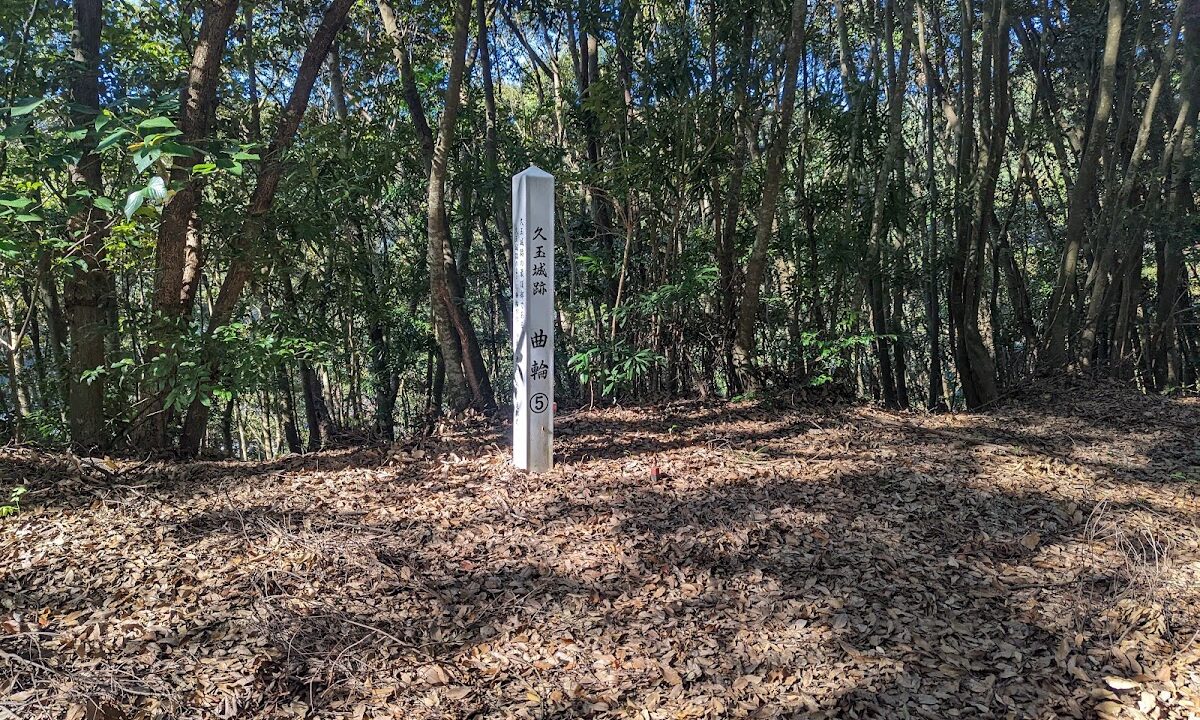
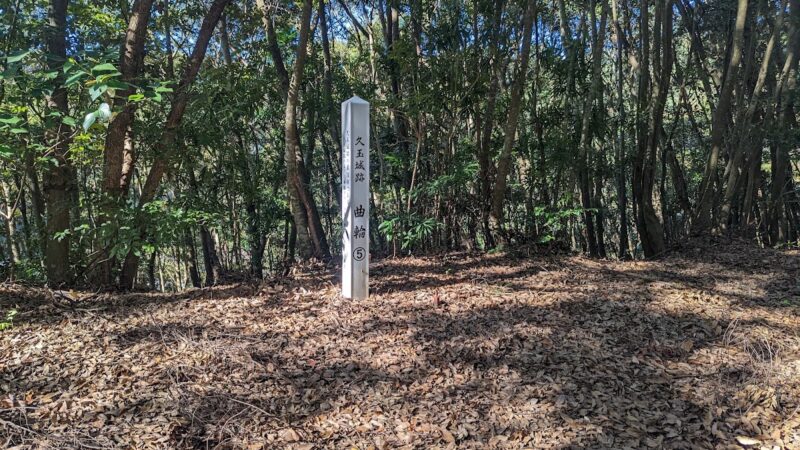
Multiple enclosures (kuruma) can be identified within the castle. The largest, the main enclosure (shukuruwa), was the central area where the lord’s residence and important facilities were located. From the main enclosure, one could overlook the surrounding terrain and the sea, and it is thought to have served a surveillance function.
Surrounding the main enclosure were the second and third enclosures (ni-no-kuruma, san-no-kuruma, etc.), creating a tiered defensive system. Each enclosure was relatively flat, and it is presumed that they were used for stationing soldiers or storing supplies.
Stone Walls
Partial traces of stone walls can also be found at Kutama Castle. While full-scale stone walls are rare in medieval mountain castles, stonework can be seen in parts of the enclosures and near the entrances (koguchi) at Kutama Castle.
While there is debate as to whether these stone walls are the result of later renovations or part of the original structure, there is no doubt that they played a crucial role in enhancing the castle’s defensive capabilities.
Main Entrance
The main entrance to the castle, the Ote-guchi, is believed to have been located on the north side. Particularly fortified defensive structures were positioned around the Ote-guchi, with a complex arrangement of moats and earthworks.
The path from the Ote-guchi to the main enclosure was designed to wind through the enclosures, a clever design to prevent attackers from easily reaching the main enclosure. This is a type of defensive technique called “masugata” or “kuichigai,” a characteristic structure of medieval castles.
Preservation of the Remains
Because the Kutama Castle ruins are located in a mountainous area untouched by development, the remains are relatively well-preserved. Moats and earthworks remain clearly visible, and the layout of the enclosures can be discerned from the topography.
However, due to years of weathering and overgrown vegetation, some of the remains are unclear. While protecting the site as a historical landmark, proper maintenance is a challenge for the future.
Information on Visiting Kutama Castle
Points to Note When Visiting
Although Kutama Castle ruins are designated as a historical site, full-scale tourism development has not been carried out. Please note the following points when visiting.
Clothing and Equipment
- Long-sleeved shirts, long pants, and athletic shoes or trekking shoes are essential as you will be walking through mountainous forests.
- Insect repellent is recommended during the summer months.
- Don’t forget to bring drinking water and a hat.
Safety Considerations
- As some areas do not have clearly marked trails, it is recommended to check a topographic map beforehand or ask a local expert to guide you.
- Avoid visiting alone; it is safer to travel in groups.
- It is best to refrain from visiting during or after rain, as the ground can become slippery.
Manners and Rules
- Please be mindful that this is a historical site and take care not to damage the remains.
- Always take your trash with you.
- Do not enter areas marked “No Entry,” as some areas may include private property.
Estimated Visit Time
For a visit to the castle ruins, allow approximately 1 to 1.5 hours for the round trip from the entrance to the main enclosure. If you wish to carefully observe the remains, it is recommended to allow about 2 hours. ### Photography Tips
At the Kutama Castle Ruins, there are several points of interest for photography, including:
- Cross-section of the moat: The moat on the north side is deep, making for impressive photographs.
- Lines of earthworks: Capturing the earthworks surrounding the baileys allows you to express the castle’s defensive structure.
- View from the main bailey: If the weather is good, you can see the sea and the surrounding mountains.
- Remaining stone walls: The partially remaining stonework is a subject that evokes the history of the castle.
Access Information
Location
Address: Yoshibegawa, Kutama-machi, Amakusa City, Kumamoto Prefecture 863-1902
Access by Public Transportation
Accessing the Kutama Castle Ruins by public transportation is difficult. It is a considerable distance from the nearest bus stop, and bus services are limited.
Nearest Bus Stop: Sanko Bus “Kutama” Bus Stop
- Approximately 40 minutes by Sanko Bus from central Amakusa City
- Approximately 20-30 minutes on foot from the bus stop to the castle ruins
If using public transportation, it is recommended to check the timetable in advance and plan with ample time to spare.
Access by Car
Access by car is the most convenient.
From Central Amakusa City
- Head south on National Route 266 towards Kutama Town
- Travel time: Approximately 30 minutes
From Hondo Bus Center
- Approximately 35 minutes via National Route 266
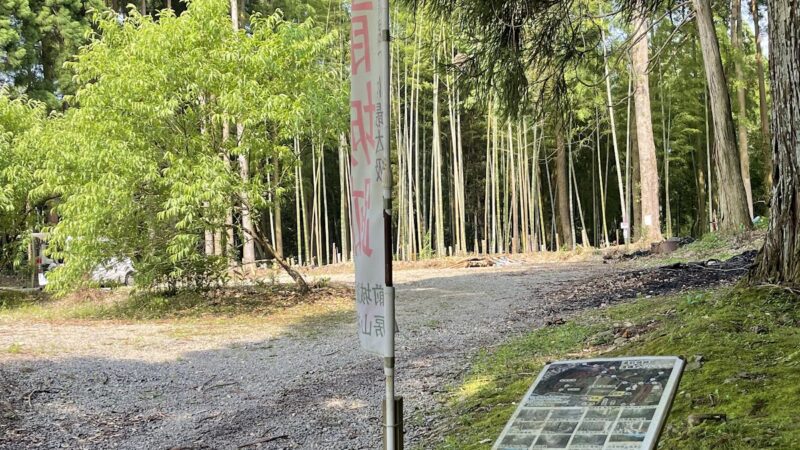
Parking: There is no dedicated parking lot for the castle ruins, but there is space for a few cars near the entrance to the castle. However, consideration should be given to avoiding inconveniencing local residents.
Hints for Setting Your Car Navigation
Searching for “Kutama Castle Ruins” on your car navigation system may not display the site. In that case, please search for “Yoshibegawa, Kutama-cho, Amakusa City” or set a nearby facility as your destination.
Nearby Tourist Spots
When visiting the Kutama Castle Ruins, you can enjoy a more fulfilling Amakusa sightseeing experience by also visiting nearby tourist spots.
Historical Sites in Amakusa City
Kawachiura Castle Ruins
The ruins of Kawachiura Castle, the main castle of Kutama Castle, are also worth visiting. As the base of the Amakusa clan, larger-scale remains remain.
Amakusa Christian Museum
This museum allows you to learn about the history of Christianity in the Amakusa region. It is helpful in understanding the history of the introduction of Christianity that lay behind the Eiroku Civil War, in which Kutama Castle was involved.
Natural and Scenic Spots
Ushibuka Area
The Ushibuka area, at the southern tip of Amakusa Shimoshima Island, is attractive for its beautiful coastline and fishing port scenery. It is about a 40-minute drive from Kutama-cho.
Amakusa Coastline
The coastline around Kutama Town is a popular driving route where you can enjoy the natural beauty of Amakusa.
Gourmet Information
Kutama Town and its surrounding areas have restaurants where you can enjoy fresh seafood. Amakusa is rich in seafood, and local fish dishes and seafood bowls are especially recommended. However, since the number of restaurants in Kutama Town is limited, it is recommended to check the opening hours in advance.
Historical Value of Kutama Castle Ruins
Position in the Medieval History of the Amakusa Region
Kutama Castle Ruins are an important historical site for understanding the medieval history of the Amakusa region. This is because it was a stage where various historical elements intersected, such as the rule system of the Amakusa clan, the actions of local lords, and the influence of the introduction of Christianity.
In particular, its role in the Eiroku Civil War is significant not only as a military facility, but also as a symbol of religious and political conflict. This civil war was a significant event not only in the Amakusa region but also in the history of Christianity throughout Kyushu, and Kutama Castle still stands today as a witness to that history.
Value in Medieval Mountain Castle Research
Kutama Castle ruins are valuable resources for studying the structure of medieval mountain castles. The remains of moats, earthworks, and baileys are well-preserved, allowing us to gain concrete insight into 16th-century castle construction techniques.
In particular, it is highly valued academically as a subject for castle research that reflects regional characteristics, such as the features of mountain castles in the island region of Amakusa, its relationship with maritime traffic, and the nature of castles built by local lords.
Challenges of Preservation and Utilization
Although Kutama Castle ruins are designated as a city historical site, they are not sufficiently developed as a tourist destination. The challenge for the future lies in finding a balance between preserving the remains and utilizing them.
On the other hand, there is also a recognition of the value of preserving it as a place where one can feel history in a quiet environment, avoiding excessive tourism development. It is essential that local residents, researchers, and the government cooperate to explore appropriate methods of preservation and utilization.
History and Culture of Kutama Town
Origins of Kutama Town
Kutama Town is one of the districts that make up Amakusa City, and has developed since ancient times, mainly through fishing and agriculture. There are various theories about the origin of the town’s name, but the most likely is that it derives from the Kutama clan who ruled this area.
Within the town are settlements such as Onoura, Uchihara, Akashi, Ajiro, Kutama, Kibahara, Shinkutama, Nitta, Nakayoshi, Nakaura, Yoshida, and Yamanoura, each with its own unique history and culture.
Regional Culture and Traditions
The Amakusa region, including Kutama Town, has formed a unique cultural sphere where Christian and Buddhist cultures coexist. The Eiroku Rebellion, in which Kutama Castle was involved, also occurred within this cultural background.
Even today, the region retains festivals and events that have been passed down since the Middle Ages, forming an important element in shaping the region’s identity.
Overview and Tourism Information of Amakusa City
About Amakusa City
Amakusa City was formed in 2006 through the merger of two cities and eight towns: Hondo City, Ushibuka City, Ariake Town, Goshoura Town, Kuratake Town, Sumoto Town, Shinwa Town, Gowa Town, Amakusa Town, and Kawauura Town. Located in the southwestern part of Kumamoto Prefecture, it has developed as the central city of the Amakusa Islands.
City Hall Address: 8-1 Higashihama-cho, Amakusa City, Kumamoto Prefecture 863-8631
Telephone Number: 0969-23-1111
FAX: 0969-24-3501
Tourism Resources of Amakusa City
Amakusa City is a tourist destination blessed with abundant nature and historical and cultural heritage.
Main Tourist Attractions
- Amakusa Christian Sites (including component sites of the World Cultural Heritage site “Hidden Christian Sites in the Nagasaki Region”)
- Dolphin Watching
- Beautiful Coastline and Sunset Views
- Fresh Seafood
- Hot Springs
- Historical Castle Ruins and Historic Sites
How to Obtain Tourist Information
Tourist information for Amakusa City can be obtained through the following methods:
- Amakusa City Official Website: Contains basic city information, various procedures, and tourist information.
- Amakusa Treasure Island Tourism Association: Provides detailed tourist information and event information.
- Amakusa City Tourist Information Center: Located inside the Hondo Bus Center, it distributes brochures and provides tourist consultations.
Summary
Kutama Castle is a medieval mountain castle site located in Kutama-cho, Amakusa City, Kumamoto Prefecture. It is a valuable historical site with a history of transitioning from the residence of the Kutama clan to a branch castle of the Amakusa clan. During the Eiroku Rebellion of 1569, it served as a base for the younger brother’s side and played a significant role in the history of the Amakusa region.
Even today, the remains of moats, earthworks, and baileys are well-preserved, making it a historical site of high academic value for understanding the structure of medieval mountain castles. While tourist facilities are limited, this allows visitors to experience history in a tranquil environment.
When visiting, it is recommended to prepare appropriate clothing and equipment for walking through the forest and to visit with safety in mind. Visiting the Kutama Castle ruins will provide a deeper understanding of the medieval history of the Amakusa region, the history of Christianity, and the history of Japanese castles.
When visiting Amakusa City, be sure to visit the Kutama Castle ruins and experience the traces of history etched into this land. The beautiful nature of Amakusa and its rich historical and cultural heritage are sure to provide visitors with an unforgettable experience.

.png)