History and Remains of Kataoka Castle (Ochi-cho, Takaoka-gun, Kochi Prefecture) | A Mountain Castle of the Kataoka Clan, a Powerful Family of Tosa
What is Kataoka Castle?
Kataoka Castle is a medieval mountain castle located in Kataoka, Ochi-cho, Takaoka-gun, Kochi Prefecture. Built on a hill north of the Kataoka settlement, at an altitude of approximately 100 to 150 meters, it is known as the residence of the Kataoka clan, a powerful family that ruled Takaoka-gun and part of Agawa-gun.
The current Kataoka Castle ruins retain well-preserved remains such as baileys, stone walls, earthworks, trenches, and dry moats, making it a valuable historical site that conveys the characteristics of medieval Tosa mountain castles. The castle ruins have a multi-bailey layout with multiple baileys arranged within an altitude difference of approximately 50 meters, making it an important site for understanding the castle construction techniques of the time.
Historical Background of Kataoka Castle
Establishment of Takaoka County and the Kataoka Clan
To understand Kataoka Castle, it is necessary to first understand the historical background of Takaoka County. Takaoka County was newly established in the early Heian period, in the 8th year of the Jōwa era (841 AD), by dividing the four western districts of Agawa County. The entry for August 23rd, the 8th year of the Jōwa era, in the *Shoku Nihon Kōki* (Continued Chronicles of Japan) states, “Eight districts of Agawa County in Tosa Province were divided into four districts each, creating two new counties. The new county name is Takaoka. There were originally four county officials, and two officials were appointed for each district.” This indicates that Takaoka County was established around this time.
The Kataoka clan was a powerful local family that built its influence around this Takaoka County. Regarding the origins of the Kataoka clan, it is believed that the Kondō clan settled in Kuroiwa-gō, Sakawa Town. The Kondō clan was a powerful samurai group in Tosa, and it is thought that a branch of their family moved to the Kataoka area and adopted the name Kataoka.
The Development of the Kataoka Clan
The Kataoka clan grew into a powerful local family in Takaoka County throughout the medieval period. Kataoka Tsuneshige, in particular, is known for clearly documenting the Kataoka clan’s name in historical records. During Kataoka Tsuneshige’s time, the clan is believed to have controlled a vast territory spanning from Takaoka County to parts of Agawa County.
The Kataoka clan was not merely a local family; they wielded political and military influence within Tosa Province. Their castle, Kataoka Castle, is thought to have functioned not only as a defensive structure but also as a base for governing their territory.
Kataoka Castle in the Sengoku Period
With the arrival of the Sengoku period (Warring States period), fierce power struggles unfolded within Tosa Province. It is presumed that the Kataoka clan strengthened the defensive capabilities of Kataoka Castle in order to survive this turbulent period. Many of the remaining stone walls and moats are thought to have been constructed during this time.
Kataoka Mitsutsuna is known as the last lord of the Kataoka clan’s castle. The tomb of Kataoka Mitsutsuna still remains within the grounds of Myofuku-ji Temple, located on the hillside of the castle. Myofuku-ji Temple functioned as the Kataoka clan’s prayer temple and had a deep connection with them.
Structure and Remains of Kataoka Castle
Location and Layout
Kataoka Castle was built on a hill north of the Kataoka settlement. Although it is a relatively low mountainous area at an altitude of 100 to 150 meters, it is situated in a strategic location overlooking the surrounding plains. Overlooking a valley formed by a tributary of the Niyodo River system, it is a strategically important location controlling a key transportation hub.
The castle’s layout is based on a linear arrangement, with multiple baileys arranged along the ridge. The main bailey is at the center, followed by the second and third baileys, each clearly demarcated by moats and earthworks. This structure is typical of medieval mountain castles, and various ingenious measures to enhance defensive efficiency can be seen throughout.
Major Remains
Enclosures (Kuruwa)
Kataoka Castle has several remaining enclosures. The largest, the main enclosure, is thought to have been the location of the lord’s residence and important facilities. Even today, the flat surface remains clearly visible, allowing us to estimate its original size. The second and third enclosures are also relatively well-preserved, and their terraced arrangement can be observed.
Stone Walls
The stone walls of Kataoka Castle were constructed using the nozurazumi technique, stacking natural stones. While not particularly high, they were positioned along the edges of the enclosures and at important defensive points, playing a role in enhancing the castle’s defenses. These are valuable remains as an example of stone wall use in mountain castles of Tosa Province.
Earthworks
Earthworks surround the enclosures. These earthworks prevented enemy intrusion and also obscured the view of the enclosure’s interior from the outside. Some of the earthworks still maintain a height of over 1 meter, allowing us to understand the scale of the defensive facilities at the time.
Moats
Moats that cut across the ridgeline are an important defensive feature of Kataoka Castle. Multiple deep moats were constructed to prevent enemies from attacking along the ridge. The moat between the main enclosure and the second enclosure is particularly large, indicating its crucial defensive position.
Horizontal Moats (Dry Moats)
Horizontal moats dug along the slope have also been confirmed. These moats hindered the movement of enemies climbing the slope and also functioned as a movement route for the defenders. While the horizontal moats of Kataoka Castle are relatively shallow, they are noteworthy as relics that demonstrate a part of the castle-building technology of the Sengoku period.
Myofuku-ji Temple and the Grave of Kataoka Mitsutsuna
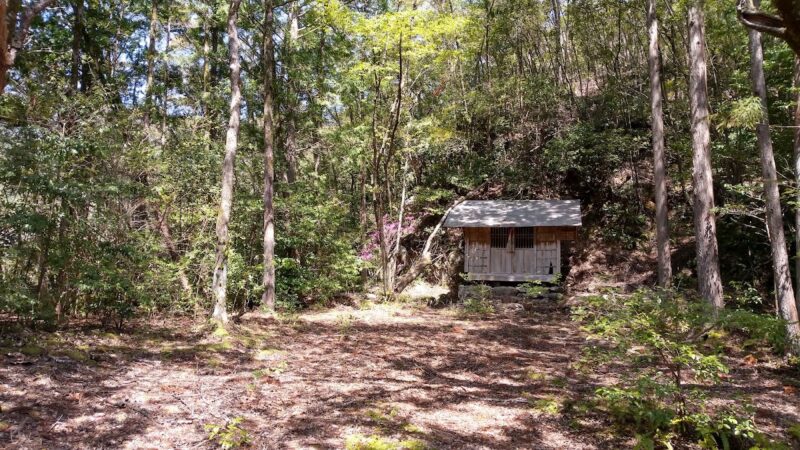
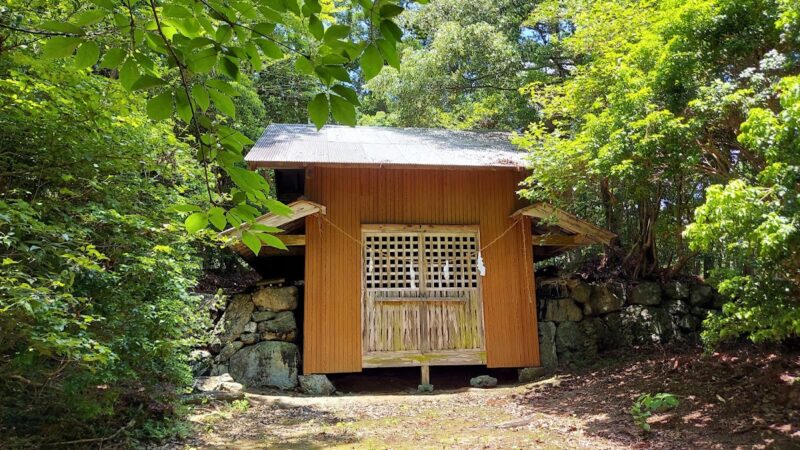
On the mountainside of Kataoka Castle lies Myofuku-ji Temple, which was the Kataoka clan’s prayer temple. Although Myofuku-ji Temple is currently uninhabited, the grave of Lord Kataoka Mitsutsuna remains on its grounds, making it a valuable historical site that conveys the history of the Kataoka clan.
Myofuku-ji Temple also served as the family temple of the Kataoka clan, witnessing their rise and fall. The tomb of Kataoka Mitsutsuna is in the form of a five-tiered pagoda, making it an important historical site for understanding the burial customs of medieval samurai.
Current Status and Access to Kataoka Castle
Current Preservation Status
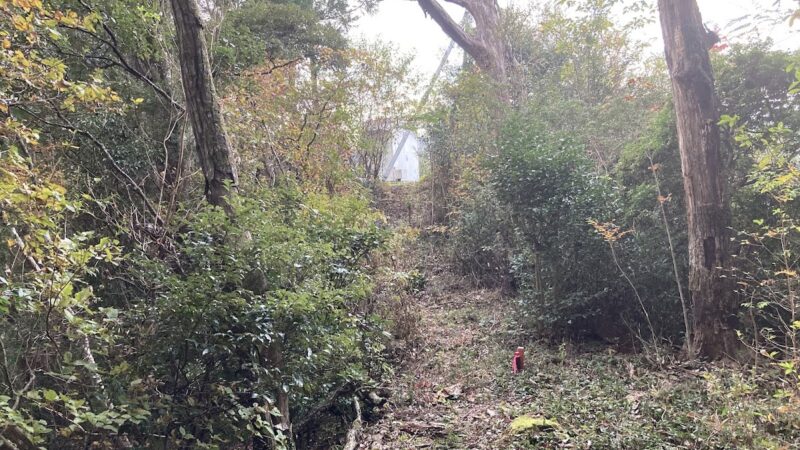
Kataoka Castle ruins are located around 1332 Kataoka, Ochi-cho, Takaoka-gun, Kochi Prefecture. Currently, most of the castle site is covered in forest, but the remains are relatively well preserved. However, it is not a well-maintained historical park, and appropriate equipment for mountain castle hiking is necessary when visiting.
Locally, the historical value of Kataoka Castle ruins is recognized, and efforts are being made to preserve the remains. However, it is not particularly well-known nationwide, and the number of visitors is currently limited.
Access Information
To access Kataoka Castle, head towards the Kataoka settlement in Ochi-cho, Takaoka-gun, Kochi Prefecture. The nearest station is Ochi Station on the JR Dosan Line, but since the castle ruins are a considerable distance from the station, visiting by private car is recommended. Parking is available near the Kataoka settlement, and the castle ruins are then a short walk away.
The path to the castle ruins is not always clearly marked, so it is recommended to check the location on a topographic map beforehand and proceed cautiously. Also, since there are animal trails and thickets in the mountains, long sleeves, long pants, and sturdy shoes are necessary.
Other Castles in Takaoka District, Kochi Prefecture
Besides Kataoka Castle, several other medieval castles exist in Takaoka District, Kochi Prefecture. These castles are important historical sites for understanding the history of Takaoka District.
Kure Castle
Kure Castle is located in Kure, Nakatosa-cho, Takaoka District, built on a mountain near the coast overlooking the Pacific Ocean. Kure flourished as a port town from the Middle Ages, and Kure Castle played a crucial role in controlling a key point for maritime traffic.
Other Castles in Takaoka District
Takaoka District also contains numerous other small mountain castles and fort ruins. These functioned as bases for local minor clans and lords, providing clues to the political and military situation in Takaoka District during the medieval period.
Comparison with Major Castles of Tosa Province
When Kataoka Castle is placed within the overall history of castles in Tosa Province, the following characteristics emerge:
Kochi Castle
Kochi Castle is a flatland castle built by Yamauchi Kazutoyo in the early modern period. It is one of Japan’s leading castles with a surviving keep, still retaining its main structure, including the keep. While different in era and scale from Kataoka Castle, it is a comparable castle in Tosa Province.
Okotoyo Castle
Okotoyo Castle is a mountain castle known as the base of the Chosokabe clan. Like Kataoka Castle, it is a medieval mountain castle, and remains such as baileys and moats still exist. The rise of the Chosokabe clan had a significant impact on the local lords of Tosa, including the Kataoka clan.
Urado Castle
Uradō Castle was the base of operations for Chosokabe Motochika and was built on a strategic location overlooking Tosa Bay. Its location, emphasizing maritime traffic, distinguishes it from the inland Kataoka Castle.
Aki Castle, Nakamura Castle, and Asakura Castle
These castles were also important strategic strongholds within Tosa, functioning as political and military centers in their respective regions. While smaller in scale compared to these castles, Kataoka Castle played a crucial role as a base for regional control in Takaoka County.
Current Status and Challenges of Kataoka Castle Research
Research on Kataoka Castle is still insufficient. Due to limited historical documents, many aspects of the Kataoka clan’s detailed history, the construction date of Kataoka Castle, and its renovation history remain unclear. The following are some of the challenges for the future:
- Conducting archaeological excavations: Revealing the details of the remains and unearthed artifacts to clarify the true nature of the castle through full-scale archaeological excavations.
- Deepening literature research: Discovering new historical materials concerning the Kataoka clan and Kataoka Castle from ancient documents and local histories.
- Refining the castle layout survey: Creating a detailed layout map using surveying techniques.
- Formulating a preservation and utilization plan: Examining strategies to balance the preservation of the remains with their utilization as a tourist resource.
Historical Significance of Kataoka Castle
Kataoka Castle is an important historical site that demonstrates the reality of regional governance in Takaoka County, Tosa Province during the medieval period. While not a nationally renowned castle, it possesses the following historical significance:
Importance in Local History
Kataoka Castle is an indispensable presence when discussing the history of Takaoka County. This provides clues to how the Kataoka clan built their power and controlled the region in Takaoka District, which was established after separating from Agawa District during the Heian period.
Contribution to Medieval Mountain Castle Research
The remains of Kataoka Castle are of research value as a typical example of a medieval mountain castle in Tosa. Various defensive structures such as baileys, stone walls, earthworks, moats, and lateral moats remain, making it a valuable sample for understanding medieval castle construction techniques.
Value as a Cultural Property
The Kataoka Castle ruins and the tomb of Kataoka Mitsutsuna at Myofuku-ji Temple together constitute a cultural property that conveys the history of the Kataoka clan. The close proximity of the castle ruins to the family temple and tomb is a rare occurrence and is important for understanding the faith and life of medieval samurai.
Summary
Kataoka Castle is a medieval mountain castle located in Ochi-cho, Takaoka District, Kochi Prefecture, and was the residence of the Kataoka clan, a powerful family that ruled Takaoka District. Built on a hill 100-150 meters above sea level, the castle retains well-preserved remains such as baileys, stone walls, earthworks, moats, and lateral trenches, preserving the characteristics of a medieval Tosa mountain castle.
The Kataoka clan originated from the Kondo clan and settled in the Kataoka area, establishing their power. During the time of Kataoka Tsuneshige, in particular, they controlled a territory spanning from Takaoka County to part of Agawa County, and were a powerful local clan within Tosa Province. The tomb of Kataoka Mitsutsuna, considered the last lord of the castle, still remains within the grounds of Myofuku-ji Temple on the hillside where the castle once stood.
While research on Kataoka Castle is still insufficient, it is a historical site of significant value for understanding the history of Takaoka County and as a resource for the study of medieval mountain castles. Further research is expected to reveal its historical value more clearly.
When visiting Kochi Prefecture, why not consider not only famous castles like Kochi Castle and Okotoyo Castle, but also mountain castles like Kataoka Castle that tell the history of the region? The spirit of the era in which the powerful clans of medieval Tosa lived still remains there.