Arai Castle (Kanagawa Prefecture): The Final Battle of Miura Dosun and the Full Story of the Conflict with Hojo Soun
Overview and Historical Significance of Arai Castle
Arai Castle (Arai-jo) is a Japanese castle located in Koajiro, Misaki-cho, Miura City, Kanagawa Prefecture. Also known as Arai Castle, Koajiro Castle, and Misaki Castle, it played an important role in the early Sengoku period as the base of the Sagami Miura clan.
Built on a cliff surrounded by the sea on three sides, this castle is a natural stronghold that skillfully utilizes the topography of a cape jutting out into Sagami Bay. The vast grounds of approximately 128 hectares, sandwiched between Koajiro Bay and Aburatsubo Bay, are a classic example of a coastal castle that makes maximum use of nature.
Arai Castle made its mark in history as the site of the final battle between Miura Dosun (Yoshitomo) and Hojo Soun in Eisho 13 (1516). This battle symbolized the beginning of the Sengoku period in Sagami Province and ended dramatically with the downfall of the prestigious Miura clan.
Location and Topographical Features of Arai Castle
A Fortress Surrounded by the Sea on Three Sides
The most distinctive feature of Arai Castle lies in its topography. Built on a cape jutting out into Sagami Bay, the castle is bordered by Koajiro Bay to the north, Aburatsubo Bay to the east, and the cliffs of Sagami Bay to the south. This topography, surrounded by the sea on three sides, provided an extremely difficult natural defense for enemy intrusion.
Land access was limited to the main drawbridge located approximately 3 kilometers to the north. Cutting down this bridge would completely isolate the castle, turning it into an isolated fortress. This topographical advantage was the main reason it was able to withstand Hojo Soun’s attacks for three years.
Utilization of Cliff and Hill Terrain
The castle was built on cliff and hill terrain, and had a three-dimensional defensive structure that utilized the difference in elevation. The steep cliffs functioned as a natural fortress, physically preventing enemy soldiers from approaching. This terrain also made the use of siege weapons difficult, making a frontal assault extremely inefficient.
History of the Sagami Miura Clan and Arai Castle
Genealogy and Power of the Miura Clan
The Miura clan was a prestigious samurai family of Sagami Province, descended from the Kanmu Taira clan. During the Kamakura period, they participated in Minamoto no Yoritomo’s uprising and held an important position as a retainer. They controlled the entire Miura Peninsula and expanded their power by controlling key points on maritime routes.
In the Sengoku period, the Miura clan allied with the Ogigayatsu Uesugi clan and became deeply involved in the political situation of the Kanto region. However, with the rise of Ise Sozui (Hojo Soun), they gradually came under pressure.
The Man Who Was Miura Dōsun Yoshiatsu
Miura Dōsun (Yoshiatsu), the last lord of Arai Castle, was a warrior who fought to ensure the survival of the Miura clan’s name. “Dōsun” was his Buddhist name; his real name was Miura Yoshiatsu.
Dōsun was known for his excellence in both military and literary arts, and is said to have been particularly knowledgeable in waka poetry. His unwavering commitment to upholding the pride of the Miura clan left a deep impression on later generations.
The Battle of Arai Castle: The Struggle Against Hōjō Sōun
The Circumstances Leading to the Battle
Around 1512 (Eishō 9), the conflict between Hōjō Sōun and Miura Dōsun intensified. Sōun aimed to unify Sagami Province and began invading the Miura clan’s territory.
Initially, the Miura clan allied with the Ōgigayatsu Uesugi clan to oppose Sōun, but they gradually found themselves at a disadvantage. With subsidiary castles such as Sumiyoshi Castle and Okazaki Castle falling one after another, Dosun decided to fortify his last stronghold, Arai Castle.
A Three-Year Siege
In 1516 (Eisho 13), Hojo Soun led a large army to besiege Arai Castle. However, Arai Castle’s geographical advantage, surrounded by the sea on three sides, was immense, and it could not be easily captured by a frontal attack.
Soun prepared for a long siege, attempting to cut off land supply lines and also attempting a blockade from the sea. Miura Dosun skillfully defended the castle with limited troops and supplies, holding out for three long years.
During this siege, food shortages became severe within the castle, and a decline in morale was unavoidable. Nevertheless, Dosun refused to surrender and maintained his fighting spirit to the very end.
The Fall of the Castle in Eisho 13
On July 11, Eisho 13 (1516), Arai Castle finally fell. While there are various theories, it is believed that betrayal by an insider and the depletion of forces due to a prolonged siege were decisive factors.
Miura Dosun and his eldest son, Miura Yoshioki, were killed in battle, marking the end of the Sagami Miura clan. Dosun’s death poem, “Both the killer and the killed, together like dew and lightning, should be viewed in this way,” is said to reflect his tragic resolve.
After this battle, there is a legend that the name “Aburatsubo” (oil pot) originated from the fact that Aburatsubo Bay was stained red with the blood of the fallen soldiers, resembling spilled oil.
Hojo Soun’s Strategy
Hojo Soun (Ise Sozui) skillfully employed a war of attrition and siege tactics in this battle. Against Arai Castle, which was difficult to attack directly, a strategy was adopted to exhaust the castle’s defenders by cutting off supply lines and blockading them at sea.
This fighting style of Soun had a significant influence on the tactics of the later Hojo clan. His emphasis on strategic encirclement and stratagem over direct assault became a crucial element in the Hojo clan’s expansion of power in the Kanto region.
Layout and Structure of Arai Castle
Scale and Arrangement of the Castle
Arai Castle was a large-scale castle boasting a vast area of approximately 128 hectares. This size indicates that it functioned not merely as a military base, but as the center of the Miura clan’s territorial control.
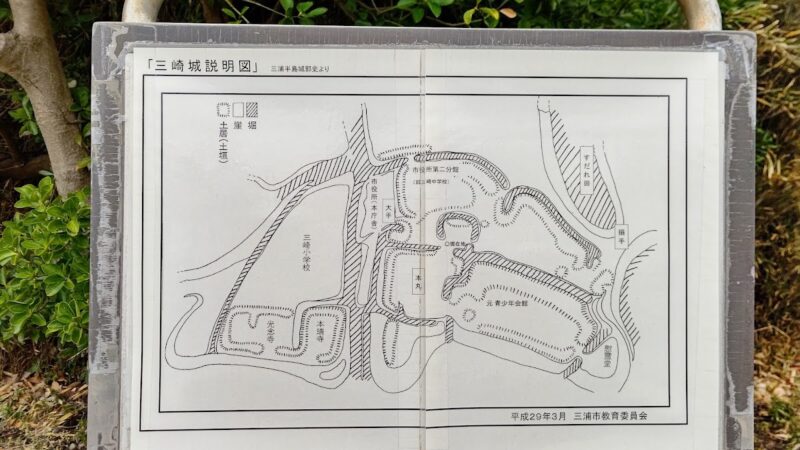
The main enclosure was located in the center of the castle, surrounded by multiple baileys. Each bailey was demarcated by moats and earthworks, forming a tiered defensive line.
Characteristics of Defensive Facilities
The defensive facilities of Arai Castle made maximum use of the terrain. The main defensive elements include the following:
Earthworks: Earthworks were built throughout the castle to prevent enemy intrusion and also functioned as firing positions for arrows and firearms. Some earthworks still remain today, allowing us to imagine the scale of the castle at the time.
Moats: Moats, built to cut across ridges, were important defensive structures to hinder enemy advances. Multiple moats were arranged in succession, forming a multi-layered defensive structure.
Dry Moats: Dry moats, which did not hold water, were also built in various locations and functioned as obstacles to restrict the movement of enemy soldiers.
Drawbridge: A drawbridge located at the main gate on the north side could be cut down in emergencies to completely isolate the castle.
Function as a Coastal Castle
Arai Castle, as a typical coastal castle, had a structure that emphasized coordination with maritime traffic. Koajiro Bay and Aburatsubo Bay functioned as natural harbors and were used for transporting supplies and as escape routes by sea. Furthermore, the castle’s layout was designed with defenses against attacks from the sea in mind, allowing for retaliation with bows and arrows and thrown stones from the cliffs.
Remains and Current State of Arai Castle
Existing Remains
Currently, most of the Arai Castle site is occupied by the former Keikyu Aburatsubo Marine Park, the University of Tokyo Marine Biological Station, and residential areas, with only limited sections retaining their original form. However, with careful observation, the following remains can be identified:
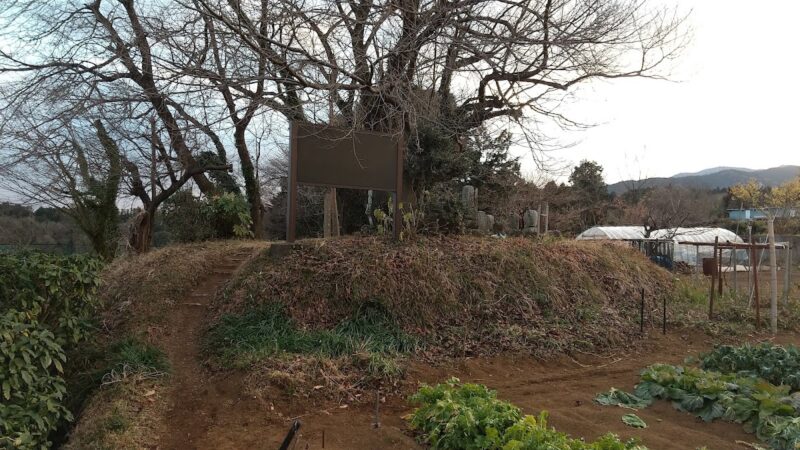
Traces of Earthworks: Traces of earthworks remain in various parts of the castle site, particularly around the University of Tokyo Marine Biological Station, where they are preserved in relatively good condition. The earthworks, reaching several meters in height, attest to the scale of the defensive facilities at the time.
Moats and Dry Moats: Moats that crossed the ridge and parts of dry moats that demarcated the baileys still exist. While some parts are covered in vegetation, they are clearly identifiable as part of the topographical undulations.
Topography of the Enclosures: Multiple flat areas of the enclosures remain as part of the topography, providing clues to the castle’s layout. Traces of elevation changes and cliffs allow for the deciphering of the original fortifications.
Historical Sites Around Aburatsubo Bay
Several historical sites related to Arai Castle remain around Aburatsubo Bay.
Grave of Miura Dosun: A stone pagoda believed to be the grave of Miura Dosun stands at a nearby temple and is carefully preserved by local residents.
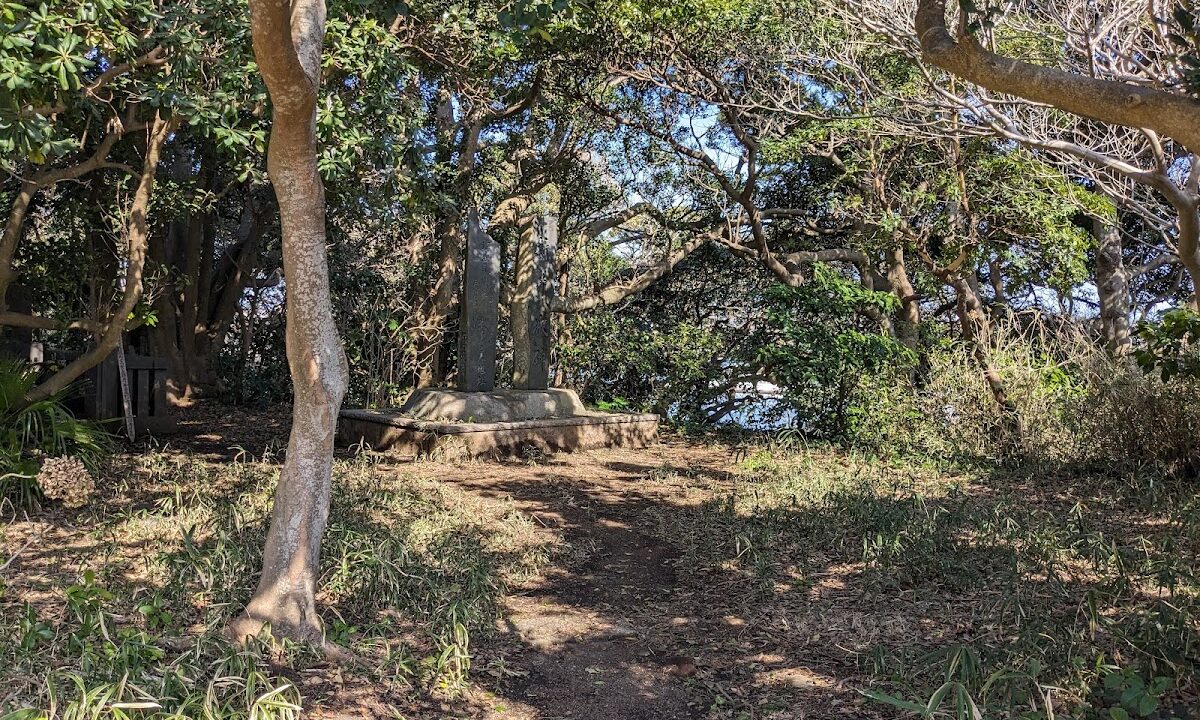
Stone Monument at Arai Castle Site: A stone monument inscribed with “Arai Castle Site” stands at the castle ruins, indicating that this area was a historical battlefield.
Information Boards: Several tourist information boards installed by Miura City provide detailed explanations of the history of Arai Castle and the Miura clan.
Preservation Status and Challenges
Because the Arai Castle ruins are not designated as a national or prefectural historical site, organized preservation activities are limited. Due to development, much of the castle has been lost, making it difficult to grasp its complete form.
On the other hand, research activities by local history enthusiasts and castle researchers continue, leading to the discovery of new remains and the elucidation of historical facts. Miura City is also considering utilizing it as a tourist resource, and balancing preservation and utilization remains a challenge.
Access and Visiting Information for Arai Castle
Transportation Access
Access by Train:
- Get off at Misakiguchi Station on the Keikyu Line
- Approximately 15 minutes by bus from the station to the Aburatsubo bus stop
- Approximately 5 minutes on foot from the bus stop to the castle ruins
Access by Car:
- Approximately 25 minutes from Kinugasa IC on the Yokohama-Yokosuka Expressway
- Use nearby paid parking lots (around the former Aburatsubo Marine Park site)
Visiting Points
When visiting the Arai Castle ruins, keeping the following points in mind will allow for an efficient visit.
Around the University of Tokyo Marine Biological Station: Although this facility is not open to the public, you can observe parts of the earthworks and moats from the outer perimeter. Caution is required to avoid entering restricted areas.
View of Aburatsubo Bay: From the hilltop overlooking the bay, you can appreciate the geographical advantage of Arai Castle, surrounded by the sea on three sides. The sheer cliffs are also visible, illustrating the difficulty of attacking the castle.
Towards Koajiro Bay: From the north, towards Koajiro Bay, you can also view the castle ruins and infer the location of the presumed main bridge.
Precautions for Visitors
- Many of the castle ruins are located on private land or within the grounds of research facilities; absolutely do not enter restricted areas.
- Some of the remains are covered in bushes; insect repellent is essential during the summer.
- The area near the cliffs is dangerous; please act with safety in mind.
- Please observe proper etiquette and avoid damaging the historical remains.
Related Historical Sites in the Surrounding Area
When visiting Arai Castle, visiting the surrounding historical sites related to the Miura clan will allow you to understand the history more deeply.
Kinugasa Castle Ruins: The early base of the Miura clan and a major castle before Arai Castle.
Grave of Miura Yoshiaki: The grave of Miura Yoshiaki, considered the ancestor of the Miura clan, where you can reflect on the family’s history.
Kainan Shrine: A shrine associated with the Miura clan and a center of local history and culture.
Historical Evaluation and Significance of Arai Castle
Place in the History of the Sengoku Period
The Battle of Arai Castle symbolized the beginning of the Sengoku period in the Kanto region. Through this battle, Hojo Soun achieved the unification of Sagami Province, laying the foundation for the Hojo clan’s five generations and 100 years of rule over Kanto.
On the other hand, the downfall of the Miura clan, a prestigious family since the Kamakura period, marked a turning point in the era where traditional samurai groups were being eliminated by Sengoku daimyo. It served as an example of the harsh reality that in the meritocratic Sengoku period, family status and tradition alone were not enough to survive.
Significance in the History of Castles
Arai Castle occupies an important position in the history of castles as a typical example of a coastal castle. Its defensive structure, utilizing the terrain surrounded by the sea on three sides, demonstrates the characteristics of castle construction techniques during the transition period from the medieval to the Sengoku period.
Furthermore, the castle’s structure, which withstood a prolonged siege of three years, indicates that it was not merely a military facility, but a comprehensive defensive stronghold capable of accommodating a certain population and sustaining its life.
Importance in Local History
In the history of the Miura Peninsula, the existence of Arai Castle and the Miura clan is extremely important. From the Kamakura period to the Sengoku period, the Miura clan was the political, economic, and cultural center of this region.
Although the Miura clan perished with the fall of Arai Castle, some of their retainers scattered throughout the region, playing active roles in various areas. The cultural legacy of the Miura clan remains in various parts of the Miura Peninsula today, forming part of the region’s identity.
Miura Dosun and His Death Poem
The death poem attributed to Miura Dosun, “Those who kill and those who are killed, together like dew and lightning, should be contemplated in this way,” has profound content expressing a Buddhist view of impermanence. This poem, meaning “Both the killer and the killed are as fleeting as dew or lightning, and this is how we should view them,” is based on a passage from the Diamond Sutra. It is a famous verse that reveals the character of Dōsun, who maintained his education and spirituality until his final moments, and has been passed down through generations.
Legends and Anecdotes Surrounding Arai Castle
Origin of the Place Name Aburatsubo
As mentioned above, there is a legend that the place name Aburatsubo originates from the fact that when Arai Castle fell, Aburatsubo Bay was stained with the blood of the fallen soldiers, resembling spilled oil. While this legend cannot be confirmed as historical fact, it is passed down as a local memory that tells of the brutality of the battle.
Legends of the Remnants of the Miura Clan
After the fall of Arai Castle, the remnants of the Miura clan are said to have fled to various places, and many legends remain. There are records that some went to Awa Province (present-day southern Chiba Prefecture) and served the Satomi clan. It is also said that many people concealed their Miura surname and returned to farming in various regions.
Ghost Legends
Around the ruins of Arai Castle, there are legends of the spirits of Miura Dosun and the samurai who died in battle. In particular, there is a legend that the spirits of warriors appear around July 11th, the day the castle fell, and this has been passed down as a local ghost story.
Arai Castle and Tourism on the Miura Peninsula
The ruins of Arai Castle are an important point on the historical sightseeing route of the Miura Peninsula. Surrounded by a beautiful coastline and abundant nature, this area is an attractive place where you can enjoy historical exploration and nature walks simultaneously.
The area around Aburatsubo is also known as a scenic spot, where you can enjoy the view of Sagami Bay while reflecting on history. There are also many restaurants where you can enjoy fresh seafood, making it possible to spend a fulfilling day combining sightseeing and historical learning.
Summary: What Arai Castle Tells Us Today
Arai Castle is a valuable historical site that conveys the lives of people who lived through the turbulent Sengoku period. The unwavering pride of Miura Dosun until his last stand, Hojo Soun’s strategic battle tactics, and the dramatic downfall of a prestigious family—these historical events continue to speak to us even today, more than 500 years later.
The strategically important terrain, surrounded by the sea on three sides, the castle’s structure that withstood a three-year siege, and the numerous remaining structures are invaluable evidence of the castle-building techniques and strategic thinking of the time. While much has been lost due to development, the remaining structures allow us to touch upon a part of history.
Visiting the Arai Castle ruins is more than just sightseeing; it’s an opportunity to experience Japanese history and learn from the lives of our ancestors. Nestled amidst the beautiful nature of the Miura Peninsula, the Arai Castle ruins will continue to convey the weight and lessons of history to many people for generations to come.