Amagiri Castle (Kagawa Prefecture) Complete Guide: The Spirit of the Sengoku Period as Seen from the Fortress of the Sanuki Kagawa Clan
What is Amagiri Castle?
Amagiri Castle is a medieval mountain castle built on Mt. Amagiri, 382 meters above sea level, straddling the borders of three cities and towns in Kagawa Prefecture: Yoshihara-cho in Zentsuji City, Mino-cho in Mitoyo City, and Tadotsu-cho in Nakatado District. Also known as Amagiri Castle or Amagiri Castle, it was designated a National Historic Site in 1990.
As a representative mountain castle of Sanuki Province, it functioned as a fortified stronghold (a base in times of emergency) for successive generations of the Sanuki Kagawa clan from the Nanboku-cho period to the Sengoku period. While their residence was located at the eastern foot of Hondaiyama Castle in Tadotsu-cho during peacetime, they would fortify Amagiri Castle during wartime.
Mount Amagiri is a natural stronghold with many unusual rock formations and cliffs, and its castle structure is characterized by its ability to make the most of the terrain. Located in a strategic position overlooking the Nakatado Plain, it played an important role as a military base in western Sanuki Province.
History of Amagiri Castle
Establishment of the Kagawa Clan and Construction of the Castle
The Kagawa clan traces its ancestry to Kamakura Gongoro Kagemasa and originated in Kagawa, Sagami Province (present-day Kanagawa Prefecture), where they adopted the name Kagawa. The Kagawa clan of Sanuki became vassals of the Hosokawa clan during the Nanboku-cho period and became an important pillar of the Hosokawa clan in Sanuki Province.
The construction of Amagiri Castle is said to have taken place during the Jōji era (1362-1368) and was built by Kagawa Kagenori. In 1367 (Tenpyo 17), when he fought and defeated Hosokawa Kiyouji, a Southern Court supporter in Sakaide, under the command of Hosokawa Yoriyuki (the Battle of Shiramine), he was granted the three districts of Mino, Toyoda, and Tado in Sanuki Province as his territory for his military achievements. It is said that at this time, he established a residence on Mount Hondai in Tadotsu and built a fortified castle on Mount Amagiri.
Kagawa Kagenori is known as one of the Four Heavenly Kings of the Hosokawa clan, the shugo (military governor) of Sanuki Province, and played an important role in supporting the Hosokawa clan’s rule in western Sanuki.
Battles during the Sengoku Period
During the Sengoku period, Amagiri Castle became the stage for fierce battles. Even after the fall of the Hosokawa clan, the castle lord, Kagawa Yukikage, refused to submit to the Miyoshi clan and sought to maintain his own independent power.
In 1562 (Eiroku 5), the Miyoshi army, led by Miyoshi Jikkyu, attacked Amagiri Castle, but Kagawa Yukikage repelled them. This battle, known as the Battle of Zentsuji, demonstrated the formidable strength of Amagiri Castle. However, afterward, Kagawa Yukikage made peace with the Miyoshi clan, achieving temporary peace.
Relationship with Oda Nobunaga and Name Change
During the Tensho era, Kagawa Yukikage received a character from Oda Nobunaga’s name (henki: being given one character from one’s name), and began to call himself Kagawa Nobukage. This is an important historical fact that shows that Oda Nobunaga’s influence extended even to Shikoku.
Relationship with the Chosokabe Clan
In the latter half of the Tensho era, Chosokabe Motochika of Tosa invaded Sanuki Province with the aim of unifying Shikoku. Kagawa Nobukage adopted Chikakazu (also known as Chikamasa), the second son of Chōsokabe Motochika, and became an ally of the Chōsokabe army.
From then on, Kagawa Nobukage and his son Chikakazu played an important role in the Chōsokabe army’s conquest of Sanuki Province. Amagiri Castle functioned not only as a base for the invasion of Sanuki Province but also for the invasion of Iyo Province, becoming an important castle for controlling the local lords of Sanuki and Tōyo.
The End of Amagiri Castle
With Toyotomi Hideyoshi’s conquest of Shikoku, the Chōsokabe clan was reduced to Tosa Province, and Sanuki Province became a direct territory of the Toyotomi regime. It is believed that Amagiri Castle was abandoned around this time, ending its historical role with the end of the Sengoku period.
Structure and Remains of Amagiri Castle
Characteristics of the Castle Layout
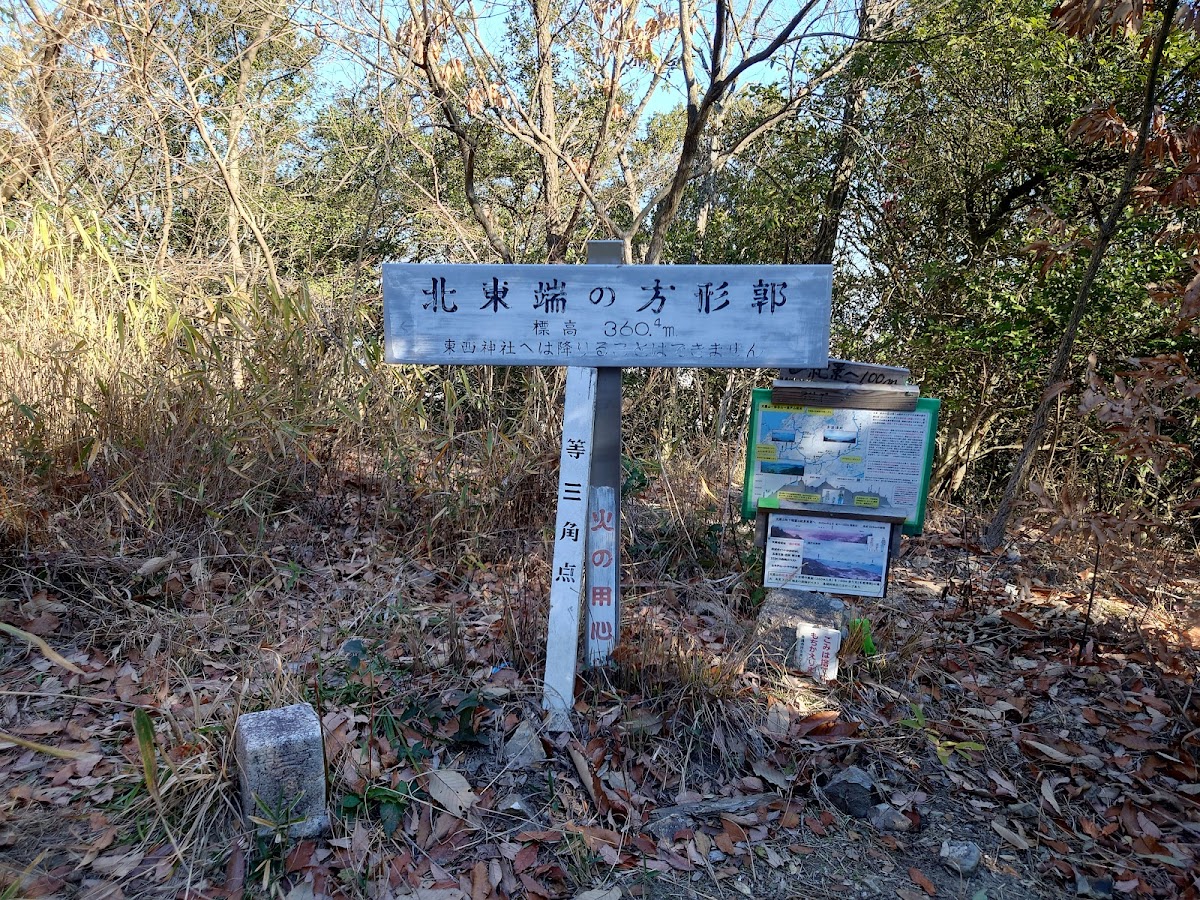
Amagiri Castle is a mountain castle with a main enclosure (honmaru) located on the summit of Mt. Amagiri at an altitude of 382 meters. Multiple enclosures (kuruwa: flat sections) extend northward, creating a stepped-type layout. The relative height from Kagawa Prefectural Road 205 at the northern foot of the mountain is approximately 375 meters, making it a formidable castle with a significant elevation difference.
The castle’s structure is so complex that it’s described as “a mountain castle on top of another mountain castle,” with enclosures continuously traversing a long ridge with repeated ups and downs. This structure was designed to prevent enemy incursions in stages.
Major Remains
The following remains still exist at Amagiri Castle:
Horikiri (Mountain Moat): A defensive structure dug to cut across the ridge, playing a crucial role in hindering enemy advances. Multiple horikiri have been identified at Amagiri Castle, enhancing the castle’s defensive capabilities.
Well Remains: A well was also constructed at the mountaintop, ensuring a water supply in preparation for a siege. Securing water was crucial for a mountain castle, and the wells at Amagiri Castle were important facilities supporting the castle’s endurance.
Enclosure Groups: Multiple enclosures are arranged around the main enclosure. Each enclosure functioned as a space for defense and residence, distributing the castle’s functions to enhance its defensive capabilities.
Traces of Stone Walls: Traces of stone walls remain in some areas, indicating that relatively advanced construction techniques were used for a medieval mountain castle.
Earthworks: Earthworks surrounded the enclosures, serving as defensive structures.
Topography as a Natural Fortress
Amagiri Mountain is a natural fortress surrounded by strangely shaped rocks and sheer cliffs. The combination of artificial defensive structures and natural terrain formed an impregnable castle. The steep cliffs on the south and west sides, in particular, made it extremely difficult for attackers.
Access
Access by Car
From Takamatsu Expressway Zentsuji IC: Approximately 10 minutes to the trailhead.
Parking: You can use the parking lot at Iyadaniji Temple. Iyadaniji Temple is located on the rear entrance (karamete) side of Amagiri Castle, and this is the most common route to climb the castle.
Access by Public Transportation
From JR Dosan Line Zentsuji Station: Approximately 15 minutes by taxi, or take a local bus towards Iyadaniji Temple.
From JR Yosan Line Tadotsu Station: Approximately 20 minutes by taxi.
Climbing Route
Iyadaniji Temple Route (Recommended): This is the most common route, starting from Iyadaniji Temple. However, considering the location, this is a climb from the rear entrance side. The hiking trail is well-maintained, but it takes approximately 1 to 1.5 hours to reach the summit.
Northern Foothills Route: There is also a route from Kagawa Prefectural Road 205, but this is steeper and more suitable for advanced hikers.
Precautions When Climbing the Castle
- The hiking trail is well-maintained, but due to the steep slopes characteristic of mountain castles, non-slip footwear such as hiking boots is essential.
- Insect repellent is necessary in summer, and warm clothing is necessary in winter.
- Bring plenty of drinking water for hydration.
- Allow approximately 2.5 to 3 hours for the round trip.
- A map of the hiking trail can be obtained from the Zentsuji City Board of Education, Lifelong Learning Division (it is recommended to inquire in advance).
Visiting Information
Visiting Hours and Fees
Visiting the Amagiri Castle Ruins is free of charge. However, as it is a mountain castle, visiting during daylight hours (from sunrise to sunset) is recommended. Especially from autumn to winter, sunset is early, so please allow ample time for your visit.
Best Season
Spring (March-May): Beautiful fresh greenery and mild weather, ideal for visiting the castle.
Autumn (October-November): Beautiful autumn foliage and ideal temperatures for hiking. The view of the Nakatado Plain is also superb during this season.
Summer (June-September): Due to the heat and numerous insects, early morning visits are recommended.
Winter (December-February): The air is clear and the views are excellent, but warm clothing is necessary.
Castle Notes (Highlights)
View from the Main Enclosure: From the 382-meter-high summit, you can enjoy a panoramic view of the Nakatado Plain, including Sanuki Fuji (Mt. Iino) and the Seto Inland Sea. This is a spectacular viewpoint where you can truly understand why the Kagawa clan chose this location.
Continuous Moats: Multiple moats run continuously along the ridge, providing a concrete understanding of the defensive system of a medieval mountain castle.
Well Site: The well site at the mountaintop is a valuable historical relic illustrating the importance of securing water for mountain castles.
Relationship with Iyadani-ji Temple: Located on the rear gate side, Iyadani-ji Temple is an ancient temple associated with Kukai. Visiting it along with Amagiri Castle allows you to appreciate the layered history of this region.
Stone Structures: Medieval stone structures remain along the hiking trail, offering a glimpse into the relationship between religious beliefs and castle fortifications of the time.
Nearby Tourist Attractions
Iyadani-ji Temple
The 71st temple of the Shikoku 88 Temple Pilgrimage, this ancient temple is said to be where Kukai (Kobo Daishi) trained in his childhood. Located on the rear gate side of Amagiri Castle, the rock-carved Buddha and stone steps are magnificent. Visiting it together with Amagiri Castle is highly recommended.
Zentsu-ji Temple
Built on the birthplace of Kukai, this is the 75th temple of the Shikoku 88 Temple Pilgrimage. Along with Kongobu-ji Temple on Mount Koya and To-ji Temple in Kyoto, it is one of the three major sacred sites associated with Kobo Daishi. It is approximately a 15-minute drive from Amagiri Castle.
Kotohira-gu Shrine (Konpira-san)
Affectionately known as “Konpira-san,” this is the Ichinomiya (first-ranked shrine) of Sanuki Province, attracting many worshippers from all over Japan. It is approximately a 20-minute drive from Amagiri Castle.
Marugame Castle
One of the twelve remaining original castle keeps, this famous castle is known for the beauty of its stone walls. Like Amagiri Castle, it is an interesting castle to visit and compare with other castles in Sanuki Province.
Motodaiyama Castle Ruins
This was the site of the Kagawa clan’s peacetime residence, functioning as a flatland castle in opposition to Amagiri Castle’s fortifications. Located in Tadotsu Town, it is an important historical site for understanding the history of Amagiri Castle.
Cultural Value of Amagiri Castle
Designation as a National Historic Site
Amagiri Castle ruins were designated a National Historic Site in 1990 (Heisei 2). This signifies the high historical and academic value of this representative medieval mountain castle in Shikoku.
Heritage Site Conveying the History of Sanuki Province
Amagiri Castle is a valuable heritage site that concretely conveys the history of Sanuki Province from the Nanboku-cho period to the Sengoku period. It is an indispensable historical site for understanding the relationships with Sengoku daimyo such as the Hosokawa, Miyoshi, and Chosokabe clans, as well as the activities of the local powerful Kagawa clan.
Important Resource for Medieval Mountain Castle Research
The layout and remains of Amagiri Castle are important resources for studying the construction techniques and defensive systems of medieval mountain castles. In particular, the arrangement of moats and baileys concretely demonstrates the castle-building philosophy of the time.
How to Enjoy Your Visit to Amagiri Castle
Experiencing Historical Romance
The greatest appeal of visiting Amagiri Castle is being able to feel the atmosphere of a mountain castle that was defended for generations by the Kagawa clan of Sanuki Province. You can reflect on the tense situation of the Sengoku period, such as the courage of Kagawa Yukikage, who repelled the large army of Miyoshi Saneyasu at the Battle of Zentsuji, and the decision of Kagawa Nobukage, who chose to ally with Chosokabe Motochika.
Enjoying the Mountain Climb
You can also enjoy a proper mountain climb, with an elevation of 382 meters and a relative height of approximately 375 meters. It provides a moderate amount of exercise and a sense of accomplishment. The view from the summit will make you forget the fatigue of the climb.
Photography Tips
There are many photogenic spots, such as the view overlooking the Nakatado Plain, the continuous moats, the strangely shaped rocks, and the cliffs. The autumn foliage season and the views on clear days are especially excellent photo opportunities.
Combined Visit with Yatani-ji Temple
Yatani-ji Temple is also the starting point for climbing Amagiri Castle and possesses a unique charm as a sacred site associated with Kukai. The opportunity to enjoy two different historical sites—a castle and a temple—at once is a major attraction of visiting Amagiri Castle.
Summary
Amagiri Castle (Kagawa Prefecture) is a strategically important mountain castle located in western Sanuki Province, defended by the Sanuki Kagawa clan from the Nanboku-cho period to the Sengoku period. Built on Mount Amagiri at an altitude of 382 meters, this terraced mountain castle is a masterpiece of medieval castle architecture that makes maximum use of the natural terrain, and was designated a national historic site in 1990.
Starting with its construction by Kagawa Kagenori, one of the four generals of the Hosokawa clan, it played an important role as a castle symbolizing the history of Sanuki Province during the Sengoku period, from the Battle of Zentsu-ji where it repelled the attack of Miyoshi Jikkyu, to the era of Kagawa Nobukage, who received a character from Oda Nobunaga’s name, and finally to the alliance with Chosokabe Motochika.
The remaining structures, such as moats, well remains, and baileys, convey the castle’s construction techniques and defensive systems of the time. From the mountaintop, reachable in about 1 to 1.5 hours of hiking from Yatani-ji Temple, a breathtaking panoramic view of the Nakatado Plain unfolds, allowing visitors to truly appreciate why the Kagawa clan protected this land for generations.
For history enthusiasts, Amagiri Castle is an important historical site for understanding Sanuki Province during the Sengoku period; for hiking enthusiasts, it offers a moderate workout and stunning views; and for tourists, it’s an attractive spot that can be combined with nearby attractions such as Yatani-ji Temple and Zentsu-ji Temple.
Why not visit Amagiri Castle and experience the history, culture, and romance of the Sengoku period of Sanuki Province?