Maruyama Castle (Mannō-cho, Nakatado-gun, Kagawa Prefecture): History and Highlights | A Thorough Explanation of Mountain Castle Remains in Sanuki Province
What is Maruyama Castle?
Maruyama Castle is a medieval mountain castle located in Kaita, Mannō-cho, Nakatado-gun, Kagawa Prefecture. Built on the summit of a hill 132m above sea level, this castle functioned as an important base in western Sanuki Province during the Sengoku period. It is known as a valuable historical site that strongly retains the characteristics of medieval castles, with its layout of baileys centered around the main enclosure, clearly defined moats, and the remains of a rare umadashi (horse enclosure) in Kagawa Prefecture.
As the place name Maruyama (meaning “round mountain”) suggests, it is characterized by a layout that skillfully utilizes the rounded hilly terrain, and defensive facilities that take advantage of the location with a relative height difference of approximately 44m can be seen throughout. Even today, the remains of baileys and moats are well-preserved, and it occupies an important position in the study of medieval castles in Sanuki Province.
Basic Information about Maruyama Castle
Common Name/Alternate Name
Maruyama Castle does not have a specific alternative name, but it is sometimes called “Kaita no Shiroyama” (Castle Mountain of Kaita) locally. Historical documents and literature simply refer to it as “Maruyama Castle.”
Location
Kaita, Mannō-cho, Nakatado-gun, Kagawa Prefecture
Maruyama Castle is located southeast of the center of Mannō-cho, built on a hill in the Kaita area. Nakatado-gun belongs to the central Sanuki region of Kagawa Prefecture, extending from the southern part of the Sanuki Plain to the northern foothills of the Sanuki Mountains. The Doki River flows nearby, and the area has long been an important transportation hub.
Former Provincial Name
Sanuki Province
The area where Maruyama Castle is located belonged to Sanuki Province from ancient times to the Middle Ages. Sanuki Province, encompassing the entirety of present-day Kagawa Prefecture, was a prosperous region with a mild climate and plains facing the Seto Inland Sea. During the Sengoku period (Warring States period), various powers such as the Hosokawa, Miyoshi, and Chosokabe clans vied for power, leading to the construction of numerous castles.
Classification and Structure
Hill Castle (Mountain Castle), Concentric Enclosure Style
Maruyama Castle is classified as a hill castle, built on a hill 132m above sea level with a relative height difference of approximately 44m. It features a concentric enclosure layout with baileys arranged to the east and west of the main enclosure, skillfully utilizing the natural terrain. The main enclosure measures approximately 50m x 15m and has a long, narrow shape.
A clear cliff is provided on the east side, and a belt-shaped bailey surrounds the main enclosure. Moats are provided along the ridges on the west and south sides, demonstrating various measures taken to prevent enemy intrusion. A particularly notable feature is the earthen bridge spanning the southern moat, with a barbican beyond it.
Castle Tower Structure
None
Maruyama Castle is a medieval mountain castle and lacked a castle tower like those found in early modern castles. Sengoku period mountain castles were primarily defensive structures, prioritizing military function over habitability. It is presumed that the main enclosure contained simple turrets or watchtowers, but details are unknown.
Builder
Iio Tarokubei Kunimori
Maruyama Castle is believed to have been built by Iio Tarokubei Kunimori. The Iio clan was a family of local lords active in western Sanuki Province, holding power in this region during the Sengoku period. However, historical records concerning the Iio clan are limited, and many aspects of their detailed lineage and activities remain unclear.
Year of Construction
Sengoku Period (Late 15th-16th Century)
The exact year of construction of Maruyama Castle is unknown, but based on the structure of the castle and the characteristics of the remains, it is estimated to have been built during the Sengoku period, from the late 15th to the 16th century. During this period, the power of the Hosokawa clan declined in Sanuki Province, and the invasions of the Miyoshi and Chosokabe clans intensified, leading to the construction of numerous defensive mountain castles throughout the region.
Main Renovator
Unknown
There are no specific records regarding renovations of Maruyama Castle. While it is possible that small-scale renovations were carried out throughout the Sengoku period in response to changes in the castle lord and surrounding circumstances, no evidence of large-scale reconstruction has been found.
Main Castle Lord
Iio Tairokubei Kunimori
According to tradition, Iio Tairokubei Kunimori was the lord of Maruyama Castle. The Iio clan is thought to have been a powerful local lord, controlling the surrounding territories. However, historical records are scarce regarding the specific period of residence and activities, so the details remain unclear.
During the Sengoku period, the Kagawa clan, vassals of the Hosokawa clan, held significant power in western Sanuki Province, and it is presumed that Maruyama Castle functioned within this sphere of influence.
Year of Abandonment
Estimated to be around the Tensho era (1573-1592)
The exact date of Maruyama Castle’s abandonment is unclear, but it is highly likely that it was abandoned after the Chosokabe clan’s invasion of Sanuki during the Tensho era, or after Toyotomi Hideyoshi’s conquest of Shikoku. After the conquest of Shikoku in 1585, the Toyotomi regime promoted the reorganization and consolidation of castles, resulting in the abandonment of many medieval mountain castles.
Remains
Enclosures, moats, cliffs, outer enclosures, earthen bridges, and outworks
The following remains are well-preserved at Maruyama Castle:
- Main Enclosure: A long, narrow, flat area approximately 50m x 15m. Location of the castle’s central facilities
- Obi-kuruma: A defensive enclosure surrounding the eastern side of the main enclosure
- Kiri-gishi: A clearly visible artificial steep slope on the eastern side of the main enclosure
- Horikiri: A defensive structure cutting off the ridges on the western and southern sides of the main enclosure
- Dohbashi: A passageway built over the southern horikiri
- Umadashi: A defensive entrance structure located at the end of the southern dohbashi. A rare structure in Kagawa Prefecture.
These remains demonstrate the typical structure of a mountain castle from the Sengoku period, as well as the incorporation of advanced defensive techniques such as umadashi.
Designated Cultural Property
Not Designated
Currently, Maruyama Castle has not received cultural property designation from the national, prefectural, or town governments. However, its academic value is highly regarded due to its well-preserved remains and the presence of umadashi, which is rare in Kagawa Prefecture. Further research and investigation may lead to cultural property designation.
Reconstructed Structures
None
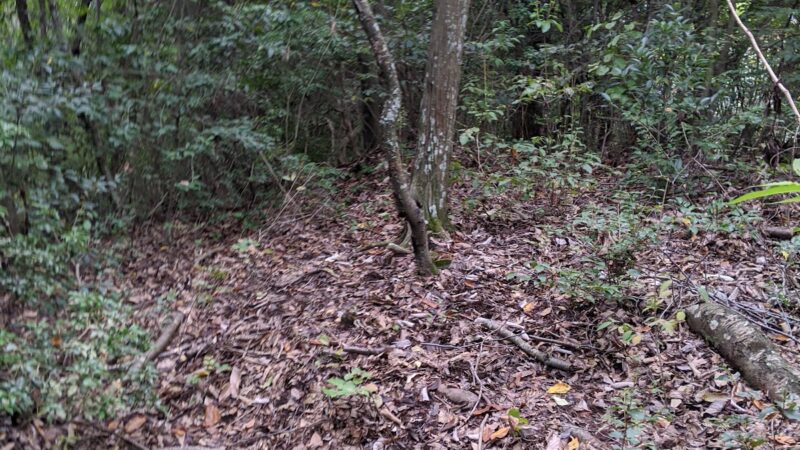
Maruyama Castle has not undergone any reconstruction or restoration of its structures. Currently, the site is a forest, and the remains are preserved in their natural state. Visitors can stroll around while imagining the topography and the layout of the defensive structures in their heyday.
History and Explanation of Maruyama Castle
Situation in Sanuki Province during the Sengoku Period
Sanuki Province, where Maruyama Castle was built during the Sengoku period, was in a complex political situation. During the Muromachi period, Sanuki Province was under the control of the Hosokawa Keichō family, with the Kagawa clan governing the western Sanuki region and the Yasutomi clan governing the eastern Sanuki region as shugodai (deputy governors). However, with the arrival of the Sengoku period, the power of the Hosokawa clan declined, and the Miyoshi clan, based in Awa Province, advanced into Sanuki.
In the latter half of the 16th century, Chōsokabe Motochika of Tosa Province began his northward advance with the aim of unifying Shikoku, and Sanuki Province was also drawn into the turmoil of war. In this situation, local lords built mountain castles in various locations to strengthen their defenses and protect their territories. Maruyama Castle is one of the castles built within this historical context.
The Iio Clan and Maruyama Castle
Iio Tairokubei Kunimori, believed to be the lord of Maruyama Castle, was a local lord who controlled the area around Mannō Town. While the detailed lineage of the Iio clan is unknown, it is highly likely that they were subordinates of or allied with the Kagawa clan, a powerful local lord in western Sanuki Province.
During the Sengoku period, local lords maintained their own independent control over their regions while being subordinate to higher powers. It is presumed that the Iio clan controlled surrounding villages, collected taxes from farmers, and had the authority to mobilize troops during wartime. Maruyama Castle served as both a base of this control and a defensive structure in times of emergency.
Castle Structure and Features
The most distinctive feature of Maruyama Castle is its presence of a umadashi (horse enclosure), which is rare in Kagawa Prefecture. The umadashi (horse enclosure) is a small enclosure built in front of the castle gate. It served as a gathering place for troops before attacking and as a defensive structure to prevent direct attacks on the gate. This technique developed in the late Sengoku period and provides an important clue to the construction or renovation period of Maruyama Castle.
The main enclosure is long and narrow, measuring approximately 50m x 15m, and extends long in the east-west direction. This shape makes maximum use of the ridge terrain, demonstrating ingenuity in efficiently utilizing the limited flat land. A clear cliff is built on the east side of the main enclosure, with a belt enclosure surrounding it. This belt enclosure served to prevent attacks on the main enclosure and also functioned as a space for deploying defensive forces.
Moats are constructed along the ridges on the west and south sides. Moats are defensive structures that prevent enemy entry by cutting off the ridge, and in Maruyama Castle, they are effectively placed in combination with the natural terrain. A dirt bridge spans the southern moat, and a umadashi is located beyond this bridge.
The Chosokabe Clan’s Invasion of Sanuki and Maruyama Castle
During the Tensho era, Chosokabe Motochika of Tosa Province intensified his invasion of Sanuki Province with the aim of unifying Shikoku. In 1579 (Tensho 7), a fierce battle took place between the Chosokabe army and the Sanuki forces at Zoda Castle, located north of Mannō Town, resulting in the death of Zoda Bichu-no-kami, the lord of Zoda Castle.
While it is unclear whether Maruyama Castle was directly involved in this battle, its geographical proximity undoubtedly indicates that it was affected by the Chosokabe invasion. In 1585 (Tensho 13), with Toyotomi Hideyoshi’s conquest of Shikoku, Sanuki Province came under the control of Sengoku Hidehisa, and subsequently Ikoma Chikamasa, and many medieval mountain castles were abandoned. It is believed that Maruyama Castle also lost its military function around this time.
Highlights of Maruyama Castle
Main Enclosure and Baileys
The main highlight of Maruyama Castle is the well-preserved main enclosure and baileys. Located on the summit at an altitude of 132m, the main enclosure measures approximately 50m x 15m and is believed to have once housed the lord’s residence and important facilities. Currently, it is a flat area offering panoramic views of the surroundings.
A clear cliff remains on the east side of the main enclosure, allowing observation of the artificially carved steep slope. Below this cliff are terraced baileys, demonstrating a multi-layered defensive structure. This is a valuable site where you can learn from actual remains how mountain castles of the Sengoku period modified the terrain to enhance their defensive capabilities.
Moats and Earthen Bridges
Moats are located on the west and south sides of the main enclosure. These moats are defensive structures excavated to cut across the ridge, serving to physically hinder enemy advances. The southern moat, in particular, is large in scale, and its deep excavation can be observed.
A dirt bridge spans this southern moat. This earthen bridge was a passage left over from the moat, a clever design to strengthen defenses by limiting access to the castle. It functioned as an entrance to the castle under normal circumstances, but could be easily destroyed during wartime to prevent enemy intrusion.
Remains of the Umadashi (Horse Outpost)
The most distinctive feature of Maruyama Castle is the Umadashi, located beyond the southern dirt bridge. The Umadashi is a small, enclosure-like space positioned in front of the castle gate, preventing direct attacks on the gate and serving as a gathering point for sorties.
Castles with Umadashi are limited in Kagawa Prefecture, and the Umadashi at Maruyama Castle is considered an important remains in the study of medieval castles in the prefecture. The Umadashi was a technique that developed in the late Sengoku period, indicating that Maruyama Castle incorporated the latest castle construction techniques.
Views and Surrounding Landscape
From the main enclosure of Maruyama Castle, you can enjoy panoramic views of the surrounding landscape. Located in the southern part of the Sanuki Plain, the plains stretch out to the north, and the mountains of the Sanuki Mountains can be seen to the south. It is likely that the castle lords of the Sengoku period also monitored the surrounding area from this location.
The area surrounding the castle is still a rural area, offering a peaceful rural landscape. It is a place where you can imagine what the castle town was like in its heyday and reflect on history.
Access and Visiting Information for Maruyama Castle
Access Methods
Access by Car
- Approximately 15 minutes from the Zentsuji Interchange on the Takamatsu Expressway
- Approximately 10 minutes from the center of Mannō Town via National Route 438
- There is no designated parking area, so you will need to park in a safe location nearby.
Access by Public Transportation
- Approximately 15 minutes by taxi from Kotohira Station on the JR Dosan Line
- Access by public transportation alone is difficult, so we recommend using a car.
Notes for Visitors
Maruyama Castle is not a well-maintained tourist facility; it is a ruin remaining in a forest. Please note the following points when visiting:
- Wear appropriate clothing and shoes for hiking.
- Take sufficient insect repellent during the summer months.
- Avoid visiting alone; visiting in groups is recommended.
- Be careful not to damage the remains.
- Always take your trash with you.
- Avoid visiting in bad weather.
Estimated Visit Time
It takes approximately 15-20 minutes to walk from the entrance to the main enclosure. Including time spent viewing the main enclosure, allow approximately 1 to 1.5 hours round trip. If you wish to carefully observe the remains, it is recommended to allow even more time.
Related Historical Sites Around Maruyama Castle
Castles in Mannō Town
Several other medieval castles exist around Maruyama Castle:
Nakaminami Fujime Castle: A mountain castle located in Ōguchi, Mannō Town. Built on a mountaintop at an altitude of 355m, it retains remains such as baileys and moats.
Shinmei Castle: A hilltop castle located in Shinme, Mannō Town. Built on a hill 160m above sea level, remnants of earthworks and baileys can be seen.
Visiting these castles together will help you understand the castle network around Mannō Town during the Sengoku period.
Major Castles of Nakatado District
Amagiri Castle (Tadotsu Town): A key castle in western Sanuki, built on the summit of Mt. Amagiri at an altitude of 382m. Known as the residence of the Kagawa clan, large-scale baileys and stone wall remains are still preserved.
Zōda Castle (Mannō Town): A mountain castle located on the summit of Mt. Shiroyama at an altitude of 428m. Known as the site of a battle against Chōsokabe Motochika.
Nishinagao Castle (Marugame City): A mountain castle located in Marugame City. It was one of the important strongholds in western Sanuki.
These castles are part of a group of castles that functioned in western Sanuki during the same period as Maruyama Castle, and are important historical sites for understanding the region’s Sengoku period history.
Tourist Attractions in Mannō Town
Mannō Pond: One of Japan’s largest irrigation reservoirs. A historical pond known for its renovation by Kūkai, the monk Kobo Daishi.
Sanuki Mannō National Park: The only national park in Shikoku. A vast area with seasonal flowers, it’s a facility enjoyable for families.
Mannō Astronomical Observatory: A facility for astronomical observation. Beautiful starry skies can be observed at night.
Visiting these tourist attractions in conjunction with a castle tour will allow you to more deeply appreciate the charm of Mannō Town.
Historical Value and Future Challenges of Maruyama Castle
Academic Value
Maruyama Castle occupies an important position in medieval castle research as a rare castle in Kagawa Prefecture with a barbican. The presence of a barbican (umadashi) is a castle construction technique that developed in the late Sengoku period, indicating that Maruyama Castle incorporated the latest military technology.
Furthermore, the basic remains such as the main enclosure, outer baileys, moats, and cliffs are well-preserved, making it a valuable resource for learning about the structure of mountain castles during the Sengoku period. Further detailed surveys and archaeological excavations could potentially yield even more information.
Challenges for Preservation and Utilization
Currently, Maruyama Castle is not particularly maintained, and its remains are scattered throughout the forest. While the remains are relatively well-preserved, the following challenges exist regarding future preservation and utilization:
- The need for detailed investigation and documentation of the remains
- Consideration of legal protection through cultural property designation
- Minimum maintenance to ensure visitor safety
- Promotion of awareness and understanding among local residents and history enthusiasts
- Development of tourist routes in conjunction with surrounding castles
By addressing these challenges, it will be possible to pass on the historical value of Maruyama Castle to future generations and utilize it as a regional historical resource.
Summary
Maruyama Castle is a Sengoku period mountain castle located in Mannō-cho, Nakatado-gun, Kagawa Prefecture, built on a hill 132 meters above sea level. Its lord was Iio Tairokubei Kunimori, and the remains of the main enclosure, baileys, moats, and the rare umadashi (horse enclosure) are well-preserved.
Functioning as a base for regional control in western Sanuki Province during the Sengoku period, this castle is believed to have been abandoned during the Tenshō era after surviving the turbulent times of the Chōsokabe clan’s invasion and Toyotomi Hideyoshi’s conquest of Shikoku. Even today, it retains its former appearance amidst the forest, making it a valuable historical site for learning about the structure of medieval castles.
When visiting Mannō-cho, why not visit the historical remains of Maruyama Castle along with other tourist attractions such as Mannō Pond and the Sanuki Mannō National Park? For history buffs, the time spent imagining the castles of Sanuki Province during the Sengoku period will be an invaluable experience.