Nishinagao Castle (Marugame City) Complete Guide | A Thorough Explanation of the History and Highlights of a Medieval Mountain Castle in Kagawa Prefecture
Nishinagao Castle, located in Marugame City, Kagawa Prefecture, is a mountain castle that played an important role in medieval Sanuki Province. This article comprehensively explains everything you need to know when visiting this valuable historical site, from its historical background to existing remains and access methods.
What is Nishinagao Castle?
Nishinagao Castle is the site of a medieval mountain castle located in Iiyama-cho, Marugame City, Kagawa Prefecture. Built on a hill approximately 150 meters above sea level, it occupies a strategic location overlooking the Sanuki Plain.
Castle Location and Features
Nishinagao Castle was built on a hilly area located in the southern part of the Marugame Plain, northeast of Mount Iino (Sanuki Fuji). This area has long been a transportation hub, situated on an important route connecting the inland and coastal parts of Sanuki Province. The castle’s name originates from the local place name “Nagao,” and the character “Nishi” (west) was added to distinguish it from Higashi-Nagao Castle, which was also under the control of the Nagao clan.
Structurally, it exhibits the typical form of a medieval mountain castle, characterized by defensive structures that skillfully utilize the natural terrain. Multiple baileys are arranged in a stepped pattern around the main enclosure at the mountaintop, and defensive structures such as moats and earthworks can be seen.
History of Nishi-Nagao Castle
Construction and the Nagao Clan
There are various theories regarding the construction period of Nishi-Nagao Castle, but it is believed to have been built between the late 14th and early 15th centuries by the Nagao clan, a powerful local family in Sanuki Province. The Nagao clan was a family that held power in Sanuki Province from the Kamakura period, and during the Muromachi period, they served as vassals of the Hosokawa clan, the governors of Sanuki.
The Nagao clan had multiple bases within Sanuki Province, and Nishi-Nagao Castle was one of their main castles. Historical records mention names such as Nagao Osumi-no-kami as the castle lord, suggesting that it functioned as an important residence for the family.
Trends during the Sengoku Period
With the arrival of the Sengoku period (Warring States period), Sanuki Province came under the influence of the Miyoshi clan of Awa Province and the Chosokabe clan of Tosa Province. Nishinagao Castle was also tossed about by the tides of the times, and its lords and ruling powers changed frequently.
In the latter half of the 16th century, when Chosokabe Motochika invaded Sanuki with the aim of unifying Shikoku, Nishinagao Castle was caught in the flames of war. During the Tensho era (1573-1592), it is possible that the castle underwent renovations and rearrangements as part of the Chosokabe clan’s control over Sanuki.
Toyotomi Hideyoshi’s Conquest of Shikoku and the Castle’s Abandonment
In 1585 (Tensho 13), Toyotomi Hideyoshi conquered Shikoku, and Sanuki Province was given to Sengoku Hidehisa. However, the Sengoku clan was soon transferred to another domain, and afterwards, Ikoma Chikamasa came to rule the entire province of Sanuki.
After the Ikoma clan’s arrival, castles within Sanuki were consolidated and reorganized. The Ikoma clan established a new base in Marugame, and many of the mountain castles from the medieval period were abandoned. Nishinagao Castle is also believed to have been abandoned around this time, and thereafter disappeared from the historical stage.
Castle Structure and Remains
Main Enclosure and Bailey Layout
The central part of Nishinagao Castle is the main enclosure (honmaru) located on the mountaintop. The main enclosure measures approximately 30 meters east-west and 20 meters north-south, and traces of earthworks remain around it. From the main enclosure, one can see a wide view of the Sanuki Plain, indicating that it served a military surveillance function.
Several baileys are arranged around the main enclosure, forming a stepped layout. These baileys are thought to have been used not only as defensive positions but also as living spaces and storage areas for supplies during peacetime.
Moats and Earthworks
A notable defensive feature of Nishinagao Castle is the moat that cuts across the ridge. A clear moat remains behind the main enclosure (south side), forming an important defensive line to prevent enemy intrusion. The moat is still several meters deep, demonstrating the high level of defensive awareness at the time.
Earthworks can be partially observed around the main enclosure. While some sections have lost their original form due to years of weathering, earthwork-like elevations are visible along the edges of the enclosures, indicating the presence of former defensive structures.
Vertical Moats and Cut Slopes
Traces of vertical moats have also been confirmed on the slopes. Vertical moats are trench-like defensive structures dug along mountain slopes, serving to hinder enemy lateral movement. At Nishinagao Castle, a terrain resembling a vertical moat remains on the eastern slope of the main enclosure, demonstrating ingenuity in slope defense.
A “kirigishi” (cut cliff) is an artificially carved steep slope that was constructed around the perimeter of a bailey. At Nishinagao Castle, kirigishi can be seen along the edges of each bailey, indicating that the natural terrain was modified to enhance defensive capabilities.
Highlights of Nishinagao Castle
View from the Main Bailey
The greatest attraction of Nishinagao Castle is the magnificent view from the main bailey. On a clear day, you can see the entire Marugame Plain, and admire the beautiful scenery of the Seto Inland Sea and Sanuki Fuji (Mt. Iino). This view truly demonstrates why Nishinagao Castle was chosen as a strategic stronghold.
Especially during the cherry blossom season in spring and the autumn foliage season, you can enjoy a beautiful landscape harmonizing with the surrounding nature.
Experience the Layout of a Medieval Mountain Castle
Nishinagao Castle is valuable because it preserves a typical layout (castle design) of a medieval mountain castle. You can observe the textbook structure of a medieval mountain castle on-site, including the stepped layout of baileys centered around the main enclosure, defensive lines created by moats, and defensive facilities utilizing the natural terrain.
For castle enthusiasts and history buffs, the opportunity to actually walk around and experience the defensive system of the time is a major attraction. The remains are relatively well-preserved, allowing you to stroll around while imagining what it looked like in its heyday.
Quiet Mountain Castle Atmosphere
Nishinagao Castle is a simple mountain castle that hasn’t been commercialized for tourism. With few visitors, you can slowly reflect on history in a quiet environment. One of its charms is that you can see the mountain castle in its original state, unlike the well-maintained tourist castles.
Access Method
Access by Car
Access to Nishinagao Castle is most convenient by car. It takes about 15 minutes from the Fuchuko Smart IC or Sakaide IC on the Takamatsu Expressway to reach near the castle ruins.
Main Route:
- From Takamatsu City: Head west on National Route 11 towards Iiyama-cho, Marugame City. Estimated time: approximately 30 minutes.
- From Marugame city center: Head south on Prefectural Road 33 towards Iiyama town. Estimated time: approximately 15 minutes.
There are a few parking spaces near the trailhead to the castle ruins, but it is not a designated parking area, so please be considerate of local residents.
Access by Public Transportation
If using public transportation, the nearest stations are Sanuki-Fuchu Station or Marugame Station on the JR Yosan Line. However, the castle ruins are a considerable distance from the stations, taking over an hour on foot, so taking a taxi is recommended.
A community bus also operates, but the number of services is limited, so it is recommended to check the timetable in advance.
Ascent Route and Estimated Time
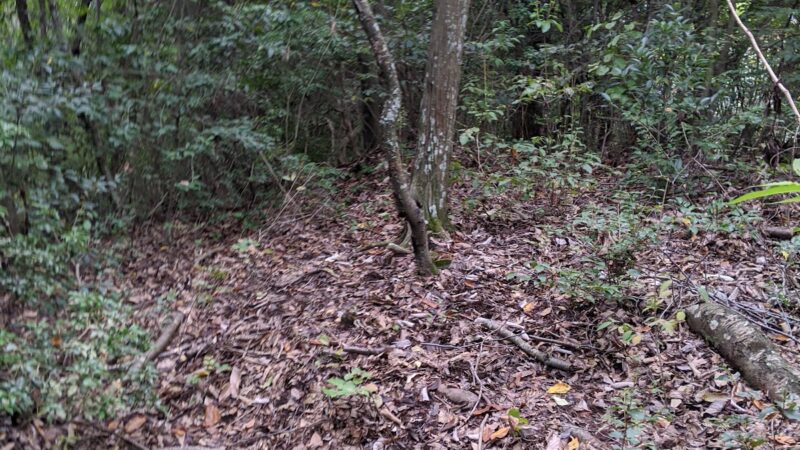
From the trailhead to the main enclosure, it is a relatively gentle mountain path that takes about 15 to 20 minutes to climb. The path is an unpaved, natural mountain trail, so comfortable shoes and clothing are necessary.
Notes for Visiting the Castle:
- The hiking trail is clear, but there are few signs, so please check a map or GPS information beforehand.
- The trail becomes slippery after rain, so please be careful.
- Don’t forget insect repellent in summer and warm clothing in winter.
- Always bring drinking water.
Nearby Historical Sites and Tourist Spots
Higashi-Nagao Castle Ruins
Higashi-Nagao Castle Ruins are a pair of castles with Nishi-Nagao Castle. Also a castle of the Nagao clan, it is located a few kilometers east of Nishi-Nagao Castle. If you have time, a historical walk visiting both castles is recommended.
Iinoyama (Sanuki Fuji)
Located southwest of Nishi-Nagao Castle, Iinoyama is affectionately known as “Sanuki Fuji” due to its beautiful conical shape. It is an isolated peak with an elevation of 422 meters, and a hiking trail to the summit is well-maintained. Visiting both Nishi-Nagao Castle and Iinoyama allows you to enjoy the nature and history of Sanuki at the same time.
Marugame Castle
Marugame Castle is a representative historical site of Marugame City. It is one of the 12 remaining original castle keeps and is known as a “famous castle with stone walls.” By comparing Marugame Castle, a modern castle, with medieval mountain castles like Nishinagao Castle, you can understand the evolution of castle architecture.
Sanuki Kokubunji Temple Ruins
The ruins of Kokubunji Temple, the center of ancient Sanuki Province, are also nearby. The remains of Sanuki Kokubunji Temple, built during the Nara period, remain, allowing you to trace the history of Sanuki from ancient times through the medieval and early modern periods.
Best Season to Visit Nishinagao Castle
Spring (March-May)
Spring is one of the best seasons to visit Nishinagao Castle. The weather is mild, making it easy to climb, and you can enjoy the beautiful scenery of fresh greenery. Especially from early to mid-April, the surrounding cherry blossoms bloom, creating a beautiful contrast between the mountain castle and the cherry blossoms.
Autumn (October-November)
Autumn is also a recommended season for visiting. The autumn foliage is beautiful, and you can see far into the distance in the clear air. From October to November, the temperature is moderate, making it a comfortable time to climb the castle. The view from the main enclosure is said to be most beautiful in autumn.
Notes for Summer and Winter
In summer (June to August), temperatures are high and there are many insects, so sufficient heat protection and insect repellent are necessary. However, visiting during the cooler hours of early morning or evening is relatively comfortable.
In winter (December to February), temperatures are low, and the wind can be strong at the summit. With proper cold-weather gear, you can enjoy the clear air and views unique to winter.
Preparations and Precautions When Visiting Nishinagao Castle
Clothing and Equipment
Since Nishinagao Castle is an undeveloped mountain castle, appropriate clothing and equipment are necessary.
Recommended Clothing and Equipment:
- Comfortable hiking boots or trekking shoes
- Long-sleeved shirt and long pants (to protect skin from plants and insects)
- Hat and sunscreen
- Drinking water (at least 500ml)
- Towel or towel
- Insect repellent spray (especially from spring to autumn)
- Rain gear (if the weather is unpredictable)
- Map, GPS device, or smartphone
Safety Precautions
Notes for Visiting the Castle:
- Avoid visiting alone; it is recommended to visit in groups if possible.
- Check the weather forecast in advance and refrain from visiting in bad weather.
- Watch your step and avoid reckless behavior.
- Be careful not to damage the ruins.
- Always take your trash with you.
- Be aware of wild animals (wild boars, venomous snakes, etc.).
- Check your cell phone signal strength in advance.
Manners and Consideration
The area around Nishinagao Castle is also a residential area for local residents. Please be considerate of the following points.
- Do not trespass on private property.
- Do not shout or make noise.
- Be careful not to interfere with farm work.
- When parking, choose a location that does not obstruct traffic.
- Greet local residents if you encounter them.
Historical Value and Preservation Status of Nishinagao Castle
Value as a Historic Site
Nishinagao Castle holds significant academic value as a typical example of a medieval mountain castle in Sanuki Province. While archaeological excavations have been limited, the remains on the surface allow for an understanding of the structure of the medieval castle, making it a valuable resource for regional history research.
In particular, its historical importance is recognized as a base of operations for the Nagao clan, a local lord of Sanuki Province, and as a stage for power struggles in Sanuki during the Sengoku period.
Current Preservation Status
Currently, no special preservation or maintenance work is being carried out on the Nishinagao Castle ruins; they are preserved in their natural state. Therefore, some parts of the remains are experiencing weathering and erosion due to vegetation.
Local history enthusiasts and castle researchers regularly conduct surveys and cleaning activities, continuing their efforts to preserve the remains and raise awareness. Further systematic surveys and the development of preservation plans are expected in the future.
Reference Materials for Learning About Nishinagao Castle
Related Books
For those who wish to learn more about Nishinagao Castle, the following materials may be helpful:
- Local history books on castles in Kagawa Prefecture
- Regional historical materials such as the Marugame City History and the Iiyama Town History
- Related articles in the “Comprehensive Survey of Japanese Castles” and castle research journals
- Research papers on medieval Sanuki Province residents
Museums and Archives
Marugame City Museum has exhibits on the history of the Marugame area, and may offer access to materials related to medieval castles and the Nagao clan. It is recommended to inquire before visiting.
Kagawa Prefectural Museum (Takamatsu City) offers a comprehensive history of Sanuki Province, deepening your understanding of the political situation and castles of medieval Sanuki.
Nishinagao Castle and the Medieval History of Sanuki
The Activities of the Local Lords of Sanuki
While the Hosokawa clan held the position of Shugo (provincial governor) of Sanuki Province during the medieval period, local lords such as the Nagao, Kagawa, and Yasutomi clans actually held power in various regions. These local lords maintained control of the region through a mix of cooperation and conflict.
The Nagao clan held power in the eastern and central parts of Sanuki Province, controlling the area with Nishinagao Castle and Higashinagao Castle as their main bases. From the Muromachi period to the Sengoku period, they also served as Shugodai (deputy governor) and held an important position within Sanuki.
The Sengoku Period in Shikoku
In the latter half of the 16th century, Shikoku entered the Sengoku period, with the Miyoshi clan of Awa, the Chosokabe clan of Tosa, and the Kono clan of Iyo vying for supremacy. Sanuki Province was also drawn into this conflict, and the local lords formed alliances with various forces in order to survive.
The Nagao clan was also tossed about by the tides of the times, and it is said that they eventually came under the control of the Chosokabe clan. Nishinagao Castle was maintained during this period amidst military tension, but its role ended with Toyotomi Hideyoshi’s conquest of Shikoku.
Summary: The Charm of Nishinagao Castle
Nishinagao Castle is a valuable medieval mountain castle site remaining in Marugame City, Kagawa Prefecture. Unlike the flashy tourist castles, this castle site, quietly nestled in the mountains, quietly speaks to visitors of the history of medieval Sanuki.
Nishinagao Castle is full of charm, from the magnificent view from the main enclosure, to the clearly preserved remains of moats and baileys, and the historical romance of the Nagao clan, the local lords of Sanuki. Because it is a mountain castle left in its natural state without any development, it is possible to realistically imagine what the castle looked like in its time.
Nishinagao Castle is a historical site worth visiting not only for castle enthusiasts, but also for history buffs and hiking lovers. Standing on a mountaintop overlooking the Sanuki Plain, why not immerse yourself in the romance of history while imagining the view seen by medieval samurai?
When visiting Marugame City or Kagawa Prefecture, be sure to also visit Nishinagao Castle and experience this little-known historical heritage of Sanuki. With proper preparation and consideration, your visit will surely be an unforgettable historical experience.