Maeda Castle (Takamatsu City, Kagawa Prefecture) Complete Guide | History, Remains, and Access Information
Maeda Castle, located in Takamatsu City, Kagawa Prefecture, is a valuable historical site that tells the story of the Sengoku period in Sanuki Province. Built during the Bunmei era, it functioned as the residence of the Maeda clan, who ruled this area for approximately 100 years until its fall to the Chosokabe clan’s invasion. Even today, the remains such as earthworks and dry moats are well-preserved, conveying the appearance of a medieval castle.
Basic Information on Maeda Castle
Location and Access
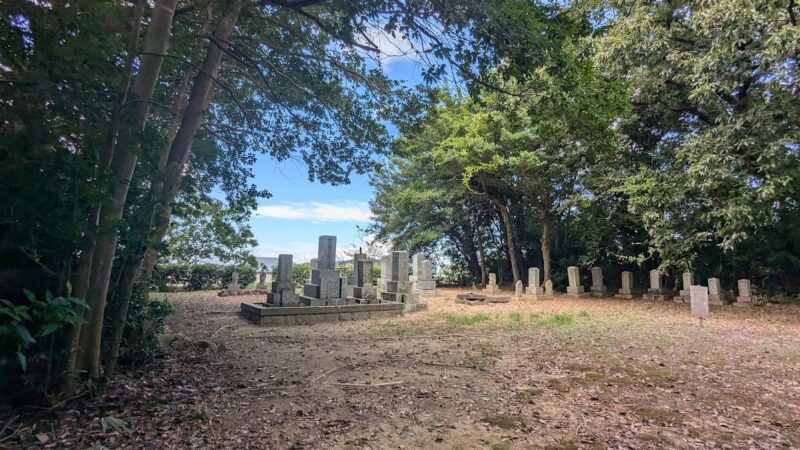
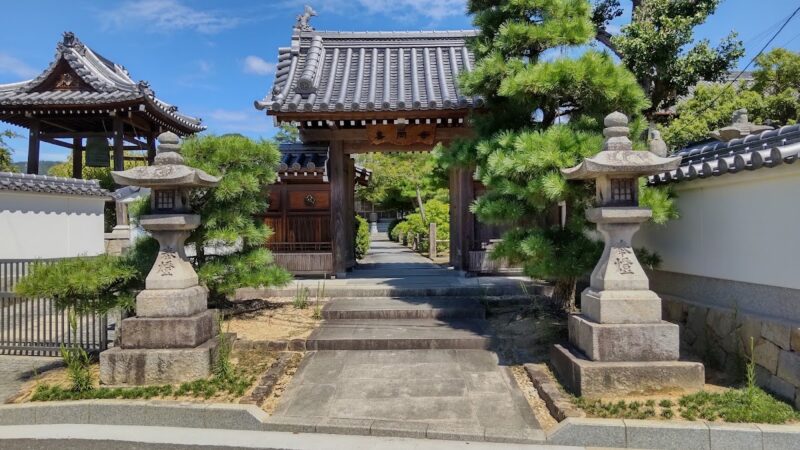
Maeda Castle ruins are located in Maeda Higashi-machi, Takamatsu City, Kagawa Prefecture. It is a flatland castle built on the tip of a hill extending southwest from Tateishiyama. Currently, it is used as the grounds of Hoju-ji Temple and a cemetery, and is designated as a Takamatsu City designated cultural property (historic site).
Location: Maeda Higashi-cho, Takamatsu City, Kagawa Prefecture
Former Province: Sanuki Province
Classification/Structure: Hilltop Castle
Keep Structure: None (As it is a medieval castle, there is no keep)
Designation: Takamatsu City Designated Historic Site
Access
While accessing Maeda Castle Ruins by car is convenient, it is located off a narrow road rather than along the main prefectural road, so first-time visitors should be careful. There is no dedicated parking space nearby, so we recommend using the parking lot for visitors to Hoju-ji Temple or a nearby public parking lot.
If using the nearest public transportation, you will need to take a taxi or walk from the nearest station on the Kotoden Nagao Line. The area around the castle ruins is residential, so please be considerate of local residents when visiting.
History of Maeda Castle
Construction and the Establishment of the Maeda Clan
Builder: Maeda Tanomoto Munemasa
Year of Construction: Bunmei Era (1469-1487)
Maeda Castle is said to have been built during the Bunmei era. The builder was Maeda Tanomoto Munemasa, who, as the younger brother (or branch family) of Sogō Kageshige (Takaharu), lord of Sogō Castle, moved to this area and adopted the name Maeda. The Sogō clan was a powerful warlord family in Sanuki Province, and the establishment of the Maeda clan as a branch family indicates the expansion of the Sogō clan’s influence in this region.
The location where the Maeda clan established their base was a strategically important spot at the tip of a hill extending from Tateishi Mountain. Built as a flatland castle utilizing an ancient hill, it overlooked the surrounding area, suggesting not only military importance but also its function as a base for territorial management.
The Three Generations of the Maeda Clan’s Reign
Maeda Castle served as the residence of the Maeda clan for three generations.
First Generation: Maeda Yorimoto Munemasa – Built the castle during the Bunmei era
Second Generation: Maeda Muneharu (Muneharu) – Succeeded Munemasa and governed the territory
Third Generation: Maeda Jinnojō Munekiyo – Served as lord of the castle until the Tenshō era
During the reign of the third lord, Maeda Jinnojō Munekiyo, Sanuki Province underwent a major transformation. In 1582 (Tenshō 10), Chōsokabe Motochika, a Sengoku daimyo of Tosa Province, began his invasion of Sanuki Province. The Maeda clan sided with the main branch of the family, the Sogō clan, and is said to have distinguished themselves in the defense of Sogō Castle.
The Invasion and Fall of Maeda Castle
From 1582 to 1584, Chosokabe Motochika conquered Sanuki Province one castle after another. Faced with the overwhelming military power of the Chosokabe army, many castles in Sanuki fell one after another. Maeda Castle was no exception, and it is said to have fallen during the Chosokabe invasion.
There are two theories regarding the exact date of its fall: one suggests 1582, and the other 1584. In any case, Maeda Castle disappeared from the historical stage during the process of the Chosokabe clan’s unification of Sanuki. Afterward, Maeda Castle was never used as a military base again and is believed to have been abandoned.
Layout and Remains of Maeda Castle
Castle Structure
Maeda Castle is a flatland castle with a long north-south layout. The main part measures approximately 36 meters east-west and 52 meters north-south. The castle is broadly composed of two baileys: the northern bailey is thought to correspond to the main keep (Honmaru), and the southern bailey to the second bailey (the current Hoju-ji Temple grounds).
The layout, which skillfully utilizes the topography of the ancient hills, clearly demonstrates the characteristics of a medieval castle. By making maximum use of the natural terrain, it was possible to construct a highly defensible castle with minimal effort.
Northern Bailey (Site of the Main Keep)
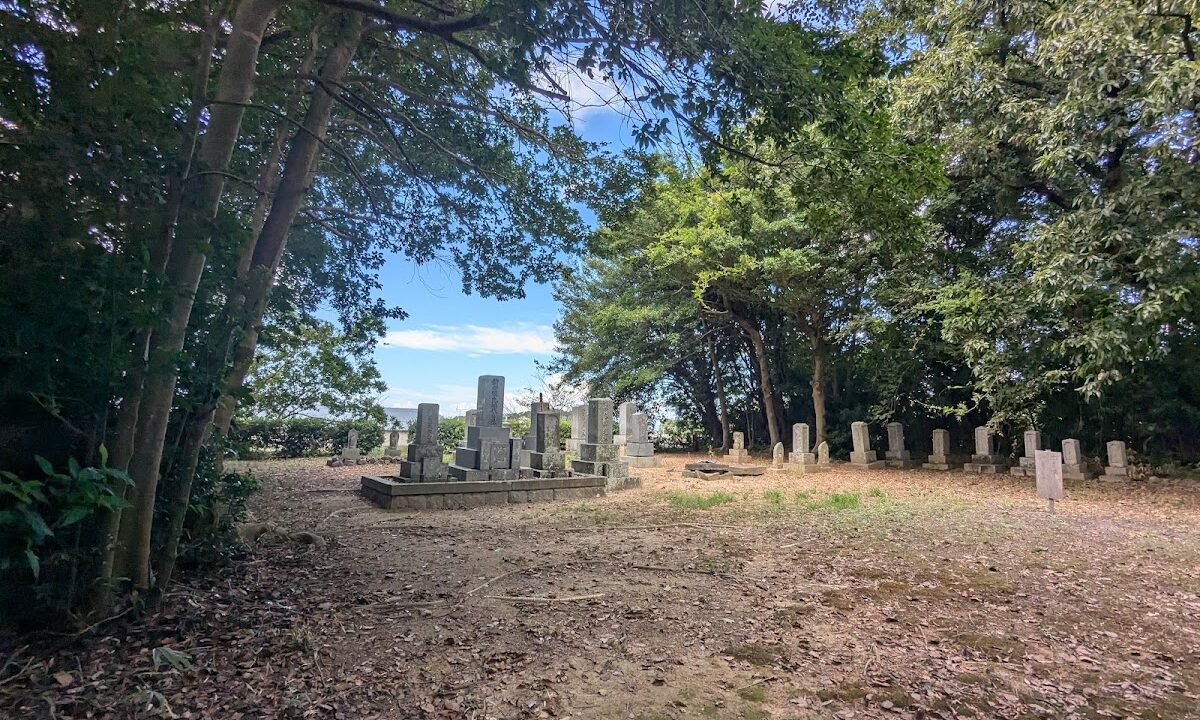
Currently, the northern bailey is used as a cemetery, and a marker indicating the castle site has been erected. The most notable feature of this bailey is the L-shaped earthen rampart remaining in the northeast corner.
Earthen ramparts played an important role as defensive structures of the castle, preventing enemy intrusion and also functioning as cover for firing from within the castle. Although the height of the earthen ramparts at Maeda Castle has been lost, the L-shape remains clearly visible, making it a valuable relic for understanding the castle’s layout at the time.
Traces of a Dry Moat
To the north and rear of the northern enclosure, a slightly lower terrain can be observed, which is believed to be the trace of a dry moat. A dry moat is a moat that does not hold water and was a common defensive structure in medieval castles.
While the current dry moat does not fully retain its original form due to burial and alteration, its location and size can be inferred from the topography. It is clear that it functioned as a defensive structure against attacks from the north, or rear, of the castle.
Southern Enclosure (Hoju-ji Temple)
Hoju-ji Temple stands in the southern enclosure, and the area has been developed as temple grounds. This enclosure is an important section second only to the main keep, and may have been used as living space or a place for administrative work.
Although part of the castle site has been altered due to the presence of Hoju-ji Temple, the basic topography of the enclosure has been preserved, allowing for an understanding of the castle structure consisting of two enclosures, north and south.
Earthen Bridge and Entrance Gate
Traces of an earthen bridge have also been confirmed near the entrance gate (koguchi) to the castle. The earthen bridge was a bridge made of earth used to cross the moat and served as a major access route to the castle. Areas around the castle’s entrance (koguchi), which were considered defensive weak points, were generally heavily fortified. It is believed that Maeda Castle also employed a combination of the earthen bridge and the entrance to control intruders.
Highlights of Maeda Castle
A Typical Example of a Medieval Castle
Maeda Castle is a valuable example of a medieval castle in Sanuki Province. It preserves the pure form of a medieval mountain castle/hilltop castle, lacking elements of early modern castles such as stone walls and keeps.
With its defensive structures primarily consisting of earthworks and dry moats, a layout that utilizes the natural terrain, and a compact yet functional arrangement of baileys, it is a historical site that provides invaluable insights into the castles of local powerful families during the Sengoku period.
Well-Preserved Remains
Maeda Castle is valued for its relatively well-preserved remains, despite the ongoing residential development and urbanization. The fact that the site was used as a cemetery and temple ultimately contributed to the preservation of the castle ruins.
The ability to see the basic structural elements of the castle, such as the L-shaped earthworks, traces of dry moats, and the topography of the baileys, is a major attraction for castle enthusiasts and history buffs.
Quiet Visiting Environment
Because Maeda Castle Ruins is not a large-scale tourist destination, visitors can explore the castle ruins in a quiet environment. The ability to wander at your own pace, relying on markers and explanatory signs, and imagining the castle’s appearance in its heyday, is a unique charm not found at other famous castles.
Historical Background of Maeda Castle and its Surroundings
Relationship with the Sogō Clan
The Maeda clan was established as a branch family of the Sogō clan. The Sogō clan was a powerful warlord in Sanuki Province, with Sogō Castle (present-day Sogō, Takamatsu City) as its base. The branching off of the Maeda clan during the time of Sogō Kageshige indicates the Sogō clan’s strategy for expanding its power and managing its territory.
Maeda Castle is thought to have also served as a branch castle, or “mukaijiro,” of Sogō Castle. The fact that the Maeda clan sided with the Sogō clan during the Chōsokabe clan’s invasion speaks to the strength of this relationship.
The Sengoku Period in Sanuki Province
16th-century Sanuki Province was a turbulent period, caught between the Kinai powers such as the Hosokawa and Miyoshi clans and the Chōsokabe clan of Tosa. The period in which Maeda Castle existed coincides precisely with this turbulent Sengoku period.
Chōsokabe Motochika’s invasion of Sanuki after 1582 drastically altered the political landscape of Sanuki Province. The fall of Maeda Castle was an event that occurred within this major historical current, and it can be seen as an example of how local powerful families’ castles were swallowed up by the tides of the times.
After the Chōsokabe Clan
The Chōsokabe clan’s rule over Sanuki did not last long. In 1585, following Toyotomi Hideyoshi’s conquest of Shikoku, Chosokabe Motochika was granted only Tosa Province, while Sanuki Province was given to Sengoku Hidehisa. Subsequently, the Ikoma clan came to rule Sanuki, and Takamatsu Castle became the new center of Sanuki.
Amidst these political changes, Maeda Castle was never used again, ending its role as a medieval castle.
Notes for Visitors
Access and Parking
Maeda Castle ruins are not located along the prefectural road, but down a narrow road. If using a car navigation system, setting “Hoju-ji Temple” as the destination will make it easier to find.
There is no dedicated parking lot, so please avoid street parking and be considerate of the neighbors. Since the visit is short, it is recommended to park within walking distance.
Visitor Etiquette
The castle ruins are located within the grounds of a cemetery and temple. Please note the following points when visiting:
- Behave quietly within the cemetery
- Do not touch gravestones or offerings
- Refrain from visiting if a memorial service or other ceremony is being held at Hoju-ji Temple
- Always take your trash with you
- Do not damage plants or historical remains
Estimated Visit Time
The estimated visit time for Maeda Castle Ruins is 15 to 30 minutes. Because the castle ruins are compact, you can see the main remains in a short time. Even if you want to take your time taking photos and observing, one hour should be sufficient.
Historical Sites and Tourist Spots Around Maeda Castle
Sogō Castle Ruins
This is the site of the castle of the Sogō clan, the main branch of the Maeda clan. It is about a 15-minute drive from Maeda Castle, and visiting both together will give you a deeper understanding of the relationship between the Sogō and Maeda clans.
Takamatsu Castle (Tamamo Castle)
Takamatsu Castle, a modern castle in Sanuki Province, is known as one of Japan’s three great water castles. The site, the heart of the Takamatsu Domain where the Ikoma and Matsudaira clans resided, is now developed as Tamamo Park. Comparing medieval castles like Maeda Castle with early modern castles like Takamatsu Castle allows for an understanding of the development process of castles.
Yashima
Yashima, famous as the site of a battle during the Genpei War, is approximately 20 minutes by car from Maeda Castle. The views from Yashima Temple and the observation deck are magnificent, making it a spot where you can feel the history of Sanuki.
Cultural Value of Maeda Castle
The Maeda Castle ruins are protected as a valuable cultural asset of the region, designated as a Takamatsu City Historic Site. As a site that demonstrates the reality of medieval castles in Sanuki Province, it holds significant academic value.
In recent years, with the growing interest in medieval castles, castles of local powerful families like Maeda Castle are being re-evaluated. As a historical site that conveys the reality of regional society during the Sengoku period, distinct from large-scale early modern castles, further research and investigation are expected.
Summary
Maeda Castle in Takamatsu City, Kagawa Prefecture, is a flatland castle in Sanuki Province built during the Bunmei era by Maeda Yorimoto Munemasa. The Maeda clan, a branch of the Sogō clan, ruled the castle for three generations, but it fell during the Chōsokabe clan’s invasion in the Tenshō era.
Even today, the remains of the castle, such as earthworks and dry moats, are well-preserved, making it a valuable historical site that conveys the appearance of a medieval castle. Because the site is now used as the grounds of Hōju-ji Temple and a cemetery, visitors must observe proper etiquette. However, it is a fascinating spot where you can imagine the castle’s appearance in its heyday in a quiet environment.
By visiting the Maeda Castle ruins, which tell the story of the Sengoku period in Sanuki Province, you can experience the history of local powerful families and the reality of medieval castles. When you visit Takamatsu City, be sure to visit the Maeda Castle ruins.