Complete Guide to Kōsuiji Castle (Iwate Prefecture): A Thorough Explanation from the Shiba Clan’s Residence to the Nanbu Clan’s Rule
Located in Shiwa-cho, Shiwa-gun, Iwate Prefecture, Kōsuiji Castle is a medieval mountain castle that served as the residence of the Shiba clan from the Muromachi period to the Sengoku period. Also known as Kōriyama Castle, it was a historical stage for approximately 250 years as an important base for the Ashikaga clan in Ōshū. Currently, it is maintained as Shiroyama Park and is also known as a famous cherry blossom viewing spot.
Basic Information on Takamizudera Castle
Location: Furudate, Futukamachi, Shiwa-cho, Shiwa-gun, Iwate Prefecture
Former Province: Shiwa-gun, Mutsu Province
Common Name/Alternate Name: Koriyama Castle, Shiba-kan, Shiwa-kan
Castle Structure: Mountain Castle (Independent Hill Type)
Year of Construction: Around Kenmu 2 (1335)
Builder: Shiba Ienaga
Main Lords: Shiba clan, Nanbu clan
Year of Abandonment: Kanbun 7 (1667)
Remains: Traces of baileys, earthworks, and moats
Designated Cultural Property: Shiwa Town Designated Historic Site
Current Status: Shiroyama Park (Shiwa Town Municipal Park)
Takamizudera Castle is an independent hill-type mountain castle built on a river terrace on the right bank of the Kitakami River, with the entire plateau, approximately 60 meters high, serving as the castle grounds. Located at a strategic point between National Route 4 and the Kitakami River, it was the political and military center of Oshu from the Nanboku-cho period to the Sengoku period.
History and Development of Takamizudera Castle
The Shiba Clan’s Move to Oshu and the Establishment of Takamizudera Castle
The history of Takamizudera Castle begins with the Shiba clan’s advance into Oshu. The Shiba clan was a branch of the Ashikaga clan, and the Shiba clan originated when Ashikaga Ieuji, the eldest son of Ashikaga Yasuuji, moved to Shiba County in Mutsu Province during the mid-Kamakura period and adopted the name Shiba.
After moving to Oshu, Ieuji made a residence in a section of Takamizudera Temple, a prominent ancient temple in the Shiwa region, as mentioned in the “Azuma Kagami.” The name of this temple, Takamizudera, later became the origin of the castle’s name.
In 1335 (Kenmu 2), Ashikaga Takauji, amidst the Nanboku-cho period (Northern and Southern Courts period), sought to expand the influence of the Northern Court and sent Shiba Ienaga, the eldest son of his relative Shiba Takatsune, to Oshu as Oshu Kanrei (governor of Oshu). It is believed that the residence at Takamizudera was fully developed into an independent castle during this period.
The Rise of the “Shiba Palace”
During the Muromachi period, the Shiba clan, based at Takamizudera Castle, wielded great power as the foremost branch of the Ashikaga family in Oshu. The Shiba clan was the most powerful branch, serving as Kanrei, and their branch in Oshu also enjoyed such influence that it was known as the “Shiba Palace.”
In particular, during the time of Shiba Akitaka, their power reached its peak, and he established a system known as the “Three Palaces” by placing his second son in Shizukuishi and his third son in Isari. During this period, Takamizudera Castle functioned as the political and cultural center of southern Oshu.
The Shiba clan also sought to expand their influence towards Iwate County, reaching their peak in 1537 when they conquered Iwate County. However, around this time, conflict with the Nanbu clan intensified.
Conflict with the Nanbu Clan and the Downfall of the Shiba Clan
With the start of the Sengoku period, the Nanbu clan expanded its power, increasing tensions with the Shiba clan. Around the Tensho era (1573-1592), the Shiba clan was pushed back by the Nanbu clan, and a complex situation arose when Yagoro, the younger brother of Kunohe Masazane (a branch of the Nanbu clan), married into the Shiba family, taking the name Takada Kichibei Yasuzane and residing in Kichibei Manor, an outpost of Takamizudera Castle.
A decisive turning point came in 1588. It was discovered that Iwashimizu Yoshinori, the lord of Iwashimizu Castle and other vassals, had secretly colluded with the Nanbu clan, causing unrest within the castle. Taking advantage of this rebellion, Nanbu Nobunao captured Takamizudera Castle. The then-lord, Shiba Akinao, abandoned the castle and fled to the Osaki clan, thus ending the Takamizudera Shiba clan.
To Koriyama Castle under Nanbu Clan Control
After capturing Takamizudera Castle, Nanbu Nobunao appointed Nakano Shuri Yasuzane as the castle lord and renamed the castle Koriyama Castle. This renaming is thought to have been intended to eliminate the Shiba clan’s influence and clearly establish Nanbu clan rule.
Later, when the Nanbu clan began construction of Morioka Castle, Koriyama Castle was temporarily used as a residence for the Nanbu clan. As Morioka Castle neared completion, Koriyama Castle was demolished in 1667, and it is said that some of its materials were reused in the construction of Morioka Castle’s main keep.
Thus, the history of Takamizudera Castle and Koriyama Castle, spanning approximately 330 years, came to an end.
Structure and Layout of Takamizudera Castle
Overall Structure
Takamizudera Castle is a large-scale mountain castle encompassing an isolated hill on the right bank of the Kitakami River. Multiple baileys were arranged on a plateau approximately 60 meters high, creating a defensive system that skillfully utilized the natural terrain.
The castle’s location was strategically advantageous, controlling water transport on the Kitakami River and overlooking the Oshu Kaido road. Its isolated hill layout, capable of defending against attacks from any direction (east, west, north, or south), exhibits typical characteristics of a medieval mountain castle.
Main Enclosure (Honmaru)
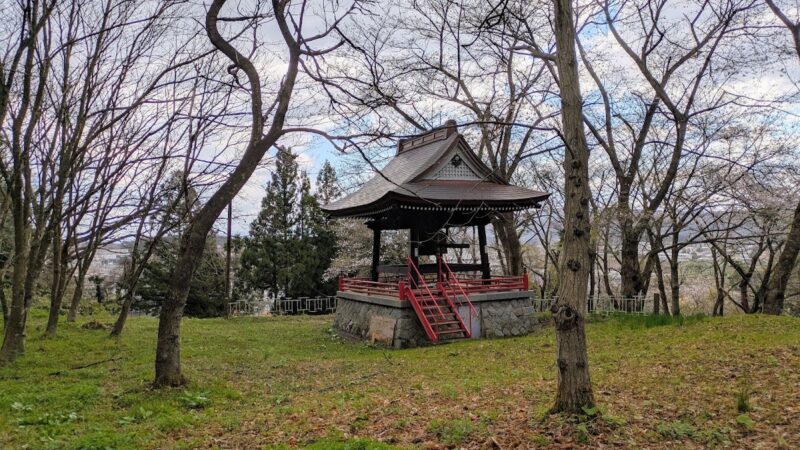
Located at the mountaintop, the main enclosure (1st enclosure) measures approximately 70 meters along its longest axis and currently houses the Kumano Shrine. The castle walls of the main enclosure exhibit bends, indicating a defensive structure designed with flanking fire in mind.
This main enclosure is believed to have been the central part of the Shiba clan’s residence and functioned as a political and military command center. The shrine’s placement is presumed to be due to the enshrinement of Kumano Gongen as the castle’s guardian deity after its abandonment.
Enclosure Layout
Multiple enclosures were arranged in a stepped pattern around the main enclosure. While the boundaries of the enclosures are unclear due to the current park development, the original layout can be inferred from the topography.
Each enclosure was demarcated by earthen ramparts, and dry trenches were provided at important locations. In particular, the approach to the main enclosure is thought to have had a complex gate structure designed to prevent enemy intrusion.
Defensive Structures
The defenses of Takamizudera Castle made maximum use of the natural terrain. The steep slopes themselves formed a natural fortress wall, and artificial cliffs were constructed at key points.
Earthworks surrounded the main enclosure, and traces of stonework have been found in some areas. However, full-fledged stone walls were not used, strongly retaining the characteristics of a medieval mountain castle, being an earthen fortress.
Moats were constructed to divide the ridge, serving to limit enemy incursions. Traces of these can still be seen today as depressions in the terrain.
Outposts and Subsidiary Castles
The defense system of Takamizudera Castle consisted not only of the main castle but also of surrounding outposts and subsidiary castles. The aforementioned Kichibei Mansion functioned as an outpost of Takamizudera Castle, playing a role in the outer defense of the castle.
Furthermore, the Shizukuishi and Inosari mansions, established when the Shiba clan created the “Three Palaces” system, are thought to have functioned as part of the broader defense network of Takamizudera Castle.
Current Status of Takamizudera Castle Ruins (Shiroyama Park)
Development as Shiroyama Park
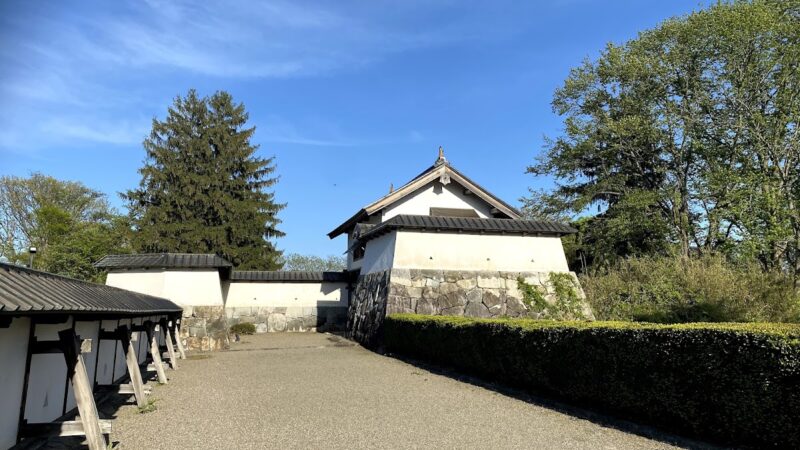
Currently, the Takamizudera Castle ruins have been developed as Shiwa Town Shiroyama Park, serving as a place of relaxation for local residents. While many of the remains have been altered due to the park’s development, the atmosphere of the castle ruins can still be felt.
Walking paths are maintained within the park, and it is possible to access the main citadel at the mountaintop by car. Therefore, it is relatively easy to visit even in summer, making it accessible not only to castle enthusiasts but also to general tourists.
As a Cherry Blossom Spot
Shiroyama Park is known as a cherry blossom spot, with approximately 2,000 cherry trees planted there. In spring, the entire hillside is covered in cherry blossoms, attracting many visitors.
During cherry blossom season, you can enjoy a magnificent view of the cherry blossoms against the backdrop of the Kitakami River and the surrounding rural landscape. The cherry blossoms that adorn the land once ruled by the Shiba clan evoke both the romance of history and the beauty of nature.
Current Status of the Remains
As a result of development into a park, unfortunately, many parts of the remains of Takamizudera Castle are unclear. However, with careful observation, traces of the remains can be confirmed as follows:
- Elevation Differences of Enclosures: Elevations remaining as undulations of the terrain in each enclosure
- Traces of Earthworks: Elevations of earth remaining around the main enclosure
- Traces of Moats: Depressions on the ridge
- Cut Slopes: Traces of artificial processing on parts of the steep slopes
The area around Kumano Shrine in the main enclosure has been relatively little altered and retains the topography from the castle era. Bends in the castle walls can also be confirmed, providing important clues for understanding the structure of medieval mountain castles.
Access and Visiting Information
Transportation Access:
- Approximately 15 minutes on foot from JR Tohoku Main Line “Shiwa-Chuo Station”
- Signposts are available from National Route 4
- Parking available (free)
Points to Note During Visit:
- View from the main enclosure (Kumano Shrine)
- Stroll while paying attention to the layout of the enclosures
- Observe the Kitakami River and surrounding topography
- Cherry blossoms in spring (best viewing time is mid-to-late April)
The park is open year-round and admission is free. However, some areas may be inaccessible due to snow in winter.
Historical Spots Around Takamizudera Castle
Tokutan Castle Ruins
Located approximately 5 kilometers north of Takamizudera Castle, Tokutan Castle is an ancient castle built in the early Heian period (first half of the 9th century). After Sakanoue no Tamuramaro’s expedition, it functioned as a base for managing the Ezo region. It is designated as a national historic site and is an important historical site for understanding the flow of history from ancient to medieval times.
Shiwa Castle Ruins
Shiwa Castle, also located in Morioka City, is known as an ancient castle ruin. Along with Tokutan Castle, it indicates that this region was an important military base from ancient times.
Morioka Castle Ruins (Iwate Park)
Morioka Castle, believed to have been built using materials from Takamizudera Castle, is a modern castle built as the base of the Nanbu clan. Currently, it is maintained as Iwate Park, and the remains, such as the stone walls, are well-preserved. It is an important spot where you can feel the historical connection to Takamizudera Castle.
Historical Significance of Takamizudera Castle
A Base of the Ashikaga Clan in Oshu
Takamizudera Castle played an important role for approximately 250 years as the base of the Ashikaga clan, the Shiba clan, who supported the Muromachi Shogunate, in Oshu. As the Oshu Kanrei (governor of Oshu) and Oshu Tandai (governor of Oshu), they contributed to the political stability and cultural development of the region.
The existence of the Shiba clan, known as the “Shiba Palace,” played a crucial role as a link between the central Ashikaga shogunate and Oshu (northern Japan), making it an indispensable element in understanding the political structure of the Tohoku region during the Muromachi period.
Stage of the Nanboku-cho War and the Sengoku Period
Takasuiji Castle is a fortress that survived turbulent times, serving as an important base for the Northern Court during the Nanboku-cho War and as a battleground for conflicts with the Nanbu clan during the Sengoku period.
In particular, the Nanbu clan’s capture of the castle in 1588 symbolized the reorganization of power in the Tohoku region during the Sengoku period and marked a significant turning point in the history of this region.
A Typical Example of a Medieval Mountain Castle
Takasuiji Castle, as an isolated hilltop-type medieval mountain castle, clearly demonstrates the castle-building techniques and defensive philosophies of the time. Its layout, which makes maximum use of the natural terrain and utilizes civil engineering techniques such as earthworks and moats, is a valuable example in the study of medieval castles.
How to Enjoy Your Visit to Takamizudera Castle
Stroll While Imagining History
When visiting Shiroyama Park, you can enjoy it more deeply by imagining that this was once the residence of the Shiba clan and the political and military center of Oshu.
The view from the main enclosure is not so different from the scenery that the lords of the Shiba clan would have seen. The flow of the Kitakami River, the mountains stretching in the distance, and the plains spreading out below. From this view, you can understand why this place was considered an important base.
Nature in Every Season
Shiroyama Park shows different faces in each of the four seasons, from the cherry blossoms in spring, to the fresh green of spring, the autumn leaves, and the snowy landscape of winter. By visiting in different seasons, you can discover different charms.
Combining with Nearby Historical Sites
By visiting Shiroyama Park in combination with nearby historical sites such as Tokutan Castle, Shiwa Castle, and Morioka Castle, you can systematically understand the history of Iwate Prefecture from ancient times to the early modern period. A day trip exploring history is also recommended. ## Summary
Takasuiji Castle (Shiwa Town, Iwate Prefecture) is a medieval mountain castle built around 1335 (Kenmu 2) as the residence of the Shiba clan, a branch of the Ashikaga clan, and functioned as an important base in Oshu for approximately 250 years. The Shiba clan, who flourished as the “Shiba Palace,” were destroyed in 1588 (Tensho 16) by Nanbu Nobunao, and the castle was renamed Koriyama Castle.
Under the control of the Nanbu clan, it temporarily served as a residence during the construction of Morioka Castle, but was demolished in 1667 (Kanbun 7), and its materials were reused for Morioka Castle. Currently, it is maintained as Shiwa Town Shiroyama Park, a famous spot with approximately 2,000 cherry trees.
While some remains are unclear due to the park’s development, traces of baileys and earthworks can be seen around the main enclosure and Kumano Shrine, allowing for an understanding of the structure of a medieval mountain castle. With its panoramic views of the Kitakami River and a sense of historical romance, the Takamizudera Castle ruins are an essential historical site for learning about the medieval history of Iwate Prefecture.