Gozenyama Castle (Shirosato Town, Ibaraki Prefecture) Complete Guide | History, Highlights, and Access Explained in Detail
What is Gozenyama Castle?
Gozenyama Castle is a mountain castle located in Gozenyama, Shirosato Town, Higashiibaraki District, Ibaraki Prefecture. The castle ruins were built on the eastern side of the summit of Mt. Gozenyama (156 meters above sea level), situated at a strategic point along the Naka River.
While much of the castle’s detailed history remains unknown, there is a tradition that it was built by Fujiwara no Tokifusa during the Jokyu era (1219-1221). However, judging from the condition of the existing remains, it is believed to have actually been used during the Sengoku period (Warring States period), and it has been suggested that it may have been used as a fortified camp during the attack on Noguchi Castle.
Mt. Gozenyama is a scenic spot sometimes called “Arashiyama of Kanto,” and it is one of Ibaraki Prefecture’s representative historical spots, possessing both historical value as a castle ruin and tourist value as a natural park.
Gozenyama is a scenic spot sometimes called “Arashiyama of Kanto,” and it is one of Ibaraki Prefecture’s representative historical sites, combining historical value as a castle ruin with tourist value as a natural park. ## History of Gozenyama Castle
The Legend of its Construction and the Mystery of the Jokyu Era
The most widely known legend regarding the construction of Gozenyama Castle is that it was built by Fujiwara no Tokifusa during the Jokyu era (1219-1221). Fujiwara no Tokifusa was a court official during the Kamakura period and is remembered in history for his involvement in the Jokyu War, but no definitive historical records have been found to confirm that he built a castle in this location.
Considering the political situation after the Jokyu War, it is possible that some kind of military base was needed in this region, but further research is needed to determine the relationship between the legend and historical facts.
The Legend of Empress Koken and Dokyo
The name Gozenyama has a legend related to Empress Koken (later Empress Shotoku) and the monk Dokyo from the Nara period. According to this legend, Dokyo, who was exiled to Shimotsuke Province (present-day Tochigi Prefecture), lived in this area with Empress Koken, and thus the name “Gozenyama” was given to the place.
Dokyo was a figure who, during the Nara period, enjoyed the favor of Empress Koken and rose to the position of Pope, but later fell from power and was demoted to the position of head priest of Yakushi-ji Temple in Shimotsuke Province. While it is historically certain that Dokyo died in Shimotsuke Province, there is no historical evidence that Empress Koken ever visited this area.
However, the very existence of such legends in the region indicates that Mount Gozenyama was recognized as a special place from ancient times. During the Edo period, it was designated a “reserved mountain,” and logging was prohibited, indicating a history of protection by the local lord.
Military Use During the Sengoku Period
Based on the condition of the existing remains, it is believed that Gozenyama Castle was primarily used as a military base during the Sengoku period (Warring States period). Located in the central part of Hitachi Province and facing the Naka River, an important waterway, this area was strategically important.
Of particular note is the possibility that it was used as a fortified camp for the attack on Noguchi Castle (a castle believed to have been located in the Noguchi district of Shirosato Town). During the Sengoku period (Warring States period), power struggles centered around the Satake clan unfolded in this region, and it is presumed that Gozenyama Castle functioned as a temporary military base during this process.
A “jinjo” (camp castle) is a military facility temporarily constructed when attacking an enemy castle; unlike a permanent residence, it was intended for short-term use. The relatively simple remains of Gozenyama Castle support this hypothesis.
Changes Since the Edo Period
In the Edo period, Gozenyama came under the protection of the domain as a “Goryoyama” (reserved mountain). This was a system that prohibited the felling of trees, aiming to conserve forest resources and water sources. This policy ensured that Gozenyama’s rich natural forest was preserved to this day.
Although its military function as a castle was completely lost, it continued to be cherished by people as an object of local worship and a scenic spot. It remained untouched by development even after the Meiji era, and in the Showa era, it was designated as an Ibaraki Prefectural Natural Park, where it remains today.
Structure and Remains of Gozenyama Castle
Basic Structure of the Castle
Gozenyama Castle is classified as a mountain castle, with its highest point being the summit of Mount Gozenyama at an elevation of 156 meters, and extending across the eastern slope. The relative height is approximately 120 meters, providing both visibility from the Naka River and excellent defensive capabilities.
The castle is a small to medium-sized mountain castle, with a relatively simple structure rather than a complex layout. As mentioned earlier, this suggests the possibility that it was used as a temporary encampment rather than a permanent residence.
Major Remains
Enclosures (Kuruwa)
Multiple enclosures (kuruwa) have been identified at Gozenyama Castle. An enclosure is a flat area within the castle grounds, used for building structures or stationing soldiers.
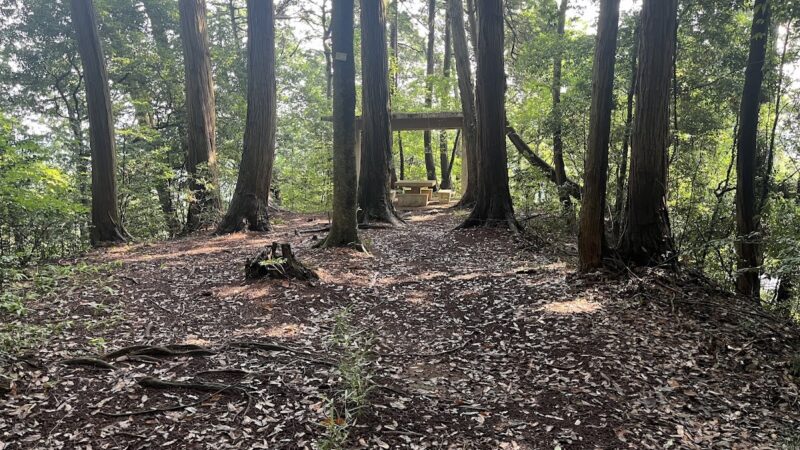
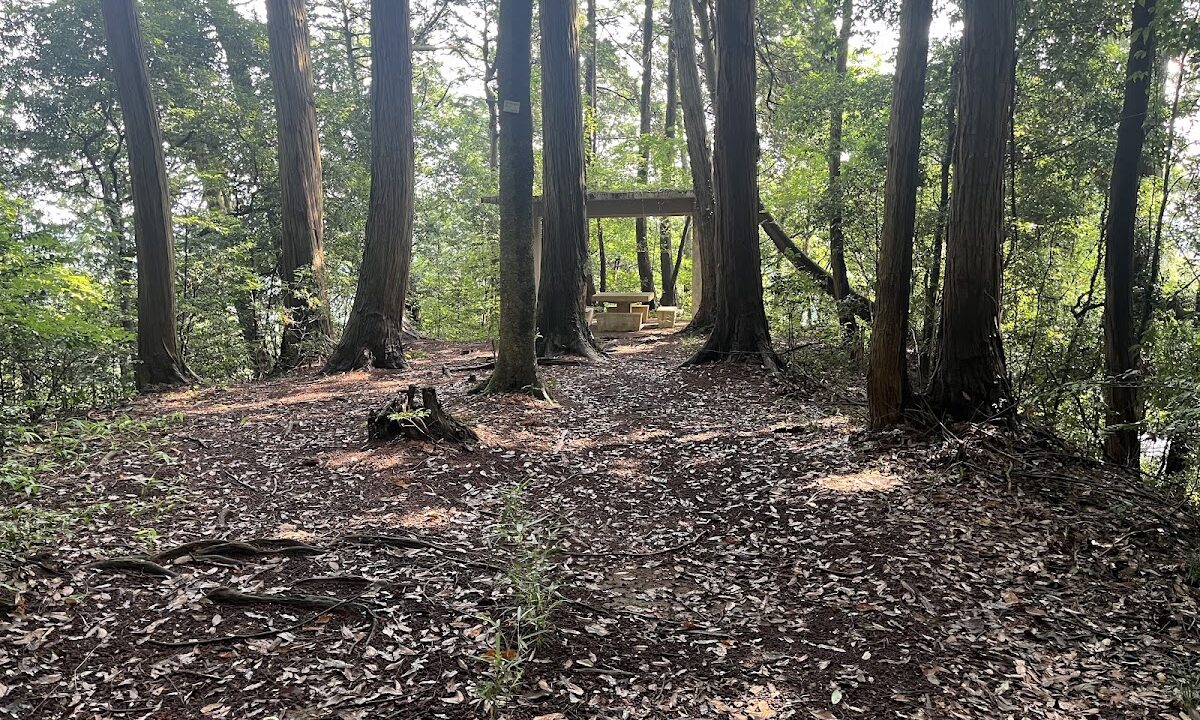
The main enclosure is located near the summit and surrounded by earthen ramparts. From the main enclosure, one can overlook the Naka River and the surrounding terrain, providing sufficient visibility for its function as a military base.
The secondary enclosures are arranged in a stepped pattern on the eastern slope of the main enclosure, skillfully constructed to follow the terrain. While the area of each enclosure is not particularly large, it is a standard size for a mountain castle.
Earthworks
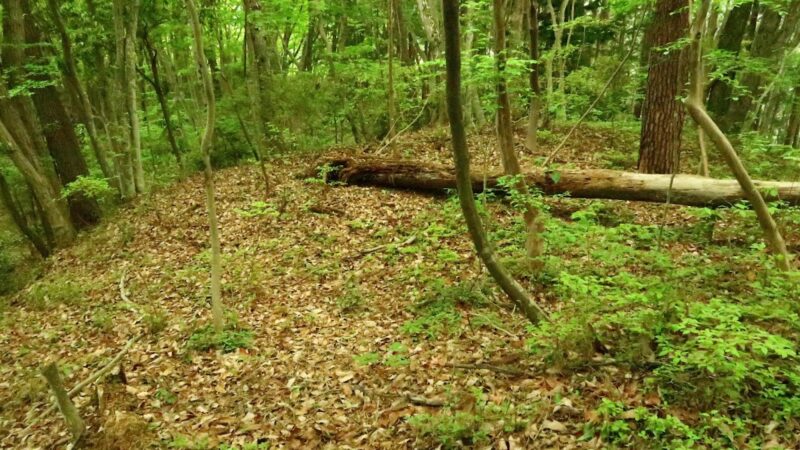
Earthworks are earthen embankments built around the enclosures and functioned as defensive structures. At Gozenyama Castle, traces of earthworks remain, mainly around the main enclosure, and in some places, earthworks approximately 1-2 meters high can be seen.
Although the scale of the earthworks is modest compared to large castles, it is thought that they provided sufficient defensive effect when combined with the steep terrain.
Moats
Moats are ditches dug to prevent enemy intrusion, and traces of moats have been partially confirmed at Gozenyama Castle. However, they are dry moats (moats without water) and not large in scale.
There are also areas that may be moats that utilize the slope terrain (moats that cut off the ridge), but these are not clear due to weathering and vegetation.
Preservation of the Ruins
The ruins of Gozenyama Castle are generally in good condition. This is because the area was protected as a protected mountain after the Edo period, and large-scale development was not carried out.
However, many parts are buried within the natural forest, and it can be difficult to identify the ruins without specialized knowledge. When visiting the castle ruins, checking the layout map beforehand will allow for a deeper understanding of the ruins.
Highlights of Gozenyama Castle
View from the Summit
The greatest highlight of Gozenyama Castle is the view from the summit. While the elevation of 156 meters is not particularly high, the view is surprisingly expansive because the surrounding area is a plain.
The Nakagawa River meanders below, and the view with the Nakagawa Bridge spanning it is so beautiful that it deserves to be called the “Arashiyama of the Kanto region.” The scenery, reminiscent of Kyoto’s Arashiyama and Togetsukyo Bridge, captivates many tourists.
Especially during the autumn foliage season (early to mid-November), the entire mountain is ablaze with red and yellow hues, creating a breathtaking contrast with the clear waters of the Nakagawa River. You can enjoy the changing scenery of each season: the fresh green of spring, the deep green of summer, the vibrant autumn leaves, and the snowy winter landscape.
Rich Natural Environment
Mt. Gozenyama is designated as an Ibaraki Prefectural Natural Park, preserving a rich natural environment. The primeval forest, protected since the Edo period, is lush with trees such as cypress, zelkova, sawtooth oak, and Japanese oak, making it an ideal environment for forest bathing.
The plant diversity is also high; wildflowers bloom profusely in spring, and many insects inhabit the area in summer. It is also known as a birdwatching spot, attracting visitors who enjoy observing wild birds.
Attractiveness as a Hiking Course
Mt. Gozenyama has well-maintained hiking courses and is popular with beginners. The time required from the trailhead to the summit is approximately 30-40 minutes, providing a moderate workout. The path is relatively well-maintained, but since it’s a mountain trail, we recommend wearing appropriate clothing and shoes. There are benches along the way for resting, allowing you to climb at your own pace.
Exploring Castle Ruins and Feeling the Romance of History
For castle enthusiasts, the act of searching for remains itself is enjoyable. Finding traces of earthworks and moats, and imagining the castle’s appearance from the layout of the baileys, allows you to feel the romance of history.
Walking while imagining what happened in this area during the Sengoku period, and what kind of people were active here, provides a deeper experience than a simple mountain hike.
Nearby Tourist Attractions
Near Gozenyama Castle is the “Katsura” roadside station, where you can enjoy local specialties and meals. It’s conveniently located for a stop before or after exploring the castle ruins.
Also, depending on the season, you can enjoy ayu (sweetfish) fishing in the Nakagawa River, and riverside walks are popular. Shirosato Town has many other historical and natural spots, making it possible to spend a whole day sightseeing.
Access Information
Access by Public Transportation
From JR Mito Station
- Take the Ibaraki Kotsu bus bound for “Gozenyama” (approximately 60 minutes)
- Get off at the “Gozenyama” bus stop and walk approximately 15 minutes to the trailhead.
Since the number of buses is limited, it is recommended to check the timetable in advance. Especially on holidays and during certain seasons, the number of buses may change, so please check the latest information on the Ibaraki Kotsu website.
Access by Car
From the Joban Expressway
- Approximately 30 minutes from Mito IC via National Route 123
- Approximately 25 minutes from Naka IC via National Route 118 and prefectural roads
From the Kita-Kanto Expressway
- Approximately 35 minutes from Kasama-Nishi IC via National Route 123
Parking is available at the “Katsura” roadside station. The Gozenyama trailhead is within walking distance from the roadside station. Parking is free, but it may be crowded during peak tourist seasons and holidays.
Car Navigation Settings
Setting your destination to “Michi-no-Eki Katsura” (37 Gozenyama, Shirosato-machi, Higashiibaraki-gun, Ibaraki Prefecture) is convenient. The most common route is to use the roadside station as a base and walk from there to the Gozenyama Castle ruins.
Estimated Time Required
- From the trailhead to the summit: Approximately 30-40 minutes on foot
- Time spent at the summit: 30 minutes to 1 hour
- Descent: Approximately 25-35 minutes on foot
- Total: Approximately 2-3 hours
We recommend taking your time and exploring at a leisurely pace, depending on your physical condition and interests.
Notes and Advice for Visitors
Clothing and Equipment
Since Gozenyama Castle Ruins is a mountain castle, we recommend the following preparations:
- Shoes: Trekking shoes or athletic shoes (non-slip)
- Clothing: Comfortable clothing appropriate for the season (long sleeves and long pants recommended)
- Items to Bring: Drinking water, towel, insect repellent (summer), rain gear
- Other: Camera, binoculars (for observing scenery and birds)
Best Season for Visiting
Gozenyama Castle Ruins can be visited throughout the year, but the best times are:
- Spring (April-May): Beautiful fresh greenery and blooming wildflowers. The weather is mild and easy to walk.
- Autumn (Early-Mid-November): The autumn leaves are at their peak. The scenery of “Kanto’s Arashiyama” is at its most beautiful during this time.
- Winter (December-February): The air is clear and the views are excellent. Caution is required during snowy periods.
Visits are possible during summer (June to August), but precautions against heat and insects are necessary. During the rainy season, the ground can be slippery, so please be careful.
Fees and Opening Hours
Admission to the Gozenyama Castle Ruins is free. As it is a nature park, there are no specific restrictions on opening hours, but for safety reasons, we recommend visiting during daylight hours.
Opening hours for the “Katsura” roadside station vary depending on the facility, but are generally around 9:00 AM to 6:00 PM.
Safety Precautions
- The mountain trail has slippery sections, so please watch your step.
- Visiting in a group is recommended over solo hiking.
- Check your cell phone signal strength.
- If the weather deteriorates, do not push yourself and turn back.
- In summer, be careful of venomous snakes such as pit vipers, and do not carelessly enter grassy areas.
Historical Background of Gozenyama Castle and its Surroundings
The Sengoku Period in Hitachi Province
Hitachi Province (present-day Ibaraki Prefecture), where Gozenyama Castle is located, was a region where the Satake clan expanded their power during the Sengoku period. The Satake clan was based in northern Hitachi Province and gradually expanded their influence southward.
During this process, conflicts were repeatedly fought with many small lords and local samurai within Hitachi Province. The area around Gozenyama Castle was also affected by these conflicts, and it is thought that the military role of Gozenyama Castle was formed in relation to surrounding castles, including Noguchi Castle.
The Strategic Importance of the Nakagawa River
The Nakagawa River, which borders Gozenyama Castle, is a vital river that runs north-south through Hitachi Province. Since ancient times, it has been used as a waterway, essential for the movement of goods and people.
Even during the Sengoku period (Warring States period), controlling the region along the Nakagawa River held significant economic and military importance. Gozenyama Castle’s location was ideal for monitoring the Nakagawa River and controlling riverside traffic.
The Mito Domain and Gozenyama in the Edo Period
During the Edo period, this region became part of the Mito Domain (Mito Tokugawa family). The Mito Domain focused on managing forest resources and protected Gozenyama as a “reserved mountain.”
This policy prevented logging of Gozenyama’s natural forest, preserving its rich natural environment to this day. Ironically, while the castle’s military function was forgotten, the remains were preserved remarkably well.
Research on Gozenyama Castle and Future Challenges
Current Research Level
Regarding Gozenyama Castle, detailed archaeological excavations have not been conducted, and historical documents are limited, leaving many aspects unclear. Even basic information such as the construction period, the lord, and the specific period of use remains undetermined.
Current knowledge is primarily based on visual inspections of the remains and oral traditions; further comprehensive academic research is awaited.
Future Preservation and Utilization
The Gozenyama Castle site is located within an Ibaraki Prefectural Natural Park and receives some protection, but comprehensive preservation and development as a castle ruin has not been carried out. The following initiatives are expected in the future:
- Detailed surveying and creation of a castle layout map
- Preservation and development of the remains and installation of information boards
- Promotion of collection and research of historical materials
- Promotion of utilization as a tourist resource
Development is needed that balances the preservation of the natural environment and the protection of historical heritage while also contributing to regional tourism development.
Summary
Gozenyama Castle (Shirosato-machi, Ibaraki Prefecture) is a mountain castle with a legend of being built during the Jokyu era, but it is actually believed to have been used as a camp fort during the Sengoku period. While many details of its history remain unclear, remnants such as earthworks, baileys, and moats remain, conveying its appearance to the present day.
It is also a scenic spot known as the “Arashiyama of Kanto,” and its beautiful scenery, the Nakagawa River and Nakagawa Bridge, the rich natural forest, and the changing seasons attract many visitors. It is also a popular hiking spot, enjoyed by beginners and experienced hikers alike.
Its easy accessibility is another attractive feature, being approximately 60 minutes by bus from Mito Station and approximately 30 minutes by car from the Mito Interchange. Admission is free, and it can be easily visited using the “Katsura” roadside station as a base.
For history buffs, it is a castle ruin that evokes the romance of the Sengoku period, and for nature lovers, it is a spot where you can enjoy the beauty of the four seasons. Gozenyama Castle is one of Ibaraki Prefecture’s leading tourist destinations. I highly recommend visiting this place at least once to experience the charm of history and nature woven together.