Noguchi Castle (Ibaraki Prefecture) Complete Guide | A Famous Castle in Hitachi Province that Flourished as the Residence of the Kawanobe Clan
What is Noguchi Castle?
Noguchi Castle (Noguchi-jō) is a Japanese castle located in Noguchi, Hitachiomiya City, Ibaraki Prefecture (formerly Noguchi, Naka District, Hitachi Province). Also known as Kawanobe Castle, it is protected as a designated historical site by Hitachiomiya City.
Built on a hill at the confluence of the Naka River and Ogawa River, this castle functioned as the residence of the Kawanobe clan for approximately 600 years, from the Heian period to the Sengoku period. Even today, remnants such as earthworks and dry moats remain well-preserved, making it a valuable historical site that conveys the appearance of a medieval castle.
Basic Information on Noguchi Castle
Location: Noguchi, Hitachiomiya City, Ibaraki Prefecture
Former Province: Naka District, Hitachi Province
Classification/Structure: Hilltop Castle
Year of Construction: 991 (Shōryaku 2)
Builder: Kawanobe Michinao
Main Lord: Kawanobe Clan
Year of Abandonment: Around 1590 (Tenshō 18)
Remains: Enclosures, earthworks, dry moats (horizontal moats), trenches
Designated Cultural Property: Hitachiomiya City Designated Historic Site
Common Name/Alternate Name: Kawanobe Castle, Hitachi Noguchi Castle
History and Development of Noguchi Castle
Heian Period: Construction and Establishment of the Kawanobe Clan
The history of Noguchi Castle dates back to 991 (Shōryaku 2). It is believed that Kawanobe Michinao, a descendant of Fujiwara no Michinao (who was a descendant of Fujiwara no Hidesato, a renowned commander of the Chinju-fu), built a castle in this area.
Fujiwara no Hidesato is known as a warrior who suppressed the rebellion of Taira no Masakado, and his descendants spread throughout the Kanto region. The Kawanobe clan, as part of this family, settled in Noguchi, Naka District, Hitachi Province, and adopted the name “Noguchi” from the place name. Later, it is said that they adopted “Kawanobe” as their surname from the name of their castle, or that they were called “Kawanobe” because the area was by a river.
It is presumed that the original Noguchi Castle was a relatively small residence, utilizing the natural fortifications of the area between the Naka River and the Ogawa River. Castles of this period primarily functioned as samurai residences and are thought to have been more like bases for local powerful families than full-fledged military facilities.
Kamakura Period: Development as a Samurai Clan
During the Kamakura period, the Kawanobe clan served as retainers of Minamoto no Yoritomo, establishing their position as a samurai clan. During this time, samurai in the Kanto region were organized as retainers of the shogunate, and the Kawanobe clan played a key role in this.
Within the Kamakura shogunate’s system of rule, the Kawanobe clan is believed to have maintained and expanded their power as a powerful local lord in Hitachi Province, centered around Noguchi Castle. While it’s possible that the castle underwent expansion or renovation during this period, detailed records are lacking.
Nanboku-cho Period: Engagement on the Southern Court’s Side
The Nanboku-cho period marked a major turning point in the history of Noguchi Castle and the Kawanobe clan. During this time, the Satake clan rose to prominence as a central force on the Northern Court’s side in Hitachi Province, while the Kawanobe clan sided with the Southern Court.
During the turbulent Nanboku-cho period, the forces of the Southern and Northern Courts were intricately intertwined and in conflict within Hitachi Province. The Kawanobe clan initially sided with the Southern Court and opposed the Satake clan. However, the Northern Court ultimately prevailed, and the Kawanobe clan fell under the influence of the Satake clan.
It is believed that the defensive structures of Noguchi Castle were strengthened in preparation for the warfare of this period. Some of the remaining earthworks and dry moats may have been constructed during this time.
Sengoku Period: Relationship with the Satake Clan
During the Sengoku period, the Satake clan gradually expanded its power in Hitachi Province, bringing many local powerful families under its control. The Kawanobe clan was also incorporated as a vassal of the Satake clan and continued to exist within their system of rule.
Records show that during the Tenbun era (1532-1555), the Kawanobe clan participated on the Satake side in battles against opposing forces. It is presumed that Noguchi Castle also functioned as a northern defense base for the Satake clan during this period.
During the late Sengoku period, the military functions of castles were further strengthened, and it is believed that the full-fledged defensive structures such as earthworks and dry moats seen today were constructed. The particularly massive dry moats demonstrate the high level of castle-building technology of this period.
Castle Abandonment and the Early Modern Period
In 1590 (Tensho 18), Toyotomi Hideyoshi’s siege of Odawara resulted in significant changes to the territories of various daimyo in the Kanto region. While the Satake clan’s territory was secured, many small and medium-sized castles were abandoned during the reorganization of their administrative system.
Noguchi Castle is also believed to have been abandoned during this period. When the Satake clan was transferred to Akita in 1602 (Keicho 7), it is believed that some members of the Kawanobe clan also followed the Satake clan to Akita.
During the Edo period, the site of Noguchi Castle was used for farmland, but the basic topography of the castle was preserved. Today, the place name “Oshiro” (御城) remains, indicating the former presence of a castle here.
Even in modern times, the history of Noguchi Castle has been passed down locally, and in the 1980s, it was designated a historical site by Hitachiomiya City (then Omiya Town). Currently, parts of the site are used for farming and solar power generation facilities, but the main remains are preserved.
Noguchi Castle’s Layout and Structure
Location and Topography
Noguchi Castle is built on the tip of a long, narrow hill extending north-south, north of the confluence of the Nakagawa and Ogawa rivers. Its elevation is approximately 50 meters, about 10-15 meters higher than the surrounding plains.
This location is a natural stronghold, sandwiched between two rivers, with steep slopes on both the east and west sides. The south side has a relatively gentle slope, which served as the main approach to the castle. The hills continue to the north, and defense in this direction was a crucial point in the castle’s design.
Main Enclosure (Oshiro)
The central part of the castle is a vast flat area called “Oshiro,” measuring approximately 150 meters north-south and 80 meters east-west. Currently, it is occupied by fields and solar power facilities, but it is believed that the lord’s residence and major buildings were once located here.
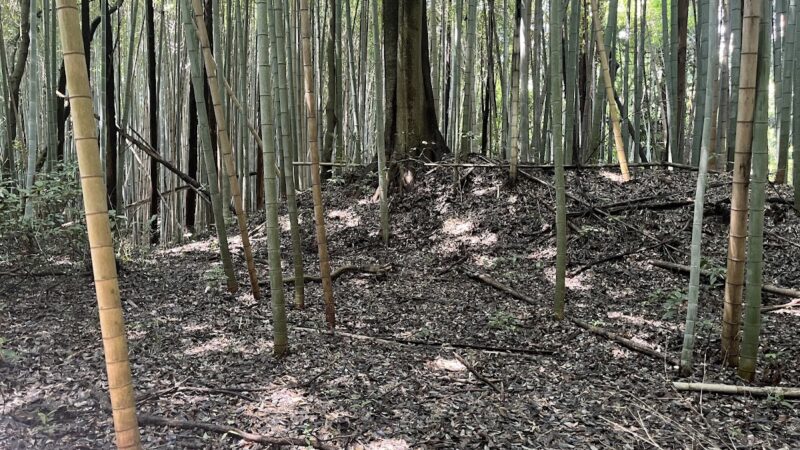
At the northern end of the main enclosure, a well-preserved earthen rampart remains, approximately 2-3 meters high and 5-6 meters wide at its base. This rampart functioned as a defensive structure against attacks from the north.
The interior of the main enclosure is relatively flat, making it a suitable terrain for building structures. While archaeological excavations have been limited, it is a site with a high probability of yielding medieval artifacts.
Dry Moats and Moats
The most distinctive remains of Noguchi Castle are the massive dry moats remaining on the north and west sides. The northern dry moat functioned as a moat separating the main enclosure from the northern hill, measuring approximately 10-15 meters wide and 5-7 meters deep. This dry moat has a cross-sectional shape close to a V, exhibiting the typical characteristics of a moat from the Sengoku period. It functioned as an important defensive line to prevent enemy incursions from the north.
The dry moat on the west side, though slightly smaller in scale, is also clearly preserved. These dry moats were formed by utilizing the natural terrain while also being artificially excavated, and are considered relics demonstrating the high level of castle construction technology in the medieval period.
Northern Cemetery and Enclosure
North of the main enclosure, beyond the dry moat, lies a flat area that is now a cemetery. This area was originally part of the castle and is highly likely to have functioned as the northern enclosure.
Some researchers point out that this cemetery area should also be included within the designated historical site area. This enclosure is thought to have been used as a forward position for the main enclosure or as a lookout post.
Approach and Entrance
From the prefectural road on the south side, a sloping path leads to the main enclosure via a slightly elevated plateau. This slope is thought to be a remnant of the former main road (the path to the front entrance).
In medieval castles, the defense of the entrance (koguchi) was considered crucial, but the detailed structure of Noguchi Castle’s entrance is currently unclear. However, the topography clearly indicates that the approach from the south was the main entrance.
Highlights of Noguchi Castle
Existing Earthworks
The biggest highlight when visiting Noguchi Castle is the earthworks remaining at the northern end of the main enclosure. The fact that these earthworks, built over 600 years ago, remain so clearly visible today evokes the atmosphere of a medieval castle.
Standing on top of the earthworks, a panoramic view to the north opens up, allowing one to imagine how the castle’s soldiers once guarded the north from this position. The earthworks are well-preserved, with little collapse, and retain much of their original shape.
Massive Dry Moats
The dry moats remaining on the north and west sides are remnants that attest to the high defensive capabilities of Noguchi Castle. The northern moat, in particular, is large and deep, and you can truly appreciate its scale and power by actually descending to the bottom.
The slopes of the dry moat are steep, designed to prevent enemy soldiers from easily climbing. Looking up at the main enclosure from the bottom of the moat also clearly demonstrates the castle’s formidable strength.
The Place Name “Gojo”
The place name “Gojo,” which still remains today, is a valuable historical trace indicating that this area was once a castle. Local people still refer to this area as “Gojo,” preserving the region’s historical memory.
View
From Noguchi Castle, you can see the flow of the Nakagawa and Ogawa rivers, as well as the surrounding plains. The view, which allows you to appreciate the topographical advantage of the hill on which the castle was built, is one of the major attractions for visitors.
The view from the main enclosure is particularly good, allowing you to imagine the former lords governing their territory while gazing upon this scenery.
Access and Visiting Information
Transportation Access
Access by Car:
- Approximately 20 minutes from the Naka IC on the Joban Expressway
- Take National Route 118 and then a prefectural road
- Parking space is limited, so be careful when parking on the street.
Access by Public Transportation:
- Approximately 15 minutes by bus or taxi from Hitachi-Omiya Station on the JR Suigun Line
- Approximately 1 hour on foot
Visiting Precautions
- Part of the castle ruins is private property, so do not enter restricted areas.
- Be careful not to damage fields or solar power facilities in areas with them.
- Watch your step as the slopes of the dry moats and earthworks can be slippery.
- Estimated visiting time is 20-30 minutes.
- Information boards and explanatory signs are limited, so researching the history beforehand will deepen your understanding.
Best Season for Visiting
While Noguchi Castle can be visited year-round, the following seasons are especially recommended:
- Spring (March-May): Mild weather and beautiful fresh greenery
- Autumn (October-November): Enjoy the autumn foliage and comfortable temperatures
- Winter (December-February): The vegetation withers, making the ruins easier to see
In summer, the vegetation is dense, making observation of the ruins somewhat difficult.
Related Historical Sites Around Noguchi Castle
Nagakura Castle
Located approximately 3 kilometers north of Noguchi Castle, Nagakura Castle is another castle associated with the Kawanobe clan. It may have functioned as a subsidiary castle of Noguchi Castle, and visiting both will provide a deeper understanding of the Kawanobe clan’s sphere of influence.
Nagakura Jinya
The Nagakura Jinya, established during the Edo period, is also an important historical site for understanding the history around Noguchi Castle. By comparing early modern encampments with medieval castles, you can learn about the changes in castle architecture over time.
Hitachiomiya City Historical and Folk Museum
This facility allows you to learn about the history of Hitachiomiya City, including Noguchi Castle. It may display materials and excavated artifacts related to Noguchi Castle, so it is recommended to visit before or after visiting the castle ruins.
About the Kawanobe Clan
Descendants of Fujiwara no Hidesato
The Kawanobe clan was a prestigious samurai family descended from Fujiwara no Hidesato, who quelled the rebellion of Taira no Masakado. Hidesato’s descendants spread throughout the Kanto region, forming many powerful samurai groups such as the Oyama, Yuki, and Sano clans.
The Kawanobe clan was one of them, settling in Naka District, Hitachi Province, and maintaining their power with Noguchi Castle as their base for approximately 600 years. This long period of local rule demonstrates the strength of the Kawanobe clan’s influence in the region.
Origin of the Surname
The surname “Kawanobe” is said to originate from the fact that their castle, Noguchi Castle, was located by the river, or from the name of the castle itself. It was common for samurai in the medieval period to adopt the name of their territory or castle as their surname, and the Kawanobe clan was no exception.
Relationship with the Satake Clan
From the Nanboku-cho period onward, the Kawanobe clan came under the influence of the Satake clan, a powerful daimyo family in Hitachi Province. Records show that during the Sengoku period, they participated in the Satake clan’s military actions as their retainers.
When the Satake clan was transferred to Akita, some members of the Kawanobe clan are believed to have followed them to Akita. Records of the Akita domain confirm the existence of samurai with the Kawanobe surname, who may be descendants of the lord of Noguchi Castle.
Current Status and Preservation Activities of Noguchi Castle
Historic Site Designation and Preservation
Noguchi Castle is a designated historical site of Hitachiomiya City and receives legal protection. However, the designated area mainly covers the main enclosure, and some important remains, such as the northern enclosure, are not included.
In recent years, castle researchers and local history enthusiasts have pointed out the need to expand the designated area and implement more proactive preservation and utilization measures.
Installation of Solar Power Facilities
In recent years, solar power facilities have been installed on part of the main enclosure. While this is a form of land use on private property, there is debate regarding its impact on the castle landscape and from the perspective of preserving the remains.
On the other hand, the installation of the facilities has led to regular grass cutting, improving the visibility of the remains.
Local Initiatives
Local history enthusiast groups and the board of education are working to pass on the history of Noguchi Castle to future generations. Efforts continue to widely communicate the value of Noguchi Castle through the installation of information boards and local history education at local elementary schools.
Historical Value of Noguchi Castle
Evidence of Long-Term Local Rule
The greatest historical value of Noguchi Castle lies in the fact that it was continuously used as a residence by a single clan (the Kawanobe clan) for approximately 600 years. Such a long period of time spent by the same clan as their base of operations is rare nationwide.
This fact demonstrates that the Kawanobe clan was deeply rooted in the local community and exercised stable rule.
A Typical Example of a Medieval Castle
Noguchi Castle is a valuable archaeological site that shows the development process of castles from the late Heian period to the Sengoku period. The remains reveal how it evolved from a simple residence to a full-fledged military base during the Sengoku period, with defensive facilities strengthened over time.
In particular, the remains of earthworks and dry moats are important resources for castle research, as they are typical defensive structures of medieval castles.
Material for Local History Research
The history of Noguchi Castle is indispensable material for studying the local history of Naka District, Hitachi Province. Through the Kawanobe clan, we can gain a concrete understanding of the history of medieval Hitachi Province, including the development of the Fujiwara Hidesato-lineage samurai group, the turmoil of the Northern and Southern Courts period, and the expansion of the Satake clan’s power.
Summary
Noguchi Castle (Hitachiomiya City, Ibaraki Prefecture) is a historical castle built in 991 (Shōryaku 2) by Kawanobe Michinao, and functioned as the residence of the Kawanobe clan for approximately 600 years. Built on a strategic location at the confluence of the Naka River and Ogawa River, its remains, such as earthworks and dry moats, are still well-preserved today.
With a long history spanning from the Heian period to the Sengoku period, it experienced the turmoil of the Northern and Southern Courts period and the conflicts of the Sengoku period before being abandoned around 1590. It is a rare castle nationwide in that it served as the residence of the Kawanobe clan for such a long period. Currently protected as a designated historical site by Hitachiomiya City, this valuable historical heritage site preserves the appearance of a medieval castle, conveying the atmosphere of the past to visitors. It is a historical site highly recommended for anyone interested in the history of Ibaraki Prefecture or castles.