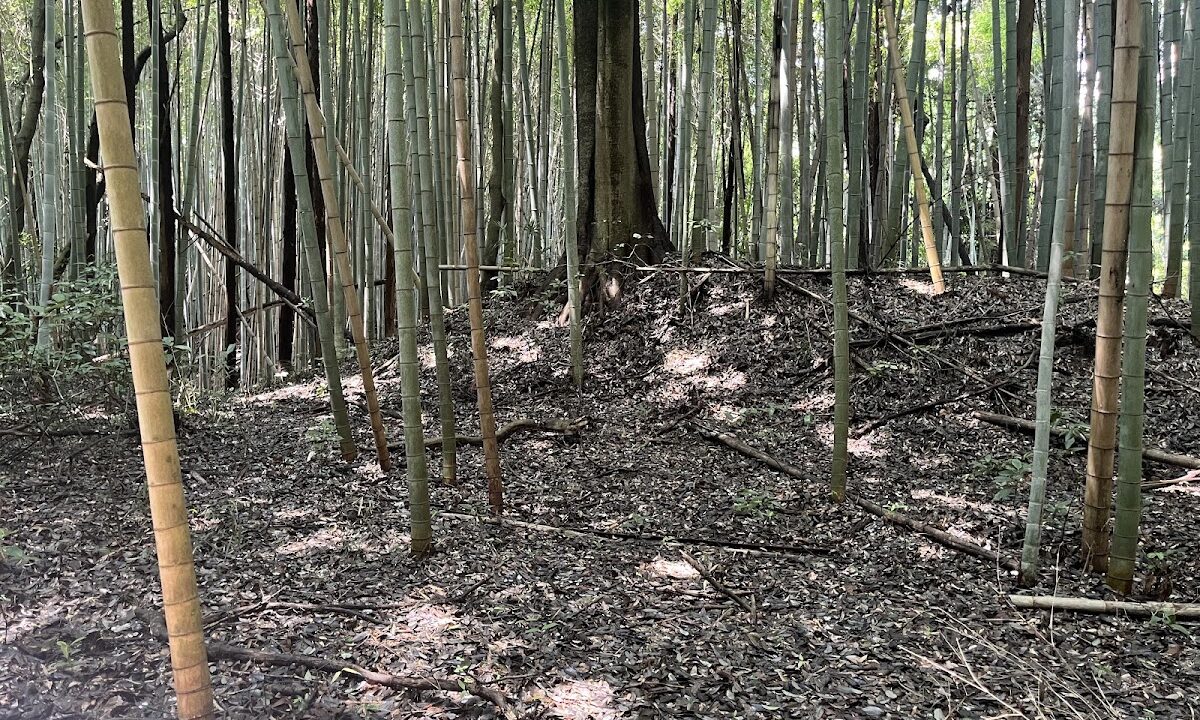
Complete Guide to Ishizuka Castle (Shirosato Town, Ibaraki Prefecture) | History, Highlights, and Access Information
What is Ishizuka Castle?
Ishizuka Castle is a medieval hilltop castle located in Ishizuka, Shirosato Town, Higashiibaraki District, Ibaraki Prefecture. Also known as “Hitachi Ishizuka Castle,” it functioned as an important base in Hitachi Province from the Nanboku-cho period to the Sengoku period. Built on a hill approximately 47m above sea level and 30m above ground level, this castle is a notable site in medieval castle research due to its large scale and well-preserved remains.
The current Ishizuka district of Shirosato Town is the administrative center where the town hall is located, and its postal code is 311-4303. The area surrounding the castle ruins is a mix of residential and agricultural land, retaining traces of its former castle status while being used as a modern living space.
Geographical Location and Environment
Ishizuka Castle is located in the Ishizuka district of Shirosato Town, almost in the center of Ibaraki Prefecture. Shirosato Town belongs to Higashiibaraki District and is adjacent to the northwest of Mito City. The castle ruins are located near a tributary of the Naka River system, and were built in a strategic location that allowed control of both water and land routes.
The surrounding area is a hilly region with undulating terrain, and the castle was constructed by skillfully utilizing the natural topography. Even today, the layout of the castle can be discerned from the elevation differences of the terrain.
History of Ishizuka Castle
Construction History and the Nanboku-cho Period
Ishizuka Castle is believed to have been built in 1362 (Jōji 1st year/Shōhei 17th year) during the Nanboku-cho period by Ishizuka Muneyoshi. This period was a turbulent time when the Southern and Northern Courts were in conflict, and samurai groups throughout the country were divided between the two forces and fighting each other.
In Hitachi Province, the forces of the Southern and Northern Courts were in a state of balance, and castles and fortifications were built throughout the region. Ishizuka Castle is believed to have been constructed as a base for regional control within this historical context. The Ishizuka clan established their power as local lords in the region, expanding their territory from the castle.
The Ishizuka Clan and the Castle’s Development
The Ishizuka clan, as one of the powerful samurai groups in Hitachi Province, used Ishizuka Castle as their base throughout the medieval period. While there are various theories regarding the Ishizuka clan’s lineage, connections to other powerful samurai groups in Hitachi, such as the Satake and Edo clans, have been pointed out.
From the Muromachi period to the Sengoku period, the Ishizuka clan maintained their power through repeated conflicts and alliances with surrounding regions. It is presumed that the castle was expanded and renovated over time, developing into a more robust defensive structure.
Trends in the Sengoku Period
With the arrival of the Sengoku period, Hitachi Province became a stage for power struggles centered around the Satake clan. The Ishizuka clan also strived to maintain their influence in the region while deepening their relationship with the Satake clan.
In the latter half of the 16th century, as Toyotomi Hideyoshi’s unification of Japan progressed, the political situation in Hitachi Province changed dramatically. The Satake clan was recognized as a powerful daimyo controlling most of Hitachi Province under the Toyotomi regime, but after the Battle of Sekigahara, Tokugawa Ieyasu ordered them to relocate to Akita in Dewa Province.
There is a theory that the Ishizuka clan also moved to Akita along with the Satake clan, but it is also said that some remained in their original location. In any case, Ishizuka Castle was abandoned in the early Edo period and lost its function as a castle.
Structure and Remains of Ishizuka Castle
Characteristics of the Castle Layout
Ishizuka Castle is a flatland castle that skillfully utilizes the hilly terrain. It has a structure where multiple enclosures are arranged in a stepped pattern around the main enclosure. The castle is relatively large, and multiple enclosures, including the second and third enclosures, have been identified in addition to the main enclosure.
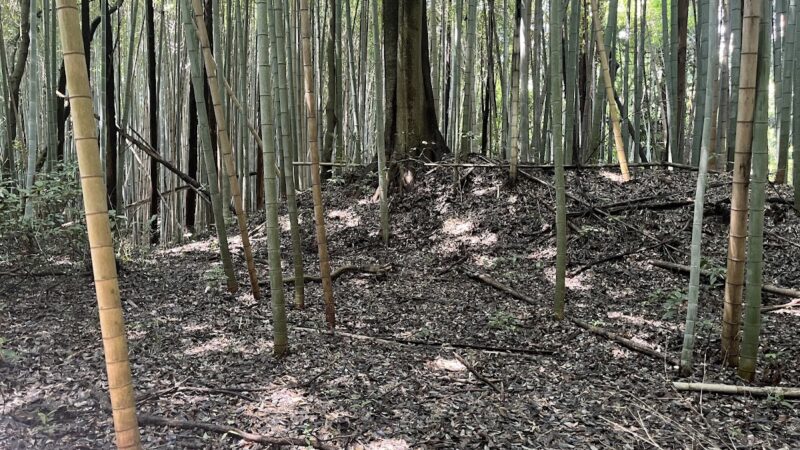
The castle’s defensive structures included dry moats, earthworks, and steep slopes. The dry moats, in particular, were positioned to surround the castle and played a crucial role in preventing enemy intrusion. Even today, some remnants of the dry moats remain as terrain, providing clues to the castle’s defensive system.
Existing Remains
The remains of the Ishizuka Castle are relatively well-preserved. The main remains include the following:
Main Enclosure: This is the central part of the castle, located at the highest point. It is now a flat area, and traces of earthworks can be seen around it.
Dry Moat: Part of the dry moat that formed the castle’s defensive line can still be seen as terrain. Its depth and width suggest the high level of its defenses at the time.
Earthworks: Part of the earthworks that surrounded the enclosure remain. Although their height is low, their arrangement allows for the estimation of the castle’s layout.
Steep Slopes: Steep slopes created by carving into the natural terrain can be seen around the castle. These served as defensive structures to make enemy incursions difficult.
Preservation of the Remains
Despite being located in a developed area, the remains of Ishizuka Castle are relatively well-preserved. However, some parts are used as residential areas and farmland, so it does not completely retain its original appearance.
While some of the bailey remains have been developed into residential areas, the basic structure of the castle, such as the elevation differences in the terrain and the remains of dry moats, can still be discerned. For castle researchers and history enthusiasts, it is a valuable site for learning about the structure of medieval castles.
Highlights of Ishizuka Castle
Observation Points for Castle Remains
The main highlight when visiting Ishizuka Castle is the well-preserved remains of the medieval castle. Paying particular attention to the following points will allow you to understand the castle’s structure more deeply:
Elevation Differences: When walking around the castle ruins, you can clearly feel the elevation differences. These are the remains of artificially constructed baileys, indicating the separation of defensive and residential spaces.
Traces of the Dry Moat: In some areas, the traces of the dry moat remain clearly visible. The width and depth provide insight into the level of civil engineering technology at the time.
Estimated Location of the Entrance (Kakuchi): At the estimated entrance to the castle enclosure, defensive measures are evident in the topography.
Surrounding Historical Environment
The area surrounding Ishizuka Castle ruins retains a historical environment from the medieval to early modern periods. The Ishizuka district is dotted with old temples, shrines, and stone structures, preserving the region’s history.
The entire town of Shirosato also boasts many historical points of interest, and visiting Ishizuka Castle in conjunction with other areas allows for a deeper understanding of the region’s history.
Visitor Ratings
According to data from “Kojodan,” a community of castle enthusiasts, the average rating for Ishizuka Castle is ★★★☆☆ (2.50), and the recommended visiting time is approximately 30 minutes. With only 44 visitors (as of the time of data collection), this castle site has relatively few visitors, but its appeal lies in the opportunity to quietly observe the remains of a medieval castle.
Access Information
Location
Address: Ishizuka, Shirosato-machi, Higashiibaraki-gun, Ibaraki Prefecture
Postal Code: 311-4303
Ishizuka Castle Ruins are located near the Shirosato Town Hall (1428-25 Ishizuka, Shirosato-machi, Higashiibaraki-gun, Ibaraki Prefecture 311-4391). Using the town hall as a landmark will make accessing the site easier.
Access by Public Transportation
Nearest Station: JR Suigun Line “Hitachi-Konosu Station” or “Shimo-Ogawa Station”
Since it is a distance from the station, you will need to use a local bus or taxi. Bus services are limited, so it is recommended to check the timetable in advance.
Local Bus: Get off at the “Ishizuka” bus stop on the Ibaraki Kotsu bus. However, since there are few train services, checking the timetable is essential.
Access by Car
Joban Expressway:
- Approximately 30 minutes from Mito IC via National Route 118
- Approximately 25 minutes from Naka IC via Prefectural Road
Kita-Kanto Expressway:
- Approximately 35 minutes from Mito-Minami IC via National Route 118
Regarding parking, there is no dedicated parking lot for the castle ruins, but you may be able to use the parking lot at Shirosato Town Hall. It is recommended to check with the town hall before visiting.
Points to Note When Visiting
Ishizuka Castle Ruins are not developed as a historical park; parts of the site are private property and residential areas. Please note the following points when visiting:
- Avoid trespassing on private property
- Do not damage the ruins or collect soil or sand
- Always take your trash with you
- Be considerate of the local residents and observe quietly
- Wear comfortable shoes as there are slippery areas
About the Ishizuka District of Shirosato Town
Overview of the Area
The Ishizuka district functions as the administrative center of Shirosato Town. It is home to the town hall and other public facilities, serving as the town’s political and administrative hub.
The population of Shirosato Town as a whole is approximately 18,000 (as of 2024), and the Ishizuka district is one of its central settlements. While agriculture remains the main industry, in recent years it has also developed as a commuter town for Mito City.
History of the Area
The Ishizuka district has a long history; it is believed that people lived there even before the medieval period when Ishizuka Castle was built. During the Edo period, it became part of the Mito Domain and developed as an agricultural area.
Following the implementation of the town and village system during the Meiji era, Ishizuka Village was established. After subsequent mergers, it became part of the present-day Shirosato Town. In 2005 (Heisei 17), Jōhoku Town, Katsura Village, and Nanae Village merged to form Shirosato Town, and the town hall was established in the Ishizuka district, which was the center of the former Jōhoku Town.
Current Ishizuka District
The current Ishizuka district has the following characteristics:
Administrative Functions: The Shirosato Town Hall main building is located here, making it the center of the town’s administrative services. The telephone number is 029-288-3111 (main).
Educational Facilities: Educational facilities such as elementary and junior high schools are available.
Commercial Facilities: Shops and financial institutions necessary for daily life are located here.
Transportation: National Route 123 passes through the area, providing good access to Mito City.
Tourist Attractions Around Ishizuka Castle
Main Tourist Attractions in Shirosato Town
When visiting Ishizuka Castle, combining your trip with visits to other tourist attractions in Shirosato Town will make your trip even more fulfilling.
Hororu no Yu: A town-run day-trip hot spring facility popular with locals and tourists alike. Perfect for relaxing after exploring the castle ruins.
Fujiigawa Dam: Known as a famous cherry blossom viewing spot, it attracts many visitors in spring. The natural scenery around the dam lake is also beautiful, making it suitable for walks and picnics.
Nakagawa River: Known as a clear stream, it’s a mecca for ayu (sweetfish) fishing. In summer, it’s bustling with people enjoying river activities.
Historical Spots in Nearby Municipalities
Mito City: Numerous historical sites that tell the history of the Mito Domain during the Edo period, such as Mito Castle ruins, Kairakuen Garden, and Kodokan. Approximately 30 minutes by car from Ishizuka Castle.
Kasama City: A tourist destination steeped in history and culture, featuring sites such as the Kasama Castle ruins and Kasama Inari Shrine. It is also famous as a town of pottery.
Research and Evaluation of Ishizuka Castle
Academic Evaluation
Ishizuka Castle holds an important position in the study of medieval castles. Remains showcasing the evolution of castles from the Nanboku-cho period to the Sengoku period, making it a valuable historical resource for understanding the activities of medieval samurai groups in Hitachi Province.
In particular, the structure of the castle layout and the arrangement of defensive facilities can be compared with other castles of the same period to reveal regional characteristics of castle construction techniques.
Challenges of Preservation and Utilization
While the Ishizuka Castle ruins are not currently designated as a national or prefectural cultural property, their preservation and utilization as a regional historical heritage site are needed.
Preservation Challenges:
- Much of the land is privately owned, making it difficult to formulate a comprehensive preservation plan.
- Risk of loss of remains due to development pressure.
- Reduced visibility of remains due to overgrown vegetation.
Potential Uses:
- Use as teaching material for history education.
- Development as a tourist resource.
- Positioning as a core element of regional identity.
Significance of Visiting Ishizuka Castle
As a Place for Historical Learning
Visiting the Ishizuka Castle ruins is a valuable opportunity to experience the true picture of medieval history that cannot be learned from textbooks. By actually walking the castle ruins and observing the topography, you can get a real sense of how people at that time considered defense and what kind of lives they led.
In particular, for those interested in the structure and construction techniques of medieval castles, it is a valuable place to directly observe well-preserved remains.
Deepening Understanding of Local History
Learning the history of Ishizuka Castle is an entry point to understanding the local history of Shirosato Town and Ibaraki Prefecture. Through the activities of the local lord, the Ishizuka clan, you can learn about the movements of history at the local level, which differ from central political history.
Furthermore, strolling around the castle ruins allows you to experience firsthand the changes in the region from the Middle Ages to the present day.
Quiet Historical Exploration
Ishizuka Castle is a quiet historical spot, far removed from the crowds of famous tourist destinations. You can observe the remains at your own pace and reflect on history.
For castle enthusiasts and history lovers, visiting such a “hidden gem” is a special pleasure. Ishizuka Castle, with its unique charm different from major castle ruins, is a historical site well worth visiting.
Summary
Ishizuka Castle is a medieval hilltop castle located in Ishizuka, Shirosato-machi, Ibaraki Prefecture, built in 1362 during the Nanboku-cho period by Ishizuka Muneyoshi. Built on a hill approximately 47m above sea level and 30m above ground, this castle is large in scale, and its remains, such as dry moats and earthworks, are relatively well-preserved.
The castle, which served as the base of the Ishizuka clan throughout the Middle Ages, was abandoned in the early Edo period, but the landscape still retains traces of its former glory. Since the castle ruins include private land, consideration is necessary when visiting, but it is a valuable historical site for learning about the structure of medieval castles.
The Ishizuka district of Shirosato Town is the administrative center where the town hall is located, and its postal code is 311-4303. It is about a 30-minute drive from Mito City, and there are other tourist attractions such as hot springs and natural landscapes scattered around the area.
Ishizuka Castle is not a famous tourist spot, but it is a charming historical site where you can quietly feel the history. It is a place that those interested in medieval castles and those who want to learn about the local history of Ibaraki Prefecture should definitely visit.