Sekijo Castle (Chikusei City, Ibaraki Prefecture) Complete Guide – The Charm of a Fierce Battlefield of the Nanboku-cho Period and a National Historic Site
Sekijo Castle, located in Sekidate, Chikusei City, Ibaraki Prefecture, is a flatland castle that played an important role from the Kamakura period to the Nanboku-cho period. Designated as a national historic site, the castle ruins were the stage for fierce battles during the Nanboku-cho period, and are particularly known for the valuable remains of tunnel warfare. This article provides a detailed explanation of everything you need to know before visiting Sekijo Castle, from its historical background to its highlights and access methods.
Historical Background of Sekijo Castle
Construction in the Kamakura Period and the Seki Clan
Sekijo Castle was built in the early Kamakura period by the Fujiwara-descended Seki clan, a branch of the Yuki clan. The Seki clan originated when Tomohiro, son of Yuki Tomomitsu, ruled Seki County and adopted the name Seki, establishing their base in this area. The castle was located in Makabe District, Hitachi Province (present-day Chikusei City, Ibaraki Prefecture), and was a strategically advantageous stronghold, utilizing the tip of a peninsula-shaped plateau that jutted out into the former Taiho Marsh.
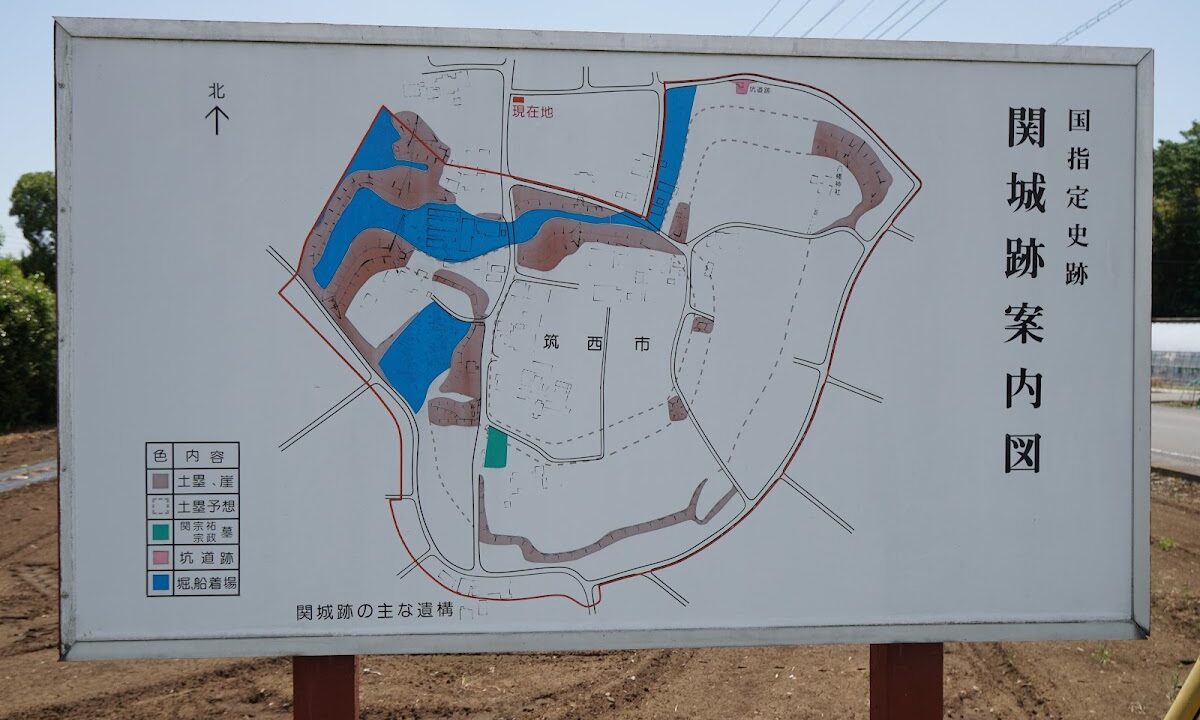
Surrounded on three sides—east, west, and south—by the low-lying wetlands of Taiho Marsh, and with a deep moat on the northern side which was connected to the mainland, it functioned as a natural fortress. This topographical feature was a crucial factor that enabled the fierce battles that followed during the Nanboku-cho period.
As a site of fierce battles during the Nanboku-cho period
Seki Castle comes to the forefront of history during the Nanboku-cho period. In 1340, Kitabatake Chikafusa, a court noble of the Southern Court, moved from Oda Castle to Seki Castle, and fought alongside the castle lords, Seki Munesuke and his son Munemasa, as a base for the Southern Court army.
Kitabatake Chikafusa is known as a close confidant of Emperor Go-Daigo, and his work, *Jinnō Shōtōki*, holds an important position in Japanese history. Because Chikafusa established Seki Castle as his base, it became a crucial military stronghold for the Southern Court and the stage for fierce battles against the Northern Court.
The Northern Court, with Kō no Morofuyu as their commander-in-chief, besieged Seki Castle with a large army, and a fierce battle ensued from 1341 to the following year. The castle lord, Seki Muneyuki, was killed, and Kitabatake Chikafusa escaped and moved to Ōhō Castle. This battle is recorded as one of the most important battles in the Kanto region during the Nanboku-chō period.
As one of the Six Castles of Kanto
During the Nanboku-chō period, Seki Castle was counted as one of the “Six Castles of Kanto” of the Southern Court. The Six Castles of Kanto refers to the major group of castles that the Southern Court used as bases in the Kanto region, and included Seki Castle, Ōhō Castle, and Makabe Castle. These castles worked in conjunction with each other to resist the Northern Court forces, playing a crucial role in maintaining the Southern Court’s influence in the Kanto region.
Structure and Topographical Features of Seki Castle
Layout Utilizing a Peninsula-Shaped Plateau
Seki Castle was built on the tip of a long, narrow, tongue-shaped plateau surrounded on three sides (east, west, and south) by Lake Taiho (now a rice paddy area). This topographical feature meant the castle was protected by a natural moat, making it a very difficult for attackers to conquer.
The plateau’s elevation was several meters higher than the surrounding low-lying wetlands, allowing for views of the purple peak of Mount Tsukuba to the east and the allied base of Taiho Castle across Lake Taiho to the south. This excellent visibility is thought to have played a vital role in military communication and information dissemination.
Remains of Moats and Earthworks
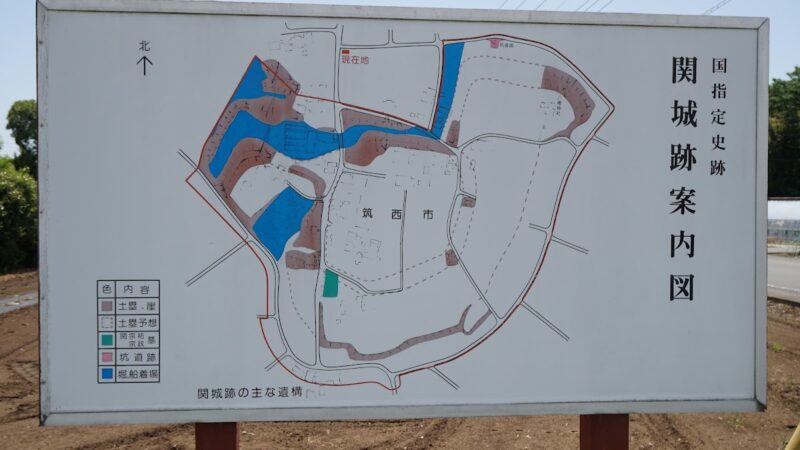
Even today, the remains of moats and earthworks, built to defend the northern side, are well-preserved at the Seki Castle site. The northern side, which was connected to the mainland, was the direction requiring the most defense. A deep moat was excavated here, and the excavated soil was used to construct an earthen embankment, forming a double line of defense.
The remains reveal that the moat was large, measuring over 10 meters wide and several meters deep. The earthen embankment was also several meters high, confirming that it possessed impressive defensive facilities for a medieval flatland castle.
Valuable Remains of Tunnel Warfare
The most distinctive feature of Seki Castle is the remains of tunnels believed to have been constructed during the siege of the castle during the Nanboku-cho period. This is an extremely rare remains in the history of Japanese castles and is an invaluable resource for understanding the realities of siege warfare at that time.
The tunnels are believed to have been dug by the Northern Court during their attack on the castle, and are evidence of an attempt to breach the castle’s defenses from underground. While tunnel warfare is known as a medieval tactic, actual examples that can be confirmed are limited nationwide, and the tunnel remains at Seki Castle are one of the important reasons for its designation as a national historical site.
Seki Castle Ruins as a National Historic Site
History and Value of Historic Site Designation
Seki Castle Ruins have been designated a National Historic Site due to their historical importance and the excellent state of preservation of their remains. Their historical value as the site of fierce battles during the Nanboku-cho period, their archaeological value as remains of tunnel warfare, and the fact that they retain a well-preserved structure of a medieval flatland castle were all recognized.
With the designation as a historic site, preservation and appropriate management of the remains are being carried out, and efforts to pass on this valuable historical heritage to future generations continue. While many medieval castles exist in Ibaraki Prefecture, only a limited number of castle ruins are designated as National Historic Sites, and Seki Castle holds a significant position among them.
Preservation Status and Current State
Currently, the remains of Seki Castle Ruins are well-preserved, mainly in the main enclosure. The surrounding area is now rice paddies, allowing visitors to imagine the former Daibo Marsh. Information boards are installed on the plateau, allowing visitors to learn about the castle’s history and structure.
While some parts of the earthworks and moats are covered with vegetation, their scale and shape are clearly discernible, allowing visitors to appreciate the structure of a medieval castle. From spring to summer, the greenery is beautiful, and in autumn, the surrounding rural landscape combines to create a charming view.
Highlights and Sightseeing Points of Seki Castle
Main Enclosure and Earthworks
When visiting Seki Castle ruins, start by walking through the main enclosure. Located on the highest point of the plateau, the main enclosure offers a panoramic view of the surrounding rice paddies, allowing you to appreciate the strategic location surrounded by the former Taiho Marsh. Standing on the earthworks, you can understand how the castle’s defensive lines were designed.
Moat Remains
The moat remains on the north side are one of Seki Castle’s highlights. Standing at the bottom of the deeply excavated moat, you can imagine how attackers attempted to cross it and how defenders defended it. The scale of the moat reveals the importance of this castle.
Traces of Tunnel Warfare
The remains of tunnel warfare, rare nationwide, are the most distinctive feature of Seki Castle. While the actual tunnel remains are not usually open to the public for preservation purposes, you can learn about their location and historical significance from the explanatory signs. As a valuable relic that conveys the reality of the fierce battles during the Nanboku-cho period, it’s a must-see for history buffs.
Views and Surrounding Landscape
From the Seki Castle ruins, you can see Mount Tsukuba to the east and the direction of Taiho Castle to the south. Especially on a clear day, you can admire the beautiful figure of Mount Tsukuba, imagining the view seen by the castle lord and Kitabatake Chikafusa in the past. The surrounding rural landscape shows different expressions in each season, making it a suitable spot for photography.
Related Historical Sites and Castles in the Surrounding Area
Taiho Castle (Shimotsuma City)
Located approximately 2.4 kilometers from Seki Castle, Taiho Castle was an important base for the Southern Court, cooperating with Seki Castle during the Nanboku-cho period. Known as the castle to which Kitabatake Chikafusa moved from Seki Castle, visiting both Seki Castle and Shimodate Castle allows for an understanding of the Southern Court’s strategies in the Kanto region during the Nanboku-cho period.
Shimodate Castle (Chikusei City)
Located in the center of Chikusei City, Shimodate Castle is approximately 10 kilometers from Seki Castle. It functioned as an important castle from the Sengoku period to the Edo period. Although it dates from a different era than Seki Castle, it is an important historical site for understanding the castle history of Chikusei City.
Makabe Castle (Sakuragawa City)
Makabe Castle, like Seki Castle, was one of the six castles in the Kanto region during the Nanboku-cho period and was the base of the Makabe clan. It fought in conjunction with Seki Castle as a base for the Southern Court against the Northern Court. Currently designated as a national historical site, it retains well-preserved remains.
Yuki Castle (Yuki City)
Yuki Castle was the base of the Yuki clan, the main branch of the Seki clan who built Seki Castle. The Yuki clan held significant power in southern Hitachi Province from the Kamakura period to the Sengoku period, and the Seki clan, as a branch of the Yuki family, played an important role. Understanding the Yuki clan’s activities is crucial to understanding the history of Seki Castle.
Access Information and Visiting Guide
Access by Public Transportation
The nearest station to Seki Castle Ruins is Kuroko Station on the Kanto Railway Joso Line. It’s approximately a 20-minute walk or a 5-minute drive from Kuroko Station to the castle ruins. From Shimodate Station on the JR Mito Line, it’s about a 15-minute drive; using a taxi or rental car is convenient.
Since public transportation is limited, it’s recommended to check the timetable in advance and plan your visit accordingly. If you plan to visit other nearby castle ruins, using a rental car is more efficient.
Access by Car
By car, it’s approximately 40 minutes from the Yawara IC on the Joban Expressway and approximately 20 minutes from the Sakuragawa-Chikusei IC on the Kita-Kanto Expressway. Access is possible via National Route 294 and prefectural roads. While there isn’t a dedicated parking lot around the castle ruins, there may be some parking spaces along the roadside. However, please avoid unauthorized parking on farm roads or private property, and visit with good manners.
Visiting Hours and Required Time
Seki Castle Ruins are an outdoor historical site and are generally open to visitors. If you plan to thoroughly examine the main enclosure and moat remains, allow 30 minutes to an hour. If you take your time to stroll around, read the information boards, and take photos, it may take more than an hour.
The castle ruins are not a well-maintained park but a preserved historical site, so comfortable walking shoes are recommended. In summer, the area may be overgrown with grass, so wearing long sleeves and long pants is advisable.
Precautions During Visit
Seki Castle Ruins are designated as a national historical site, and the destruction or removal of any remains is prohibited by law. Please be careful not to damage the earthworks or moats, and be sure to take all your trash with you. The surrounding area is farmland, so please be considerate and avoid interfering with agricultural work.
The mine shafts are normally off-limits for preservation purposes. Please refrain from attempting to explore them unnecessarily and instead rely on the information provided on the explanatory signs. Also, be especially careful when visiting during or after rain, as the ground can become slippery depending on the weather.
Tips for Enjoying Sekijo Castle
Recommendations for Prior Study
To gain a deeper understanding of Sekijo Castle, it is recommended to study the history of the Nanboku-cho period and Kitabatake Chikafusa beforehand. Reading books on the Nanboku-cho period and the conflict will provide a clearer understanding of the historical role Sekijo Castle played.
Historical museums in Ibaraki Prefecture and Chikusei City may have exhibits and materials related to Sekijo Castle. Gathering information at these facilities before your visit will enrich your experience.
Photography Tips
Sekijo Castle ruins are a beautiful historical site that displays different expressions throughout the seasons. Enjoy the fresh greenery in spring, the lush green rice fields in summer, the golden rice stalks in autumn, and the snowy landscapes in winter. Photographs with Mount Tsukuba in the background are particularly good records of Sekijo Castle’s geographical location.
When photographing the remains of earthworks and moats, it’s a good idea to take pictures that convey a sense of scale. Taking photos with explanatory signs will make it easier to recall the location and content when reviewing them later.
Combining with surrounding sightseeing
Visiting sightseeing spots in Chikusei City and the surrounding area in conjunction with a visit to Sekijo Castle ruins will make for a more fulfilling trip. Shimodate city center has historical buildings and shopping streets, and you can enjoy local food culture.
Besides Sekijo Castle, Chikusei City has other historical sites such as Shimodate Castle ruins and Ebigashima Castle ruins, making it worthwhile for castle enthusiasts to spend a day exploring. Furthermore, there are many spots where you can experience history and culture, such as the Mooka Railway’s steam locomotive train and the townscape of Makabe in the nearby Sakuragawa City.
Sekijo Castle’s cultural value
Importance in medieval castle research
Sekijo Castle, as a medieval flatland castle, is an important resource for studying its structure and defensive system. In particular, the remains of tunnel warfare are valuable physical evidence of medieval siege tactics and hold significant value in the study of Japanese castle history.
The castle’s layout, utilizing the terrain surrounded by low-lying wetlands to the east, west, and south, demonstrates strategic thinking in the selection of a flatland castle’s location and serves as an important case study for understanding medieval castle construction techniques and military thought.
Contribution to the Study of the Nanboku-cho Period
Seki Castle, as an important base for the Southern Court in the Kanto region during the Nanboku-cho period, makes a significant contribution to the study of this era’s history. The fact that Kitabatake Chikafusa, a key figure from the central government, based himself in a castle in Kanto is important evidence that the Nanboku-cho period was a nationwide civil war.
Records of the battles at Seki Castle are also found in historical sources such as the “Jinnō Shōtōki” and “Taiheiki,” and as a valuable example where documentary sources and archaeological remains coincide, it is being studied from both historical and archaeological perspectives.
As a Regional Historical Heritage Site
Sekijo Castle is one of the representative historical heritage sites of Chikusei City and Ibaraki Prefecture. It plays an important role in local history education, and opportunities to learn about the history of Sekijo Castle are provided in local elementary and junior high schools.
Its designation as a National Historic Site is a source of pride for local residents, and many people are involved in the preservation of the site and the transmission of its history. Sekijo Castle is not merely a historical relic, but a crucial element that continues to shape the region’s identity.
Things to Know Before Visiting Sekijo Castle
History and Culture of Chikusei City
Chikusei City was formed in 2005 through the merger of Shimodate City, Akeno Town, Sekijo Town, and Kyowa Town. The name Sekijo Town originates from Sekijo Castle itself, and it has long been cherished as a historical symbol of the region.
Chikusei City has developed as a transportation hub since ancient times, and many castles were built there from the Kamakura period to the Sengoku period. Sekijo Castle is considered one of the oldest and most important castles among them.
History and Genealogy of the Seki Clan
The Seki clan, who built Seki Castle, were a branch of the Yuki clan and held power in Hitachi Province from the Kamakura period to the Sengoku period. It began with Yuki Tomomitsu’s son, Tomohiro, who ruled Seki County and adopted the name Seki, and the clan ruled this area for generations.
During the Nanboku-cho period, Seki Muneyuki fought on the side of the Southern Court and was killed in a fierce battle against the Northern Court. The Seki clan continued until the Sengoku period, but eventually fell under the influence of powerful forces such as the Satake and Later Hojo clans, and is believed to have returned to farming during the Edo period.
Understanding Cultural Property Preservation
When visiting the Seki Castle ruins, it is important to understand that this is an important national cultural property and to observe appropriate manners. Please follow basic rules such as not damaging the remains, not littering, and not trespassing on private property.
The preservation of historical sites is supported by the efforts of local residents and the government. By each visitor having an awareness of cultural property preservation, we can pass on this valuable historical heritage to future generations.
Summary – The Charm of Seki Castle and the Significance of Visiting It
Seki Castle, located in Chikusei City, Ibaraki Prefecture, is an important castle ruin with a long history, from its construction in the Kamakura period to the fierce battles of the Nanboku-cho period and its designation as a national historical site today. Built by the Seki clan, a branch of the Yuki clan, and serving as a stronghold for the Southern Court, where Kitabatake Chikafusa was based, it left a significant mark on Japanese history.
The remains of tunnel warfare, which are rare nationwide, the well-preserved earthworks and moats, and the beautiful surrounding rural landscape allow visitors to experience medieval history firsthand. Its value as a national historical site lies not only in its past battlefield status, but also in its importance as a vital resource for understanding medieval castle construction techniques and tactics, and the turbulent era of the Nanboku-cho period.
Visiting the Seki Castle ruins is a valuable opportunity to experience the history of the Nanboku-cho period, which you may have learned about in textbooks, in a real-world setting, and to reflect on the era in which our ancestors lived. Visiting nearby castles such as Taiho Castle and Makabe Castle will give you a deeper understanding of the overall picture of the battles in the Kanto region during the Nanboku-cho period.
When you visit Ibaraki Prefecture, be sure to visit Seki Castle Ruins in Chikusei City and experience the value of this precious historical site designated as a National Historic Site. The castle ruins, nestled amidst a tranquil rural landscape, will teach you about the depth of Japanese history and the importance of preserving cultural properties that convey that history to the present day.