Complete Guide to Okami Castle (Ibaraki Prefecture): History and Remains of the Birthplace of the Okami Clan, Dating Back to the Nanboku-cho Period
What is Okami Castle?
Okami Castle was a Japanese castle located in Okami-cho, Ushiku City, Ibaraki Prefecture. It is known as the first residence of the Okami clan, who wielded considerable power in southern Hitachi Province from the Nanboku-cho period to the Sengoku period. Built on a plateau on the north bank of the Ono River, this castle holds significant historical value as the birthplace of the Okami clan, and its remains, such as earthworks and dry moats, remain in excellent condition even today.
The castle ruins are located adjacent to a residential area in Okami-cho, Ushiku City, and exhibit the form of a flatland castle centered around a square main enclosure. Although it was abandoned at the end of the Sengoku period, its remains are valuable historical materials for understanding the castle-building techniques of the time and the extent of the Okami clan’s influence.
History of Okami Castle
Construction During the Nanboku-cho Period and the Origin of the Okami Clan
Okami Castle is believed to have been built during the Nanboku-cho period. The Okami clan was a branch of the Oda clan, a prominent family in Hitachi Province. They separated from the Oda clan and established their base in the Ushiku region. During the turbulent Nanboku-cho period, the Okami clan sided with the Northern Court alongside the Oda clan, solidifying their power base in the region.
The ancestor of the Okami clan is said to be Okami Haruchika, son of Oda Haruhisa, and it is believed that they adopted the name Okami from the place name Okami. Okami Castle was the first castle the Okami clan established, and is literally the birthplace of the Okami clan.
From the Muromachi Period to the Sengoku Period
Throughout the Muromachi period, the Okami clan grew into a powerful local lord in southern Hitachi Province. While based at Okami Castle, they expanded their influence into the surrounding areas. In particular, it is believed that they strengthened their economic base by controlling water transport in the Onogawa River basin.
With the arrival of the Sengoku period, the Okami clan built Ushiku Castle, a more formidable fortress, and moved their base there. However, it is presumed that Okami Castle was not abandoned and continued to be used as a subsidiary castle of Ushiku Castle. During this period, the Okami clan maintained their own sphere of influence while still being subordinate to the Oda clan.
The Turmoil of the Sengoku Period and the Okami Clan
During the Sengoku period, Hitachi Province became the stage for conflict between the Satake clan to the north and the Oda clan to the south. The Okami clan, as a branch of the Oda clan, sided with them, but amidst the complex political situation in the region, they sometimes acted on their own judgment.
In the mid-16th century, when the Oda clan was at a disadvantage in their battle against the Satake clan, the Okami clan also found themselves in a difficult situation. Because the Ushiku region was located on the border between the Satake and Oda clan spheres of influence, it became embroiled in the conflict between the two forces.
Abandonment of the Castle in 1590
In 1590, Toyotomi Hideyoshi launched the Siege of Odawara. During this period, the various daimyo of the Kanto region were forced to submit to Hideyoshi, and those who refused had their territories confiscated. The Oda clan, including the Okami clan, was also affected by this major political upheaval.
After the Siege of Odawara, when Tokugawa Ieyasu was transferred to the Kanto region, southern Hitachi Province became a direct territory of the Tokugawa clan or the territories of their vassals. In this process, Okami Castle was abandoned, ending its role as a castle of the Sengoku period. While many details about the Okami clan’s subsequent fate remain unclear, it is said that they either returned to farming or moved to other regions.
Structure and Layout of Okami Castle
Location and Topographical Characteristics
Okami Castle was built on the southern edge of a slightly elevated area (plateau) on the north bank of the Ono River. This location, with the Ono River as a natural moat to the south, utilizes the plateau’s topography for a defensive layout. Although classified as a flatland castle, its slightly elevated plateau provides a certain level of defensibility.
The Onogawa River flows into Lake Kasumigaura and was a vital waterway at the time. The castle’s location suggests it served not only as a military defense but also as a base for economic activities and information gathering utilizing water transport.
Structure of the Main Enclosure
The main enclosure of Okami Castle is composed of a nearly square enclosure. Based on the remaining structures, it is estimated to have been approximately 80 meters on each side. An earthen rampart surrounded the main enclosure, and a dry moat encircled it.
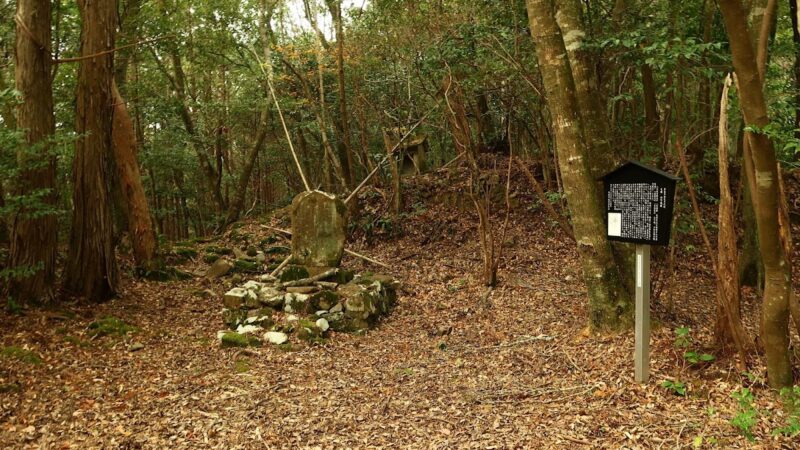
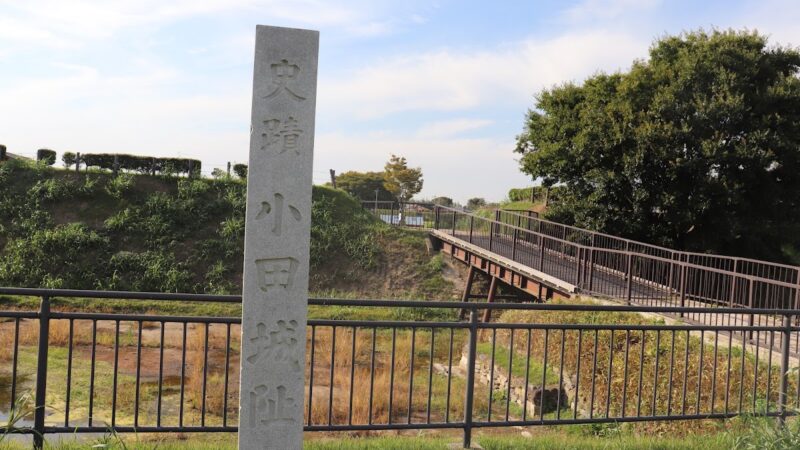
Near the entrance to the main enclosure, a stone monument marking the “Okami Castle Site” and a memorial tower for the Okami family stand, indicating the castle’s location. Approximately 2-3 meters of the earthen rampart remain, providing a glimpse into the defensive structures of the time.
The Overall Structure of Okami Castle as Seen in the Tenpo-era Map of Okami Village
A map of Okami Village created in 1834 (Tenpo 4) is included in the *Tsuchiura Shibōko* (Tsuchiura Historical Notes), and it is an important historical document for understanding the structure of Okami Castle. According to this map, three ancient castle structures are depicted, and the existence of the “Main Enclosure,” “West Hall,” and “South Hall” can be confirmed.
From this map, it is clear that Okami Castle was not a single enclosure, but a complex castle composed of multiple enclosures. The structure, with the Main Enclosure at the center and separate enclosures to the west and south, is thought to have been intended for tiered defense and separation of living spaces.
Functions of the West Hall and South Hall
The “West Hall” and “South Hall” depicted in the Tenpo-era map are presumed to have functioned as enclosures complementing the Main Enclosure. The West Hall was located west of the Main Enclosure and is thought to have contained living quarters for retainers and storage facilities for supplies.
The South Palace is believed to have been located south of the main enclosure, near the Ono River, and may have served as a facility related to water transport or as a defensive base against incursions from the river. The detailed structure and scale of these enclosures are difficult to determine from the current topography, and further archaeological investigations are awaited.
Existing Remains
The main remains currently identifiable at the Okami Castle site are as follows:
Earthworks: Earthworks surrounding the main enclosure remain in good condition. The height varies depending on the location, but approximately 2-3 meters can be observed. The cross-section of the earthworks reveals careful construction using the rammed earth method.
Dry Moat: Traces of a dry moat remain outside the earthworks. While some parts are now buried, the shape and scale of the moat can be inferred. The moat is thought to have been approximately 5-8 meters wide.
Enclosures: The rectangular main enclosure remains relatively clearly as part of the topography, allowing for an understanding of the castle’s boundaries. The interior is flat, allowing us to imagine what a building once stood there.
These remains exhibit a typical structure of a flatland castle from the Sengoku period, making them a valuable example for the study of medieval castles.
Highlights of Okami Castle
Castle Site Monument and Memorial Tower
At the entrance to the Okami Castle ruins stands a stone monument inscribed with “Okami Castle Site,” indicating that this is a historical castle site. Beside it is the “Okami Family Memorial Tower,” commemorating the Okami clan. These monuments are evidence of how the local people have carefully preserved the history of Okami Castle and the Okami clan.
Walking the Main Enclosure’s Earthworks
The earthworks surrounding the main enclosure are the most impressive remains of Okami Castle. Walking along the earthworks allows you to experience the scale and defensive mechanisms of the castle at that time. From the earthworks, you can overlook the surrounding terrain, understanding its relationship to the Ono River and the topographical features of the plateau on which the castle was built.
The height and thickness of the earthworks indicate that this castle was not merely a residence, but a defensive structure designed for battle. The earthworks are well-preserved, making them a valuable historical site for studying medieval castle construction techniques.
Traces of the Dry Moat
The traces of the dry moat remaining outside the earthworks are another highlight. Although partially filled in, the shape of the moat can still be observed. The dry moat not only prevented enemy intrusion but also served as a source of soil for constructing the earthworks. This is a valuable spot to observe a defensive system where the moat and earthworks were integrated.
Relationship with the Ono River
The Ono River flows south of Okami Castle, and this river functioned as a natural moat. Looking towards the Ono River from the castle ruins, one can understand why the castle was built in this location. You can appreciate the ingenuity of the castle’s construction, which skillfully utilized the topography of the river and plateau.
Location in relation to the Ono River
The Ono River flows south of Okami Castle, and this river functioned as a natural moat. ## Access and Visiting Information for Okami Castle
Location
- Address: Okami-cho, Ushiku City, Ibaraki Prefecture
- Castle Type: Flatland Castle
- Construction Period: Nanboku-cho period
- Year of Abandonment: Tensho 18 (1590)
Access by Train
The nearest station is Ushiku Station on the JR Joban Line. The distance from Ushiku Station to the Okami Castle ruins is approximately 4 kilometers, taking about 50 minutes on foot. A taxi from the station takes about 10 minutes.
Alternatively, you can take a bus from Ushiku Station. Take a Kanto Railway bus bound for Okami, get off at the nearest bus stop, and the castle ruins are a few minutes’ walk away.
Access by Car
It’s about 15 minutes from the Ushiku-Ami Interchange on the Joban Expressway. Access is possible via National Route 6 or prefectural roads. There is no dedicated parking lot around the castle ruins, but there are spaces where street parking is possible. However, since it is adjacent to a residential area, consideration must be given to avoid disturbing nearby residents.
Points to Note When Visiting
Okami Castle Ruins are not developed as a park, but are preserved as a historical site. Visiting is free, but please note the following:
- Be careful not to damage the remains.
- Always take your trash with you.
- Pay attention to the boundaries of private property.
- Be careful as the ground can be slippery in rainy weather.
- In summer, the vegetation is lush, so wearing long sleeves and long pants is recommended.
The estimated time required for a thorough visit is about 30 minutes.
Related Historical Sites in the Surrounding Area
When visiting Okami Castle, we recommend also visiting the following related historical sites:
Ushiku Castle Ruins: This castle was where the Okami clan moved their base, and is located about 3 kilometers from Okami Castle. Ushiku Castle still retains earthworks and dry moats, making it important for understanding the evolution of the Okami clan’s castle.
Onna-ke Shrine: An ancient shrine located in Ushiku City, with connections to the Okami clan also suggested.
Ushiku City Kappa-no-Sato Historical and Folk Museum: Exhibits materials related to the history of Ushiku City and the Okami clan, deepening understanding of Okami Castle.
Cultural Property Designation Status of Okami Castle
Currently, the Okami Castle ruins are not designated as a national or prefectural cultural property, but they are recognized as an important historical heritage site of Ushiku City. They are registered as castle ruins on the Ibaraki Prefecture archaeological site map, and their cultural value is acknowledged.
Further detailed excavation surveys and research may lead to cultural property designation. There is growing local interest in the preservation and utilization of the castle ruins, and efforts to pass on its value as a historical heritage to future generations are expected.
Okami Castle and the Medieval History of Hitachi Province
Political Situation in Southern Hitachi Province
Southern Hitachi Province, where Okami Castle was located, was the stage for complex political situations throughout the medieval period. During the Nanboku-cho period (Northern and Southern Courts period), the forces of the Southern and Northern Courts were in balance, and during the Sengoku period (Warring States period), the Satake and Oda clans clashed.
The Okami clan, as a branch of the Oda clan, was deeply involved in the political developments of this region. The Oda clan was a prominent family in southern Hitachi Province, with a lineage dating back to the Kamakura period, but during the Sengoku period, they suffered under the pressure of the Satake clan and ultimately perished. The Okami clan shared the same fate as the rise and fall of the Oda clan.
Relationship between the Oda and Okami Clans
The Okami clan, as a branch of the Oda clan, contributed to the expansion of the Oda clan’s power. It is believed that by establishing their base in the Ushiku region, they played a role in protecting the eastern part of the Oda clan’s sphere of influence.
On the other hand, the Okami clan maintained a certain degree of independence from the Oda clan and sometimes acted on their own judgment. This is a typical example of a local lord during the Sengoku period, and the Okami clan, too, struggled to survive while being tossed about by the tides of the times.
The End of the Sengoku Period as Seen from Okami Castle
The Siege of Odawara in 1590 marked the end of the Sengoku period in the Kanto region. During Toyotomi Hideyoshi’s process of unifying Japan, the small and medium-sized lords of Kanto were forced to adapt to the new era.
The abandonment of Okami Castle can be seen as a symbolic event of this major turning point. Having fulfilled its role as a castle during the Sengoku period, Okami Castle was transformed into farmland and residential areas during the Edo period. However, its remains have survived to this day, continuing to convey the memory of the Sengoku period.
Research on Okami Castle and Future Challenges
Previous Research
Okami Castle has been introduced in “The Complete Guide to Japanese Castles” and various castle-related books, but no full-scale archaeological excavation has been conducted. Current knowledge is primarily based on observations of the ground surface and analysis of historical documents and maps.
The Okami Village map from 1834 (Tenpo 4) is a valuable historical document that conveys the state of the castle ruins in the late Edo period, but many details about the castle’s structure at the time of its construction remain unclear.
Expectations for Future Research
To further clarify the historical value of Okami Castle, the following research is expected:
Archaeological Excavation: Archaeological excavations are desired to clarify the detailed structure, building layout, and period of use of the main enclosure, west hall, and south hall.
Documentary Research: Further research into historical documents and records related to the Okami clan may provide a more detailed understanding of the castle’s history and the Okami clan’s activities.
Topographic Survey: Precise surveying may reveal traces of lost remains.
Preservation and Utilization Plan: A plan that balances the preservation and utilization of the remains is necessary.
Summary
Okami Castle is a valuable medieval castle ruin remaining in Ushiku City, Ibaraki Prefecture. Functioning as the residence of the Okami clan from the Nanboku-cho period to the Sengoku period, this castle is an important historical site that tells the history of southern Hitachi Province.
The remaining earthworks and dry moats convey the castle’s construction techniques and defensive systems of the time, making it a valuable example for the study of medieval castles. The complex structure of the main enclosure, west hall, and south hall depicted in the Tenpo-era map indicates that Okami Castle was not merely a fort, but a full-fledged castle combining residence and defense.
Even now, more than 400 years after its abandonment in 1590, the Okami Castle ruins continue to convey the memory of the Sengoku period. When visiting Ushiku City, be sure to visit this historic castle ruin and reflect on the era in which the Okami clan lived. Standing on the earthworks and gazing at the Ono River, you will surely feel the spirit of the Sengoku period.