Oda Castle (Ibaraki Prefecture) Complete Guide: A Thorough Explanation of History, Highlights, and Access Information
Located in Tsukuba City, Ibaraki Prefecture, Oda Castle is a medieval castle known as the residence of the Oda clan, who ruled southern Hitachi Province from the Kamakura period to the Sengoku period. Currently, it is a nationally designated historical site and a valuable historical relic that preserves the structure of a medieval castle. This article provides a detailed explanation of Oda Castle, from its history and highlights to access methods.
What is Oda Castle?
Oda Castle is a flatland castle located in Oda, Tsukuba City, Ibaraki Prefecture. It functioned as the base of the Oda clan for approximately 400 years, from the early Kamakura period to the end of the Sengoku period. Built on a plateau approximately 25 meters above sea level, it features a layout that utilizes the natural fortifications of the surrounding low-lying wetlands known as “yatsu.”
In 2001, it was designated a national historical site, and the Tsukuba City Board of Education continues to conduct archaeological excavations and historical site maintenance. Currently, the earthworks and moat remains have been restored around the site of the main keep, making it a popular historical park where citizens can experience the appearance of a medieval castle.
History of Oda Castle
Kamakura Period: Establishment of the Oda Clan and Castle Construction
The history of Oda Castle dates back to around 1193 (Kenkyu 4), in the early Kamakura period. It is believed that Hatta Tomoie, a senior retainer of Minamoto no Yoritomo, was appointed governor of Hitachi Province, and his second son, Hatta Tomoshige, ruled this area and adopted the name Oda.
Hatta Tomoie was from the Utsunomiya clan of Shimotsuke Province, and was granted a vast territory in Hitachi Province for his service in following Minamoto no Yoritomo from the time of his uprising. Tomoie’s eldest son founded the Tsukuba clan, his second son the Oda clan, and his third son the Tanaka clan, building a major power in southern Hitachi Province.
It is thought that the Oda clan initially established a residence on the site of the present-day Oda Castle and gradually developed it into a castle. The Oda clan expanded their power as a retainer of the Kamakura Shogunate and as a powerful samurai group in Hitachi Province.
Nanboku-cho Period: The Oda Clan in Turmoil
During the Nanboku-cho period, the Oda clan sided with the Northern Court. However, the Southern Court also held significant power in Hitachi Province during this time, and fierce battles repeatedly took place around Oda Castle.
In particular, in 1340 (Kōkoku 1/Ryakuō 3), Southern Court forces led by Kitabatake Chikafusa invaded Hitachi Province, and Oda Castle was reportedly attacked. During this period, the Oda clan played an important role as a base for the Northern Court, but they were frequently subjected to attacks from the Southern Court, creating a difficult situation.
Muromachi Period: Relationship with the Kanto Kanrei
During the Muromachi period, the Oda clan maintained their power while maintaining relationships with the Kanto Kanrei Uesugi clan and the Koga Kubo. During this period, Oda Castle was gradually expanded and improved, developing into a full-fledged castle with multiple baileys.
In the latter half of the 15th century, Oda Narishige played an active role as the head of the family, solidifying the Oda clan’s position in southern Hitachi Province. It is estimated that Oda Castle at this time had a typical medieval castle structure, with the main keep at the center, surrounded by other baileys such as the second and third baileys, and defended by earthworks and moats.
Sengoku Period: Repeated Battles with Oda Ujiharu
The Sengoku period marked the most turbulent time for Oda Castle. In particular, the era of the 16th head of the family, Oda Ujiharu, followed a remarkable destiny, earning him the nickname “the phoenix of Hitachi.”
Oda Ujiharu repeatedly engaged in conflicts with powerful Sengoku daimyo, such as the Satake clan to the north and the Yuki clan to the east, primarily during the Eiroku era (1558-1570). His battles with Satake Yoshishige were especially fierce, and Oda Castle was repeatedly captured and recaptured. Main Records of Attacks and Defenses:
- 1560 (Eiroku 3): Castle fell to an attack by Satake Yoshiaki
- 1564 (Eiroku 7): Ujiharu recaptured
- 1569 (Eiroku 12): Defeated by the Satake army at the Battle of Tebaisaka, castle fell again
- 1570 (Genki 1): Recaptured again
- 1574 (Tensho 2): Castle fell to an attack by Satake Yoshishige
- 1576 (Tensho 4): Recaptured yet again
In this way, Oda Ujiharu never gave up, even after losing the castle multiple times, and repeatedly recaptured it, earning him the nickname “Phoenix.” However, ultimately, during Toyotomi Hideyoshi’s siege of Odawara in 1590 (Tensho 18), he sided with the Hojo clan, resulting in the confiscation of his territory and the end of the Oda clan’s rule.
From the Early Modern Period Onward: Abandonment and Designation as a Historic Site
After the Oda clan left, Oda Castle was abandoned. During the Edo period, the area around the castle was used for farmland, and the castle’s remains gradually disappeared. However, parts of the earthworks and moats remained as part of the topography.
Even after the Meiji era, it was used as farmland for a long time. In the latter half of the 20th century, its historical value was re-recognized, and archaeological excavations began. Full-scale investigations started in 1975 (Showa 50), and the true nature of Oda Castle gradually became clear from the building remains and excavated artifacts.
Following its designation as a National Historic Site in 2001 (Heisei 13), the city of Tsukuba proceeded with a historical site development project, and it is now open to the public as a historical park.
Structure and Layout of Oda Castle
Basic Structure
Oda Castle is classified as a flatland castle (hirajiro), but it has a unique location, also known as a “valley castle,” utilizing the surrounding valleys as natural moats. The castle grounds extended approximately 600 meters east-west and 500 meters north-south, making it a relatively large castle for a medieval fortress.
The main enclosure (Honmaru), the heart of the castle, measured approximately 100 meters east-west and 80 meters north-south, and was surrounded by earthen ramparts 3 to 5 meters high. Surrounding the Honmaru were smaller enclosures such as the Ninomaru and Sannomaru, each demarcated by earthen ramparts and moats.
Characteristics of the Honmaru
Excavation surveys have revealed the remains of multiple buildings within the Honmaru. The remains of a large building, believed to be the main hall, measured approximately 20 meters east-west and 10 meters north-south, and were found to be a stone-foundation building.
To the south of the Honmaru was an elevated earthen rampart, presumably a watchtower base, from which one could overlook the castle town. Furthermore, the remains of a well were discovered in the northwest corner of the Honmaru, suggesting it may have served as a water source during sieges.
Moat and Earthwork System
The core of Oda Castle’s defensive system was the combination of moats and earthworks. The inner moat surrounding the main keep was 10-15 meters wide and 3-4 meters deep, with a V-shaped cross-section known as a yagenbori (V-shaped moat).
The earthworks were constructed by piling up the soil excavated from the moats, reaching a height of 3-5 meters. It is presumed that fences or walls were built on top of the earthworks, making them a significant obstacle for attackers.
Multiple moats were also positioned in the outer enclosure, forming a multi-layered defensive structure. These moats connected with the surrounding valleys, creating a more effective defensive line.
Placement of Entrances (Koguchi)
Entrances to the castle, called koguchi, were located in two places in the main keep, and also in the second and third baileys. These koguchi were not simple openings, but rather featured structures such as “kuichigai koguchi” (staggered entrances) with bent earthworks, and square-shaped spaces, demonstrating ingenuity in enhancing defensive capabilities.
Excavations have uncovered stone materials believed to be the foundation stones of a gate near the entrance, confirming the presence of a wooden gate.
Excavation Results and Unearthed Artifacts
Continuous Excavations
Since 1975, continuous excavations have been conducted at the Oda Castle site, primarily by the Tsukuba City Board of Education. To date, approximately 40 excavations have been carried out, focusing on the main keep, second bailey, and third bailey, gradually revealing the castle’s structure, its evolution, and the realities of daily life.
The excavations have unearthed building remains, well remains, moat remains, earthworks, and other structures, as well as a large quantity of ceramics, weapons, armor, and daily life implements.
Main Unearthed Artifacts
Ceramics:
In addition to domestic ceramics such as Tokoname ware, Seto ware, and Bizen ware, numerous Chinese celadon, white porcelain, and underglaze blue porcelain pieces have also been unearthed. These ceramics indicate that the Oda clan possessed an extensive trade network and a certain level of economic power.
The discovery of tea ceremony pottery, particularly Tenmoku tea bowls and Shino-Oribe ware from the 15th and 16th centuries, suggests that the Oda clan may have embraced tea ceremony culture.
Weapons and Armor:
Weapons such as iron arrowheads, small knives, and musket balls have also been unearthed. The discovery of musket balls, in particular, is valuable evidence that matchlock guns were used at Oda Castle during the late Sengoku period.
Daily Life Items:
Cooking utensils such as pots, kettles, and mortars, tableware such as lacquerware bowls and chopsticks, stationery such as inkstones and brushes, copper coins, Go stones, and Shogi pieces have also been unearthed, providing clues to the daily life within the castle.
Discovery of Building Remains
Several foundation stone building remains have been confirmed within the main enclosure, the largest of which is presumed to be the main hall. The column spacing is approximately 2 meters (6 feet), suggesting it was a building of high status. Numerous post-and-beam building remains have been discovered in the Ninomaru and Sannomaru areas, indicating that residences of retainers and warehouses once stood there.
Highlights of Oda Castle Ruins Historical Plaza
Restored Main Enclosure Site
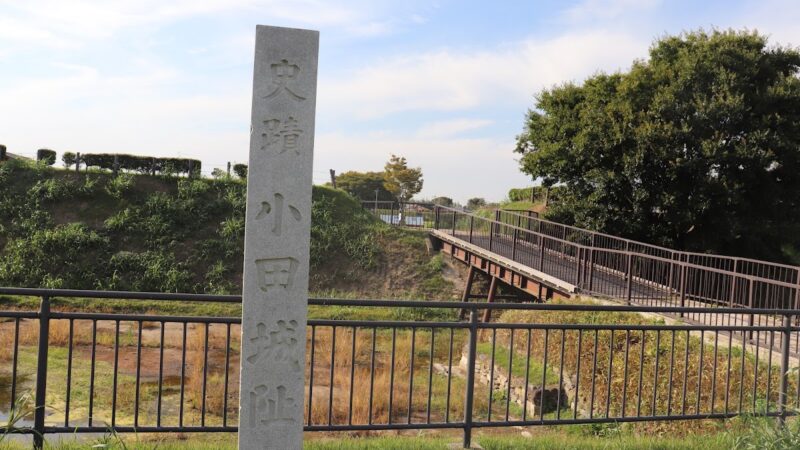
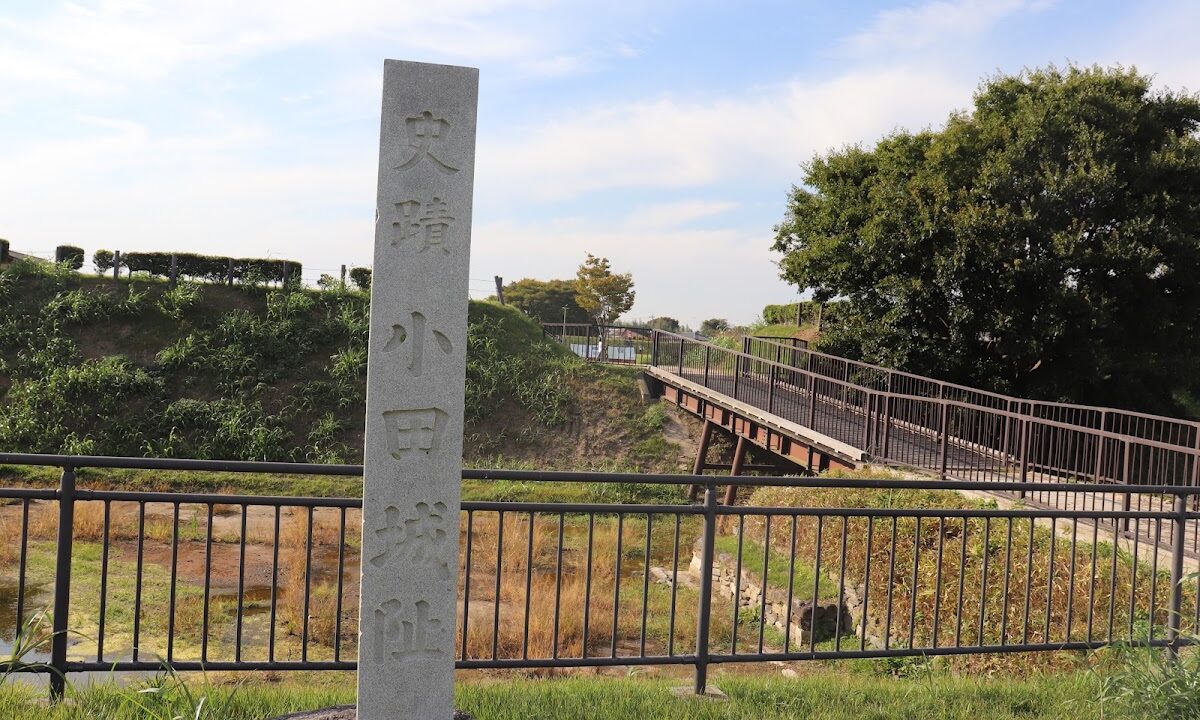
Currently, the Oda Castle Ruins have been developed as the “Oda Castle Ruins Historical Plaza” and are open to the public. The earthworks of the main enclosure have been restored, allowing visitors to experience the castle’s appearance in its heyday.
The restored earthworks are approximately 3 meters high and can be climbed. From the top of the earthworks, you can overlook the entire main enclosure, making it ideal for understanding the spatial configuration of a medieval castle.
Moat Remains Markings
The remains of the moat surrounding the main enclosure are marked on the ground surface, allowing visitors to confirm its size and location. Some exhibits include restored cross-sections of the moat, allowing visitors to understand the structure of the Yagenbori moat.
Information Boards and Explanation Boards
Several information boards explaining the history and structure of Oda Castle are installed throughout the park. The history of the Oda clan, the changes in the castle, and the results of archaeological excavations are explained in an easy-to-understand manner, making it accessible even for first-time visitors.
Oda Castle Ruins Information Center (Oda Castle Ruins Historical Plaza Information Center)
Near the entrance to the historical plaza is an information center where materials related to Oda Castle and the Oda clan are displayed, along with replicas of excavated artifacts. Guided tours by volunteer guides are also available (advance reservations required).
Pamphlets and materials about Oda Castle are also available at the information center.
Aspect as a Cherry Blossom Spot
Oda Castle Ruins Historical Plaza is also known as a cherry blossom spot in spring. Numerous cherry trees are planted around the main keep site, allowing visitors to enjoy beautiful cherry blossoms in early April. It is a popular spot among locals for enjoying both historical walks and cherry blossom viewing.
About the Oda Clan
Genealogy of the Oda Clan
The Oda clan traces its ancestry to Tomoshige, the second son of Hatta Tomoie, and was a prominent family that survived for approximately 400 years until the end of the Sengoku period. Among the successive heads of the Oda clan, the following individuals are particularly well-known:
Oda Tomoshige (1st head): Founded the Oda clan as the second son of Hatta Tomoie and built Oda Castle.
Oda Haruhisa (8th head): Active on the side of the Northern Court during the Nanboku-cho period and received a letter of commendation from Ashikaga Takauji.
Oda Naruharu (13th head): Expanded the Oda clan’s power during the late Muromachi period, establishing its position as a powerful samurai in southern Hitachi Province.
Oda Ujiharu (16th head): The head of the clan during the Sengoku period, known as the “Phoenix of Hitachi.” An indomitable warrior who repeatedly lost and recaptured his castles.
The Oda Clan’s Territory
At its peak, the Oda clan controlled a vast territory centered around present-day Tsukuba City, encompassing parts of Tsuchiura City, Kasumigaura City, and Ishioka City. The area around Mount Tsukuba, in particular, formed the core of the Oda clan’s sphere of influence and had deep ties to Tsukuba Shrine.
The Oda clan’s retainers included powerful samurai families from southern Hitachi Province, such as the Sugaya, Shinoda, and Makabe clans.
The Life of Oda Ujiharu
Oda Ujiharu, as the last head of the Oda clan during the Sengoku period, led a turbulent life. Despite suffering numerous defeats in conflicts with the Satake clan and losing his castles, he possessed an indomitable spirit, never giving up and constantly attempting to recapture them.
On the other hand, he is also said to have lacked military talent, and is remembered in later generations as a “warrior who never gave up despite repeated defeats.” Ultimately, after Toyotomi Hideyoshi’s siege of Odawara, he lost his territory and spent the rest of his life relying on the Yuki clan.
Ujiharu’s life is noteworthy among history enthusiasts as a symbol of the struggles of small and medium-sized feudal lords during the Sengoku period.
Access Information
Location
2532 Oda, Tsukuba City, Ibaraki Prefecture 300-4223, Japan
Access by Public Transportation
Using Tsukuba Express:
- Take the Kanto Railway bus bound for “Tsukuba Yamaguchi” or “Tsukuba-san Jinja Iriguchi” from Tsukuba Station.
- Get off at the “Oda” bus stop and walk for approximately 5 minutes.
- Travel time: Approximately 20 minutes from Tsukuba Station.
Using JR Joban Line:
- Take the Kanto Railway bus bound for “Tsukuba Yamaguchi” from Tsuchiura Station.
- Get off at the “Oda” bus stop and walk for approximately 5 minutes.
- Travel time: Approximately 30 minutes from Tsuchiura Station.
Access by Car
From the Joban Expressway:
- Approximately 15 minutes from Tsuchiura Kita IC
- Approximately 20 minutes from Sakura Tsuchiura IC
From the Kita-Kanto Expressway:
- Approximately 30 minutes from Sakuragawa Chikusei IC
Parking
There is free parking at the Oda Castle Ruins Historical Square (approximately 20 spaces). Please note that it may be full during peak seasons such as cherry blossom season.
Opening Hours and Closing Days
Historical Square: Always open (free admission)
Information Center:
- Opening Hours: 9:00 AM – 4:30 PM
- Closed: Mondays (or the following day if Monday is a public holiday), New Year holidays
Nearby Tourist Attractions
Mount Tsukuba
Mount Tsukuba, located about 15 minutes by car from the Oda Castle Ruins, is a famous peak with an elevation of 877 meters, known as “Fuji of the West, Tsukuba of the East.” You can reach the summit by cable car or ropeway and enjoy a panoramic view of the Kanto Plain. The Oda clan also worshipped Mount Tsukuba.
Tsukuba Shrine
This ancient shrine, located on the slopes of Mount Tsukuba, was under the patronage of the Oda clan. It is said that Oda Ujiharu frequently visited the shrine.
Tsukuba City Oda Castle Ruins Historical Plaza Information Center
This facility, adjacent to the Oda Castle ruins, features detailed exhibits about Oda Castle and the Oda clan. Replicas of excavated artifacts and reconstructed models are also on display, making it ideal for deepening your understanding of Oda Castle.
Hojo Oike Pond
Located approximately 2 kilometers north of the Oda Castle ruins, this irrigation reservoir is surrounded by lush natural walking trails.
Points to Note When Visiting Oda Castle
Estimated Visiting Time
For a thorough visit to the Oda Castle Ruins Historical Plaza, allow approximately 1 to 1.5 hours. Including the exhibits at the information center, 2 hours should be sufficient for a complete enjoyment.
Clothing and Items to Bring
Since the historical plaza is an outdoor facility, comfortable walking shoes and clothing are recommended. In summer, the sun is strong, so a hat and sunscreen are useful. Insect repellent is also recommended.
Photo Spot
The view from the earthen rampart of the main keep is an excellent photo spot. In spring, during cherry blossom season, photos combining the cherry blossoms and the rampart are particularly popular. A reconstructed image of Oda Castle is displayed in front of the information center, making it a great spot for commemorative photos.
Guided Tour
Tsukuba City offers guided tours of the Oda Castle ruins by volunteer guides (advance reservations required). Listening to explanations from knowledgeable guides will allow you to understand the history of Oda Castle more deeply.
Reservations and Inquiries: Tsukuba City Board of Education, Cultural Properties Division (TEL: 029-883-1111)
Historical Significance of Oda Castle
Oda Castle is an important historical site indispensable to understanding the history of Hitachi Province in the Middle Ages. The castle, which existed for approximately 400 years from the Kamakura period to the Sengoku period, is a valuable example for understanding the development process of medieval castles.
In particular, the castle’s layout, which skillfully utilizes the surrounding natural terrain despite being a flatland castle, is highly valued academically as it demonstrates the level of castle-building technology in the Middle Ages. Furthermore, long-term archaeological excavations are revealing the lifestyles and cultural aspects of medieval samurai, and further research is anticipated.
Known as the residence of the unique warlord Oda Ujiharu, it is an important historical site for understanding the struggles and survival strategies of small and medium-sized lords during the Sengoku period.
Summary
Oda Castle Ruins are a valuable medieval castle site located in Tsukuba City, Ibaraki Prefecture. It functioned as the residence of the Oda clan for approximately 400 years, from the Kamakura period to the Sengoku period, and was particularly the stage for the turbulent history of Oda Ujiharu, known as the “Phoenix of Hitachi,” during the Sengoku period.
Currently, it is a nationally designated historical site, and visitors can experience the appearance of a medieval castle through the restored earthworks and moat remains. It is easily accessible from the Tsukuba Express and the Joban Expressway, making it a recommended visit in conjunction with sightseeing at Mount Tsukuba.
Oda Castle Ruins are a great place for history buffs, families looking for a stroll, and even cherry blossom viewing during the spring. If you’re interested in the medieval history of Ibaraki Prefecture, why not pay a visit?