Asakura Bikuni Castle (Yabu City, Hyogo Prefecture) Complete Guide: Mountain Castle Remains at the Birthplace of the Echizen Asakura Clan
What is Asakura Bikuni Castle?
Asakura Bikuni Castle is a medieval mountain castle located in Asakura, Yoka-cho, Yabu City, Hyogo Prefecture. It is one of the representative mountain castles of Tajima Province and is known as a castle built in conjunction with Asakura Castle, the birthplace of the Echizen Asakura clan, who ruled Echizen Province (present-day Fukui Prefecture) as a Sengoku daimyo.
This castle is located east of Asakura Castle, across a valley, and is built on a hill that extends westward in a tongue-like shape. Situated at an altitude of approximately 160 meters and a relative height of approximately 50 meters, it has a distinctive layout with the highest point at the eastern end and a series of terraced enclosures extending westward. Stone masonry remains can be seen throughout the sides, making it a valuable historical site that conveys the defensive functions of a medieval mountain castle.
Historical Background of Asakura Bikuni Castle
Relationship between the Echizen Asakura Clan and the Tajima Asakura Clan
Understanding the roots of the Echizen Asakura clan is essential to understanding Asakura Bikuni Castle. The Asakura clan, who ruled Echizen Province during the Sengoku period and flourished with Ichijōdani as their base, is believed to have originated in Asakura, Yabu District, Tajima Province (present-day Asakura, Yōka-chō, Yabu City).
The Asakura clan originally held power as local lords in Tajima, but during the Nanboku-chō and Muromachi periods, some members of the family moved to Echizen Province and eventually grew into a powerful Sengoku daimyo. The Asakura clan remaining in Tajima maintained a certain level of influence in the region, even while under the influence of powerful shugo daimyo such as the Yamana clan.
Origin of the Name “Bikuni Castle”
There are several theories regarding the unique name “Bikuni Castle.” The most plausible theory is that the castle was either inhabited or managed by a woman associated with the Asakura clan, particularly a nun (bikhuni). In the medieval period, it was not uncommon for women to be involved in the management and defense of castles, sometimes even playing a crucial role in protecting important clan strongholds.
Furthermore, it has been suggested that while Asakura Castle was the main castle, Bikuni Castle may have functioned as a subsidiary or auxiliary castle. The two castles, facing each other across a valley, are thought to have formed a defensive system that coordinated with each other to protect the Asakura territory.
Transition from the Muromachi to the Sengoku Period
The exact construction date of Asakura Bikuni Castle is unclear, but like Asakura Castle, it is estimated that the initial fortifications were built during the Muromachi period, and its defensive functions were strengthened during the Sengoku period. The remains, such as moats and vertical trenches, are thought to be the result of renovations during the Sengoku period, reflecting the tense political situation of the time.
Tajima Province was within the sphere of influence of the Yamana clan, and the Asakura clan sought to survive through its relationship with the Yamana clan. During the Sengoku period, Oda Nobunaga’s influence extended to Tajima Province, and in the Tensho era, Hashiba Hideyoshi (later Toyotomi Hideyoshi) conquered Tajima. It is believed that Asakura Bikuni Castle was abandoned during this process.
Layout and Structure of Asakura Bikuni Castle
Overall Arrangement and Utilization of Terrain
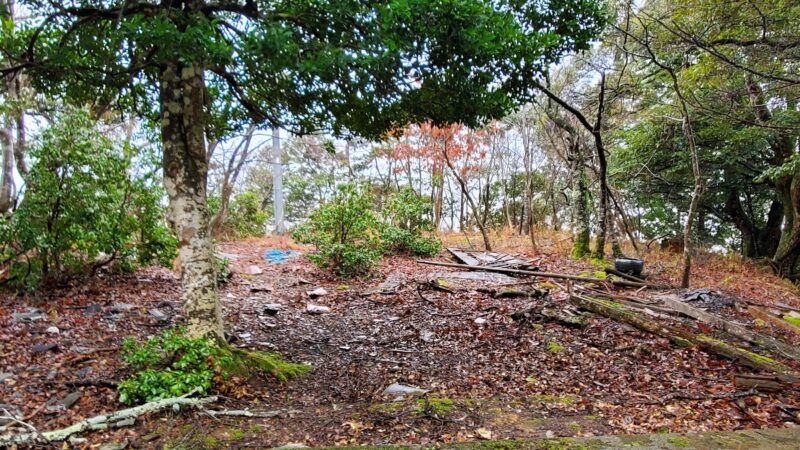
Asakura Bikuni Castle is a mountain castle that skillfully utilizes the terrain of a long, narrow hill stretching east to west. The highest point at the eastern end serves as the main enclosure, and a series of enclosures are arranged in a stepped fashion towards the west, employing a linear layout. This arrangement allows for effective defense against enemy incursions from the east.
The castle area measures approximately 100 meters east-west and 50 meters north-south. While somewhat smaller than Asakura Castle, it boasts a robust defensive structure that takes advantage of the terrain. The tip of the tongue-shaped hill extending westward is somewhat broadly leveled, suggesting that this served as the castle’s front.
Layout and Characteristics of the Enclosures
The main enclosure at the eastern end is located at the highest point and is thought to have functioned as a command post overlooking the entire castle. From here, the second and third enclosures are arranged in a stepped pattern to the west, each enclosure being demarcated by earthworks and steep slopes.
The leveling of each enclosure was carried out relatively carefully, ensuring sufficient flat surfaces to serve as living spaces and defensive strongholds. The elevation difference between the enclosures is approximately 2-3 meters, a design that balances ease of movement with defensive capabilities.
Characteristics of the Stone Masonry Remains
One of the major highlights of Asakura Bikuni Castle is the remains of stone masonry visible throughout its sides. These stone masonry structures were built to reinforce the edges of the enclosures and steep slopes, and are valuable remains that demonstrate the developmental stage of stone wall technology in medieval mountain castles.
The stone masonry is constructed using the nozurazumi method, stacking natural stones, preserving a simple construction method that predates the introduction of advanced stone wall technology. Although some parts have collapsed, many sections remain in their original positions, making them important historical resources for understanding the castle construction techniques of the time.
Defense using moats and vertical trenches
To enhance the castle’s defensive capabilities, moats were constructed to block the ridges and vertical trenches were dug vertically into the slopes. These are thought to be defensive facilities added during the Sengoku period (Warring States period), serving to restrict enemy incursion routes and make attacks difficult.
Moats can be seen on the east and west sides of the main enclosure. The moat on the east side, in particular, is deeply excavated, serving as an important defensive line to prevent attacks from the rear. Multiple vertical trenches were constructed on the north and south slopes, effectively hindering the movement of enemy soldiers climbing the slopes.
Relationship with Asakura Castle
Paired Castles Across a Valley
Asakura Bikuni Castle is located east of Asakura Castle, across a valley, suggesting that the two castles formed an integrated defensive system. While Asakura Castle was the main castle, measuring 130 meters east-west and 110 meters north-south, Bikuni Castle, though slightly smaller, functioned as an important subsidiary castle.
The valley between the two castles functioned as a natural moat, a topographical barrier that made enemy intrusion difficult. Simultaneously, the Asakura settlement spread across this valley, suggesting that both castles also played a role in protecting this settlement.
Complementary Defensive Functions
Asakura Castle and Bikuni Castle were positioned to respond to attacks from different directions. Asakura Castle was located on the western hill, giving it an advantageous position against attacks from the west, while Bikuni Castle was located on the east, preparing for attacks from the east.
This arrangement created a defensive system in Asakura that could respond to attacks from all directions. Furthermore, it has been suggested that visual communication was possible between the two castles, and that information may have been transmitted using smoke signals or flags.
Highlights of Asakura Bikuni Castle
Observation of Stone Wall Remains
The most noteworthy remains within the castle are the stone walls remaining on the sides of the baileys. While a simple construction method using natural stones, it offers a valuable opportunity to directly observe medieval castle-building techniques. In particularly well-preserved areas, you can closely observe the ingenuity of the stone stacking and arrangement.
Some parts of the stone walls have collapsed due to age, but this also adds to the sense of historical weight. When taking photographs, it is recommended to photograph from various angles to capture the texture and characteristics of the stonework.
Staircase-like Bailey Arrangement
The staircase-like arrangement of the baileys from east to west best represents the unique layout of Asakura Bikuni Castle. By visiting each bailey in order, you can understand the overall structure and defensive mechanisms of the castle.
Movement between baileys is relatively easy, and it is possible to walk around the entire castle in about 30 minutes. The views from each enclosure differ, and from the main enclosure in particular, you can see the surrounding mountains and the Asakura settlement.
Observation of Earthworks and Cut Slopes
Earthworks surround the enclosures, and some parts remain in good condition. By observing the height, width, and shape of the earthworks, you can imagine their defensive function at the time.
Furthermore, the cut slopes separating the enclosures are also clearly visible, and it is clear that the artificially carved steep slopes made it difficult for enemies to invade. The angle and height of the cut slopes provide important information for understanding the defensive techniques of medieval mountain castles.
The Impressiveness of the Moats
The moats located on the east and west sides of the main enclosure are key defensive structures of the castle. The moat on the east side, in particular, is deeply excavated, creating an impressive structure that completely blocks the ridge. Standing at the bottom of the moat, you can truly appreciate its depth and the steepness of the cut slopes on both sides.
A moat was not merely a ditch, but a crucial military structure designed to hinder enemy advances and give the defending side an advantage. Its scale and shape suggest that large-scale civil engineering work was carried out during renovations in the Sengoku period.
Visitor Guide: Access and Visiting Information
Access Method
The most convenient way to access Asakura Bikuni Castle is to first head towards Asakura Tenmangu Shrine. There is a small park in front of Asakura Tenmangu Shrine where you can park. From the park to the castle entrance is approximately a 5-minute walk.
Access by Car:
- Approximately 10 minutes from the Yoka-Hyono-yama Interchange on the Kita-Kinki Toyooka Expressway
- From National Route 9, take the prefectural road to the Asakura settlement.
Access by Public Transportation:
- Approximately 15 minutes by bus or taxi from Yoka Station on the JR San’in Main Line
- Approximately 10 minutes on foot from the nearest bus stop
Ascent Route
From the Asakura Tenmangu Shrine park, proceed along the path within the settlement to the trailhead. There are few signs at the trailhead, so it is recommended to check a map beforehand. The ascent route is a mountain trail, with an elevation difference of approximately 50 meters.
The ascent route is a natural mountain path, not a well-maintained walking trail. The estimated time is approximately 15-20 minutes for the ascent and 10-15 minutes for the descent. Since there are some uneven sections, comfortable walking shoes such as trekking shoes are necessary.
Precautions for Visiting
Clothing and Equipment:
- Long-sleeved shirt and long pants (to protect skin from vegetation and insects)
- Trekking shoes or hiking boots
- Hat and gloves (depending on the season)
- Drinking water
- Insect repellent spray (spring to autumn)
Safety Precautions:
- Be careful as the ground can be slippery during and after rain.
- Avoid climbing alone; visiting in groups is recommended.
- Check cell phone signal strength in advance.
- Descend before sunset.
Weeding and Maintenance Status:
While local preservation societies regularly mow the grass, vegetation may be overgrown at certain times of the year. Especially in summer, the grass grows quickly, making observation of the remains difficult. It is recommended to check the maintenance status with the Yabu City Board of Education or the local tourism association before visiting.
Estimated Visiting Time
Please use the following time allocation as a guideline for visiting Asakura Bikuni Castle:
- Ascending the Castle: 15-20 minutes
- Exploring the Castle Interior: 30-45 minutes
- Descending the Castle: 10-15 minutes
- Total: Approximately 1 hour to 1 hour 30 minutes
If you wish to carefully observe the remains or enjoy taking photographs, it is recommended to allow an additional 30 minutes to 1 hour.
Best Time to Visit
Spring (March-May):
Early spring, before the vegetation sprouts, is ideal for observing the remains, and the mild weather makes it suitable for visiting the castle. However, those with hay fever should take precautions.
Autumn (October-November):
The scenery is beautiful during the autumn foliage season, and the temperature is comfortable. If the grass has been cut, it is an ideal time to observe the remains.
Summer (June-September):
Vegetation tends to grow profusely, and there are many insects during this time. While precautions against heatstroke are necessary, you can enjoy the lush green scenery.
Winter (December-February):
The vegetation withers, making the ruins easier to see, but there is a possibility of snow and ice, so please check the weather carefully before visiting.
Nearby Attractions and Tourist Spots
Asakura Castle
If you visit Asakura Bikuni Castle, we highly recommend visiting Asakura Castle as well. Located on the west side across the valley, it is a historically important castle as the birthplace of the Echizen Asakura clan. Asakura Castle is larger in scale than Bikuni Castle, and its remains, such as moats and earthworks, are well-preserved.
The entrance to Asakura Castle is also near Asakura Tenmangu Shrine, and visiting both castles together allows you to understand the entire defensive system of the Asakura region. If you have time, a half-day course visiting both castles is recommended.
Asakura Tenmangu Shrine
Asakura Tenmangu Shrine is not only the starting point for the climb to the castle, but is also a historical shrine in itself. As a shrine associated with the Asakura clan, it has long been a center of local faith. The grounds have a quiet and peaceful atmosphere, making it suitable for resting before or after visiting the castle.
Yagi Castle
There are other important mountain castles within Yabu City. Yagi Castle was the residence of the Yagi clan, a powerful local family in Tajima Province, and is designated a national historical site. It is about a 20-minute drive from Asakura Bikuni Castle, and is recommended for a visit when touring the mountain castles of Tajima.
Yagi Castle is larger in scale than Asakura Castle and Bikuni Castle, and its remains, such as stone walls and baileys, are well-preserved. The climbing route is also well-maintained, making it a relatively easy castle to climb even for beginners.
Tourist Attractions in Yabu City
Yabu City also has other attractive tourist attractions:
- Hyono-yama: The highest mountain in Hyogo Prefecture, where you can enjoy mountain climbing and skiing.
- Akebono Mine: A facility where you can learn about the history of a former mining town.
- Oya Townscape: A traditional rural landscape of Tajima.
- Yabu Onsen: A hot spring facility where you can relax after climbing the castle.
The Mountain Castle Culture of Tajima and the Position of Asakura Bikuni Castle
Mountain Castles of Tajima Province
Tajima Province (present-day northern Hyogo Prefecture) is a region where many mountain castles were built during the medieval period. Due to its topographical features of many rugged mountains, a defensive system centered on mountain castles developed. Asakura Bikuni Castle also needs to be understood within this Tajima mountain castle culture.
Tajima’s mountain castles are mainly small to medium-sized castles built by local lords under the control of the Yamana clan, the shugo daimyo (provincial governor). These castles served not only as centers of territorial control but also as refuges and defensive strongholds during wartime.
A Typical Example of a Medieval Mountain Castle
Asakura Bikuni Castle possesses many typical characteristics of medieval mountain castles:
- A location that skillfully utilizes the terrain
- A multi-bailey layout
- Defenses provided by earthworks and moats
- Reinforcement of baileys with stone masonry
- A relatively small but robust structure
These characteristics are common to castles of local lords during the Sengoku period, and Asakura Bikuni Castle can be considered one of the representative sites of Tajima’s mountain castle culture.
Challenges of Preservation and Utilization
Asakura Bikuni Castle is protected by a local preservation society and the board of education, but its name is not necessarily widely known. While regular maintenance such as grass cutting is carried out, full-scale archaeological excavations and development are limited.
In order to clarify the academic value of the castle ruins and utilize them as a tourist resource in the future, the following initiatives are expected:
- Detailed surveying and creation of a layout map
- Clarification of the castle’s construction date and structure through archaeological excavations
- Installation of information boards and explanatory signs
- Improvement of access routes and safety measures
- Integrated preservation and utilization plan with Asakura Castle
Significance of Visiting Asakura Bikuni Castle
Tracing the Roots of the Echizen Asakura Clan
The greatest significance of visiting Asakura Bikuni Castle is the opportunity to touch upon the roots of the Echizen Asakura clan, who made a name for themselves as a Sengoku period daimyo. The Ichijodani Asakura Clan Ruins in Fukui Prefecture have been developed as a national special historic site and attract many tourists, but the fact that the Asakura clan originated from a small settlement in Tajima evokes a sense of historical romance.
By visiting Asakura Bikuni Castle and Asakura Castle, you can understand a part of the history of the Asakura clan, including the power they wielded in Tajima and how they expanded into Echizen.
Experience the Charm of a Medieval Mountain Castle
Asakura Bikuni Castle is a “natural mountain castle” that hasn’t undergone excessive restoration. This is a major attraction for castle enthusiasts. Climbing the mountain paths on foot, pushing aside the vegetation to search for the remains, and imagining its former glory—these experiences offer a pleasure that can’t be found in well-maintained tourist spots.
By seeing and touching the remains such as stone walls, moats, and baileys with your own eyes, you can feel the medieval castle-building techniques and the tension of the Sengoku period firsthand.
The Joy of a Quiet Mountain Castle Visit
Asakura Bikuni Castle is not a famous tourist destination, so it doesn’t attract many visitors. Spending time exploring the castle ruins alone (or in small groups) in the quiet mountains is a precious experience that allows you to forget the hustle and bustle of everyday life.
Walking through the castle grounds while listening to the birdsong, and gazing at the Tajima mountains through the trees—the charm of Asakura Bikuni Castle lies in the opportunity to enjoy both history and nature in such a tranquil setting.
Summary: The Value and Charm of Asakura Bikuni Castle
Asakura Bikuni Castle is a valuable medieval mountain castle ruin remaining in Yabu City, Hyogo Prefecture. As a castle that complements Asakura Castle, the birthplace of the Echizen Asakura clan, it occupies an important position in the history of Tajima.
The castle retains typical features of a medieval mountain castle, such as the stepped enclosures, the remaining stone walls on the sides, and the deeply excavated moats, allowing visitors to learn about the construction techniques and defensive mechanisms of the time. Furthermore, its integrated defensive system with Asakura Castle is a fine example of the ingenuity of medieval castle layouts.
Visiting the castle requires physical strength to climb the mountain paths and appropriate equipment, but the sense of accomplishment and the joy of historical discovery are immense. For those interested in exploring the mountain castles of Tajima or the history of the Echizen Asakura clan, this castle site is a must-visit.
Starting from Asakura Tenmangu Shrine, you can visit both Asakura Castle and Asakura Bikuni Castle, and if time permits, also visit surrounding mountain castles such as Yagi Castle. This will allow you to experience the rich castle culture of Tajima. Enjoy a luxurious time reflecting on the history of the Sengoku period in the tranquil mountains.