Sayo Castle (Hyogo Prefecture) Complete Guide: History, Access, and Highlights Explained in Detail
Sayo Castle (Sayo-jo) is a medieval mountain castle located in Sayo-cho, Sayo-gun, Hyogo Prefecture. Situated at a strategic point in western Harima Province, it is known as a castle that played an important role under the control of the Akamatsu clan. This article provides a detailed explanation of Sayo Castle, from its historical background to its current remains.
Overview and Location of Sayo Castle
Sayo Castle is a medieval mountain castle located in Sayo, Sayo-cho, Sayo-gun, Hyogo Prefecture, built on a mountaintop approximately 240 meters above sea level. The castle ruins overlook the current center of Sayo-cho, and are strategically located in a crucial position controlling a key transportation hub in the Chikusa River basin.
Geographical Importance
The Sayo area is located on a transportation route connecting Harima Province and Mimasaka Province (present-day Okayama Prefecture), and has long been a militarily and economically important region. The valley along the Chikusa River served as a route connecting the San’in region and Harima Province, and Sayo Castle functioned as a central control point for this area.
The mountain on which the castle stands has a relative height of approximately 100 meters, and its structure utilizes the relatively steep slopes from the foot of the mountain, resulting in a highly defensible design. Even today, the mountain’s shape can be seen from the town of Sayo.
History of Sayo Castle
Construction History and Period
While there are no clear records regarding the exact construction date of Sayo Castle, it is believed to have been built around the mid-Muromachi period, in the 15th century, by a member of the Akamatsu clan. The Akamatsu clan boasted immense power as the shugo daimyo (provincial governor) of Harima Province, and Sayo Castle was developed as a fortress protecting the western edge of their territory.
There are various theories regarding the builder, but the most likely is that Akamatsu Murahide, a member of the Akamatsu clan, or his descendants were involved. Sayo was an important strategic point west of the Akamatsu clan’s base in eastern Harima, and a castle was needed to defend against attacks from the Mimasaka region. ### Sayo Castle during the Akamatsu Clan Era
During the Muromachi period, Sayo Castle functioned as a branch castle of the Akamatsu clan. The Akamatsu clan played a crucial role in the Ōnin War (1467-1477), and they established branch castles throughout the region to maintain their sphere of influence.
Sayo Castle is thought to have been part of this branch castle network, serving as a defensive base against invasions from the west and as a base for expansion into the Mimasaka region. The castle lord was a member of the Akamatsu clan or a senior retainer, who governed the surrounding area.
Turmoil of the Sengoku Period
With the arrival of the Sengoku period, Harima Province became a stage for complex power struggles. The Akamatsu clan’s power gradually declined, and new forces such as the Urakami and Ukita clans rose to prominence.
The area around Sayo Castle was no exception, becoming embroiled in conflicts between various forces. Especially from the mid-16th century onward, the influence of the Mori clan, who invaded from the west, extended to the region, forcing the castles of western Harima to make difficult choices.
Hashiba Hideyoshi’s Conquest of Harima and Sayo Castle
In 1577 (Tensho 5), Hashiba Hideyoshi (later Toyotomi Hideyoshi), acting on orders from Oda Nobunaga, invaded Harima Province and began his campaign to pacify the region. During this period, the castles of Harima were forced to choose between siding with the Oda or the Mori.
While detailed records of Sayo Castle’s fate are scarce, it is believed to have come under Oda control during Hideyoshi’s conquest of Harima. With the fall of Miki Castle in 1580 (Tensho 8), Harima came almost entirely under Hideyoshi’s control, and it is presumed that Sayo Castle lost its strategic importance around this time.
The Road to Abandonment
During the late Tensho and Keicho periods under the Toyotomi regime, many medieval mountain castles were abandoned. Sayo Castle was no exception; it is believed that the base of operations was moved from the inconvenient mountain castle, which was impractical for peacetime governance, to a more convenient flatland encampment or residence.
The exact date of its abandonment is unknown, but it is estimated to have been abandoned around the time of the Battle of Sekigahara (1600), or at the latest by the “One Castle Per Province” decree (1615) in the early Edo period. Afterward, the Sayo area came under the control of the Himeji Domain, and the castle ruins were left as a forest.
Layout and Structure of Sayo Castle
Main Enclosure Structure
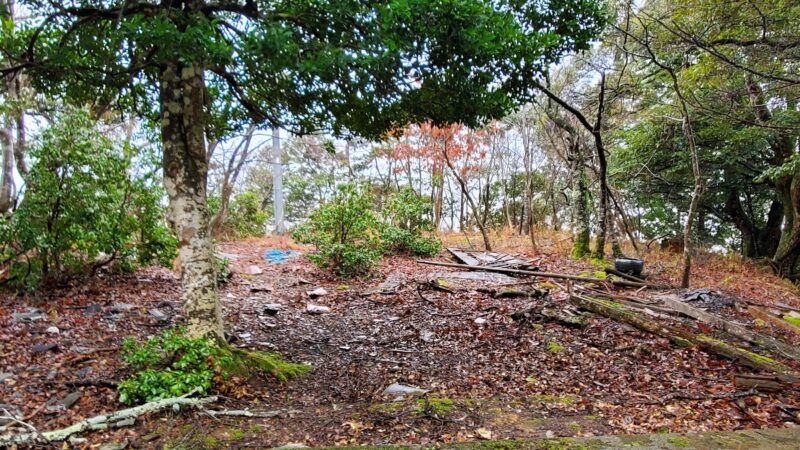
Sayo Castle has the typical structure of a medieval mountain castle, with the main enclosure (honmaru) located at the mountaintop. The main enclosure is relatively small, measuring approximately 30 meters east-west and 20 meters north-south.
Earthworks surround the main enclosure, with particularly high earthworks built along the ridge, which was especially vulnerable to attack. The interior of the main enclosure is currently flat, and it is believed that buildings such as the lord’s residence and watchtowers once stood there.
Secondary Enclosures and Groups of Enclosures
Several secondary enclosures (such as the second and third enclosures) are arranged around the main enclosure. These enclosures formed a tiered defensive line to protect the main enclosure, playing a role in delaying enemy advances.
Each enclosure is separated by a cliff (an artificial steep slope), restricting movement between them. This type of layout is a common feature of mountain castles from the Sengoku period.
Moats and Vertical Moats
Moats are an important defensive feature of Sayo Castle. Moats are dry moats dug to cut across ridges, and are effective defensive structures to prevent enemy incursions. Multiple moats have been identified behind the main enclosure of Sayo Castle (in the direction of the ridge).
Furthermore, vertical trenches dug into the slopes remain, which hindered enemy lateral movement and also functioned as rainwater drainage channels. These remains are still clearly visible in the mountains today.
Ascent Route and Gate
While it is believed there were multiple routes to the castle, the main route is presumed to have been a route from the southern valley, winding along the mountainside to the main enclosure. The exact location of the gate (koguchi) is unclear, but an opening in the earthworks is visible at the entrance to the main enclosure, suggesting this may have been the gate.
A characteristic of medieval mountain castles is that the ascent routes were not linear but rather complex, passing through enclosures and other structures, enhancing their defensive capabilities.
Current State of Sayo Castle Ruins
Preservation Status of Remains
The Sayo Castle ruins are currently a forest, but the main remains are relatively well preserved. The earthworks, trenches, and cliffs of the main enclosure are clearly visible, making it a valuable site for understanding the structure of medieval mountain castles.
Because it has been spared from recent development, the remains have been largely unaltered and are considered to have retained a considerable portion of their original appearance. However, due to years of weathering and tree growth, some parts of the remains are unclear.
Designation Status and Protection
Sayo Castle Ruins are not currently designated as a national historic site, but they are recognized locally as an important historical heritage site. The Sayo Town Board of Education is undertaking protection and utilization efforts, including surveys and the installation of information boards.
The hiking trail to the castle ruins is well-maintained, making it accessible to history enthusiasts and castle fans. However, as it is a mountain castle, appropriate equipment and preparation are necessary for visitors.
Archaeological Excavation and Research
While detailed archaeological excavations have not yet been conducted at Sayo Castle Ruins, research is underway through the creation of layout maps and observations of the ground surface. Future excavations could potentially reveal a more concrete historical picture of the castle, including its detailed structure, period of use, and unearthed artifacts.
Local historians and castle researchers are continuously conducting investigations, and new knowledge is accumulating.
Access to Sayo Castle
Access by Public Transportation
Access by Train:
- Get off at Sayo Station on the JR Kishin Line, then walk approximately 20 minutes to the trailhead.
- From Osaka, transfer to the JR Kishin Line at Himeji Station.
- From Okayama, transfer to the JR Kishin Line at Tsuyama Station.
While it is possible to walk from Sayo Station to the castle ruins trailhead, it is a bit of a distance, so consider taking a taxi.
Access by Bus:
- There is a community bus that circulates within Sayo Town, but it does not run directly to the castle ruins.
- Sayo Station is the most convenient starting point.
Access by Car
Using the Expressway:
- Approximately 5 minutes from the Sayo IC on the Chugoku Expressway.
- Accessible via the Harima Expressway as well.
Parking:
- There is no dedicated parking lot for the castle ruins, but public parking lots in the center of Sayo Town are available.
- It is common to park near the Sayo Town Hall and access on foot.
Precautions When Visiting the Castle
Since Sayo Castle is a mountain castle, the following points should be noted when visiting:
- Clothing and Equipment: Comfortable clothing, trekking shoes or athletic shoes, drinking water, towel, etc.
- Estimated Time: Approximately 20-30 minutes one way from the trailhead to the main enclosure; allow about 1 hour round trip.
- Season: In summer, take precautions against insects; in winter, be mindful of sunset times.
- Weather: It’s best to avoid visiting during rainy weather or after rain, as the ground can be slippery.
- Solo Visit: Visiting with multiple people is preferable if possible.
Nearby Tourist Facilities
Nearby tourist facilities you can visit when visiting Sayo Castle Ruins:
Sayo Town Historical and Folk Museum: A museum introducing the history and culture of Sayo Town, including exhibits related to Sayo Castle.
Hirafuku Townscape: The Hirafuku district of Sayo Town retains the atmosphere of an Edo-period post town, and is a beautiful tourist spot with riverside scenery.
Rikami Castle Ruins: Another important castle ruin in Sayo Town, a mountain castle known as the “Castle in the Sky.” Visiting it together with Sayo Castle is also recommended.
Highlights of Sayo Castle
View from the Main Enclosure
One of the greatest attractions of Sayo Castle is the view from the main enclosure. From the mountaintop, approximately 240 meters above sea level, you can enjoy a panoramic view of the town of Sayo, the flow of the Chikusa River, and the surrounding mountains. On a clear day, you can even see the mountains of Harima in the distance, giving you a real sense of the castle’s strategically important location.
On a fine day, you can imagine the view the castle lord had in the past, surveying his territory from this spot.
Clearly Preserved Moat Remains
One of the highlights of Sayo Castle is its well-preserved moats. Multiple moats are arranged in a series along the ridge behind the main enclosure, some reaching depths of 3-4 meters.
These moats are valuable remnants that demonstrate the castle-building techniques and defensive philosophies of the time, making them a must-see for castle enthusiasts. Standing at the bottom of the moats, you can experience their depth and defensive effectiveness firsthand.
Earthworks and Enclosure Structure
The earthworks surrounding the main enclosure are also a highlight. Earthen ramparts, 1-2 meters high, surround the baileys, and are particularly high in the direction of the ridge. Walking along the top of the ramparts allows you to understand the castle’s structure from the defender’s perspective.
The structure, with multiple baileys arranged in stages, also exhibits a typical layout of a medieval mountain castle and is an interesting remains for learning about the development of castle architecture.
The Impressiveness of the Cut Slopes
The cut slopes (artificial steep slopes) separating each bailey are also noteworthy. These slopes, reaching several meters in height, demonstrate the advanced civil engineering technology of the time and illustrate the significant obstacle they posed to attackers.
Looking up from below the cut slopes, you will be overwhelmed by their height and steepness, and you will truly appreciate the difficulty of besieging the castle.
Historical Background of Sayo Castle and its Surroundings
Medieval History of Harima Province and the Akamatsu Clan
Harima Province was an important region from ancient times as a strategic point on the Sanyo Road. In the Middle Ages, the Akamatsu clan was appointed as the governor of Harima Province and built a powerful force. As one of the most influential daimyo (feudal lords) of the Muromachi Shogunate, the Akamatsu clan played a significant political role.
The Akamatsu clan’s base was Shirahata Castle in eastern Harima (present-day Kamigori-cho, Ako-gun, Hyogo Prefecture), but they established branch castles throughout their vast territory. Sayo Castle was located at the western end of this branch castle network and played a crucial role as a defense against attacks from the Mimasaka region.
The Ōnin War and the Disturbances in Harima
The Ōnin War (1467-1477) was a large-scale civil war centered in Kyoto, but its effects extended throughout the country. The Akamatsu clan also participated on the Eastern Army side, and various military actions unfolded within Harima Province.
During this period, Sayo Castle was likely used as a military base, and it is thought that mobilization of troops from surrounding areas and the accumulation of supplies took place there. After the Ōnin War, the Akamatsu clan’s power gradually declined, leading to a series of independence movements and internal conflicts among their retainers.
Harima in the Sengoku Period
With the arrival of the Sengoku period, Harima Province found itself in a complex power dynamic. Following the decline of the Akamatsu clan, new forces such as the Urakami and Ukita clans rose to prominence, and the influence of the Mōri clan extended from the west.
Sayō was no exception, becoming a stage for conflicts between various forces. The castle lord likely changed over time, and local minor lords engaged in complex diplomacy to survive.
Hideyoshi’s Conquest of Harima and the Unification of the Government
Hashiba Hideyoshi’s conquest of Harima, which began in 1577, marked a major turning point in Harima’s history. Through skillful diplomacy and military power, Hideyoshi successively brought various forces in Harima under his control.
Various castles in western Harima, including Sayō Castle, came under the control of the Oda clan during this process. With Hideyoshi’s conquest of Harima Province, the turmoil of the Sengoku period ended, ushering in an era of peace under a unified government. However, this also marked the end of the role of mountain castles as military strongholds.
History and Culture of Sayo Town
Origin of the Name Sayo
There are several theories regarding the origin of the name “Sayo.” One theory suggests it derives from the ancient powerful clan, the “Sayo clan,” while another suggests it’s a corrupted form of a word related to the topography or vegetation.
Sayo, a place that has been inhabited since ancient times and flourished as a transportation hub, preserves many historical legacies to this day.
Development as a Post Town
During the Edo period, Sayo developed as a post town on the Inaba Highway. It thrived as a post town, frequented by daimyo processions on their sankin-kotai (alternate attendance) journeys and merchants. The Hirafuku district, in particular, retains a strong sense of its post town past and remains a popular tourist destination today.
The prosperity of Sayo as a post town represented a new form of development for Sayo after the abandonment of Sayo Castle. Its role shifted from a military base to a transportation and commercial hub.
Sayo in the Modern Era
From the Meiji era onward, Sayo developed as a region centered on agriculture and forestry. In the Showa era, the opening of the Kishin Line improved transportation access and promoted regional development.
In 2005 (Heisei 17), the former towns of Sayo, Kozuki, Nanko, and Mikazuki merged to form the new town of Sayo, which remains to this day. The ruins of Sayo Castle are a symbolic presence of this long-established Sayo region and are cherished by the local people.
The Cultural Value of Sayo Castle
Significance in Medieval Mountain Castle Research
Sayo Castle occupies an important position in castle research as a typical example of a medieval mountain castle in the Harima region. The main enclosure, secondary enclosure, moats, vertical moats, and earthworks are well-preserved, making it a valuable resource for understanding the structure of medieval mountain castles.
In particular, the structure with multiple moats arranged in succession is an important remains that demonstrates the development of castle construction techniques during the Sengoku period. Further detailed investigations are expected to yield additional insights.
Importance in Local History
Sayo Castle is an important historical site that tells the story of the medieval history of the Sayo region. It is associated with various historical events, such as the rule of the Akamatsu clan, the turmoil of the Sengoku period, and Hideyoshi’s conquest of Harima, providing concrete evidence of the region’s history.
For the local people, it serves as a symbol of their local history and a cornerstone of their identity. It is also used in school education and lifelong learning, contributing to the transmission of local culture.
Potential as a Tourism Resource
In recent years, interest in historical tourism and castle tours has been growing, and medieval mountain castles like Sayo Castle are attracting attention. Amidst this phenomenon, sometimes called the “mountain castle boom,” Sayo Castle is expected to be a promising tourist resource. With proper maintenance and information dissemination, it’s possible to attract more visitors and contribute to regional revitalization. However, balancing the protection and utilization of the historical remains is a crucial challenge.
How to Enjoy Your Visit to Sayo Castle
Learn About History
Learning about the history beforehand will allow you to enjoy Sayo Castle more deeply. Gaining basic knowledge about the history of the Akamatsu clan, the medieval history of Harima, and the structure of mountain castles will deepen your understanding at the site.
Visiting the Sayo Town Historical and Folk Museum first and viewing the exhibits before heading to the castle ruins is also recommended.
Observe the Layout
At the castle ruins, observing the layout (the design and arrangement of the castle) is important. Check the arrangement of the main enclosure, secondary enclosures, moats, earthworks, etc., and consider what defensive principles were based on their design.
Bringing a map of the layout will make it easier to confirm locations at the site. Also, taking photographs and recording the characteristics of each structure is a good idea.
Enjoying the Scenery
One of the charms of a mountain castle is the view from its high vantage point. Enjoy the scenery from the main enclosure and imagine what the castle lord saw from this spot. The surrounding mountains, which show different expressions depending on the season, and the townscape of Sayo spread out below, are well worth visiting.
The scenery is especially beautiful during the fresh greenery of spring and the autumn foliage, making it ideal for photography.
Exploring Local Historical Heritage
Exploring Sayo Castle in conjunction with the surrounding historical heritage will make for a more fulfilling historical exploration. Sayo Town has many historical sights, including the ruins of Rikami Castle, the post town of Hirafuku, and historical sites of the Chizu Highway.
Planning a one-day course to explore the history of Sayo Town is also recommended.
Summary
Sayo Castle is a valuable medieval mountain castle ruin remaining in Sayo Town, Hyogo Prefecture. Built under the rule of the Akamatsu clan, it played an important role in protecting a strategic point in western Harima. After the turmoil of the Sengoku period and the subsequent pacification of Harima by Hideyoshi, the castle was abandoned. However, the remains of the main enclosure, moats, and earthworks are still well-preserved.
Located on a mountaintop approximately 240 meters above sea level, the castle ruins offer panoramic views of the town of Sayo and the surrounding mountains, allowing visitors to feel the history of that time. It is a valuable cultural asset, both for learning about the structure of medieval mountain castles and for understanding the history of the region.
Accessible within walking distance of JR Sayo Station, the castle ruins are relatively easy to visit. However, as it is a mountain castle, appropriate equipment and preparation are necessary. It is a recommended spot not only for history enthusiasts and castle fans, but also for those who enjoy hiking and nature walks.
Visiting the Sayo Castle ruins offers a valuable experience of touching upon the medieval history of Harima and tracing the footsteps of our ancestors. It is hoped that this regional historical heritage will continue to be carefully preserved and cherished by many people.