Ponmoi Chashi Complete Guide: History and Highlights of the Nemuro Peninsula Chashi Ruins, One of Japan’s Top 100 Castles
What is Ponmoi Chashi?
Ponmoi Chashi is the remains of a “chashi,” a defensive structure built by the Ainu people, located at Cape Nosappu in Nemuro City, Hokkaido. Situated on a cliff overlooking the Pacific Ocean, very close to Cape Nosappu, Japan’s easternmost point, it is designated a national historic site as part of the Nemuro Peninsula Chashi Ruins.
“Ponmoi” means “small inlet” in the Ainu language, reflecting this geographical feature. Registered as the first of Japan’s Top 100 Castles, it is a valuable historical heritage site in Hokkaido, attracting many castle enthusiasts and history buffs.
What is a Chashi?
A chashi is a general term for facilities built by the Ainu people, and their uses were diverse. It is believed to have been used for various purposes, such as defensive structures, ceremonial sites, watchtowers, or meeting places. Approximately 500 Chashi sites have been identified throughout Hokkaido, and 32 of them remain within Nemuro City.
Many Chashi structures are of the “hilltop type,” cleverly utilizing the natural terrain, and Ponmoi Chashi is classified as this type. It is characterized by a structure that enhances defense by having moats and earthworks on the landward side, with cliffs or steep slopes as its backdrop.
Nemuro Peninsula Chashi Sites and National Historic Site Designation
The Nemuro Peninsula Chashi Sites were designated as a national historic site on April 26, 1983, and received additional designation on July 25, 1984, making them an important cultural property. Of the 32 Chashi sites remaining in Nemuro City, 24 are collectively designated as a historic site under the name “Nemuro Peninsula Chashi Sites.”
Characteristics of the Nemuro Peninsula Chashi Sites
The Nemuro Peninsula has an extremely high density of Chashi sites compared to other regions. This indicates that this region was an important living area for the Ainu people and flourished as a center of trade and fishing. The area around Cape Nosappu was strategically important, situated on a trade route to the Kuril Islands.
The main chashi (fortified settlements) included in the Nemuro Peninsula Chashi Sites are as follows:
- Ponmoi Chashi: A hilltop chashi located south of Cape Nosappu
- Onnemoto Chashi: One of the best-preserved chashi sites on the Nemuro Peninsula
- Notsukamafu Chashi: Located in the Onnemoto area
- Charukorofina Chashi: Remains in the Goyomai area
- Harutoru Charanke Chashi: Located around Shunkokudai
- Moshiriya Chashi: Remains near Nemuro city
These chashi sites each have different locations and structures, conveying the diverse lifestyles and defensive strategies of the Ainu people.
Historical Background of Ponmoi Chashi
The Ainu People and the Nemuro Region
Ponmoi Chashi is estimated to have been built between the 15th and 18th centuries. During this period, the Nemuro Peninsula was an important settlement for the Ainu people, flourishing as a center for fishing, hunting, and trade. The area around Cape Nosappu, in particular, was located on a trade route to the Kuril Islands and Sakhalin, and trade in marine products and furs was thriving.
The Kunashiri-Menashi War
At the end of the 18th century, a major event known as the “Kunashiri-Menashi War” (1789) occurred in the eastern Hokkaido region, including the Nemuro area. This was a revolt by the Ainu people against the harsh exploitation by Japanese merchants, and some of the Chashi ruins on the Nemuro Peninsula are thought to be relics that tell the story of the tensions of this period.
However, detailed traditions and records of use regarding Ponmoi Chashi itself have not been passed down to the present day, and it is unclear what its specific purpose was and until when it was used.
Selection as one of Japan’s Top 100 Castles
In 2006, when the Japan Castle Association selected “Japan’s Top 100 Castles,” the Nemuro Peninsula Chashi Ruins were registered as the first item. This was due to its evaluation as a historical heritage of the indigenous people of Hokkaido and as an important cultural property demonstrating the diversity in the history of Japanese castles.
This selection brought nationwide recognition to Ponmoi Chashi and the other Nemuro Peninsula Chashi Ruins, making them a popular tourist spot for many castle enthusiasts.
Structure and Characteristics of Ponmoi Chashi
Structure of a Hilltop Chashi
Ponmoi Chashi is a type of chashi known as a “hilltop chashi.” This type is characterized by its construction utilizing the tip of a cape or hill, and its structure taking advantage of the natural fortifications surrounded on three sides by cliffs or steep slopes.
The specific structural elements are as follows:
- Location: Located on the south side of Cape Nosappu, at the tip of a cape jutting out into the Pacific Ocean.
- Defensive Line: Defensive features include moats and earthworks on the landward side (the base of the cape).
- Cliffs: Surrounded on three sides by cliffs facing the sea, forming a natural defensive wall.
- Scale: A relatively small-scale structure, with a limited enclosure area.
Current Status of the Remains
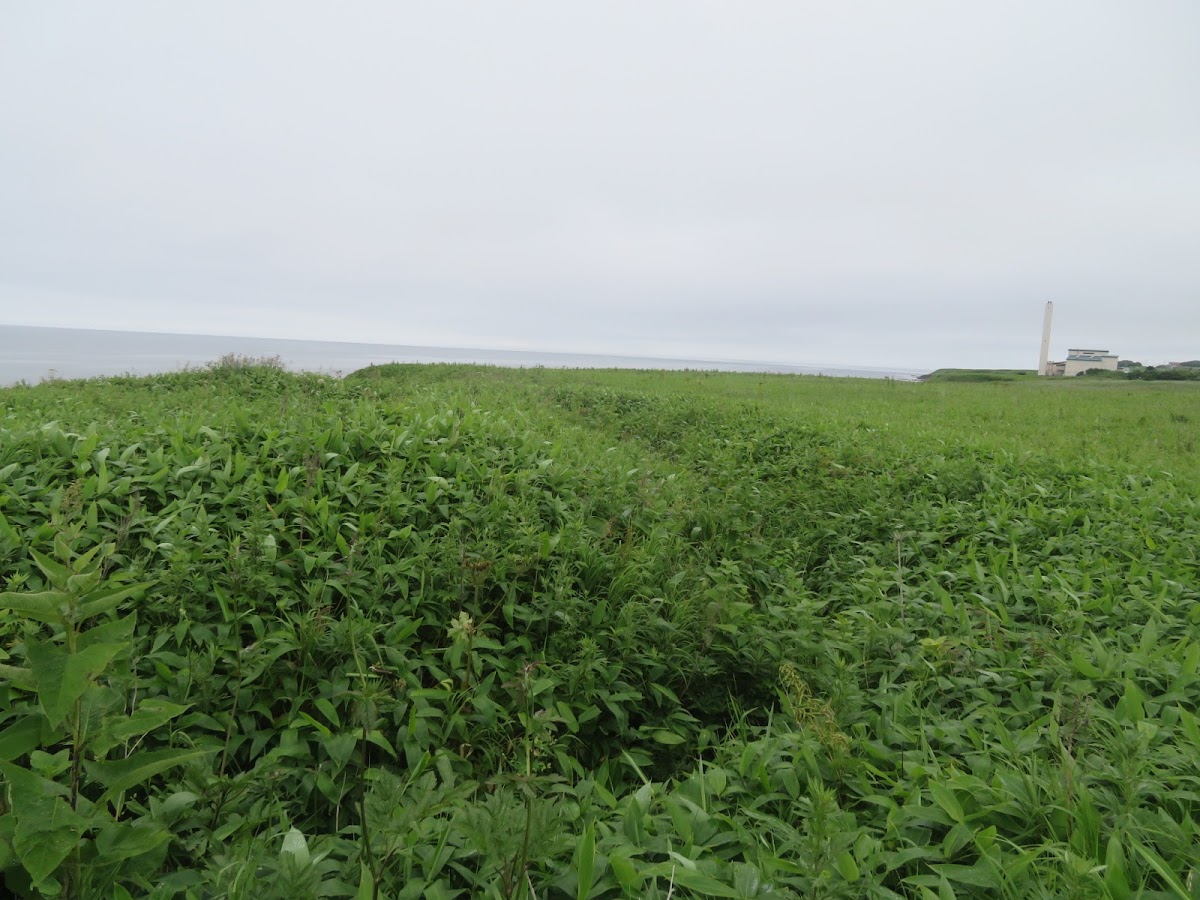
Currently, Ponmoi Chashi is covered in grass, making it difficult to clearly see the remains. Due to its location surrounded by cliffs, it is difficult to grasp the overall structure, and for safety reasons, approaching the cliff edge is not recommended.
A small marker post is erected at the site, serving as the only landmark indicating the location of Ponmoi Chashi. Located on the cliff side of a settlement with houses, it may appear as “just a grassy field” at first glance, and first-time visitors may overlook it.
Topographical Features
The most distinctive feature of Ponmoi Chashi lies in its geographical location. Cape Nosappu is known as Japan’s easternmost cape, situated where the Pacific Ocean and the Nemuro Strait meet. From this location, on clear days, the Habomai Islands of the Northern Territories can be seen, suggesting it was an important lookout point since ancient times.
As the place name “Ponmoi,” meaning “small inlet,” suggests, the surrounding area is dotted with small inlets, making it a suitable location for ship mooring and fishing activities. It is believed that the chashi (fortified settlement) was built in this location to take advantage of these geographical advantages.
Highlights of Ponmoi Chashi
Monuments and Signs
A monument and explanatory plaques marking the site’s designation as a national historical site are installed. These explain the historical value of Ponmoi Chashi and the importance of the Nemuro Peninsula chashi site group as a whole, serving as valuable information for visitors.
The area around the monument is a popular spot for photography, and many castle enthusiasts take pictures there to commemorate their completion of visiting all of Japan’s 100 Famous Castles.
Combined Sightseeing with Cape Nosappu
Ponmoi Chashi is located very close to Cape Nosappu, so it’s common to visit it in conjunction with sightseeing at the cape. Cape Nosappu has the following attractions:
- Nosappu Cape Lighthouse: The easternmost lighthouse in Hokkaido
- Northern Territories Museum/House of Nostalgia: A museum of materials related to the Northern Territories
- Bridge to the Four Islands: A monument expressing the hope for the return of the Northern Territories
- Aurora Tower: Observation facility
From Cape Nosappu, if the weather is good, you can see Kaigarajima and Suishojima islands of the Northern Territories with the naked eye, providing an opportunity to reflect on Japan’s territorial issues.
Surrounding Chashi Sites
Numerous Chashi sites are scattered throughout the Nemuro Peninsula, and if you have time, you can enjoy a “Chashi tour” visiting several of them. The following Chashi sites are particularly accessible and recommended:
Onnemoto Chashi Site is one of the best-preserved Chashi sites on the Nemuro Peninsula, with its moats and earthworks remaining relatively clearly defined. Its connection to the Kunashiri-Menashi War has also been noted, making it a historically important site.
Notsukamafu No. 1 & 2 Chashi Sites are located in the Onnemoto area and are typical hilltop Chashi built on a coastal terrace.
Scenic Charms
The view from Ponmoi Chashi is a spectacular spot offering panoramic views of the vast Pacific Ocean. Especially on clear summer days, the contrast between the deep blue sea and sky is beautiful, and in winter, drift ice sometimes reaches the shore, allowing visitors to enjoy the scenery in all four seasons.
The area around Cape Nosappu, also known as a sunrise viewing spot, offers the earliest sunrise in Japan (excluding remote islands), attracting many tourists on New Year’s Day.
Access Information
Location
Address: Near 2-chome, Nosappu, Nemuro City, Hokkaido
Location: South of Nosappu Cape Lighthouse, on the opposite side of the cape
Transportation
Access by Car:
- Approximately 25km from Nemuro city center via National Route 44 and Prefectural Route 35, about 30 minutes by car
- Approximately 135km from Kushiro City, about 2 hours 30 minutes by car
- Approximately 70km from Nakashibetsu Airport, about 1 hour 20 minutes by car
Public Transportation:
- Approximately 40 minutes by Nemuro Kotsu bus bound for Nosappu Cape from JR Nemuro Main Line “Nemuro Station,” get off at “Nosappu Cape” bus stop, about 5 minutes on foot
- Bus service is limited, so it is necessary to check the timetable in advance.
Parking
There is a free parking lot at Nosappu Cape, from which you can access Ponmoi Chashi on foot. The ruins are approximately a 5-10 minute walk from the parking lot.
Points to Note When Visiting
- Condition of the Ruins: Covered in grass, the clearly defined ruins are difficult to see.
- Safety: Surrounded by cliffs, approaching the cliff edge is dangerous.
- Clothing: Long pants and comfortable walking shoes are recommended as you may be walking through grass.
- Season: Visiting in winter is difficult due to snow and strong winds.
- Time Required: Viewing the ruins themselves takes an average of 15-20 minutes.
Best Season for Visiting
Spring (April-June)
Spring, after the snow melts, is a good time to observe the topography of the ruins because the grass is still short. However, April is still cold and windy, so warm clothing is necessary. Late May to June offers stable weather and is suitable for visiting.
Summer (July-August)
This is the peak tourist season, with mild and pleasant weather. However, overgrown vegetation makes observing the ruins difficult. Fog is also common during this time, resulting in poor visibility on some days.
Autumn (September-October)
Autumn offers relatively stable weather, and the vegetation begins to wither, making it an ideal time for observing the ruins. While autumn foliage is less pronounced in this area, the scenery on clear autumn days is magnificent and perfect for photography.
Winter (November-March)
Due to snowfall, severe cold, and strong winds, winter visits are not recommended. However, February-March, when drift ice approaches the shore, offers a unique landscape. Thorough cold-weather gear is essential.
Information on the Stamp for Japan’s Top 100 Castles
The stamp for Japan’s Top 100 Castles at the Nemuro Peninsula Chashi Ruins can be obtained at the following locations:
Location:
- Nemuro City Tourist Information Center (in front of JR Nemuro Station)
- Nemuro City Museum of History and Nature
Opening Hours:
- Tourist Information Center: 9:00 AM – 5:00 PM (excluding New Year’s holidays)
- Museum of History and Nature: 9:30 AM – 4:30 PM (closed Mondays, or the following day if Monday is a public holiday)
Notes:
- There is no stamp at the Ponmoi Chashi site itself.
- The Tourist Information Center in front of Nemuro Station is the most easily accessible location.
- Bring your Top 100 Castles stamp book or you can obtain a stamp sheet.
Nearby Tourist Attractions
Nemuro City Museum of History and Nature
This facility offers comprehensive learning about Nemuro’s history, nature, and culture. The museum also features exhibits on Ainu daily life tools and the Chashi (fortified settlement), making it ideal preparation before visiting Ponmoi Chashi.
Shunkunitai
A sandbar separating Nemuro Bay and Lake Furen, it is a Ramsar Convention-registered wetland. Known as a popular spot for birdwatching, it is home to many birds, including Japanese cranes and white-tailed eagles.
Lake Furen
The largest coastal lagoon in eastern Hokkaido, it boasts a rich natural environment. Fishing for clams and scallops is thriving, and there are observation facilities on the lakeshore.
Cape Ochishi
A cape jutting out into the Pacific Ocean from the Nemuro Peninsula, it is a place of beautiful natural scenery along with the Kiritappu Marsh.
Cultural Value of Ponmoi Chashi
Importance as an Ainu Cultural Heritage Site
Ponmoi Chashi is a valuable heritage site that conveys the history and culture of the Ainu people to the present day. For the Ainu people, who lacked written records, remains like Chashi are extremely important physical evidence for understanding their lifestyle, social structure, and technological level.
The distribution and structure of Chashi reveal that the Ainu possessed defensive techniques that skillfully utilized natural terrain, that there were regional differences in cultural characteristics, and that their lives revolved around trade and fishing.
Position in the History of Japanese Castles
The inclusion of Chashi in the list of Japan’s 100 Famous Castles is significant in demonstrating the diversity of Japanese castle history. Traditionally, “castles” primarily referred to early modern castles with stone walls and keeps located south of Honshu. However, including Ainu Chashi allows for a more comprehensive understanding of the history of defensive structures throughout the Japanese archipelago.
Like mountain castles and moated settlements in Honshu, Chashi are unique defensive structures adapted to regional topography, climate, and social structure, and can be considered symbolic of the diversity of Japanese castle culture.
Challenges in Preservation and Utilization
The Nemuro Peninsula Chashi ruins, including Ponmoi Chashi, are legally protected as a national historical site, but there are various challenges in their preservation and utilization.
- Obviousness of Remains: Remains such as earthworks and moats are covered with grass, making them difficult to see.
- Lack of Explanatory Facilities: Detailed explanations at the site are scarce, making it difficult to understand the historical background.
- Access Problems: Public transportation is limited, making visits difficult.
- Climate Conditions: Due to the harsh climate, the period during which visitors can see the sites is limited.
In response to these challenges, Nemuro City is working to improve tourist information and implement guided tours.
Visitor Reviews and Testimonials
Evaluation from Castle Enthusiasts
Castle enthusiasts who are touring Japan’s 100 Famous Castles hold a special place in its status as a “historical heritage site at the edge of the world.” According to data from the Castle Enthusiasts Group, the average rating is a relatively low 2.16 out of 5, which is likely due to the poor visibility of the ruins and the difficulty of access.
The average visit time is relatively short, at approximately 19 minutes, with most visitors only staying long enough to take photos of the monument and enjoy the surrounding scenery.
Actual Visitor Feedback
Visitors have shared the following feedback:
Positive Reviews:
- “Worth visiting as the easternmost castle ruin in Japan.”
- “Enjoyable in conjunction with the scenery of Cape Nosappu.”
- “A good opportunity to learn about Ainu culture.”
- “Visited to complete my 100 Famous Castles list, and it has a unique atmosphere.”
Negative Reviews:
- “Almost no remains visible, just a grassy field.”
- “Surrounded by cliffs, dangerous and inaccessible.”
- “Few explanatory signs, making it difficult to understand the historical background.”
- “Inconvenient access, time-consuming.”
Tips for a More Enjoyable Visit
To make the most of your visit to Ponmoi Chashi, the following points are important:
- Pre-visit Study: Study at the Nemuro City Museum of History and Nature before visiting.
- Visit Multiple Chashi: Visit other Chashi, such as Onnemoto Chashi.
- Combine with Nosappu Cape sightseeing: Create a comprehensive sightseeing plan that includes the cape’s tourist facilities.
- Participate in a guided tour: Participate in a guided tour conducted by the Nemuro City Tourism Association.
- Use your imagination: Even if the remains are unclear, observe while imagining the lives of the Ainu people in the past.
History and Culture of Nemuro City
Overview of Nemuro’s History
Nemuro, as the easternmost city in Japan, has long been a settlement of the Ainu people. During the Edo period, it developed as a trading hub under the rule of the Matsumae Domain. After the Meiji Restoration, it prospered as a base for northern fishing, and the fishing industry remains the main industry today.
Contact between the Ainu People and the Japanese
From the 17th century onward, the Japanese (Matsumae Domain) began to expand into the Nemuro region, and trade with the Ainu people flourished. However, inequality and exploitation in trade gradually became more serious, leading to the Kunashiri-Menashi War at the end of the 18th century.
Following this battle, the shogunate brought Ezo (Hokkaido) under its direct control and strengthened its rule over the Ainu people. In this process, many chashi (fortified settlements) fell into disuse and were preserved as historical ruins.
Northern Territories Issue
Nemuro City is a region deeply involved in the Northern Territories issue. From Cape Nosappu, on a clear day, parts of the four Northern Islands can be seen with the naked eye, and many former islanders and their descendants reside in Nemuro City.
Facilities such as the Northern Territories Museum and the House of Nostalgia offer opportunities to learn about the history of the Northern Territories and the return movement. A visit to Ponmoi Chashi, combined with this opportunity, provides a valuable understanding of the complex history of this region.
Summary
Although Ponmoi Chashi has low visibility as a historical ruin, it is an important cultural property demonstrating the diversity in the history of Japanese castles and a valuable legacy that conveys the history of the Ainu people to the present day. As the first of Japan’s 100 Famous Castles, it attracts many castle enthusiasts, and its unique location at Cape Nosappu, Japan’s easternmost point, is also one of its attractions.
When visiting, don’t just look at the ruins; learn about Nemuro’s history and culture, the lives of the Ainu people, and understand the multifaceted history of this region for a more fulfilling experience. Combined with the magnificent natural scenery of eastern Hokkaido, Ponmoi Chashi is a historical site well worth visiting.
Ponmoi Chashi, throughout the Nemuro Peninsula Chashi ruins, offers a valuable opportunity to experience the diverse history and culture of the Japanese archipelago. Its existence teaches us the profoundness of Japanese history and the importance of preserving and passing on the cultural heritage of indigenous peoples.