Miyamori Castle (Fukushima Prefecture) Complete Guide: From the Base of the Oshu Governor to the Stage of the Date Terumune Abduction Incident
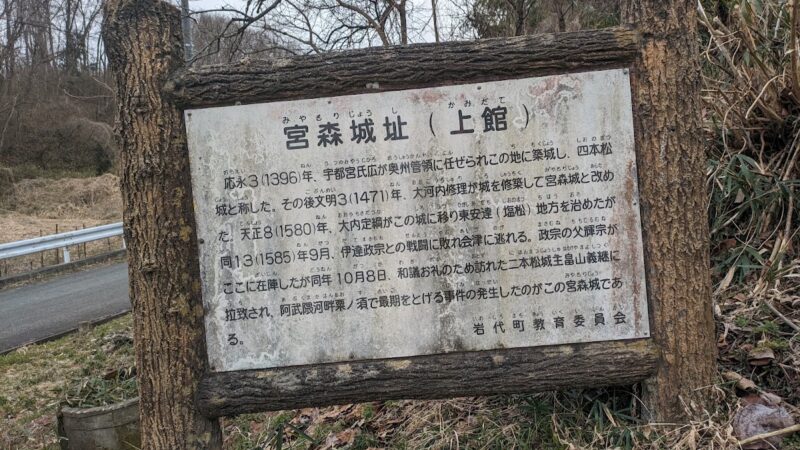
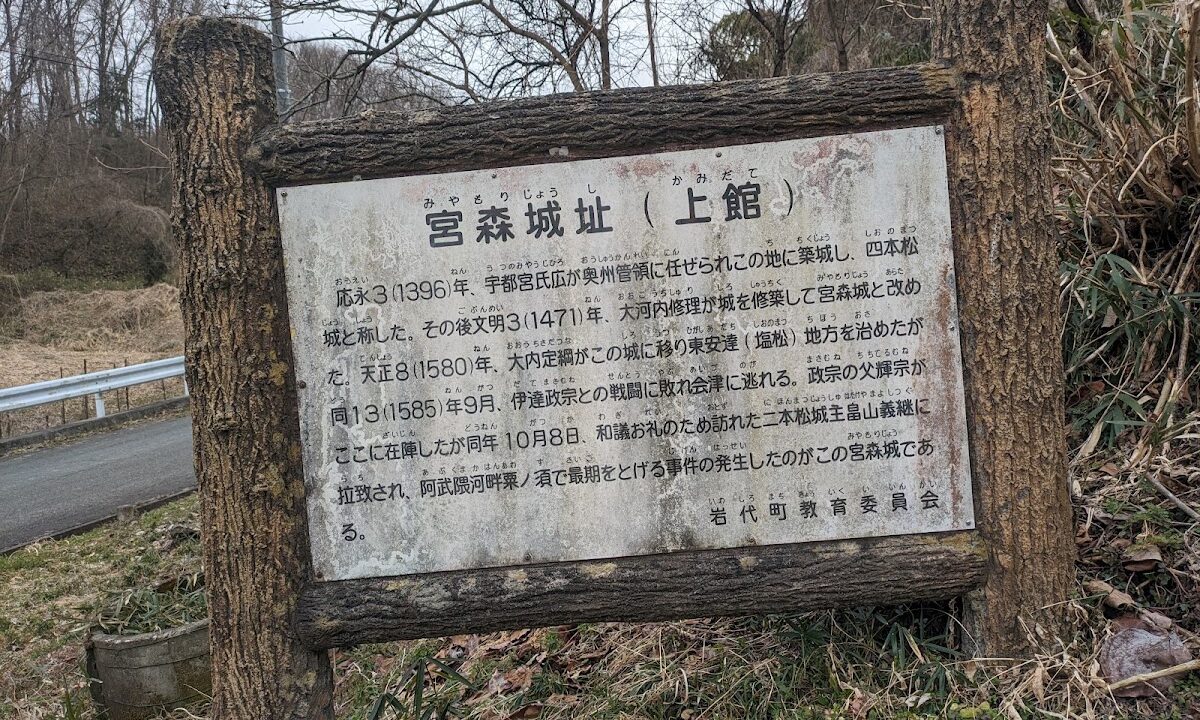
Miyamori Castle, located in Obama, Nihonmatsu City, Fukushima Prefecture, is a mountain castle built in 1396 by Utsunomiya Ujihiro, the Oshu Governor. Also known by other names such as Shionomatsu Castle, Miyamori Castle, and Kamikan, it was the stage for the Date Terumune abduction incident, a major event that shook Japanese history during the Sengoku period. This article provides a detailed explanation of Miyamori Castle, including its history, structure, and current remains.
Basic Information on Miyamori Castle
Location: Kamikan, Obama, Nihonmatsu City, Fukushima Prefecture
Former Province: Iwashiro Province (Mutsu Province)
Classification/Structure: Mountain Castle
Other Names: Shihonmatsu Castle, Miyamori Castle, Kamikan
Builder: Utsunomiya Ujihiro
Year of Construction: 1396 (Oei 3)
Main Lords: Utsunomiya clan, Hatakeyama clan, Ouchi clan
Keep Structure: None (Mountain Castle)
Remains: Earthworks, baileys, dry moats, Harakiri Stone
Miyamori Castle is located in the former Iwashiro town area of Nihonmatsu City, approximately 2 km north of Obama Castle. Built at a strategic transportation hub where the Miharu and Motomiya roads passed through the castle town, it functioned as an important base in Oshu during the Sengoku period.
History and Background
Oei Period: Construction by the Utsunomiya Clan
The history of Miyamori Castle begins in 1396 (Oei 3). Utsunomiya Ujihiro, appointed as the Oshu Kanrei (governor of Oshu) by the Muromachi Shogunate, moved to this area, replacing Kira Mitsuie, who had previously resided at Shihonmatsu Castle (Kamichoori, Nihonmatsu City), and built this castle as a new base. Initially, this castle was called “Shihonmatsu Castle” and served as the Utsunomiya clan’s base of operations in Oshu.
The Utsunomiya clan was a prestigious samurai family based in Shimotsuke Province (present-day Tochigi Prefecture), but their influence expanded in this region after they were entrusted with governing the Tohoku region as Oshu Kanrei. Miyamori Castle functioned as a fortress symbolizing the Utsunomiya clan’s authority in Oshu.
Bunmei Period: The Hatakeyama Clan’s Era
During the Bunmei era (1469-1487), the Hatakeyama clan became the lords of the castle. The Hatakeyama clan was a powerful local lord based at Nihonmatsu Castle, and they utilized Miyamori Castle as an important subsidiary castle to strengthen their control over the region. It is believed that from this period onward, Miyamori Castle came to be known simply as “Miyamori Castle.”
During the Hatakeyama clan’s time, conflicts with surrounding local lords such as the Ouchi, Ishikawa, and Terasaka clans were frequent, and Miyamori Castle’s importance as a military base increased.
Eiroku-Tensho Period: A Time of War
From the Eiroku period (1558-1570) to the Tensho period (1573-1593), Miyamori Castle was embroiled in fierce warfare. In 1569 (Eiroku 12), a battle took place against the Ouchi, Ishikawa, and Terasaka clans, and it is said that a warrior named Okouchi Soshiro committed seppuku (ritual suicide) within the castle during this battle. The “harakiri stone” believed to have been used at this time remains an important historical site at the castle ruins.
Tensho 13 (1585): The Abduction of Date Terumune
The most famous event in the history of Miyamori Castle is the abduction of Date Terumune, which occurred on October 8, Tensho 13 (1585).
At the time, Hatakeyama Yoshitsugu, the lord of Nihonmatsu Castle, was suffering under the pressure of the rapidly rising Date Masamune. Cornered, Yoshitsugu offered to make peace with Masamune’s father, Date Terumune. Terumune went to Miyamori Castle to meet with Yoshitsugu, but this was a trap set by Yoshitsugu.
During the meeting, Yoshitsugu suddenly abducted Terumune and attempted to take him back to Nihonmatsu Castle as a hostage. Upon hearing this news, Date Masamune immediately led his army in pursuit and caught up with Yoshitsugu and his group near Awanosu (present-day Motomiya City) near the Abukuma River. At this point, the Date army fired a volley of shots, resulting in the tragic loss of both Terumune and Yoshitsugu’s lives. This incident is also known as the “Awanosu Incident,” and it was a heartbreaking event for the young Date Masamune, who lost his father.
After this incident, Date Masamune destroyed the Nihonmatsu clan, and Miyamori Castle came under the control of the Date clan.
From the Early Modern Period Onward: Towards Abandonment
From the end of the Tensho era to the Keicho era, Miyamori Castle gradually ceased to serve its purpose. With Toyotomi Hideyoshi’s pacification of Oshu and the arrival of the Edo period, medieval mountain castles became outdated, and Miyamori Castle is believed to have been abandoned.
Structure
Layout and Topography
Miyamori Castle is a typical medieval mountain castle built on a mountain approximately 300 meters above sea level. Located in a strategic position overlooking the basin of the Adatara River, a tributary of the Abukuma River, the castle boasts a strategic location that allows for monitoring of the major roads, the Miharu Road and the Motomiya Road.
The castle’s layout features a central main enclosure (shukuro) surrounded by multiple terraced enclosures (kuruma), creating a linear structure. It exhibits a typical medieval castle design, skillfully utilizing the mountainous terrain and employing natural steep slopes as defensive lines.
Main Remains
Main Enclosure (Honmaru)
The main enclosure, located at the highest point of the castle, measures approximately 40 meters east-west and 30 meters north-south. Traces of earthworks can still be seen today, revealing remnants of its former defensive structure. From the main enclosure, one can see the city of Nihonmatsu and Mount Adatara, suggesting it also served as a lookout point due to its excellent views.
Second and Third Enclosures
Multiple enclosures are arranged around the main enclosure. These structures are thought to have served not only to defend the main enclosure but also as troop garrisons and storage areas for supplies.
Dry Moats Several traces of dry moats remain within the castle grounds. These were defensive structures designed to prevent enemy intrusion, and some were built as vertical moats descending slopes, demonstrating a strategy to prevent flanking attacks.
Earthworks Earthworks surrounded the enclosures, and parts of them remain in good condition today. Since no stone walls were used, and the structures are purely made of earth, they clearly demonstrate the characteristics of a medieval mountain castle.
Harakiri Stone The most famous structure at the castle site is the “Harakiri Stone.” It is said that during the battle of 1569, Okouchi Soshiro committed seppuku (ritual suicide) on this stone. This stone still remains at the castle site, making it a valuable historical site that conveys the history of fierce battles during the Sengoku period.
Defensive Features
The defensive structure of Miyamori Castle exhibits numerous ingenious features characteristic of medieval mountain castles. The combination of natural defensive lines utilizing steep slopes, multiple layers of defense through various enclosures, and artificial defensive structures such as dry moats and earthworks formed a formidable fortress.
Particularly noteworthy is its location for monitoring major roads. By overlooking the Miharu and Motomiya roads, major transportation routes, it was possible to detect enemy movements early and control the flow of goods and people along these roads. This geographical advantage made Miyamori Castle a strategically important base.
Miyamori Castle and the Surrounding Castle Network
Miyamori Castle did not exist in isolation; it functioned as part of a castle network coordinating with several surrounding castles.
Relationship with Obama Castle
Obama Castle, located approximately 2 km to the north, had a close relationship with Miyamori Castle. The two castles supported each other, and were located close enough to send reinforcements if one was under attack. Cooperation with Nihonmatsu Castle
During the Hatakeyama clan’s era, it functioned as an important subsidiary castle of Nihonmatsu Castle, the main castle. Located approximately 10 km southeast of Nihonmatsu Castle, it served as a forward base against threats from the south, such as those from the Date clan.
Road Monitoring Base
Situated at the intersection of the Miharu and Motomiya roads, it also played a role in monitoring and controlling traffic to Aizu, Miharu, and Soma. This geographical characteristic made Miyamori Castle a strategically important fortress beyond a mere military base.
Current Miyamori Castle Ruins
Access and Visiting
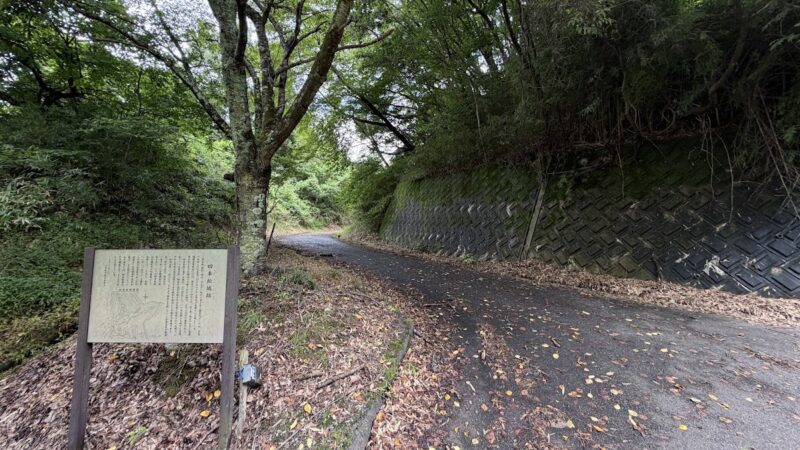
The current Miyamori Castle ruins are located in Kamikan, Kohama, Nihonmatsu City, Fukushima Prefecture, and are open to visitors. However, as it is a mountain castle, a certain level of physical fitness and equipment is required to climb it.
Access Information
- By Car: Approximately 15 minutes from the Nihonmatsu Interchange on the Tohoku Expressway
- By Public Transport: Approximately 10 minutes by taxi from Adachi Station on the JR Tohoku Main Line
- Parking: Several parking spaces are available near the castle ruins.
The climb from the entrance to the main enclosure takes approximately 15-20 minutes. Since some parts of the path are not well-maintained, comfortable shoes and clothing are recommended.
Highlights
Harakiri Stone
The Harakiri Stone, the most famous structure at the castle ruins, is a must-see. As a valuable historical site that conveys the way of life of samurai during the Sengoku period, it attracts many castle enthusiasts.
Earthworks and Enclosures
The remains of earthworks and enclosures around the main enclosure are very helpful in understanding the structure of medieval mountain castles. The earthworks of the main enclosure, in particular, are well-preserved, allowing visitors to imagine the defensive facilities of the time.
View
The view from the main enclosure is magnificent, offering a panoramic view of Nihonmatsu city and the majestic Mount Adatara. This excellent view clearly demonstrates the importance of its function as a lookout point.
Preservation Status and Challenges
Fortunately, the Miyamori Castle ruins escaped modern development, resulting in relatively well-preserved remains of this medieval mountain castle. However, because very few structures such as stone walls and foundation stones remain, it can be difficult for the average tourist to identify the remains.
In recent years, local history enthusiasts and castle researchers have been conducting surveys and preservation activities, including the installation of information boards and the improvement of the access routes. However, due to budget and personnel constraints, sufficient improvements have not yet been achieved.
Awanosu Ancient Battlefield: The Site of Date Terumune’s Demise
Indispensable to understanding Miyamori Castle is the Awanosu Ancient Battlefield, the site of the final stages of the Date Terumune abduction incident. Located approximately 5 km north of Miyamori Castle, in what is now Motomiya City, this is where Terumune and Hatakeyama Yoshitsugu met their fate.
While legend says the incident occurred on the banks of the Abukuma River, the actual site is more than 1 km away. A monument now stands at this location, commemorating the tragedy of the Sengoku period.
For Date Masamune, this incident, the loss of his father Terumune, profoundly impacted his life. The painful experience of his father’s death marked a turning point in his growth into the renowned general known as the “One-Eyed Dragon.”
Historical Significance of Miyamori Castle
Miyamori Castle transcends the boundaries of a mere regional mountain castle; it holds significant importance in the history of Japan’s Sengoku period.
A Base for the Oshu Governor
Built by the Utsunomiya clan as a symbol of the Muromachi Shogunate’s rule over Oshu, it was an important base connecting the central government with the Tohoku region.
A Stage of Turmoil in the Sengoku Period
This site holds an extremely important historical position as the starting point of the Date Terumune abduction incident, a major event that shook Japanese history.
A Typical Medieval Mountain Castle
As a mountain castle built of earth without stone walls, it retains many characteristics of medieval castles, making it a valuable historical site for castle research.
Points to Note When Visiting Miyamori Castle
Keeping the following points in mind will make your visit to Miyamori Castle ruins more fulfilling.
Preparation
- Wear comfortable shoes and clothing
- Bring drinking water
- Check the location in advance using a map or guidebook
- Check the weather and avoid visiting in rainy weather
Tips for Visiting
- It is recommended to visit in the following order: main enclosure, suicide stone, and earthworks
- Imagine the defensive structure while observing the layout of the enclosures
- Consider the strategic importance of this area while enjoying the view
- Be careful not to damage the remains when taking photographs
Related Historical Sites in the Surrounding Area
Visiting the following historical sites in conjunction with Miyamori Castle will give you a deeper understanding of the Sengoku period history of this region.
- Obama Castle Ruins (approx. 2km north)
- Nihonmatsu Castle Ruins (approx. 10km northwest)
- Awanosu Ancient Battlefield (approx. 5km north)
- Dairinji Temple (where Date Terumune’s grave is located)
Summary
Miyamori Castle is a mountain castle that watched over the history of Oshu for approximately 200 years, from its construction in 1396 (Oei 3) until its abandonment during the Tensho era. Built by Utsunomiya Ujihiro, the governor of Oshu, and the site of the wars during the Hatakeyama clan’s era, as well as the tragic Date Terumune abduction incident, this castle is a valuable historical site that conveys the turbulent times of the Sengoku period.
While it lacks grand structures such as stone walls and keeps, the remains such as earthworks, baileys, and the “harakiri stone” (a stone used for ritual suicide) are valuable resources that convey the true nature of a medieval mountain castle. When you visit Fukushima Prefecture, be sure to visit this historical site and feel the spirit of the Sengoku period.
As you enjoy the view from the ruins of Miyamori Castle and reflect on the glory of the Utsunomiya clan, who ruled the Tohoku region as the governor of Oshu, and the tragic fates of Date Terumune and Hatakeyama Yoshitsugu, you will feel the weight of history and the depth of human drama.