Tajima Jinya Ruins (Fukushima Prefecture) Complete Guide: History, Highlights, and Access Information
Located in Minamiaizu-machi, Minamiaizu-gun, Fukushima Prefecture, the Tajima Jinya Ruins are the site of a magistrate’s office that governed the Minamiyama Gokurairi territory of the Aizu Domain during the Edo period. Preserved as a historical site, it is a valuable historical legacy that conveys the administrative functions of the time. This article provides a detailed explanation of the Tajima Jinya Ruins, from its historical background to its highlights and access methods.
What are the Tajima Jinya Ruins?
The Tajima Jinya Ruins are the remains of a magistrate’s office established by the Aizu Domain during the Edo period. It functioned as the administrative and economic center of the region known as the Minamiyama Gokurairi territory, responsible for collecting land tax and governing the area.
Definition and Role of a Jinya
A Jinya refers to an office established by daimyo or hatamoto during the Edo period to govern their territory. While not as large as a castle, it housed a magistrate or district magistrate, responsible for administrative, judicial, and police functions within the territory. The Tajima Jinya (fortified residence) managed a unique region that, while under the control of the Aizu Domain, also possessed characteristics of a shogunate-controlled territory.
Characteristics of the Nanzan Gokurairi Territory
The Nanzan Gokurairi Territory was a region within the Aizu Domain that received special treatment as a direct territory of the domain lord. The name “Gokurairi” originates from the fact that the annual rice tax was directly deposited into the domain’s storehouse. This region had a rice yield of approximately 30,000 koku and was an important source of revenue for the Aizu Domain.
History of the Tajima Jinya
Establishment History
The establishment of the Tajima Jinya dates back to the early Edo period. When Hoshina Masayuki, the lord of the Aizu Domain, took control of Aizu in 1643, he recognized the importance of the Nanzan region and established a magistrate’s office for efficient governance. Tajima was a crucial transportation hub in the Minami-Aizu region, where roads to Shimotsuke Province (present-day Tochigi Prefecture) and Echigo Province (present-day Niigata Prefecture) intersected.
Development during the Edo Period
The Tajima Jinya (fortified residence) functioned not merely as an administrative body but also as a center of regional economic activity. Forestry was thriving in the surrounding area, and the town flourished as a timber collection point. It also developed as a post town on the Aizu-Nishi Kaido (Shimotsuke Kaido), bustling with travelers and merchants.
The Jinya housed several officials, including a magistrate, who carried out a wide range of duties, including tax collection, supervision of flood control projects, and adjudication of lawsuits. In particular, the Minamiyama region, being mountainous, faced important challenges in forest management and the development of irrigation canals.
From the End of the Edo Period to the Meiji Restoration
During the Boshin War at the end of the Edo period, the Aizu Domain fought against the new government forces, and the area around Tajima was caught in the fighting. In 1868 (Keio 4), when the new government forces invaded Aizu, the Tajima Jinya (fortified residence) temporarily became a battlefield. Following the defeat of the Aizu domain, the Tajima Jinya was abolished as part of the Meiji government’s administrative reforms, and its functions were transferred to new local administrative bodies.
Current Status and Remains of the Tajima Jinya Site
Existing Remains
Currently, no buildings remain at the Tajima Jinya site, but a portion of the grounds is preserved as a historical site. Archaeological excavations have revealed the layout and size of the Jinya buildings, and explanatory signs have been installed.
The Jinya site is believed to have once covered an area of approximately 2,000 tsubo (approximately 6,600 square meters). Major buildings included the “Yakusho” (office of the magistrate), the “Okura” (storehouse for tax rice), officials’ quarters, and a prison.
Results of Archaeological Excavations
Recent archaeological excavations have unearthed building foundations, drainage ditch remains, and pottery fragments. These artifacts provide insights into the lifestyle and structure of the jinya (fortified residence) at the time. In particular, the discovery of high-quality pottery suggests that officials of the magistrate class maintained a reasonable standard of living.
Surrounding Historical Landscape
Around the Tajima Jinya site, some of the townscape retaining the atmosphere of the Edo period highway is preserved. Along the Aizu-Nishi Highway, old merchant houses and storehouses are scattered, allowing visitors to experience the history of the post town. Furthermore, within walking distance of the jinya site is the Tajima Gion Kaikan, famous for the Tajima Gion Festival, offering a chance to experience local traditional culture.
Highlights of the Tajima Jinya Site
Development as a Historical Park
The Tajima Jinya site has been developed as a historical park, providing a place to learn about the region’s history. Within the park, there are information boards showing the layout of the jinya (fortified residence) and reproductions of illustrations depicting Tajima during the Edo period.
Stone Monument and Information Board
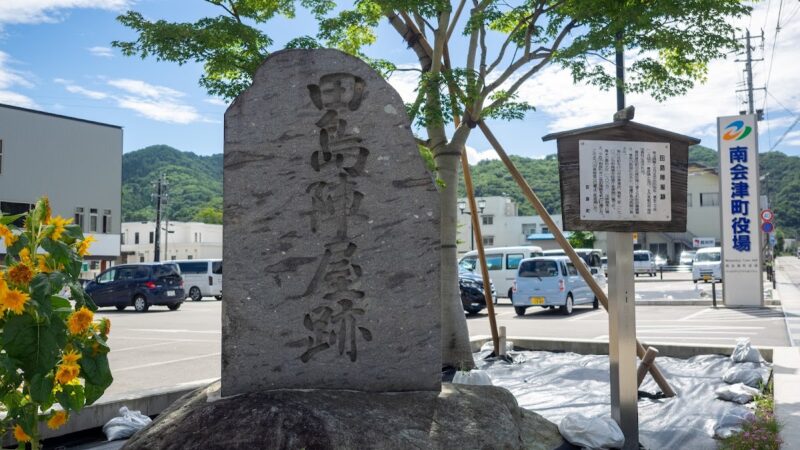
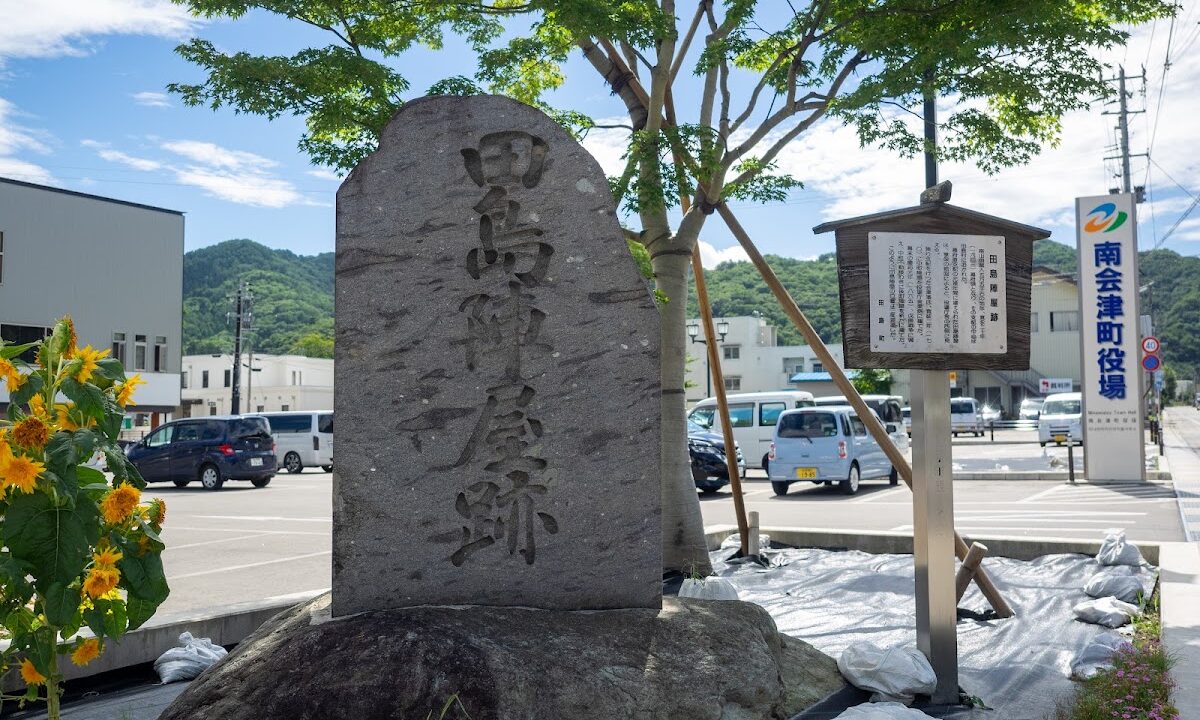
A stone monument inscribed with “Tajima Jinya Site” stands at the site of the jinya, ensuring visitors recognize it as a historical site. Detailed information boards describe the history, role, and building layout of the jinya, making it easy to understand even for those unfamiliar with history.
Seasonal Scenery
The area around the Tajima Jinya Site boasts attractive natural scenery throughout the seasons. Cherry blossoms bloom in spring, lush greenery flourishes in summer, the autumn leaves are beautiful, and a snowy landscape unfolds in winter. The autumn foliage season, in particular, is an excellent time to enjoy both historical exploration and nature appreciation.
Seasonal Scenery ## Access to Tajima Jinya Ruins
Access by Public Transportation
By Train
- Approximately 10 minutes on foot from Aizu Railway’s “Aizu-Tajima Station”
- From Tokyo, take the Tohoku Shinkansen to Shin-Shirakawa Station or Koriyama Station, then transfer to the local line and Aizu Railway.
- From Aizu-Wakamatsu, direct access is possible via the Aizu Railway.
By Bus
- Take an Aizu Bus and get off at the “Tajima” bus stop, then approximately 5 minutes on foot.
- Tourist buses may also operate depending on the season.
Access by Car
Travel Time from Major Cities
- From Tokyo: Approximately 3 hours 30 minutes (via Tohoku Expressway)
- From Fukushima City: Approximately 2 hours (via National Route 121)
- From Aizu-Wakamatsu City: Approximately 1 hour (via National Route 121)
- From Nikko: Approximately 1 hour 30 minutes (via National Route 121)
Parking Information
There is no dedicated parking lot at the Tajima Jinya Ruins, but there are public parking lots and tourist parking spaces in the surrounding area. It is convenient to use parking lots around Aizu-Tajima Station and walk to the ruins.
Nearest Tourist Information Center
There is a tourist information center inside Aizu-Tajima Station where you can obtain tourist information about the Minami-Aizu area, including the Tajima Jinya Ruins. Pamphlets and maps are also distributed free of charge.
Nearby Tourist Attractions
When visiting the Tajima Jinya Ruins, we recommend also visiting nearby tourist attractions.
Tajima Gion Hall
Located about a 5-minute walk from the Tajima Jinya Ruins, the Tajima Gion Hall is a museum dedicated to the “Aizu-Tajima Gion Festival,” which is designated as a National Important Intangible Folk Cultural Property. It displays floats and decorations used in the festival, allowing you to gain a deeper understanding of the traditional culture of Minami-Aizu.
Minamiaizu Town Local History Museum
The Minamiaizu Town Local History Museum exhibits local history and folklore materials. It also has materials related to the Tajima Jinya (fortified residence), making it ideal for those who want to learn more about the history of the Jinya.
Aizu-Nishi Kaido (Shimotsuke Kaido)
Tajima was an important post town on the Aizu-Nishi Kaido. The old townscape remains along the road, making it perfect for a historical stroll. Walking along the road as if you were a traveler in the Edo period is a unique experience.
Maezawa Magariya Village
Located about 30 minutes by car from Tajima, the Maezawa Magariya Village is a beautiful settlement lined with thatched-roof houses. Designated as an Important Preservation District for Groups of Traditional Buildings, it offers a glimpse into the original landscape of Japan.
Ouchi-juku
Located about 40 minutes by car from Tajima, Ouchi-juku is a valuable tourist destination where the townscape of an Edo-period post town is preserved in almost perfect form. Thatched-roof houses line the road, giving you the feeling of stepping back in time.
Points to Note When Visiting the Tajima Jinya Ruins
Precautions During Your Visit
- The Tajima Jinya Ruins are an outdoor historical park, and admission is free.
- There are no specific opening hours, but we recommend visiting during daylight hours.
- To protect the historical site, please refrain from entering or touching the remains.
- Please take all your trash with you.
Best Time to Visit
The Tajima Jinya Ruins are open year-round, but the following times are especially recommended.
- Spring (April-May): The area around the Tajima Jinya site is vibrant with cherry blossoms in bloom.
- Summer (July): The entire region is bustling with activity during the Tajima Gion Festival.
- Autumn (October-November): The autumn foliage is beautiful, and the weather is perfect for historical walks.
- Winter (December-March): The snowy landscape is magical, but warm clothing is necessary.
Clothing and Items to Bring
- Comfortable walking shoes (some areas around the historical site are unpaved)
- Seasonal clothing (be aware of large temperature fluctuations in Minami-Aizu)
- Sunscreen and hat (summer)
- Camera (for commemorative photos)
- Drinks (especially summer)
Historical Significance of the Tajima Jinya Site
A Historical Site that Conveys the Reality of Local Governance
The Tajima Jinya Site is an important historical site for understanding the local governance system of the Edo period. Unlike Aizu-Wakamatsu Castle, the residence of a daimyo (feudal lord), the Tajima Jinya (fortified residence) served as the actual site of administrative work, conveying the realities of local administration at the time.
The Uniqueness of the Gokurairi Territory
The Minamiyama Gokurairi Territory, a unique form of governance, was a crucial region supporting the financial base of the Aizu Domain. The Tajima Jinya functioned as the center of this unique governance system, supporting the domain’s economy.
A Symbol of Regional Identity
The Tajima Jinya site is also a symbol of the historical identity of the Minami-Aizu region. For local residents, the site is a place to remember the era in which their ancestors lived and serves as an educational space for passing on regional history to future generations.
Tajima Jinya Site and Regional Development
Utilization as a Historical Tourism Resource
In Minami-Aizu Town, efforts are underway to utilize historical heritage, including the Tajima Jinya site, as a tourism resource. Historical walking tours and guided tours by local guides are being planned, providing tourists with opportunities to learn more about the region’s history.
Use in Educational Activities
Local elementary and junior high schools conduct lessons at the Tajima Jinya Ruins as part of their local history studies, allowing children to learn about the region’s history firsthand. Visiting the actual historical site allows children to experience a living history that cannot be gained from textbooks alone.
Future Preservation and Utilization Plans
Minamiaizu Town is planning further development and utilization of the Tajima Jinya Ruins. They are considering using digital technology, such as augmented reality (AR) to recreate the Jinya and developing a detailed explanatory app, which is expected to transform the site into an even more attractive historical landmark.
Summary
The Tajima Jinya Ruins are a valuable historical site that conveys the realities of local governance during the Edo period. Although the buildings no longer exist, its historical significance is immense, making it an indispensable place for understanding the history of the Minamiaizu region.
It is conveniently located within walking distance of Aizu-Tajima Station, and there are many attractive tourist spots nearby, such as the Tajima Gion Kaikan and Ouchi-juku. When visiting Minamiaizu, be sure to stop by the Tajima Jinya Ruins and experience the atmosphere of the place that was once the center of local administration during the Edo period.
For history buffs, those interested in Japan’s local governance system, and those who want to learn more about the culture and traditions of Minami-Aizu, the Tajima Jinya Ruins are a must-see spot. Enjoy a historical stroll amidst the beautiful natural scenery that changes with the seasons.