Murakami Castle (Fukushima Prefecture) Complete Guide: The History and Highlights of Soma Yoshitane’s Unfinished Coastal Castle
Located in Odaka Ward, Minamisoma City, Fukushima Prefecture, Murakami Castle is known as a tragic castle built by Soma Yoshitane at the end of the Sengoku period, but abandoned unfinished due to an unfortunate fire. Built on a plateau facing the Pacific Ocean, this castle is a valuable historical site that conveys the ambition and setbacks of the Soma clan, who aimed to rise to the status of a modern daimyo.
Basic Information on Murakami Castle
Location: Murakami-Tatekoshi and Murakami-Maeyachi, Odaka-ku, Minamisoma City, Fukushima Prefecture
Other Names: None
Castle Structure: Hilltop Castle (Sea Castle)
Year of Construction: Keicho 1 (1596) or Keicho 3 (1598)
Builder: Soma Yoshitane
Year of Abandonment: Around Keicho 2 (1597)
Designated Cultural Property: Minamisoma City Designated Historic Site
Elevation: Approximately 24 meters
Size: Approximately 130 meters east-west, approximately 200 meters north-south
Murakami Castle is located on a plateau facing the Pacific Ocean, south of the mouth of the Odaka River. Due to its proximity to the sea, it is a castle with the characteristics of a “sea castle.” Its layout is characterized by utilizing the natural fortifications of its location, surrounded by the Odaka River to the west and facing the Pacific Ocean to the east.
Background and History of Murakami Castle’s Construction
The Soma Clan and the Limitations of Odaka Castle
The Soma clan was a prestigious samurai family that ruled the Namekata district of Mutsu Province (present-day northern Hamadori region of Fukushima Prefecture) from the Kamakura period. They used Odaka Castle as their residence throughout the Sengoku period, but by the end of the 16th century, Odaka Castle had become too small to accommodate their needs as a modern daimyo.
The problems with Odaka Castle were as follows:
- Small size of the castle: As a medieval castle, Odaka Castle was not large enough to accommodate the expansion of the retainer group or the enhancement of administrative functions.
- Defensive weakness: The castle was vulnerable due to its topography, as it could be overlooked from the mountains to the north.
- Demands of the times: A modern castle was needed to demonstrate the prestige of a daimyo under the Toyotomi regime.
Castle Construction Plan during the Keicho Era
To solve these problems, Soma Yoshitane began construction of a new castle in Murakami from 1596 to 1598. The Murakami plateau offered the following advantages:
- Proximity to the Sea: Facing the Pacific Ocean, it offered a location that allowed for the use of water transport.
- Vast Flat Land: A large plot of land measuring 130 meters east-west and 200 meters north-south.
- Natural Defense: A natural moat, with the Odaka River to the west and the sea to the east.
- Excellent Visibility: A strategic location for monitoring maritime traffic.
Construction of the castle was progressing smoothly, and the construction of earthworks and baileys was almost complete. The castle’s completion was imminent, and it was time to construct the palace (main building).
The Fire That Changed Destiny
However, the day before the construction of the palace, or while the timber for construction was being prepared, a large fire broke out. The fire was so massive that the prepared timber was reduced to ashes, and the valuable materials that had been collected over a long period of time were lost overnight.
Soma Yoshitane perceived this fire as an “ominous omen.” The warlords of that time placed great importance on good and bad fortune and divination, and especially in the construction of important strongholds like castles, such misfortunes were considered manifestations of the will of the gods and Buddhas. Yoshitane abandoned the construction of Murakami Castle and instead decided to repair Ushikoshi Castle (Nakamura Castle).
Relocation to Ushikoshi Castle and Abandonment of Murakami Castle
In 1597 (Keicho 2), Soma Yoshitane repaired Ushikoshi Castle (later Nakamura Castle) and moved his residence there. Ushikoshi Castle later functioned as the headquarters of the Soma clan throughout the Edo period and became the administrative center of the Soma Nakamura Domain.
Meanwhile, although the basic structure of Murakami Castle, including the main keep and baileys, was completed, the palace was never built, and it was abandoned unfinished. It is an extremely rare example of a castle being abandoned after only a short period of 1-2 years from the start of construction.
Structure and Layout of Murakami Castle
Basic Structure of the Castle
Murakami Castle is a flatland castle built on a plateau approximately 24 meters above sea level, facing the Pacific Ocean. It had the characteristics of a coastal castle and possessed the following structure:
Main Enclosure Site
The main enclosure, the central part of the castle, remains today as a vast flat area. Boasting a size of approximately 130 meters east-west and 200 meters north-south, it was a considerably large castle for its time. Currently, the Kifune Shrine stands on the site of the main enclosure.
Enclosure Layout
It is believed that multiple enclosures were arranged around the main enclosure. However, because the castle was abandoned before completion, many details about the enclosure layout remain unknown.
Earthworks and Moats
Earthworks surrounded the castle. The Odaka River on the west side served as a natural moat, and the east side faced the sea, making it a strategically advantageous location for defense.
Topographical Features
Plateau Location
Murakami Castle was built on a plateau located south of the mouth of the Odaka River. This plateau was formed by coastal erosion, and the cliffs facing the sea served as a natural defensive wall.
Characteristics as a Coastal Castle
Its location directly facing the Pacific Ocean had the following strategic significance:
- Monitoring and control of maritime traffic
- Transport of goods by water
- Escape by sea in emergencies
- Defense against attacks from the sea
River to the West
The Odaka River flows west of the castle, functioning as a natural moat. This river made attacks from the west difficult.
Current Remains
Flat Area
A vast flat area centered around the main keep remains today, allowing one to appreciate the scale of the former castle.
Traces of Earthworks
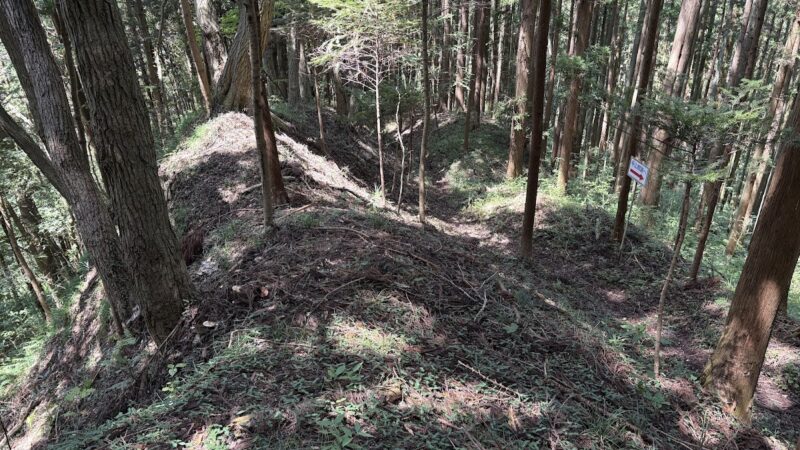
Some traces of earthworks can be seen, but due to years of weathering and erosion, clear remains are scarce. In particular, the eastern side facing the sea has lost some of its original topography due to coastal erosion.
Kifune Shrine
Kifune Shrine, built on the site of the main keep, serves as a landmark for the castle ruins. The shrine grounds are the central part of the castle site, allowing visitors to explore the ruins while paying their respects.
Near the Entrance
Near the entrance to the castle ruins, the terrain remains that is presumed to be the site of the former castle gate.
Highlights and Points of Murakami Castle
The Vast Flat Area of the Main Keep
The greatest highlight of Murakami Castle is the vast flat area of the main keep. Measuring 130 meters east-west and 200 meters north-south, it is an astonishingly large area for an unfinished castle. Standing on this flat area, one can truly appreciate the grandeur of the castle that Soma Yoshitane envisioned.
Although it is currently a grassy area, imagining the palace and turrets standing here, it would have been a magnificent castle showcasing the prestige of the Soma clan if completed.
Kibune Shrine
Kibune Shrine, situated on the site of the former main keep, is an important landmark when visiting the castle ruins. While the shrine itself is small, its central location within the main keep allows for a panoramic view of the entire castle site.
Visiting the shrine and exploring the castle ruins together creates a space where local beliefs and history blend seamlessly.
Ocean View
A major attraction of Murakami Castle is its view of the Pacific Ocean. From the eastern side of the plateau, one can see the vast Pacific Ocean, experiencing the castle’s excellent location as a coastal castle.
On clear days, a spectacular view stretches all the way to the horizon. During the Sengoku period, the warriors of the Soma clan likely gazed upon the same ocean from this very spot.
Strategic Insights from the Topography
While walking through the castle ruins, you can observe the following strategic arrangements:
- Odakagawa River to the West: Serves as a natural moat
- Sea to the East: Advantages in both defense and transportation
- Elevation Differences of the Plateau: Difficulties for attackers
By observing the topography, you can understand why this location was chosen as a candidate site for a new castle.
History Told by an Unfinished Castle
The most distinctive feature of Murakami Castle is that it was abandoned before completion. Unlike viewing the remains of a completed castle, the ruins of a castle abandoned during construction allow you to sense the gap between plan and reality, and the moment when a fire, a fortunate coincidence, changed history.
Access to Murakami Castle
Access by Public Transportation
Using the JR Joban Line
- Get off at Odaka Station on the JR Joban Line
- Approximately 3 kilometers east from the station
- Approximately 40 minutes on foot, or 10 minutes by taxi
Odaka Station is the central station of Odaka Ward in Minamisoma City, and is accessible from Soma and Iwaki. Taking a taxi from the station is convenient.
Access by Car
Using the Joban Expressway
- Approximately 15 minutes from Minamisoma IC on the Joban Expressway
- Take National Route 6 towards Odaka
Parking Information
- Some parking spaces are available around Kibune Shrine
- Parking for large vehicles is difficult
- Please be considerate of local residents when visiting
Address and Map
Location: Murakami, Tatekoshi and Maeyachi, Odaka Ward, Minamisoma City, Fukushima Prefecture
Using Kibune Shrine as a landmark makes it easy to find. Searching for “Kifune Shrine, Minamisoma City” on your car navigation system will guide you there.
Notes for Visitors
Points to Note
- Free to Visit: There are no specific entry restrictions, but please be mindful that it is shrine grounds.
- Estimated Time Required: Approximately 30 minutes to 1 hour
- Attire: Comfortable walking shoes are recommended (there are grassy and uneven areas).
- Season: Spring to autumn is recommended (strong sea breezes in winter).
Consideration for the Surrounding Environment
- Please be mindful of noise as it is adjacent to a residential area.
- Please take all your trash with you.
- Please observe proper etiquette when visiting a shrine.
- Entering private property is strictly prohibited.
Post-Disaster Situation
Due to the 2011 Great East Japan Earthquake and the nuclear accident, Odaka Ward in Minamisoma City was temporarily designated as an evacuation zone. Currently, the evacuation order has been lifted, and visits are permitted. However, reconstruction in the surrounding area is ongoing, and visitors are requested to be considerate of the local situation.
Related Historical Sites in the Surrounding Area
Odaka Castle
The residence of the Soma clan before the construction of Murakami Castle. Located approximately 3 kilometers northwest of Murakami Castle. Typical remains of a medieval castle remain, and visiting both Murakami Castle and Odaka Castle provides a better understanding of the Soma clan’s relocation of their residence.
Location: Odaka, Odaka-ku, Minamisoma City
Highlights: Earthworks, moats, and bailey remains
Ushikoshi Castle (Nakamura Castle Ruins)
A castle used by Soma Yoshitane after the abandonment of Murakami Castle’s construction. Later, it functioned as the administrative center of the Soma Nakamura Domain throughout the Edo period.
Location: Nakamura, Soma City
Highlights: Main bailey ruins, stone walls, moat remains, Soma Shrine
Okada Manor
A medieval manor site located south of Murakami Castle. It was one of the bases within the Soma clan’s territory.
Shimoura Castle
A medieval castle site located in the Odaka River basin. It is believed to have been the residence of the Soma clan’s retainers.
Historical Significance of Murakami Castle and the Soma Clan
Transition Period to Early Modern Castles
Murakami Castle was one of the attempts during the transition period from medieval to early modern castles. In the Tohoku region at the end of the 16th century, many daimyo under the influence of the Toyotomi regime were modernizing their castles.
Soma Yoshitane’s construction of Murakami Castle was also an attempt within this trend, but it was interrupted by a fire. However, this experience was later utilized in the construction of Ushikoshi Castle (Nakamura Castle), and the Soma clan established their position as an early modern daimyo.
Value as a Coastal Castle
Facing the Pacific Ocean, Murakami Castle possessed the characteristics of a coastal castle. There are few examples of attempts to build coastal castles on the Pacific side of the Tohoku region, making Murakami Castle a valuable example in this respect.
Yoshitane’s strategic vision is evident in his attempt to leverage the advantages of a coastal castle, such as managing maritime traffic, transporting goods by water, and securing sea routes in emergencies.
What the Unfinished Castle Tells Us
Murakami Castle, abandoned before completion, is a historical site that prompts us to consider “what if” scenarios. Had the fire not occurred, Murakami Castle might have become the base of the Soma clan, and the history of the Soma Nakamura Domain might have unfolded differently.
Murakami Castle holds significant meaning as an example of how a single coincidence can alter the course of history.
Current Status and Challenges of Murakami Castle Research
Archaeological Investigations
Regarding Murakami Castle, full-scale archaeological excavations have been limited. While it is protected as a city-designated historical site, the creation of detailed layout maps and scientific investigation of the remains remain challenges for the future.
Documentary Sources
Contemporary sources concerning Murakami Castle are scarce, and details of its construction and the circumstances of the fire rely on later records. A comprehensive examination of the Soma clan’s genealogies and local traditions is necessary. ### Preservation and Utilization
Due to coastal erosion, parts of the castle ruins are being lost. The eastern side, facing the sea, in particular, requires long-term preservation measures. Furthermore, its use as a regional historical resource for tourism and education is anticipated.
Summary: The Charm of Murakami Castle
Murakami Castle in Minamisoma City, Fukushima Prefecture, is a valuable historical site that conveys the ambition and setbacks of Soma Yoshitane. It possesses the unique characteristic of being an unfinished castle abandoned before completion, and offers the following attractions:
- Historical Drama: The story of a castle whose fate was changed by fire
- Vast Remains: Experience the scale of the castle from the flat area of the main keep site
- View of the Sea: A spectacular view overlooking the Pacific Ocean
- Strategic Location: Topographical features as a coastal castle
- History of the Soma Clan: Showing the transition period from Odaka Castle to Nakamura Castle
It is a quiet historical site with few visitors, but that is precisely why you can slowly reflect on its history. Visiting Murakami Castle along with the ruins of Odaka Castle and Nakamura Castle will give you a deeper understanding of the history of the Soma clan.
As a hidden gem of Fukushima Prefecture, Murakami Castle is a historical site well worth a visit for castle enthusiasts and history buffs. Why not visit the remnants of the dreams of warlords from the Sengoku period while feeling the breeze of the Pacific Ocean?