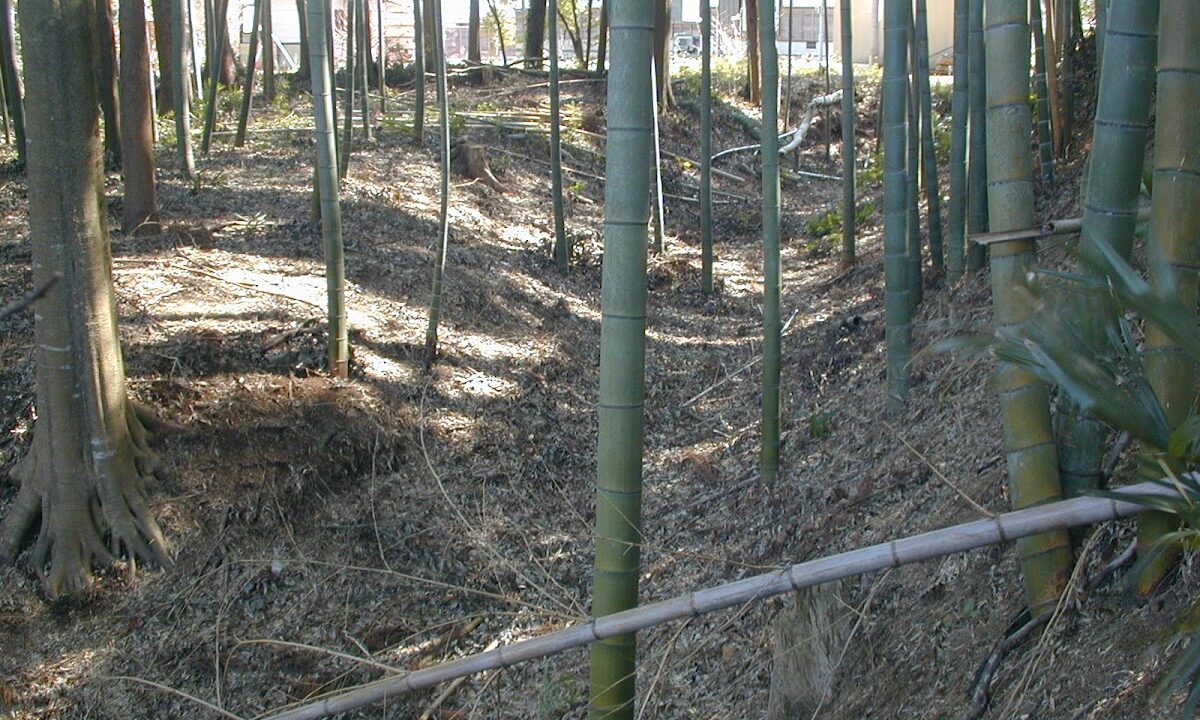
Tabeta Castle (Chiba Prefecture) – History and Remains of a Hilltop Castle in Shimosa Province Built by the Chiba Clan
Tabeta Castle was a medieval castle located in Tabeta-cho, Wakaba-ku, Chiba City, Chiba Prefecture. Built by the Tabeta clan, a branch of the Chiba clan, the castle stood on a plateau overlooking the Miyako River and its tributaries. Even today, well-preserved remains such as baileys, earthworks, and dry moats remain around Saifuku-ji Temple. This article comprehensively explains the charm of Tabeta Castle, including its historical background, castle structure, detailed remains, and access methods.
Basic Information on Tabeta Castle
Location and Environment
Tabeta Castle is located in Matsuzaki-shuku, Tabeta-cho, Wakaba-ku, Chiba City, Chiba Prefecture. It is situated approximately 8 kilometers east of Chiba city center, and the castle ruins are located directly behind Saifuku-ji Temple. The castle is built on a plateau approximately 18-30 meters high, overlooking the Miyakogawa River and its tributaries, making it a highly defensible location that utilizes the surrounding terrain.
Under the old provincial name, it belonged to Shimosa Province, and this region was within the sphere of influence of the Chiba clan. The plateau location exhibits the characteristics of a typical flatland castle situated at the boundary between plains and hilly areas, revealing the strategic thinking behind the selection of the site for a medieval castle.
Common Names and Alternative Names
There are no particularly well-known common names or alternative names recorded for Tabeta Castle. The castle name is simply the place name, and it is called “Tabeta-jo.” This is a typical example of the place name and castle name matching, as the castle was built by the local lord, the Tabeta clan, and served as their residence for generations.
Structure and Classification
Tabeta Castle is classified as a flatland castle. A Hirayama castle is a castle built on an isolated hill or plateau in a plain. It is less steep than a Yamashiro (mountain castle) and offers greater defensibility than a Hirajo (flatland castle).
The castle grounds are divided into seven large enclosures on the plateau, with impressive dry moats and earthworks between each enclosure. This structure is designed to progressively prevent enemy incursions, demonstrating the technological advancements in the development of medieval castles.
History of Tabeta Castle
Construction History and the Tabeta Clan
The construction period of Tabeta Castle is believed to be the Muromachi period, but there are several theories regarding its origins.
The most plausible theory is that it began in the Kamakura period when Tabeta Shiro (Osuga Tanenobu), the fourth son of Chiba Tsunetane, settled in the area as a Jito (land steward). Chiba Tsunetane was a powerful retainer who supported Minamoto no Yoritomo’s uprising, and for his achievements, he acquired vast territories, mainly in Shimosa Province. Tsunetane divided his territory among his six sons, each forming their own independent family.
His fourth son, Osuga Tanenobu, was granted the land of Tabeta and took the name Tabeta Shiro. Later, Tabeta Tanetada is said to have formally adopted the name Tabeta and built the castle. The Tabeta clan, as a branch of the Chiba clan, developed as local lords who controlled this region.
Changes in Castle Lords
The main lords of Tabeta Castle are as follows:
- Tabeta Clan: From the castle’s construction until the Sengoku period, the Tabeta clan served as lords for generations. As a branch of the Chiba clan, they contributed to maintaining the Chiba clan’s power in Shimosa Province.
- Hara Clan: Records show that the Hara clan became lords of the castle at some point during the Sengoku period. The Hara clan is also thought to be related to the Chiba clan, but many details of their history remain unclear.
The End of the Sengoku Period and the Fall of the Castle
The most important event in the history of Tabeta Castle was its fall during the Siege of Odawara in 1590.
In that year, Toyotomi Hideyoshi launched a large-scale military campaign to destroy the Hojo clan. Because the Chiba clan was subordinate to the Hojo clan, they were drawn into this conflict. While the heads of the Chiba clan, Munemoto and Tanemura, entered Odawara Castle and defended it, Tanetaka was entrusted with the defense of Tabeta Castle.
However, Tabeta Castle surrendered and opened its gates after being attacked by forces under the command of Honda Tadakatsu and Hiraiwa Chikayoshi, both senior retainers of Tokugawa Ieyasu. With this fall, Tabeta Castle was abandoned, and its history came to an end.
After the Siege of Odawara, the Chiba clan’s territories were confiscated, marking the end of the Chiba clan’s era in Shimosa Province. Tabeta Castle, too, ended its role with this turning point in history.
Remains of Tabeta Castle
Overview of Existing Castle Remains
The following remains still exist at Tabeta Castle:
- Kuruwa (Enclosures): Seven enclosures are arranged on the plateau.
- Earthworks: Earthworks that demarcate each enclosure and serve a defensive function remain in good condition.
- Dry Moats: Large dry moats dug between enclosures.
- Moat Cut: A defensive structure that divides the plateau.
- Koguchi (Gate): Entrance to the enclosures.
- Earthen Bridge: An earthen bridge used to cross the moats.
These remains exhibit a typical structure of medieval castles and are valuable resources for understanding the castle construction techniques of the time.
Condition of the Main Enclosure
The main enclosure is currently overgrown with vegetation, making it difficult to examine the details of the remains even if one enters the area. However, geographically, it is located at the highest point of the plateau, clearly indicating that it was the core of the castle.
Traces of earthworks can be seen around the main enclosure, suggesting that a considerable defensive structure once existed there. Flat areas of enclosures can also be seen within the thicket, but detailed investigation requires further preparation.
Remains of the Second Enclosure (Saifuku-ji Temple)
The most easily accessible and clearly preserved remains are around Saifuku-ji Temple (also known as Nishifuku-ji Temple), which constitutes the second enclosure.
Proceeding further into Saifuku-ji Temple, the following remains can be seen in very clear condition:
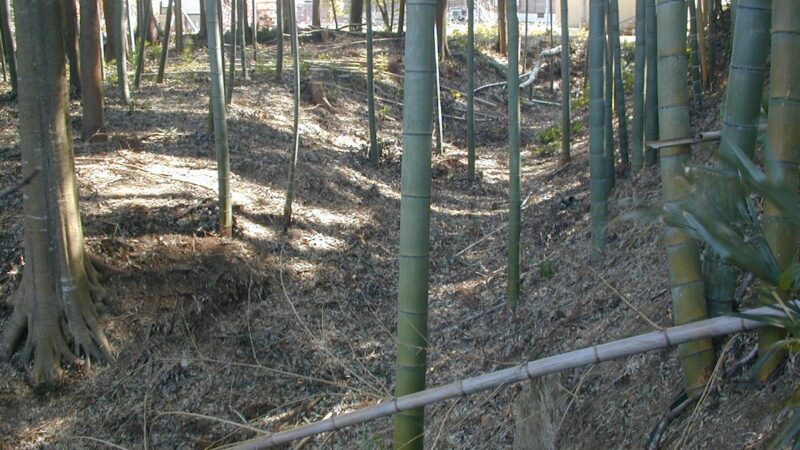
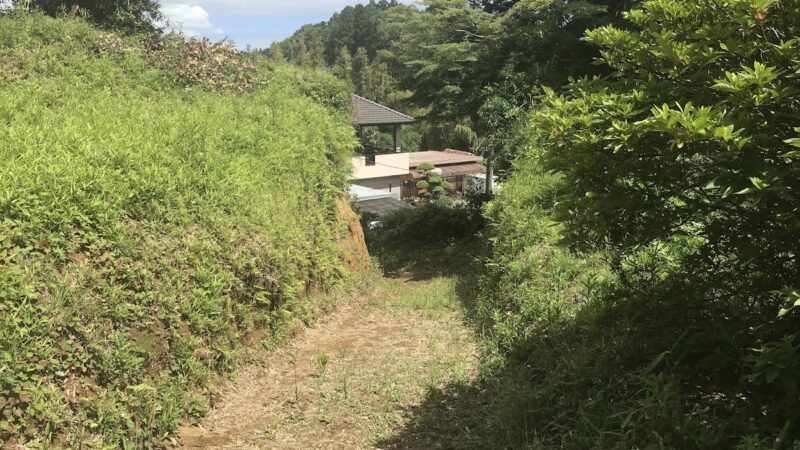
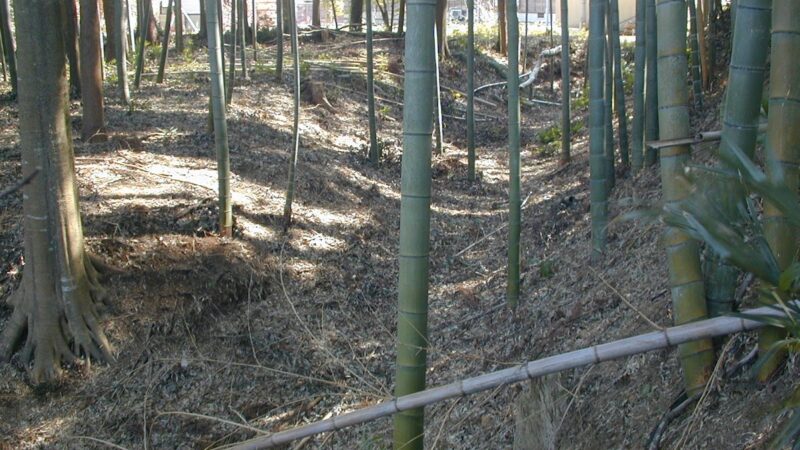
Earthworks: Earthworks several meters high remain in good condition. The cross-section of the earthworks is clear, and layered structures created using rammed earth techniques can be observed in some places. The top of the earthworks is flat, suggesting a high probability that fences or walls were once installed there.
Dry Moat: The dry moat dug along the earthworks is a substantial structure, several meters wide and deep. The bottom of the moat is still clearly visible, retaining the typical V-shaped cross-section of a medieval dry moat. This horizontal moat prevented lateral movement of enemies and, in combination with the earthworks, formed a strong defensive line.
Kuchi: Traces of the koguchi (gateway) to the enclosure can also be seen. Located where the earthworks are interrupted, it is not a complex structure like a masugata koguchi, but defensive ingenuity is evident.
Remains of Other Enclosures
In addition to the main enclosure and the second enclosure, several other enclosures were located on the plateau. These enclosures differed in size and shape, and it is thought that each had a different function.
Third to Seventh Enclosures: These enclosures were arranged surrounding the main enclosure, forming a multi-layered defensive structure. Moats and earthworks were provided between each enclosure, creating a layout that allowed for tiered defense.
Some of the enclosures are now used as farmland or residential areas, and parts do not retain their original form, but the topography allows us to infer the original layout of the enclosures.
Preservation Status of the Ruins
The ruins of Tabeta Castle are relatively well-preserved for a castle located near an urban area. In particular, the ruins around Saifuku-ji Temple have been managed as temple grounds, thus escaping development and remaining intact to this day.
However, there are preservation challenges, such as overgrown vegetation in the main enclosure and the development of some enclosures into residential areas. It is hoped that appropriate preservation and maintenance will be carried out in the future, allowing more people to experience this valuable historical heritage.
Tabeta Castle and the Chiba Clan
Chiba Tsunetane and His Six Sons
Understanding the history of the Chiba clan is essential to understanding Tabeta Castle. Chiba Tsunetane (1118-1201) was a samurai who was active from the late Heian period to the early Kamakura period. He participated in Minamoto no Yoritomo’s uprising and made a significant contribution to the establishment of the Kamakura Shogunate.
Tsunetane had six sons, and he divided the territory among them:
- Eldest son, Tanemasa: Inherited the main branch of the Chiba clan
- Second son, Moritsune: Ancestor of the Soma clan
- Third son, Tanemori: Ancestor of the Takeshi clan
- Fourth son, Tanenobu: Ancestor of the Osuga and Tabeta clans
- Fifth son, Tanemichi: Ancestor of the Kokubun clan
- Sixth son, Taneyori: Ancestor of the Higashi clan
These six families were known as the “Six Chiba Parties” and formed a powerful force centered in Shimosa Province. The Tabeta clan is a branch of the Osuga clan within this group.
Genealogy and Role of the Tabeta Clan
The fourth son, Osuga Tanenobu, was granted the land of Tabeta, and his descendants adopted the name Tabeta. The Tabeta clan, as a branch of the Chiba clan, played the following roles:
Local Administration: Based in Tabeta, they governed the surrounding area. They were responsible for practical aspects of local governance, including agricultural production management, maintaining public order, and collecting taxes.
Military Role: They led troops and participated in military actions of the main Chiba clan. Tabeta Castle also functioned as a base for these military activities.
Maintaining the Chiba Clan’s Territory: As a key component supporting the Chiba clan’s power in Shimosa Province, they, along with other Chiba family members, were responsible for territorial control.
The Decline of the Chiba Clan and Tabeta Castle
From the Muromachi period to the Sengoku period, the Chiba clan gradually weakened due to internal conflicts and conflicts with other forces. Especially during the Sengoku period, they fell under the influence of the Hojo clan and effectively lost their independence.
The Siege of Odawara in 1590 was a fatal event for the Chiba clan. The Chiba clan, who were subordinate to the Hojo clan, were caught in the crossfire of Toyotomi Hideyoshi’s campaign against the Hojo and lost their territories. The fall of Tabeta Castle was also an event within this larger historical context.
Castles Surrounding Tabeta Castle
Tabeta Castle was not an isolated castle, but part of a network of castles built by the Chiba clan. The following castles existed in the surrounding area and are thought to have been interconnected:
Chiba Castle: The main residence of the Chiba clan, located in what is now Chuo Ward, Chiba City. It is approximately 8 kilometers west of Tabeta Castle.
Konakadai Castle: A castle located in Inage Ward, Chiba City, and one of the residences of the Chiba clan. Like Tabeta Castle, it was a base supporting the Chiba clan’s sphere of influence.
Nakano Castle: A castle located in Wakaba Ward, Chiba City, close to Tabeta Castle.
It is presumed that these castles maintained contact with each other and sent reinforcements in times of emergency. Tabeta Castle also played a part in this network, contributing to the defense of eastern Shimosa Province.
Access
Access by Public Transportation
Tabeta Castle Ruins can be accessed by public transportation.
Nearest Station: JR Sobu Main Line, Chiba Station
By Bus:
- Take the “Chiba Flower Bus” from the East Exit of JR Chiba Station
- Get off at the “Heiwa Park” or “Rose Town Entrance” bus stop
- Saifuku-ji Temple (castle ruins) is approximately a 5-minute walk from the bus stop.
Since bus services are limited, it is recommended to check the timetable in advance.
Access by Car
Nearest Interchange:
- Approximately 10 minutes from Takada Interchange on the Chiba-Togane Expressway
- Approximately 15 minutes from Anagawa Interchange on the Keiyo Expressway
Parking: Saifuku-ji Temple has parking spaces for visitors, but it is advisable to inform the temple before visiting the castle ruins.
Notes for Visitors
Visitable Area: The main viewing area is the grounds of Saifuku-ji Temple and its surroundings. The main enclosure is overgrown with vegetation, so unauthorized entry should be avoided.
Attire: When viewing the remains of the earthworks and moats, comfortable shoes and clothing are recommended. Insect repellent is also necessary during the summer months.
Manners: Saifuku-ji Temple is an active temple, so please be considerate of visitors and temple staff.
Photography: Photography of the remains is permitted, but it is considered good manners to refrain from photographing the temple buildings and cemetery.
Historical Significance of Tabeta Castle
Position in the History of Medieval Castles
Tabeta Castle is an important example illustrating the development process of medieval castles. As the residence of a local lord from the Kamakura to Muromachi periods, it possesses the following characteristics:
Plateau-Utilizing Hilltop Castle: It exhibits skillful castle construction techniques that cleverly utilize the natural terrain. The moderate height of 20-30 meters was a choice that balanced defense and habitability.
Multi-Enclosure Layout: The complex structure with seven enclosures reflects the progress of castle construction techniques during the Sengoku period. It is a good example showing the development from simple single-enclosure castles to multi-enclosure castles.
Combination of Earthworks and Dry Moats: It possesses a typical structure as an earthen castle without the use of stone walls. This is a common characteristic of medieval castles in the Kanto region and indicates a regional trend in castle construction techniques.
Importance in Chiba Clan Research
Tabeta Castle is an important historical site for understanding the power structure of the Chiba clan. As the base of the Tabeta clan, one of the six Chiba clans originating from the six sons of Chiba Tsunetane, Tabeta Castle holds the following research value:
Reality of Family Rule: The castle remains are valuable as physical evidence of the Tabeta clan’s activities as local lords.
Expansion of Sphere of Influence: The location of Tabeta Castle serves as an indicator of how far the Chiba clan’s sphere of influence extended eastward from Chiba City.
Understanding Medieval Society: The changes in local communities from the Kamakura period to the Sengoku period can be understood through the castle.
Value in Local History
Tabeta Castle is indispensable when discussing the history of Wakaba Ward in Chiba City. It provides clues to the role this region played in the medieval period and the kinds of people who lived there.
The layered history of the site, now a local place of worship as Saifuku-ji Temple, once being a castle where samurai resided and prepared for battle, is an important element in shaping the region’s identity.
Future Preservation and Utilization of Tabeta Castle
Current Status and Challenges of Preservation
While a portion of the Tabeta Castle remains are protected within the grounds of Saifuku-ji Temple, the following challenges exist:
Overgrown Main Enclosure: The main enclosure, a key feature of the castle, is overgrown with vegetation, making detailed observation difficult. Regular maintenance, such as undergrowth clearing, is desirable.
Low Awareness: Awareness of Tabeta Castle’s existence and historical value is not necessarily high, even among local residents.
Lack of Information Boards: There are few detailed information boards at the site, making it difficult for first-time visitors to understand the remains.
Potential Utilization
Tabeta Castle has the following potential uses:
Site for Historical Learning: It can be used as teaching material for local history lessons in elementary and junior high schools. Visiting the remains in person allows students to experience history firsthand.
Tourism Resource: As part of Chiba City’s historical sightseeing routes, it can be combined with other Chiba clan-related historical sites to create a comprehensive tour.
Research Subject: Archaeological and surveying investigations may reveal more detailed information about the castle’s structure.
Regional Revitalization: Holding local events centered around the castle ruins and training volunteer guides can contribute to the revitalization of the local community.
Expectations for Development
Ideally, the following developments are desired:
Maintenance of Remains: Clearing undergrowth in the main enclosure and implementing safety measures in dangerous areas to create a more accessible environment for visitors.
Installation of Information Boards: Installing information boards explaining the castle’s history, structure, and highlights at key locations.
Development of Visiting Paths: Developing safe walking paths to allow visitors to view the remains.
Digital Utilization: Providing content that recreates the castle’s appearance in its heyday using AR (Augmented Reality) technology.
Through these improvements, Tabeta Castle will become a more familiar and valuable historical and cultural asset of Chiba City to a wider audience.
Summary
Tabeta Castle is a medieval hilltop castle located in Wakaba Ward, Chiba City, Chiba Prefecture. It was built by the Tabeta clan, descendants of Osuga Tanenobu, the fourth son of Chiba Tsunetane. Built during the Muromachi period, it served as the residence of the Tabeta and Hara clans until its fall during the Siege of Odawara in 1590.
Even today, remnants such as baileys, earthworks, and dry moats remain in good condition around Saifuku-ji Temple, making it a valuable historical site for understanding the structure of medieval castles. The remains behind Saifuku-ji Temple, which constitute the second bailey, are particularly clear and suitable for viewing.
As an important castle demonstrating the power structure of the Chiba clan and a cultural heritage site conveying the history of the region, Tabeta Castle should continue to be appropriately preserved and utilized. Located in an easily accessible area by bus from Chiba Station, this is a must-visit for anyone interested in the history of Chiba City.
The castle, built, defended, and ultimately lost by medieval samurai, still bears quiet but undeniable traces on the Tabeta plateau.