

Nyui Chausu Castle Ruins, Hirosaki City | The Complete Picture of a Mountain Castle Built at a Key Point in Medieval Tsugaru
The Nyui Chausu Castle Ruins, located in the Nyui district of Hirosaki City, Aomori Prefecture, are an important mountain castle site that tells the history of the Tsugaru region during the medieval period. Built on an isolated hill approximately 30 meters high, this castle served as a political and military stronghold in the Tsugaru region during the Sengoku period (Warring States period). Even today, the traces of the castle remain well-preserved, making it a must-see spot for history enthusiasts and castle fans.
Historical Background of Nyui Chausu Castle
Construction Date and Builder
While detailed records of the construction date of Nyui Chausu Castle are not available, it is believed to have been built in the late medieval period, particularly in the early Sengoku period. The prevailing theory is that it was built by the Nyui clan, who ruled this region. The Nyui clan was a powerful local family in the Tsugaru region, and while under the influence of the Nanbu clan, they maintained their own independent sphere of influence.
The name Chausu-kan (茶宇役館) is presumed to originate from the castle’s shape resembling a tea mill (chausu). Indeed, a visit to the site confirms the unique topography of the hillside, resembling an inverted tea mill.
The Invasion of Tsugaru Tamenobu and the Castle’s Fate
During the Tensho era (1573-1592), Tsugaru Tamenobu’s invasion, aimed at unifying the Tsugaru region, intensified. Using Oura Castle as his base, Tamenobu expanded his power, conquering various powerful clans in the Tsugaru region one after another.
Nyuui Chausu-kan also became a target of Tsugaru Tamenobu’s invasion and is believed to have fallen during the Tensho era. During this period, several castles in the Nyuui area, including Nyuui Kodate and Nyuui Castle, the main base of the Nyuui clan, were captured by Tsugaru Tamenobu. Chausu-kan likely functioned as a branch castle or fortified stronghold of the Nyuui clan, and is presumed to have served as an emergency refuge and military base.
After the unification by Tsugaru Tamenobu, Chausu Castle was abandoned and lost its military function. Subsequently, this region was incorporated under the control of the Tsugaru clan and developed into a peaceful agricultural area throughout the early modern period.
Geographical Characteristics of the Nyui Chausu Castle Ruins
Location and Topography
The Nyui Chausu Castle ruins are built on an isolated hill in the Nyui Chausu-kan district of Hirosaki City. The elevation is approximately 150 meters, and the relative height from the surrounding plains is approximately 30 meters. This hill extends long and narrow from north to south, making it a natural stronghold surrounded by plains.
Located just east of the Owani-Hirosaki Interchange on the Tohoku Expressway, it is a modern transportation hub. Even in the Middle Ages, this area held an important position as a gateway to the Tsugaru region. The ancient Okudaido (a major road) passed through this area, suggesting that it was recognized as a transportation hub from an early stage.
Relationship with Surrounding Castles and Fortifications
In addition to Chausu Castle, numerous other castle ruins exist in the Nyui area. The concentration of multiple castles and fortifications, including Nyui Old Castle, Nyui Castle, Furuyashiki Castle, Kura Castle, and Hachiman Castle, indicates that this region was an important base during the medieval period.
It is believed that these castles and fortifications formed a network of interconnected castles and fortifications. Chausu Castle, though low in elevation, is located on a hill with a good view, and may have functioned as a monitoring and communication base for the surrounding area.
The Hirosaki city area also contains many other medieval castles and fortifications, such as Takahata Castle, Takadate Castle, Okidate Castle, Hachimakiyama Castle, Haguro Castle, Karatake Castle, Karatake Old Castle, Shinkan Castle, Motonagamine Castle, and Higawa Castle, telling the story of the complex medieval history of the Tsugaru region.
Castle Structure and Remains
Characteristics of the Layout
The layout (castle design) of Nyui Chausu Castle skillfully utilizes the topography of an isolated hill. This castle has a typical mountain castle structure, with the main enclosure (honmaru) located at the summit and surrounded by lower and outer baileys.
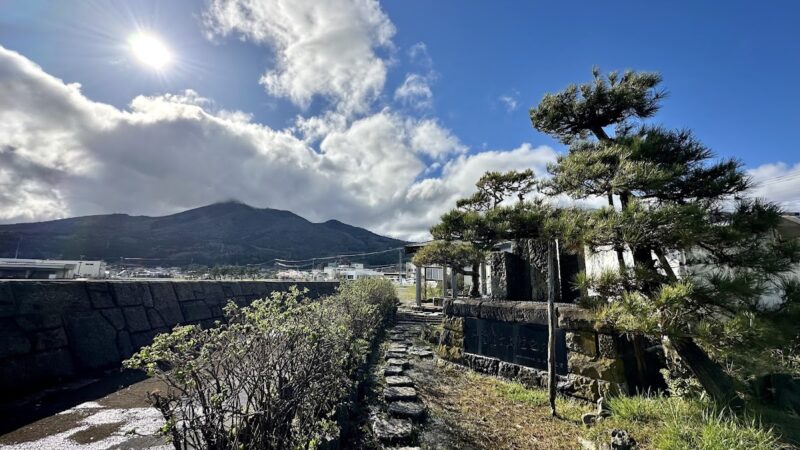
The main enclosure measures approximately 40 meters east-west and 30 meters north-south, and is currently a flat open space. A gazebo, which also serves as an observation deck, is located here, offering panoramic views of the surrounding area. On a clear day, you can see Mount Iwaki and the vast Tsugaru Plain, giving you a real sense of the castle’s strategic importance.
Elevation differences can be observed around the main enclosure, leaving traces of former earthworks and moats. However, since the area is currently used as an orchard, some of the remains may have been altered.
Existing Remains
Upon visiting the site, you can observe the following remains:
Main Enclosure Site: A flat area at the summit, with a gazebo and a sign for the “Nyuui Chausukan Observation Deck.” The remains are relatively well-preserved.
Remains of Enclosures: Traces of enclosures remain as terraces around the main enclosure. While some have been altered due to its use as an orchard, the original structure can be inferred from the topography.
Road to the Castle: The current road to the castle was constructed in later periods, but it is believed to largely follow the original route.
In terms of the evaluation of the remains, it is considered a medium-sized mountain castle, with a state of preservation rated at ★★★☆☆ (3 out of 5). Although it has not undergone major alterations, some details of the remains are unclear due to its use as an orchard.
Access and Visiting Information
Location and Parking
Location: Near 66-2 Chausudate, Hirosaki City, Aomori Prefecture
Nearest Landmark: Located east of Seishoin Temple. Aiming for Seishoin Temple will make access easier.
Parking: Parking is available along the city road. There is a parking space for 2-3 cars along the road near Seishoin Temple, from where you can walk to the castle entrance.
Map Code: 323 758 573*56 (Near the castle entrance)
Castle Ascent Route
East of Seishoin Temple, along the city road, there is a signpost indicating “Nyuui Chausukan Observation Deck →” marking the castle entrance. Use this signpost as a guide to begin your ascent.
From the castle entrance to the main enclosure at the summit, it takes about 5-10 minutes on foot along a well-maintained walking path. The elevation difference is only about 30 meters, so it is relatively easy to climb even for those who are not confident in their physical strength. However, since there are parts of the path that are dirt trails and pass through orchards, it is recommended to wear comfortable shoes.
Since the path passes through orchards, especially during the apple harvest season (September to November), consideration must be given to avoid interfering with farm work.
Points to Note During Your Visit
- Consideration for Orchards: The area around the castle ruins is still used as an orchard. Please be careful not to trespass on private property.
- Season: Spring to autumn is the best time to visit, but in winter, snowfall may make it difficult to climb the castle.
- Estimated Time Required: Please allow approximately 30 minutes to 1 hour for the entire visit, including climbing up, sightseeing, and descending.
- Facilities: There are no facilities such as toilets or vending machines. Please prepare in advance before visiting.
- Bear Precautions: There have been reports of bear sightings in the mountainous areas of Aomori Prefecture. We recommend taking basic precautions, such as carrying a bear bell, before visiting.
Historical Walk in the Nyui Area
Nyui Shrine and Surrounding Historical Sites
When visiting Nyui Chausukan, we recommend also visiting the surrounding historical sites.
Nyuui Shrine is an ancient shrine said to be one of seven shrines built in Tsugaru by Sakanoue no Tamuramaro during the Enryaku era (782-806). Legend says that Bishamonten was enshrined there and that weapons were enshrined. Within the shrine grounds is a five-tiered pagoda, a prefectural designated cultural property, which conveys the state of religious beliefs in the Middle Ages.
This five-tiered pagoda was originally placed behind the main hall of Nyuui Shrine and is thought to be a memorial tower associated with the Nyuui clan. The area around Nyuui Shrine is the entrance to Tsugaru on the Oku-dōdō (main road to the north), and has developed since the Middle Ages.
Nyuui District Historical Trail
Hirosaki City has established the “Nyuui District Historical Trail Walking Course,” which provides a route to visit local historical sites, including the Chausu-kan ruins. Using this course, you can efficiently visit multiple castle ruins, such as Nyuui Old Castle and Nyuui Castle.
By walking and exploring the entire region, you can gain a deeper understanding of the reality of the medieval Tsugaru castle network and the strategic importance of this area.
The Position of the Tsugaru Region in Medieval History
The Nanbu Clan and the Tsugaru Region
Medieval Tsugaru was located at the western edge of the Nanbu clan’s sphere of influence. The Nanbu clan was a Sengoku daimyo who controlled a vast territory stretching from present-day northern Iwate Prefecture to eastern Aomori Prefecture. While nominally under the Nanbu clan’s control, the various local clans of Tsugaru existed as semi-independent forces.
The Nyui clan was one such clan, maintaining its own power base in the Nyui area. Chausu Castle was one of the castles that supported the Nyui clan’s system of rule.
Tsugaru Tamenobu’s Unification of Tsugaru
In the latter half of the 16th century, Tsugaru Tamenobu, based at Oura Castle, rose to power. Initially a vassal of the Nanbu clan, Tsugaru Tamenobu gradually showed signs of independence, conquering various local clans in the Tsugaru region one after another. Through a series of military actions during the Tensho era, Tsugaru Tamenobu virtually unified the Tsugaru region, effectively becoming an independent daimyo. In this process, many local powerful families, including the Nyuui clan, were either destroyed or incorporated under the Tsugaru clan’s control.
The fall of Nyuui Chausu Castle was one event in this process of Tsugaru unification. Although a small mountain castle, its fall symbolized the complete submission of the Nyuui clan to Tsugaru Tamenobu.
Transition to the Early Modern Period
After unification by Tsugaru Tamenobu, the Tsugaru region came under the rule of the early modern daimyo Tsugaru clan. The Tsugaru clan built Hirosaki Castle as their base and governed the Tsugaru region.
Medieval castles and fortifications lost their military function and were abandoned. Nyuui Chausu Castle was no exception, and after the early modern period, it was buried in history. However, its remains have been preserved to this day as a valuable cultural asset that conveys the history of the region.
Nyūi Chausu Castle from the Perspective of Castle Research
Characteristics of Mountain Castles in the Tsugaru Region
Mountain castles in the Tsugaru region are characterized by their relatively low relative elevation and the fact that many are built on hills or plateaus. This is due to the topographical characteristics of the Tsugaru Plain; because there are few steep mountains, castles utilizing isolated hills and river terraces became the mainstream.
Nyūi Chausu Castle is also built on a low hill with a relative elevation of 30 meters, making it a typical mountain castle of the Tsugaru region. Such low mountain castles are thought to have served more as centers of regional control or as emergency refuges rather than large-scale military bases.
Results of Layout Research
In Hirosaki City, a reconstructed layout diagram of Nyūi Chausu Castle is included in “New Edition of Hirosaki City History, Materials Volume 1 (Ancient and Medieval Periods).” This research has revealed the castle’s structure and scale in more detail.
According to castle layout research, Chausu Castle was a small mountain castle with a simple single-enclosure or multi-enclosure structure, lacking complex defensive features. This suggests it was more of a temporary outpost than a permanent military base.
Current Status of Preservation and Utilization
Cultural Property Designation
The Nyui Chausu Castle ruins are not currently designated as a national, prefectural, or municipal cultural property. However, they are recognized as an important historical site that conveys the region’s history, and efforts are being made to utilize them, such as incorporating them into Hirosaki City’s historical walking courses.
Just as the nearby Nyui Shrine Gorinto (five-ring pagoda) is a designated cultural property of Aomori Prefecture, the entire Nyui area is protected and utilized as a region of high historical value.
Local Preservation Activities
A sign for the “Nyui Chausu Castle Observation Deck” and a gazebo have been installed at the site, demonstrating the local community’s efforts to preserve and utilize the site. A signpost has also been installed at the entrance to the castle, ensuring that visitors can find their way without getting lost.
This site successfully balances land use as an orchard with the preservation of historical remains, making it a prime example of how ruins are protected with the understanding and cooperation of local residents.
Visitor Feedback and Attractions
Evaluation from Castle Enthusiasts
Castle enthusiasts appreciate the relatively good state of preservation of the remains, the magnificent views, and the easy access. While not a large-scale castle, it’s a valuable spot where many castle enthusiasts can experience the history of medieval Tsugaru firsthand.
In particular, the view from the summit is superb, with the panoramic view of the Tsugaru Plain and Mount Iwaki being highly praised as well. A gazebo is also provided, allowing visitors to leisurely enjoy the scenery and reflect on the castle’s former appearance.
Chausukan for Locals
For locals, the Chausukan ruins are a familiar historical site and a popular spot for walks. Many locals visit to enjoy the view from the observation deck, making it a symbolic landmark of the region.
In spring, the surrounding orchards are adorned with flowers, and in autumn, visitors can enjoy the autumn foliage and fruit harvest, making the changing scenery throughout the seasons one of its charms. It’s a popular spot in the region where you can enjoy both historical exploration and nature walks.
Summary: The Historical Value of the Nyui Chausu Castle Ruins
Although not large in scale, the Nyui Chausu Castle Ruins are an important historical site that tells the story of the medieval Tsugaru region. It is a castle that tells the story of a turning point in history—the unification of Tsugaru by Tsugaru Tamenobu—and is an indispensable site for learning about the region’s history.
Built on a low hill with a relative elevation of 30 meters, it is a typical Tsugaru mountain castle, and its layout and location provide valuable information for understanding the castle-building techniques and strategic thinking of the time. Furthermore, because numerous castles remain in the surrounding area, it is an important field for studying the medieval castle network.
Although it is now a quiet hill surrounded by orchards, imagining the historical drama that once unfolded here evokes a profound sense of awe. When visiting Hirosaki City, be sure to stop by the Nyui Chausukan Ruins and experience the medieval history of Tsugaru.
It’s relatively easy to access and can be visited in a short time, making it a great place to combine a visit with Hirosaki Castle or other nearby attractions. Whether you’re a history buff or simply want to experience the nature and history of Tsugaru, the Nyui Chausukan Ruins are definitely worth a visit.

-800x450.png)