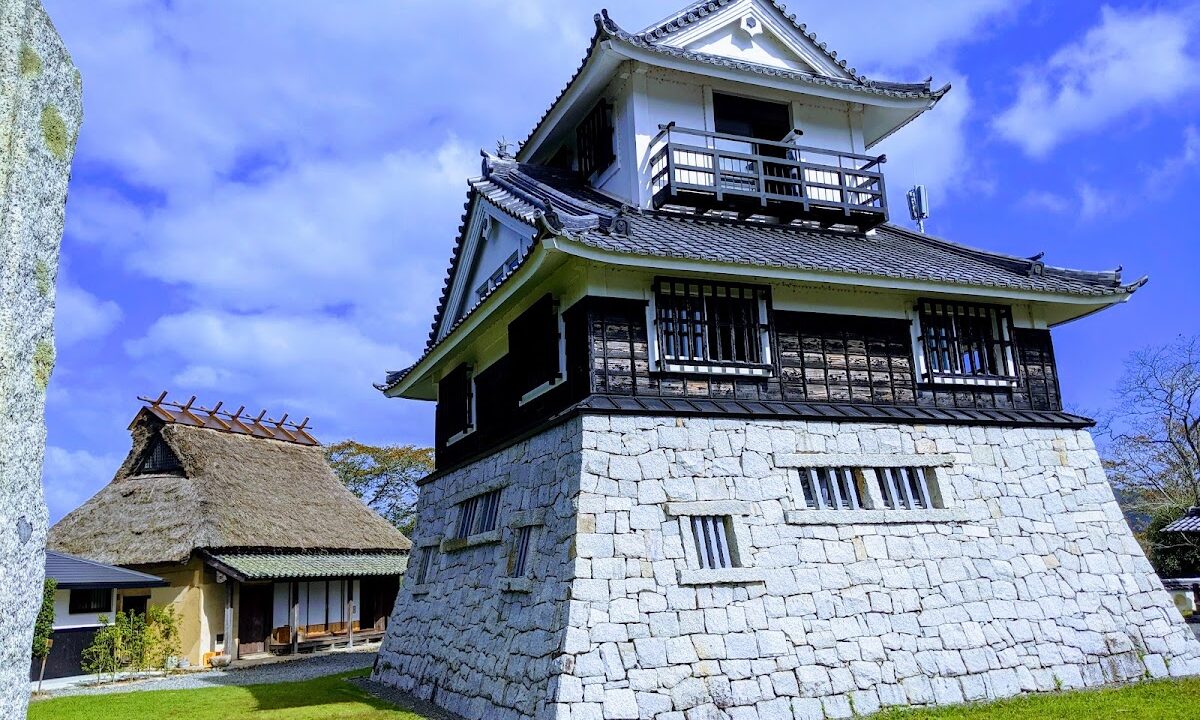
Usudate Ruins (Akita Prefecture): A Complete Overview of a Medieval Historic Site that Flourished as a Branch Castle of the Hiyama Ando Clan
Located in Noshiro City, Akita Prefecture, the Usudate Ruins are an important historical site known as the remains of a residence built by the Hiyama Ando clan during the Sengoku period (Warring States period) of the medieval era. It functioned as a branch castle located northwest of Hiyama Castle and is now designated as a national historic site as part of the “Hiyama Ando Clan Castle Site.” This article provides a detailed explanation of this valuable medieval site, from its historical background and the details of its remains to the results of archaeological excavations and visitor information.
What are the Usudate Ruins?: Their Position within the Hiyama Ando Clan Castle Site
The Usudate Ruins are the remains of a medieval residence located in the Hiyama district of Noshiro City, Akita Prefecture. This was a subsidiary castle built approximately 1.5 km northwest of Hiyama Castle, the main castle of the Hiyama Ando clan, and played an important role in the castle network centered around Hiyama Castle.
Designation as a Historic Site of the Hiyama Ando Clan Castle Site
In 1980 (Showa 55), the Usu Castle site, along with the Hiyama Castle site and the Chausu Castle site, was designated a national historic site as the “Hiyama Ando Clan Castle Site.” This collective designation was based on the evaluation that the remains, which demonstrate the relationship between the main castle and subsidiary castles of the Hiyama Ando clan, who developed as a powerful Sengoku daimyo, are in remarkably good condition and are extremely valuable examples in the study of medieval castles.
The Hiyama Ando clan was a powerful feudal lord that ruled northern Akita Prefecture from the late medieval period to the Sengoku period, and wielded considerable power backed by trade along the Sea of Japan. The Usu Castle site is believed to have functioned as an important base protecting the Ando clan’s sphere of influence.
Historical Background of the Usudate Site
History of the Ando Clan and the Hiyama Region
The Ando clan was originally a powerful family based in the Tsugaru region, expanding their influence from the Nanboku-cho period to the Muromachi period. In the latter half of the 15th century, the Ando clan split into the Hiyama and Minato branches due to internal conflict. The Hiyama Ando clan developed independently, based in the Hiyama district of Noshiro City.
The Hiyama Ando clan controlled trade along the Sea of Japan coast and played an important role in trade with Ezo (Hokkaido). Backed by this economic power, they developed a group of castles centered around Hiyama Castle, establishing a system of territorial control.
Construction Period and Role of Usudate
The exact construction period of Usudate is unclear, but archaeological excavations have confirmed that it was in use from the latter half of the 15th century to the 16th century. Located northwest of Hiyama Castle, Usu Castle is thought to have functioned as a subsidiary castle forming part of Hiyama Castle’s defense line, and as a defensive base against invasions from the north of the Hiyama region.
As a medieval residence site, Usu Castle was not merely a military facility, but also functioned as a base for regional control. It is presumed that retainers of the Ando clan were stationed at the castle, and that they were responsible for governing the surrounding area, collecting taxes, and mobilizing troops.
Structure and Remains of Usu Castle Site
Location and Topography
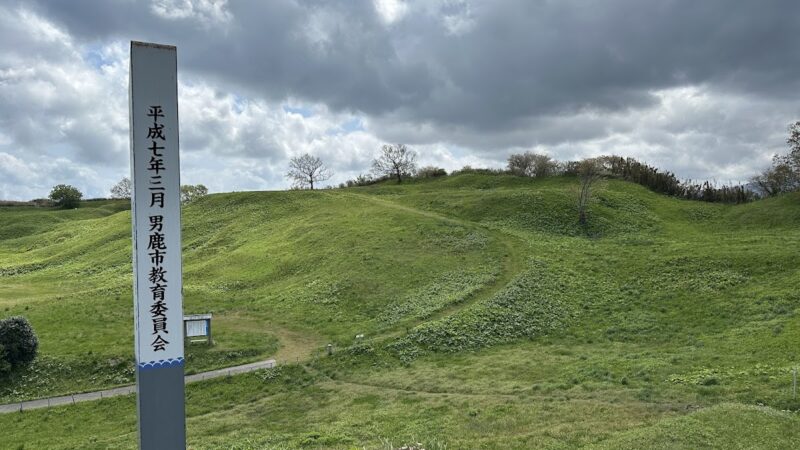
The Usu Castle site is located on a plateau approximately 40-50 meters above sea level, overlooking the Noshiro Plain. This plateau extends long and narrow from east to west, making it a defensive location that skillfully utilizes the natural terrain. The north and south sides of the plateau have steep slopes, forming a natural stronghold.
Arrangement of Enclosures
The most distinctive feature of the Usu Castle site is that the vast plateau is composed of multiple enclosures (kuruwa) divided north and south. The main enclosures currently identifiable are as follows:
Main Enclosure (Shukaku): This enclosure is the central part of the residence, located at the highest point of the plateau. Surrounded by earthen ramparts, it is believed to have housed the residence’s central facilities.
Second Enclosure (Ninokuruwa): This enclosure is adjacent to the east of the main enclosure and is presumed to have served a defensive role.
Outer Enclosure (Okuruwa): This group of enclosures surrounds the main enclosure and is believed to have contained living spaces, warehouses, and other facilities.
Earthen Ramparts and Dry Moats
At the Usukan site, earthen ramparts and dry moats, typical defensive structures of medieval castles, remain in excellent condition.
Earthen Ramparts (Edoruwa): Earthen ramparts, built to surround the enclosures, can still be seen today, some reaching a height of 1-2 meters. These ramparts served to prevent enemy intrusion and also to obscure the interior of the enclosures from view from the outside.
Dry Moats: Multiple dry moats, approximately 5-10 meters wide and 2-3 meters deep, have been identified, separating the baileys. These dry moats were important defensive structures designed to prevent enemy advances.
The large dry moat dividing the plateau north-south is one of the most impressive remains at the Usukan site. This moat traverses the plateau from east to west, clearly indicating the castle’s defensive line.
Entrances (Koguchi)
Several locations of entrances (koguchi) to the baileys have also been identified. These entrances were not simple openings; they incorporated features such as curved earthworks and staggered sections to make enemy intrusion difficult.
Results of Excavation
Six Excavations
Six excavations were conducted at the Usukan site starting in 1971 (Showa 46). These investigations were conducted as academic research for the designation of the site as a historical site, and with the aim of obtaining basic data for the preservation and maintenance of the ruins.
The results of the excavation revealed that the Usudate site is not a single-period site, but a complex site where the remains of a medieval manor house and an ancient settlement overlap. This discovery is an extremely important result in understanding the historical changes of this region.
Medieval Structures and Artifacts
Remains related to the medieval manor house include the remains of post-hole buildings, well remains, and pits. The post-hole building remains indicate buildings constructed by directly embedding posts into the ground, suggesting that the main buildings within the manor were built using this method.
The excavated artifacts include medieval ceramics (Suzu ware, Seto-Mino ware, etc.), iron products (knives, iron arrowheads, etc.), and stone products (whetstones, millstones, etc.), estimated to date from the late 15th to 16th centuries. The discovery of Suzu ware, in particular, is important evidence indicating a connection to trade along the Sea of Japan.
Ancient Settlement Site
Below the medieval manor site, the remains of an ancient settlement (from the Nara to Heian periods) were confirmed. Pit dwellings, earthenware, and Sue ware were unearthed, revealing that this plateau was used as a place of human habitation from ancient times.
This ancient settlement has been suggested to be related to Akita Castle (an ancient fortified settlement) located nearby, and it is thought that it may have been one of the regional bases in the northern control of the Ritsuryo state.
Significance of the Survey Results
The results obtained from the excavation are valuable materials for understanding the castle structure and living conditions of the Hiyama Ando clan. Furthermore, the overlap of medieval and ancient remains indicates that this region remained an important base for a long period, and is of significant importance in regional history research.
Highlights of the Usu Manor Site
Well-Preserved Earthworks and Dry Moats
The biggest highlight when visiting the Usu Manor site is the well-preserved earthworks and dry moats. Walking around the site, you can truly appreciate the defensive features of a medieval castle. The large dry moat dividing the plateau is particularly impressive, demonstrating the advanced civil engineering techniques of the medieval period.
Understanding the Castle’s Structure from the Layout of the Enclosures
By observing the tiered arrangement of multiple enclosures, you can understand the spatial configuration of a medieval castle. The site confirms that defensive and residential functions were systematically arranged around the main enclosure.
Views from the Plateau
From the plateau where the Usu Castle ruins are located, you can see the Noshiro Plain and the Sea of Japan. This view provides a clue to understanding why the castle was built in this location. It becomes clear that this location was extremely important for monitoring trade routes and strategic military points.
Relationship with Hiyama Castle Ruins
When visiting the Usu Castle ruins, we highly recommend also visiting the Hiyama Castle ruins and the Chausu Castle ruins. By visiting these castle ruins, one can understand the entire network of castles belonging to the Hiyama Ando clan and gain insight into the realities of their territorial rule during the medieval period.
Access and Visiting Information
Location
Tateshita, Hiyama, Noshiro City, Akita Prefecture
Access Methods
Access by Car:
- Approximately 15 minutes from the Noshiro Minami Interchange on the Akita Expressway
- Approximately 20 minutes by car from JR Noshiro Station
- Parking: Parking spaces are available in the Hiyama area (please contact the Noshiro City Board of Education for details)
Access by Public Transportation:
- Approximately 30 minutes by bus from JR Gonō Line Noshiro Station, get off at Hiyama bus stop, then approximately 10 minutes on foot
- Since bus services are limited, it is recommended to check the timetable in advance.
Visiting Hours and Precautions
- Free to visit (Please be careful not to damage the historical remains as it is a historical site)
- Estimated visit time: 30 minutes to 1 hour
- There are well-maintained walking paths, but some areas have uneven footing, so comfortable shoes are recommended.
- Due to the lush vegetation in summer, visiting in spring or autumn is recommended.
- Information boards are installed, but those who want more detailed information should obtain materials in advance.
Nearby Related Facilities
Hiyama Castle Ruins: Approximately 1.5 km from Usudate Ruins, about a 20-minute walk. This was the main castle of the Hiyama Ando clan, and larger-scale remains can be seen here.
Chausudate Ruins: A subsidiary castle located near Hiyama Castle Ruins. Visiting both Usudate Ruins and Chausudate Ruins allows for an understanding of the entire castle network.
Noshiro City Library: You can view materials related to the history of Noshiro City and the Hiyama Ando clan.
Contact Information
Noshiro City Board of Education, Cultural Promotion Division
- Address: 1-3 Kamimachi, Noshiro City, Akita Prefecture
- Phone: 0185-73-5285
Preservation and Utilization of Usudate Ruins
Preservation as a Historic Site
The Usudate Ruins, designated as a national historic site, are protected under the Cultural Properties Protection Law. In Noshiro City, while prioritizing the preservation of the remains, minimal maintenance is being carried out to ensure that visitors can safely view the historical site.
Local Utilization
The Usudate site is also used as a place for local history education. Local elementary and junior high schools provide opportunities for students to visit the Usudate site as part of their local history studies.
Furthermore, in the Hiyama area, walking events are held to tour historical sites related to the Hiyama Ando clan, utilizing the site as a local historical resource.
Future Challenges
Several challenges remain in the preservation and utilization of the Usudate site. These include weathering of the remains, management of vegetation, updating of information boards, and improvement of the visitor environment, such as parking and restrooms.
In addition, the formulation of a comprehensive development plan for the entire Hiyama Ando clan castle site and the consideration of further ways to utilize it as a tourist resource are needed.
Learning Medieval History from the Usudate Site
Characteristics of Medieval Castles
The Usudate site possesses typical characteristics of a medieval castle. The site offers valuable insights into medieval castle construction techniques, including its defenses using earthworks and dry moats, its utilization of natural terrain (a plateau), and its spatial configuration with multiple baileys.
Unlike the stone walls of early modern castles, medieval castles and residences were primarily constructed using civil engineering. Visiting the Usudate site allows one to experience firsthand what Japanese castles were like before the advent of stone walls.
Japan Sea Trade and the Ando Clan
Artifacts such as Suzu ware unearthed from the Usudate site indicate the deep involvement of the Hiyama Ando clan in Japan Sea trade. A vast trade network stretched from the Hokuriku region to the Tohoku region and even to Ezo (present-day Hokkaido) along the Japan Sea coast during the medieval period, with the Ando clan functioning as a crucial hub.
The Usudate site is situated within this extensive trade network, making it more than just a local residence site; it holds significant importance for understanding medieval economic history.
Continuity from Ancient to Medieval Times
The overlap between the ancient settlement and medieval fortifications found at the Usudate site demonstrates historical continuity in this region. The historical transition from the ancient Ritsuryo state’s northern rule to the rule of local lords in the medieval period, as confirmed within a single site, is extremely valuable.
This continuity indicates that the northern region of Akita Prefecture remained a consistently important center from ancient to medieval times.
Summary: Historical Value of the Usudate Site
The Usudate site is a site of multi-layered historical value, serving as a branch castle of the powerful medieval Hiyama Ando clan and as a regional center dating back to ancient times. The well-preserved remains, such as earthworks and dry moats, are valuable resources for understanding the structure of medieval castles.
Designated as a national historic site, the Usudate site, along with the Hiyama Castle site and the Chausudate site, is protected as part of the “Hiyama Ando Clan Castle Sites,” a rare example nationwide that allows for a comprehensive understanding of the medieval castle network. When visiting Noshiro City in Akita Prefecture, be sure to stop by the Usudate Ruins and reflect on the history of the Middle Ages. Walking around the site will allow you to experience a living history that you can’t learn from textbooks.
The Usudate Ruins are a valuable cultural heritage site that conveys the history of the region, and at the same time, an indispensable historical site for understanding Japanese medieval history. It is hoped that they will continue to be appropriately preserved and utilized in the future.