Akaotsu Castle, Yurihonjo City (Akita Prefecture) – A Complete Guide to the History and Highlights of Tenro Castle, the Base of the Twelve Lords of Yuri
Akaotsu Castle, located in Iwaki Shimohebita, Yurihonjo City, Akita Prefecture, is a medieval mountain castle also known as Tenro Castle, Takajoyama Castle, Takajo Castle, Takajo, and Takadate. Built on Takajoyama Mountain, at an altitude of 170m and a relative height of 150m, this castle played an important role as a political and military stronghold in the Yuri region from the Nanboku-cho period to the early Edo period. This article provides comprehensive information on Akaotsu Castle, including its detailed history, structure, highlights, and access information, satisfying both castle enthusiasts and first-time visitors.
History of Akaotsu Castle
Construction during the Nanboku-cho Period and the Ogasawara Clan
The history of Akaotsu Castle dates back to the Nanboku-cho period. The castle’s builder is believed to be Ogasawara Mitsusada, who hailed from the Oi clan of Shinano Province. Mitsusada later moved to Yuri District in Dewa Province and adopted the name Akaotsu. During this period, Dewa Province was a turbulent region where the forces of the Southern and Northern Courts clashed, and Akaotsu Castle held a crucial position as a base for regional control.
Ogasawara Mitsusada chose the location of Takajoyama for its geographical advantages. The steep, 150-meter-high mountain provided a natural stronghold, and its excellent panoramic views offered a significant military advantage. The castle built on this site earned the beautiful alternative name of Tensagi Castle and became a symbolic landmark of the region.
The Sengoku Period and the Twelve Lords of Yuri
With the arrival of the Sengoku period, Yuri District became a battleground for the “Twelve Lords of Yuri,” a group of powerful local clans. The Akaotsu clan was one of them, maintaining their power by using this castle as their residence for generations. The Twelve Lords of Yuri consisted of the Akaotsu clan, as well as the Nikaho, Iwaya, Yajima, Uchikoshi, Koyoshi, Ayukawa, Ishizawa, Takizawa, Komai, Kataho, and Hagawa clans, and they had a complex relationship of mutual cooperation and competition.
The Akaotsu clan was known as a powerful family within Yuri County and had established territorial control centered around Akaotsu Castle. The castle functioned not only as a military base but also as the political and economic center of the region, and it is believed that a settlement of retainers and merchants had formed in the castle town.
The Battle of Sekigahara and the Rule of Mogami Yoshiaki
The Battle of Sekigahara in 1600 (Keicho 5) was a turning point that drastically changed the fate of Akaotsu Castle. Mogami Yoshiaki, lord of Yamagata Castle and a member of the Eastern Army, gained a vast territory including Yuri County in the Keicho Dewa Campaign. In this battle, many of the twelve lords of Yuri sided with the Western Army, and after the war, their territories came under the control of the Mogami clan.
In 1603 (Keicho 8), Mogami Yoshiaki dispatched his senior retainer, Tateoka Mitsushige, to Yuri County and granted him 45,000 koku. Tateoka Mitsushige initially chose Akaotsu Castle as his residence. This indicates that Akaotsu Castle was recognized as the central castle of Yuri County. For a time, Tateoka Mitsushige went by the name Akaotsu Mitsushige and governed the region.
Relocation to Honjo Castle and Abandonment
However, Tateoka Mitsushige began to feel that Akaotsu Castle’s location was inconvenient. While Akaotsu Castle, a mountain castle, was militarily strong, its poor transportation links made it unsuitable as a political and economic center for managing his domain.
Therefore, Mitsushige began construction of a new castle around 1610 (Keicho 15). The location was Ozakiyama, one of the twelve castles of Yurihonjo, where the Sato and Inoue clans had their stronghold. The new castle, built over two years, was completed in 1613 (Keicho 18) and named Honjo Castle (Honjo Castle). Tateoka Mitsushige moved his base to this new castle, and Akaotsu Castle was abandoned.
Thus, the history of Akaotsu Castle, spanning approximately 300 years, came to an end. However, its remains still exist on Takajoyama, conveying its former appearance.
Structure and Layout of Akaotsu Castle
Location and Topography
Akaotsu Castle is located on Takajoyama in Iwaki Shimohebita, Yurihonjo City, Akita Prefecture. It is a mountain castle at an elevation of 170m and a relative height of 150m. Surrounded by steep slopes, it was a natural stronghold, a formidable defensive point that was difficult for attackers to approach.
From Takagiyama, one can see a wide expanse of the surrounding plains and the Sea of Japan, making it an excellent location for military surveillance. This superb view remains one of the major attractions of Akaotsu Castle, captivating visitors even today.
Main Enclosures (Kuruwa)
The central part of Akaotsu Castle consists of several enclosures (kuruwa) centered around the main keep (honmaru). The main keep, located at the mountaintop, was the castle’s most important stronghold, and a stone monument now stands there. From the site of the main keep, one can see the surrounding terrain, appreciating the castle’s strategic importance.
Around the main keep were the second and third enclosures, forming a tiered defensive line. These enclosures were cleverly positioned to utilize the terrain, exhibiting a typical layout for a medieval mountain castle.
Defensive Structures
Akaotsu Castle was equipped with defensive structures such as moats, earthworks, and steep slopes. In particular, the moats that cut off the ridge served as an important defensive line to prevent enemy intrusion. Even today, some of these remains can be seen, providing valuable resources for learning about medieval castle construction techniques.
The steep slopes themselves served as natural fortifications, creating a defensive system that integrated artificial defensive structures with the natural terrain. The castle’s layout, which made maximum use of this terrain, clearly demonstrates the characteristics of mountain castles from the Sengoku period (Warring States period).
Highlights of Akaotsu Castle
Main Enclosure Ruins and Monument
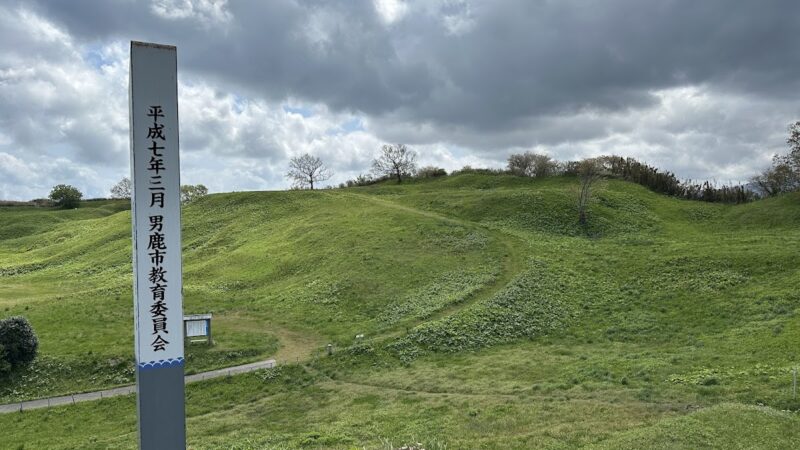
The main highlight of Akaotsu Castle is the main enclosure ruins at the mountaintop. Currently, a stone monument inscribed with “Akaotsu Castle Main Enclosure Ruins” stands there, indicating that this was once the castle’s center. The area around the monument has been maintained, allowing visitors to imagine the layout of the enclosures in their heyday.
The view from the main enclosure ruins is magnificent, offering panoramic views of Yurihonjo city and the Sea of Japan. On clear days, the majestic figure of Mount Chokai can be seen in the distance, demonstrating why this excellent view was chosen as a key factor in the castle’s location.
Condition of the Remains
The remains of Akaotsu Castle are relatively well-preserved. Traces of defensive structures such as terraces, cliffs, and moats can be seen, making it a valuable historical site for learning about the structure of medieval mountain castles.
In particular, the moats along the ridge are clearly visible, allowing direct observation of the ingenuity used to prevent enemy intrusion. Furthermore, the steep cliffs show clear signs of artificial excavation, demonstrating the advanced civil engineering techniques of the time.
Development as Takajo Castle Ruins Park
The Akaotsu Castle ruins have been developed as Takajo Castle Ruins Park, ensuring that visitors can safely view the historical site. The climbing path is also well-maintained, making it relatively easy to reach the summit. However, as it is a mountain castle, a certain level of physical fitness and appropriate equipment (such as comfortable walking shoes) is necessary.
Information boards are installed within the park, allowing visitors to learn about the castle’s history and structure. Preservation activities by local residents are also underway, ensuring the site’s value as a historical landmark.
Photo Spot
Akaotsu Castle is an excellent spot for photography. The stone monument at the main keep site, the terraced layout of the baileys, and above all, the view from the mountaintop offer stunning opportunities for memorable photos. The view of the Sea of Japan at sunset is particularly exceptional, attracting many castle enthusiasts and photography lovers.
Akaotsu Castle displays different expressions throughout the seasons—fresh greenery in spring, deep green in summer, vibrant autumn leaves, and snowy winter landscapes—offering new discoveries with each visit.
Access and Visiting Information
Location
Address: Takajo, Iwaki-shimohebita, Yurihonjo City, Akita Prefecture
Akaotsu Castle Ruins (Takajo Castle Park) are located in the Iwaki district of Yurihonjo City. It is relatively close to the center of the former Iwaki town, making it easily accessible.
Access by Car
Access by car is the most convenient. The castle ruins can be reached in about 10 minutes from the Iwaki Interchange on the Nihonkai Tohoku Expressway. There is parking space near the entrance to the castle, but the number of spaces is limited, so caution is advised during busy times.
When using a car navigation system, it is recommended to search for “Takajo Castle Ruins Park” or “Iwaki Shimohebita, Yurihonjo City.”
Access by Public Transportation
If using public transportation, the nearest stations are JR Uetsu Main Line’s Michikawa Station or Iwaki Minato Station. However, the castle ruins are a considerable distance from the stations, so taking a taxi is more practical. There are also bus routes, but the number of services is limited, so it is recommended to check the timetable in advance.
Time to Visit and Explore
The time required from the entrance to the main keep is approximately 15-20 minutes at a normal walking pace. Including time to explore at the summit, it is advisable to allow approximately 30-40 minutes in total. If you plan to carefully observe the remains or enjoy taking photographs, it is recommended to allow about an hour. ### Important Notes for Visitors
Since Akaotsu Castle is a mountain castle, please observe the following points when visiting:
- Clothing and Equipment: Wear comfortable walking shoes (trekking shoes or sneakers). Sandals and high heels are dangerous.
- Weather: The ground can be slippery during and after rain, so caution is necessary.
- Season: Take precautions against insects in summer, and be aware of snow and ice in winter.
- Drinking Water: It is especially recommended to bring drinks for hydration during summer.
- Solo Visit: Visiting in groups is preferable if possible. If visiting alone, inform family or friends of your destination.
Admission Fee and Opening Hours
Admission to Akaotsu Castle Ruins (Takajo Castle Park) is free. While there are no specific opening or closing times, visiting during daylight hours is safer. Visiting early in the morning or at dusk should be avoided due to poor visibility.
Nearby Tourist Attractions
Honjo Castle (Tsurumai Castle)
If you visit Akaotsu Castle, we highly recommend also visiting Honjo Castle. Honjo Castle, built by Tateoka Mitsushige after relocating from Akaotsu Castle, is located in the heart of Yurihonjo City and is now maintained as Honjo Park. Remains such as stone walls and moats remain, and it is also known as a famous cherry blossom viewing spot.
Honjo Castle, as the successor to Akaotsu Castle, was an important castle that served as the administrative center of the Honjo Domain throughout the Edo period. Visiting both castles allows you to understand the changes in castle architecture from the medieval to the early modern period.
Kameda Jinya Ruins
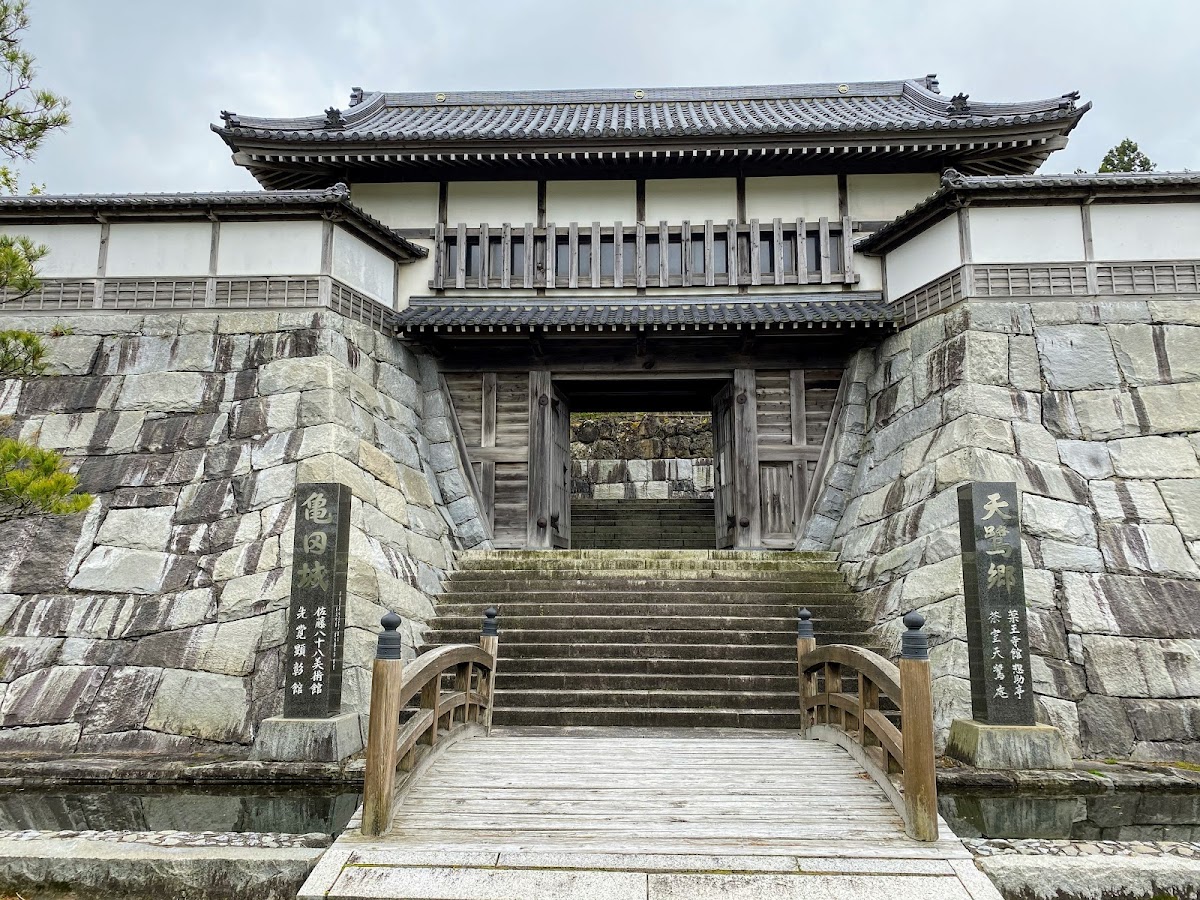
Yurihonjo City also has the Kameda Jinya Ruins. This was the encampment of the Kameda Domain, ruled by the Iwaki clan, and you can see early modern castle ruins with a different form than Honjo Castle. When enjoying a tour of castles in the Yuri region, visiting these historical sites in combination will provide a deeper understanding.
Michi-no-Eki Iwaki
For a rest stop during your visit, we recommend “Michi-no-Eki Iwaki.” Located on the Sea of Japan coast, this roadside station offers local specialties and fresh seafood. The restaurant also serves dishes made with local ingredients. It’s relatively close to Akaotsu Castle, making it convenient to stop by before or after your visit.
Other Castle Ruins in Yurihonjo City
Yurihonjo City is home to many castle ruins related to the Twelve Lords of Yuri. Castles such as Takizawa Castle, Yajima Castle, and Akada Castle, each with its own unique characteristics, are scattered throughout the area, making it a must-see for castle enthusiasts. If you have time, enjoying a “Twelve Lords of Yuri Castle Tour” visiting these ruins would be a great idea.
Evaluation and Appeal of Akaotsu Castle
Evaluation from Castle Enthusiasts
Akaotsu Castle has earned a certain level of recognition among castle enthusiasts nationwide. Online castle information websites have received positive comments from visitors, such as “The remains are well-preserved,” “The view is magnificent,” and “You can quietly feel the history.”
On the other hand, its popularity is not necessarily high, so the number of visitors is limited. However, this also has the advantage of allowing visitors to “enjoy a leisurely visit without crowds,” making it an ideal environment for those who want to thoroughly enjoy the castle ruins.
Historical Value
The historical value of Akaotsu Castle lies in its status as an important historical site that tells the history of the Yuri Twelve Lords, a local powerful family. As a castle of a local powerful family during the Sengoku period, and as a historical site that shows the political changes after the Battle of Sekigahara, it occupies an important position academically.
In particular, the fact that Tateoka Mitsushige initially used this castle as his residence but eventually moved to Honjo Castle symbolizes the major trend in castle history of the transition from medieval mountain castles to early modern flatland castles, and can be said to have high educational value.
Harmony with the Natural Environment
One of the charms of Akaotsu Castle is its harmony with the natural environment. The castle ruins, nestled amidst the rich natural beauty of Takagiyama Mountain, are a precious spot where you can enjoy both history and nature. The castle ruins display different expressions throughout the seasons—spring wildflowers, summer shade, autumn foliage, and winter snowscapes—offering new discoveries with every visit.
Enjoying a forest bath while walking the path to the castle, reflecting on history at the summit, and enjoying the panoramic views—this kind of multifaceted experience is a major attraction of Akaotsu Castle.
Preservation and Future of Akaotsu Castle
Local Preservation Activities
The Akaotsu Castle ruins are maintained through preservation activities by local residents. Regular maintenance, such as grass cutting and maintenance of the climbing paths, ensures that visitors can safely explore the historical site.
The value of Akaotsu Castle as a regional historical heritage and tourist resource is recognized locally, and appropriate preservation is expected in the future.
Future Challenges and Prospects
Future challenges for Akaotsu Castle include increasing its recognition and conducting more detailed academic research. Archaeological excavations and other research could yield more detailed information about the castle’s structure and history, further enhancing its value as a historical site.
Furthermore, improving information boards and utilizing digital technology (such as AR technology to recreate the castle’s appearance in its heyday) would be effective means of deepening visitors’ understanding.
The Significance of Visiting Akaotsu Castle
Visiting Akaotsu Castle is not simply about viewing castle ruins; it’s a valuable opportunity to experience the history of the Yuri region from the medieval to the early modern period. The unique regional governance system of the Twelve Lords of Yuri, the political upheavals brought about by the Battle of Sekigahara, and the major shift in castle history from medieval mountain castles to early modern flatland castles—all of these can be gleaned from this single castle site.
When visiting Yurihonjo City in Akita Prefecture, be sure to visit Akaotsu Castle (Tensagi Castle). The view from the summit of Takajo Mountain and the weight of history etched there will surely leave a deep impression on your heart.
Summary
Akaotsu Castle is a medieval mountain castle located on Takajoyama Mountain in Iwaki Shimohebita, Yurihonjo City, Akita Prefecture. It stands at an elevation of 170m and a relative height of 150m. Built by Ogasawara Mitsusada during the Nanboku-cho period, it became the residence of the Akaotsu clan, one of the twelve powerful families of Yuri, during the Sengoku period. After the Battle of Sekigahara, it became the residence of Tateoka Mitsushige, but was abandoned in 1613 when Honjo Castle was completed.
Currently, the site is maintained as Takajo Castle Ruins Park, where visitors can see the remains of the main keep, including a stone monument, baileys, and moats. The view from the mountaintop is magnificent, offering panoramic views of Yurihonjo city and the Sea of Japan. Access is convenient by car, approximately 10 minutes from the Iwaki Interchange on the Nihonkai Tohoku Expressway.
As an important historical site that tells the history of the Yuri region, and as an attractive spot where nature and history harmonize, Akaotsu Castle is a castle ruin well worth visiting. Visiting nearby historical sites such as Honjo Castle and the Kameda Jinya ruins in conjunction with this visit will provide a deeper understanding of history.