Complete Guide to Zakimi Gusuku (Okinawa Prefecture) | A Thorough Explanation of the Charm of a World Heritage Site and the Techniques of Gosamaru, a Master Castle Builder
What is Zakimi Gusuku?
Zakimi Gusuku is a gusuku (castle) from the Ryukyu Kingdom era, located in Yomitan Village, Nakagami District, Okinawa Prefecture. Built on a small hill approximately 120-130 meters above sea level, this gusuku was registered as a World Cultural Heritage site in December 2000 as a component of the “Gusuku Sites and Related Properties of the Ryukyu Kingdom.” Furthermore, in 2017, it was selected as the 199th of the “Continued Top 100 Japanese Castles,” attracting attention both domestically and internationally as an important cultural property representing Okinawa.
The most distinctive feature of Zakimi Gusuku is that it was built by Gosamaru, known as the foremost castle builder of the Ryukyu Kingdom. Built in the early 15th century, after the capture of Nakijin Castle in 1416, it was originally called “Yomitanzan Castle.” Currently, it is known as Zakimi Castle, due to its location north of the Zakimi settlement in Yomitan Village.
The History of Gosamaru and Zakimi Castle
Gosamaru, the Master Castle Builder
Gosamaru was a military commander who was active from the Three Kingdoms period to the unification of the Ryukyu Kingdom. He is remembered in Ryukyu history as a person of exceptional castle-building skills. In 1416, during the Battle of Nakijin Castle, where King Sho Hashi of Chuzan defeated King Han Anchi of Hokuzan, Gosamaru is said to have played a crucial role.
Due to his military achievements, Gosamaru was appointed Yomitanzan Aji (local lord of Yomitan Mountain) and ordered the construction of a new gusuku (castle) in Zakimi to prepare for the remnants of the Hokuzan forces. Zakimi Gusuku is believed to have functioned not only as a military base but also as a political center for governing the Yomitan region.
Period and Background of Gusuku Construction
The construction period of Zakimi Gusuku is estimated to be sometime between immediately after the capture of Nakijin Gusuku in 1416 and around 1422. To counter the remnants of the Hokuzan forces and the unstable situation in the surrounding areas, it was necessary to build a strong fortress in the strategically important location of Yomitan.
Gosamaru skillfully utilized the terrain of the area, completing a gusuku consisting of two interconnected enclosures on a red earth plateau called Kunigami-maji. Later, Gosamaru moved to Nakagusuku around 1440, but Zakimi Gusuku continued to function as an important base in the Yomitan region.
Structure and Characteristics of Zakimi Gusuku
Connected Enclosure Layout
Zakimi Gusuku is a connected enclosure castle composed of two enclosures: the first enclosure (Ichinokuruwa) and the second enclosure (Ninokuruwa). The first enclosure is located on the highest point to the north, with the second enclosure surrounding it to the south. This layout allows for a tiered defense against enemy invasions.
The first enclosure measures approximately 52 meters east-west and 35 meters north-south. The presence of foundation stones inside indicates the former existence of buildings such as a main hall. The second enclosure is larger and served as an outer enclosure protecting the first enclosure.
Okinawa’s Oldest Arch Gate
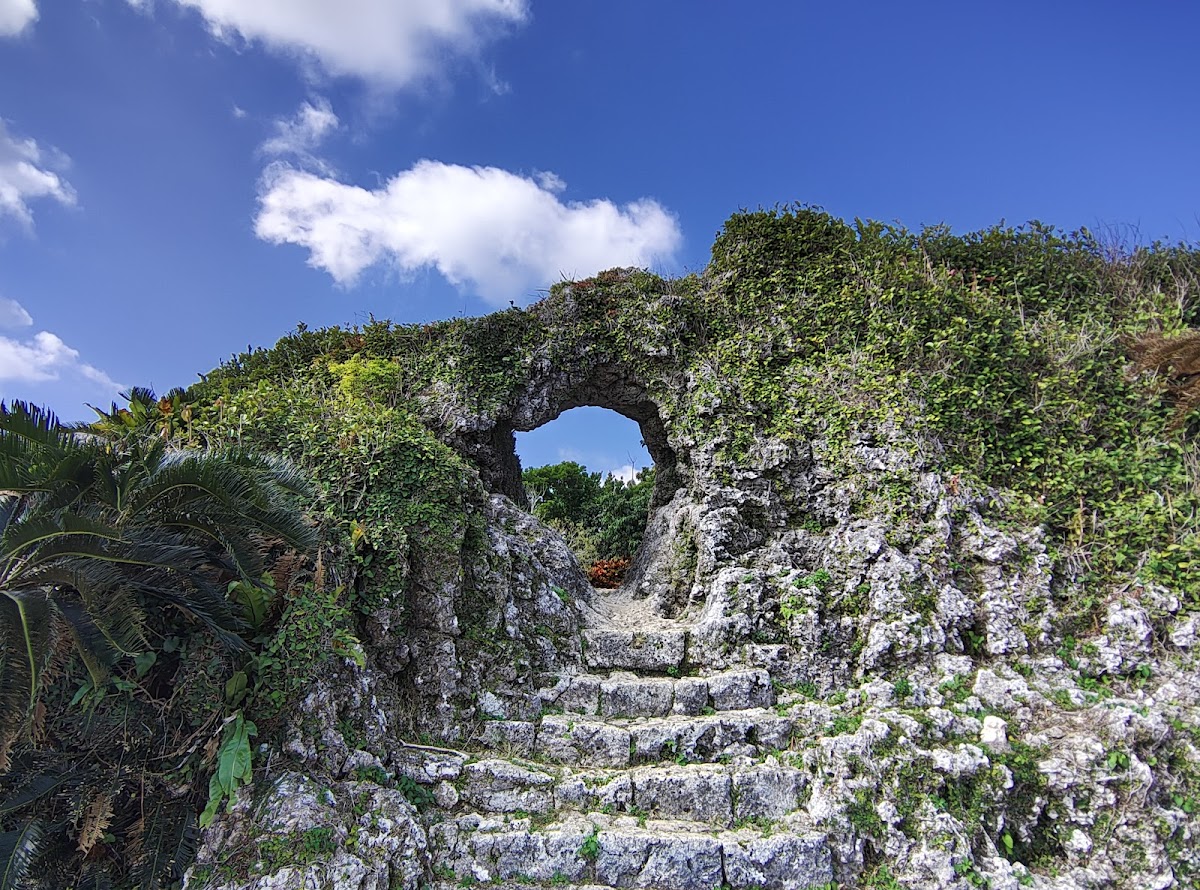
The greatest highlight of Zakimi Gusuku is the stone arch gates (arched gates) located in both the first and second enclosures. Particularly noteworthy is that these arch gates are considered to be the oldest existing arch gates in Okinawa’s gusuku (castles).
The distinctive feature of the arch gate lies in its structure, where a wedge-shaped stone called a “kusabi-ishi” (wedge stone) is fitted into the center of the arch stone (ridge stone). This wedge stone secures the interlocking parts on both sides of the arch, enhancing the overall stability of the structure. This technique is important evidence of the high level of Ryukyu stone construction technology.
The arch gate of the first enclosure is approximately 3 meters high and 2.5 meters wide, while the arch gate of the second enclosure is slightly larger. Both feature beautiful curves and, even after approximately 600 years, have retained their original form in almost perfect condition.
Exquisite Stone Masonry Techniques
The castle walls of Zakimi Gusuku are considered a masterpiece demonstrating Gosamaru’s outstanding castle-building skills. The walls were constructed using a technique called “aikata-zumi” (mutual stacking) with Ryukyu limestone, skillfully combining stones of various sizes to create a strong and beautiful stone wall.
Particularly noteworthy is the beauty of the curves of the castle walls. The walls of Zakimi Gusuku are not straight, but arranged in gentle curves. This is not merely an aesthetic consideration, but also a defensive feature designed for flanking fire. The design is calculated to allow attacks from the flanks against enemies attempting to advance along the walls.
Furthermore, the walls are 2-3 meters thick in some places, and reach a maximum height of approximately 13 meters. These thick walls not only enhance defensive capabilities during battle, but also serve a structural role in reinforcing the relatively soft soil of Kunigami-maji, preventing collapse. This demonstrates that Gosamaru had a deep understanding of the terrain and geology before designing the fortress optimally.
Projections for Flanking Fire
An important element of Zakimi Gusuku’s defensive system is the projecting section located beside the arched gate. This is a defensive technique called “flanking fire,” designed to attack enemies approaching the gate from the flank.
Both the first and second enclosures have stone walls projecting outwards on either side of the arched gates, a design intended to eliminate blind spots for enemies attempting to pass through. This technique is similar to the “yokoya” (flanking fire) concept found in castles on the Japanese mainland, demonstrating Gosamaru’s advanced understanding of castle construction theory.
Highlights of Zakimi Gusuku
View from the First Enclosure
The first enclosure is located at the highest point of Zakimi Gusuku, offering a panoramic view of the Yomitan village area from its walls. On a clear day, you can see the blue expanse of the East China Sea and even the distant Kerama Islands, experiencing the same scenery that the Anji (lords) of the Ryukyu Kingdom era saw.
The excellent view also held significant military importance. It was an ideal location for monitoring the movement of ships from the sea and the surrounding area, making it one of the reasons Zakimi Gusuku was chosen as a strategically important location.
Currently, foundation stones remain within the first enclosure, indicating the former presence of buildings such as the main hall and warehouses. The arrangement of these foundation stones allows us to infer the scale and layout of the building, providing clues to imagining what the castle looked like at the time.
Beautifully Curved Castle Walls
Visitors to Zakimi Gusuku are always impressed by the beautiful curves of the castle walls. In particular, the walls viewed from outside the second enclosure stretch towards the sky in a gentle curve, creating a spectacular contrast between the white Ryukyu limestone and the blue sky.
These curves are not merely decorative; as mentioned earlier, they are the result of a meticulously calculated design that combines defensive function with structural stability. These walls, a culmination of Gosamaru’s castle-building techniques, are often described as “the most beautiful among Okinawan castles” and are a popular spot for photography.
Details of the Arch Gate
The arch gate is a technical highlight of Zakimi Gusuku. Upon closer inspection, one can see how precisely processed stonework is fitted together without gaps. The wedge-shaped stones, in particular, are intricately crafted to fit together perfectly with the arch stones on either side, showcasing the remarkable skill of the stonemasons of the time.
Looking out from inside the arch, the scenery beyond the gate is framed like a picture, creating a photogenic composition. Furthermore, the surface of the stone shows signs of weathering due to age, conveying the weight of 600 years of history.
Collaboration with Yuntanza Museum
Near the entrance to Zakimi Gusuku is the Yomitan Village Historical and Folk Museum (Yuntanza Museum), where you can see detailed exhibits on the history of the gusuku and Gosamaru. Artifacts unearthed during excavations and a reconstructed model of the gusuku are also on display, allowing for a deeper understanding if you visit before or after your visit.
At the museum, you can learn not only about Zakimi Gusuku but also about the history and culture of Yomitan Village, understanding the gusuku’s place within the historical context of the entire region.
Access and Tourist Information
Location and Basic Information
Location: 708-6 Zakimi, Yomitan Village, Nakagami District, Okinawa Prefecture
Designation: National Historic Site (1972), World Cultural Heritage Site (2000)
Continued Top 100 Japanese Castles: No. 199
Opening Hours: Open year-round (Yuntanza Museum: 9:00-18:00, closed Mondays)
Admission Fee: Free
Parking: Free parking available (approximately 50 regular cars)
Access by Car
From Naha Airport to Zakimi Gusuku, it takes approximately 1 hour to 1 hour 15 minutes by car. If using the Okinawa Expressway, exit at Ishikawa IC or Okinawa Minami IC, and head towards Yomitan Village via local roads. Head north on National Route 58, and follow the signs within Yomitan Village to reach the castle.
If using a car navigation system, searching for “Zakimi Castle Ruins” or “Yomitan Village Historical and Folk Museum” is recommended. Parking is free and located a short walk from the castle entrance.
Access by Public Transportation
If using public transportation, take a bus bound for Yomitan Village (such as bus number 28 or 29) from Naha Bus Terminal and get off at the “Zakimi” bus stop. It’s about a 15-minute walk from there. However, since bus service is limited, it’s recommended to check the timetable in advance.
If you don’t rent a car, consider using a taxi or tour bus. Yomitan Village also has other tourist attractions such as Cape Zanpa and Yachimun no Sato (pottery village), so combining visits is an efficient plan.
Estimated Visiting Time
A leisurely walk through the interior of Zakimi Gusuku takes approximately 30-45 minutes. Including time for photography and enjoying the views from the castle walls, allow about an hour. If you plan to visit the Yuntanza Museum, we recommend allocating an additional 30-45 minutes.
Since there are many stone paths and stairs within the castle grounds, comfortable walking shoes are essential. Also, because there is little shade, don’t forget to bring a hat, sunscreen, and drinks during the summer months.
Tourist Attractions Around Zakimi Castle
Zanpa Cape
Located about 10 minutes by car from Zakimi Castle, Zanpa Cape is a scenic spot where a cliff approximately 30 meters high stretches for about 2 kilometers. From the cape jutting out into the East China Sea, you can enjoy a panoramic view of the blue ocean stretching to the horizon, and it is especially known for its beautiful sunsets. The white lighthouse is also impressive, making it a popular spot for tourists to visit in conjunction with Zakimi Castle.
Yachimun Village
Yomitan Village is known as a production area for “yachimun,” Okinawan pottery. About a 10-minute drive from Zakimi Gusuku is “Yachimun no Sato,” a village of pottery workshops where you can observe artisans at work and purchase pottery. Experiencing Ryukyuan traditional crafts will deepen your understanding of Okinawan culture.
Other World Heritage Gusuku Sites
Okinawa Island has five World Heritage gusuku sites, including Zakimi Gusuku. These are Nakijin Gusuku (Motobu Town), Nakagusuku Gusuku (Nakagusuku Village/Kitanakagusuku Village), Katsuren Gusuku (Uruma City), and Shuri Castle Ruins (Naha City), each possessing distinct characteristics and charms. If time permits, visiting multiple gusuku sites will allow you to experience the diversity and development of Ryukyu Kingdom castle architecture.
Cultural Value of Zakimi Gusuku
Significance as a World Heritage Site
Zakimi Gusuku was registered as a World Heritage Site because it is an important heritage site that tells the story of the history and culture of the Ryukyu Kingdom. The “Gusuku Sites and Related Properties of the Ryukyu Kingdom” are valued as evidence of a unique civilization that flourished as the political, economic, and cultural center of the Ryukyu Kingdom from the 12th to the 17th centuries.
Zakimi Gusuku, in particular, is important as a heritage site that demonstrates the pinnacle of Ryukyu’s unique castle-building techniques. The arched gate technology and the stonework techniques utilizing curves are a culmination of architectural technology that developed uniquely in Ryukyu, while being influenced by China and mainland Japan.
The Legacy of Gosamaru’s Castle-Building Techniques
The castle-building techniques established by Gosamaru at Zakimi Gusuku had a significant impact on subsequent Ryukyu castle architecture. After Zakimi Gusuku, Gosamaru also worked on the renovation of Nakagusuku Gusuku, where he further demonstrated refined stonework techniques.
The arched gate technology of Zakimi Gusuku was adopted in castles throughout Ryukyu, becoming a characteristic element of Ryukyu architecture. The arched structures still seen in traditional Okinawan architecture today are a result of this transmission of technology.
A Symbol of Regional Identity
Zakimi Gusuku is a symbol of Yomitan Village and is deeply cherished by the local residents. The village emblem also features the castle’s arched gate, making it an important cultural heritage site that expresses the region’s identity.
Every year, local festivals and events are held around the castle, providing a place for interaction between residents and tourists. While possessing the universal value of a World Heritage Site, Zakimi Gusuku continues to thrive as a cultural heritage deeply rooted in the community.
Preservation and Utilization of Zakimi Gusuku
Restoration and Preservation Activities
Since being designated a national historic site in 1972, Zakimi Gusuku has undergone continuous preservation and repair work. In particular, large-scale restoration work carried out from 1973 to 1983 involved the restoration of collapsed castle walls and reinforcement of the arched gate.
This restoration work emphasized reproducing the techniques of the time as much as possible, employing traditional stonework techniques using Ryukyu limestone. Archaeological excavations were also conducted concurrently, deepening our understanding of the castle’s structure and history. Regular inspections and maintenance are still carried out, and careful preservation efforts continue to ensure that the value of the site as a World Heritage Site is not diminished.
Utilization as a Tourism Resource
Zakimi Gusuku is a representative tourist destination in Okinawa, attracting many tourists throughout the year. Since its designation as a World Heritage Site, it has attracted particular attention from both domestic and international visitors, and also functions as an important educational site for learning about Okinawa’s history and culture.
Yomitan Village is focusing on promoting tourism centered around Zakimi Gusuku, and is working on improving the surrounding area, providing multilingual signage, and enhancing guided tours. Through collaboration with the Yuntanza Museum, they are offering opportunities for deeper learning that go beyond simply visiting the ruins.
Passing on to Future Generations
Educational activities are also actively being carried out to pass on the value of Zakimi Gusuku to future generations. Local elementary and junior high schools incorporate lessons on the history and culture of the gusuku into their curriculum, designed to instill in children a sense of pride in their local history.
Furthermore, volunteer guide training and regular cleaning activities by local residents are carried out, creating a system where the entire community protects and nurtures the World Heritage site.
Summary
Zakimi Gusuku is a magnificent castle that embodies the pinnacle of the Ryukyu castle builder Gosamaru’s techniques, and is a representative World Heritage site of Okinawa. Consisting of two baileys built in the early 15th century, this gusuku boasts numerous attractions, including Okinawa’s oldest arched gate, beautifully curved castle walls, and exquisite stonework.
Located on a hill approximately 120 meters above sea level, the first bailey offers a spectacular panoramic view of Yomitan Village and the East China Sea. It is a nationally designated historical site, registered as a World Cultural Heritage site in 2000, and selected as one of the Continued Top 100 Japanese Castles in 2017.
It is easily accessible, approximately one hour by car from Naha Airport, and has ample free parking. Visiting it in conjunction with the Yuntanza Museum will provide a deeper understanding of Gosamaru’s life and the history of the gusuku.
When you visit Okinawa, be sure to stop by Zakimi Gusuku and experience the history of the Ryukyu Kingdom and the exceptional castle-building skills of Gosamaru. The white limestone walls that stand out against the blue sky and the arched gate that has survived for over 600 years are sure to leave a lasting impression on visitors.