.png)
Yunagaya Jinya (Iwaki City, Fukushima Prefecture) Complete Guide | History, Remains, and Access Explained in Detail
What is Yunagaya Jinya?
Yunagaya Jinya was a fortified residence located in the former Ienaka site of Tokiwa Shimoyunagaya-machi, Iwaki City, Fukushima Prefecture. During the Edo period, it functioned as the administrative center of the Yunagaya Domain in Iwasaki District, southern Mutsu Province (Iwaki Province). Established as a branch domain of the Iwaki-Taira Domain, it is known as a historical castle site ruled by the Naito family, a hereditary daimyo family, for 14 generations.
The current site of the fortified residence is the grounds of Iwaki Municipal Iwasaki Junior High School and its surroundings, with some remains such as earthworks and dry moats still existing. It is a historical site that has recently attracted attention as the castle of the Yunagaya Domain, which served as the model for the novel and film “Chōsoku! Sankin Kōtai” (Super Fast! Sankin Kōtai).
The Establishment and History of the Yunagaya Domain
From Yumoto Domain to Yunagaya Domain
The history of the Yunagaya Domain begins in 1670 (Kanbun 10). Toyama Masasuke (Naito Masasuke), the third son of Naito Tadaoki, the lord of the Iwaki-Taira Domain, was granted 10,000 koku of newly cultivated land in Iwamae and Kikuta districts upon his father’s retirement. Initially, Masasuke established a temporary residence in Yumoto village, and the domain was called the “Yumoto Domain.”
In 1676 (Enpo 4), Masasuke moved his residence to Yunagaya and officially constructed the Yunagaya Jinya (fortified residence). The domain’s name was then changed to “Yunagaya Domain,” and the Naito family ruled it for approximately 200 years.
Relationship with the Iwaki-Taira Domain
The Yunagaya Domain was established as a branch domain of the Iwaki-Taira Domain. The Iwaki-Taira Domain was a fudai daimyo domain ruled by Naito Tadaoki, and the Yunagaya Domain was positioned as a branch domain. Despite being a branch domain, it governed independently, and the Naito family served as its lords for generations.
Although a small domain with a rice yield of 10,000 koku, it governed an important region in southern Mutsu Province and played a vital role in the shogunate system as a fudai daimyo of the Edo shogunate. The lords were obligated to participate in the sankin-kotai system, commuting between Edo and Yunagaya.
Successive Lords and Domain Administration
The Yunagaya Domain was ruled by the Naito family for 14 generations, starting with the first lord, Naito Masasuke (Toyama Masasuke). Despite being a small domain, its administration was relatively stable, and it focused on regional development and the utilization of hot spring resources.
The domain’s finances were not particularly strong, and the burden of the sankin-kotai system was a major challenge with a rice yield of only 10,000 koku. This financial difficulty would later be the subject of the film “Chōsoku! Sankin-kōtai” (Super Fast! Sankin-kōtai).
The Boshin War and the Fall of Yunagaya Jinya
Participation in the Ouetsu Reppan Alliance
When the Boshin War broke out in 1868 (Keio 4, Meiji 1), the Yunagaya Domain found itself in a difficult position. It was forced to partially align itself with the Ouetsu Reppan Alliance, formed by various domains in the Tohoku region.
As a small domain, Yunagaya was easily influenced by the actions of the surrounding larger domains, and its geographical location in the Tohoku region also forced it to join the alliance. However, given its position as a Fudai daimyo (hereditary vassal), opinions within the domain were divided on whether to side with the new government or the alliance.
Fall of the Castle in Meiji 1
In June 1868 (Meiji 1), the new government forces attacked Yunagaya Jinya. As a small domain, Yunagaya lacked sufficient military strength to resist the new government forces, and the castle fell. This battle resulted in the burning or destruction of many of the buildings of the jinya (fortified residence).
After the Boshin War, the Yunagaya Domain pledged allegiance to the new government and welcomed the Meiji Restoration. With the abolition of the feudal domains in 1871 (Meiji 4), the Yunagaya Domain was abolished, bringing an end to the approximately 200-year rule of the Naito family.
Structure and Scale of the Yunagaya Jinya
Layout of the Jinya
The Yunagaya Jinya was built in the typical Edo period jinya style. A jinya is the residence of a daimyo or hatamoto (high-ranking samurai) without a castle, and is a style often seen in small domains of around 10,000 to 50,000 koku (a unit of rice production).
At the center of the jinya was the lord’s residence, the Goten, surrounded by the residences of his retainers. The current site of Iwasaki Junior High School corresponds to the former center of the jinya, and the surrounding place name “Kachuato” (meaning “site of the samurai residences”) suggests that samurai residences once stood there.
Defensive Structures
The jinya (fortified residence) was equipped with defensive structures consisting of earthen ramparts and dry moats. While not as large-scale as a castle, it is known to have provided a certain level of defensive capability.
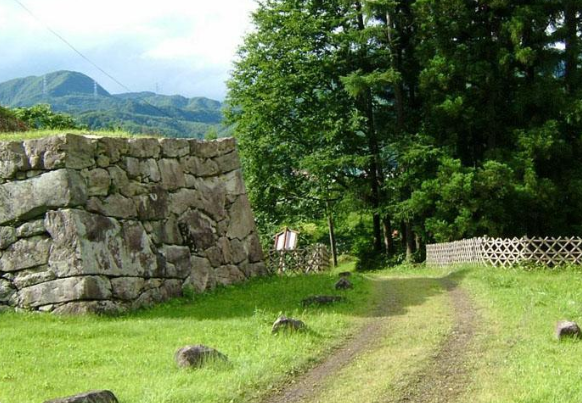
The earthen ramparts surrounded the jinya, and a dry moat was dug outside of them. Some of these remains still exist today, providing clues to the scale of the jinya in its heyday.
Facilities within the Jinya
In addition to the lord’s residence, the jinya housed administrative offices, vassal quarters, and warehouses. A domain school was also established, where the children of samurai were educated.
Taking advantage of its location near a hot spring, it is possible that a bathhouse was also located within the jinya. As the place name Yunagaya suggests, this area has long been known for its hot springs, and it is thought that the lord and his vassals benefited from them.
Existing Remains and Points of Interest
Remains Around Iwasaki Junior High School
Currently, most of the Yunagaya Jinya (fortified residence) site is occupied by Iwaki Municipal Iwasaki Junior High School. The area where the school grounds and buildings now stand was the center of the former Jinya.
Within and around the school grounds, there are partial remains of mounds believed to be the remains of earthworks and traces of dry moats. These are remnants of the Edo period Jinya’s defensive facilities and are valuable remains that allow us to imagine its scale at the time.
Earthworks and Moat Traces
Parts of earthworks can be seen along the boundaries of the junior high school grounds. They are about 1-2 meters high, and it is presumed that they were higher in the past, but have been lowered by years of weathering and development.
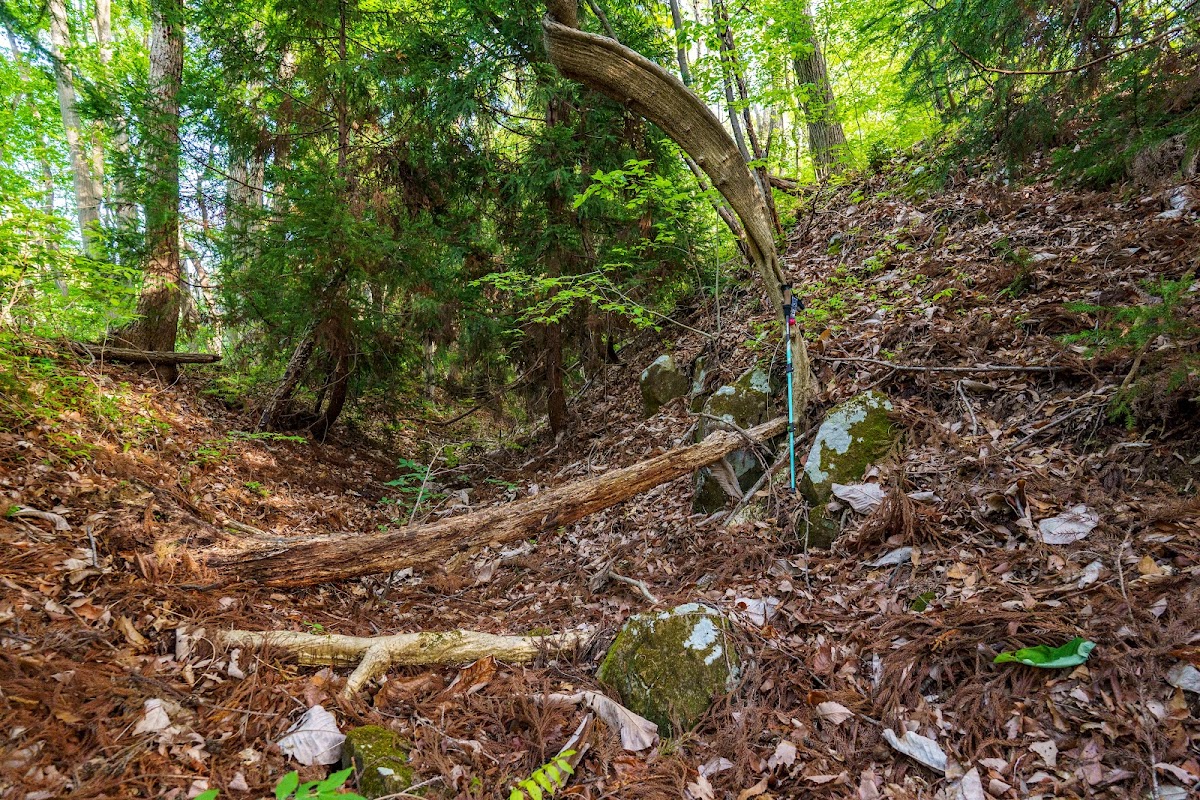
Some traces of dry moats also remain, visible as depressions. Although not preserved in their complete form, they provide clues to the location and size of the moats that surrounded the Jinya.
Stone Monument and Information Board
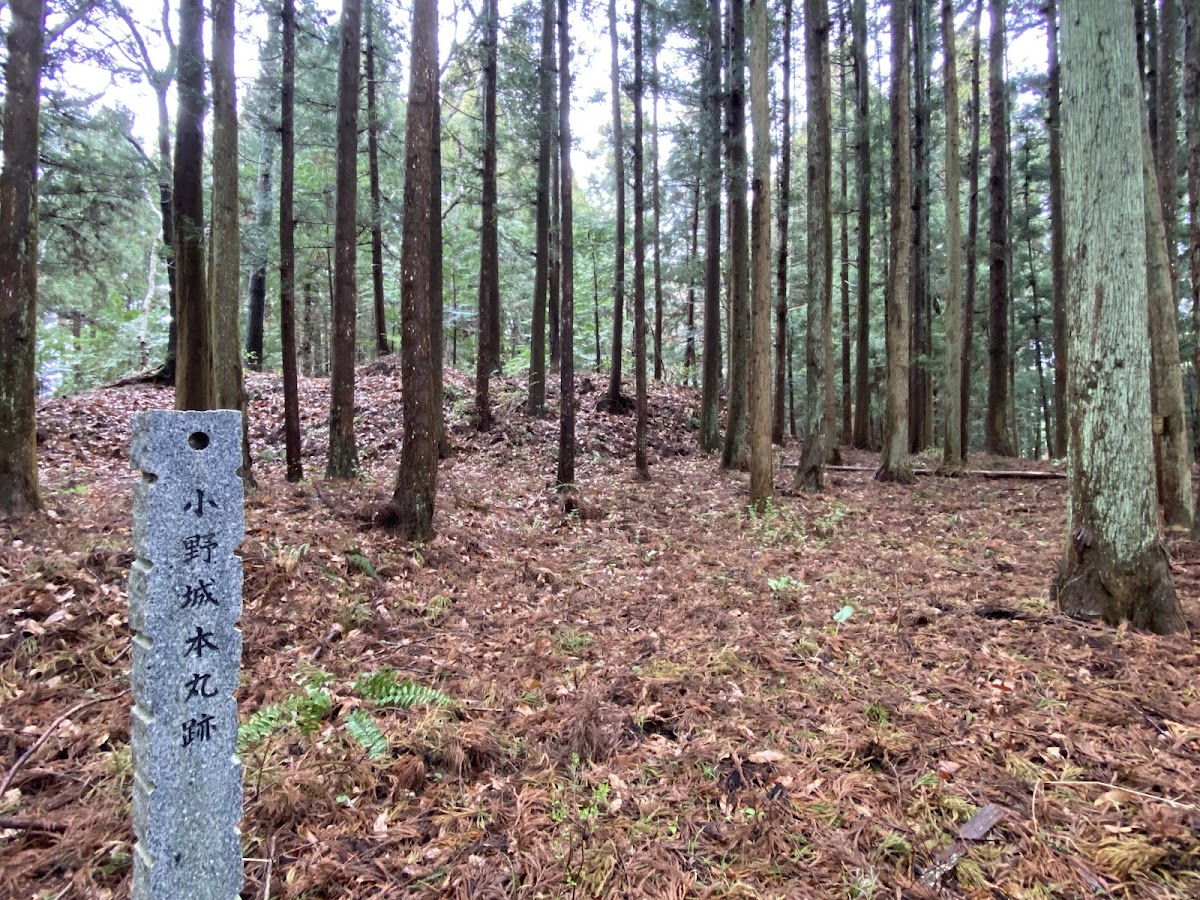
A stone monument marking the “Yunagaya Domain Jinya Site” stands at the site of the former jinya (fortified residence). This monument, erected by local history enthusiasts and related parties, serves as an important landmark indicating the location of the historical site.
An information board is also located near the monument, providing a brief explanation of the history of the Yunagaya Domain and the outline of the jinya. Visitors can understand the historical background of the jinya through these materials.
Traces Remaining in Surrounding Place Names
The place name “Kachu-ato” (家中跡) remains around the jinya site. “Kachu” refers to an area where samurai residences stood, indicating that the residences of the domain’s retainers once stood here.
Furthermore, the current place name “Tokiwa Shimoyunagaya-machi” also conveys that this was once the Yunagaya area where the jinya was located. Place names are an important element in preserving historical memory and play a role in passing on the existence of the Yunagaya Jinya to future generations.
Relationship with the movie “Super Fast! Sankin-kōtai”
Modeled after the Yunagaya Domain
The 2014 film “Super Fast! Sankin-kōtai” (directed by Katsuhide Motoki, based on a novel by Akihiro Tsuchihashi) is based on the Yunagaya Domain. It was a huge hit as a hilarious period comedy about a small domain struggling with financial difficulties that manages to complete the Sankin-kōtai (alternate attendance system) to Edo in just five days.
In the film, the domain is named “Yunagaya Domain,” and it depicts how this small 10,000-koku domain overcomes its difficulties through wit and ingenuity. The actual Yunagaya Domain was also a small 10,000-koku domain, and the historical fact that it struggled with the financial burden of the Sankin-kōtai serves as the backdrop for the story.
Increased Attention Due to the Film Adaptation
The film’s success made the Yunagaya Jinya (fortified residence) suddenly famous. Previously a historical site not well-known outside the local area, the film attracted many history and film fans.
While the film wasn’t shot at the actual Yunagaya Jinya (fortified residence), it has attracted considerable attention as the site of the castle of the domain that served as its model. In Iwaki City, the local area, there are also efforts to utilize the film’s connection to tourism.
The Reality of the Sankin-kōtai (Alternate Attendance System)
While the film contains some exaggerated depictions, it is historically true that the Sankin-kōtai was a significant financial burden for small domains. For a small domain like the Yunagaya Domain, with a 10,000 koku (unit of rice production) yield, the costs of Sankin-kōtai strained the domain’s finances and made its management difficult.
The distance from Edo to Yunagaya is approximately 250 kilometers, and it is thought that the journey usually took around 10 days. The travel expenses, accommodation costs, and living expenses in Edo for the lord and retainers required enormous sums of money. The film skillfully incorporated this historical background, making it a successful piece of entertainment.
Nearby Historical Spots
Iwaki Yumoto Onsen
Located about a 10-minute drive from Yunagaya Jinya, Iwaki Yumoto Onsen is a renowned hot spring resort with a long history. As the name “Yumoto” suggests, hot springs were an important resource for the region. The early Yunagaya Domain was called the “Yumoto Domain” because its temporary residence was located in this hot spring area.
The hot spring town boasts numerous inns and hotels, allowing visitors to enjoy the hot springs after visiting Yunagaya Jinya. A sightseeing plan combining historical walks and hot springs offers a course that fully showcases the charm of Iwaki City.
Iwaki-Taira Castle Ruins
The ruins of Iwaki-Taira Castle, the residence of the Iwaki-Taira Domain (the main branch of the Yunagaya Domain), are also a highlight. Located in the heart of Iwaki City, it is now a park. Visiting it along with Yunagaya Jinya will provide a deeper understanding of the Edo period history of the Iwaki region.
Iwaki-Taira Castle is a castle that was developed as a modern-day fortress, and it differs significantly in scale and structure from the Yunagaya Jinya (fortified residence). By comparing the two, you can truly appreciate the differences between large and small domains, and between castles and fortified residences.
Shiramizu Amida-do Hall
The Shiramizu Amida-do Hall, designated as a National Treasure, is also an important historical building in Iwaki City. Built in the late Heian period, it has a much older history than the Yunagaya Jinya. It is a spot where you can feel the depth of Iwaki City’s history.
Spa Resort Hawaiians
Spa Resort Hawaiians is a representative tourist facility of modern Iwaki City. It is a large leisure facility built on the site of the former Joban Coal Mine, and is perfect for relaxing after exploring the history.
Access Information
Access by Public Transportation
Using the JR Joban Line:
- Get off at JR Joban Line “Yumoto Station”
- Take the Shin-Joban Kotsu bus bound for “Ena” or “Onahama” from the station
- Get off at the “Iwasaki Junior High School” bus stop and walk for approximately 3 minutes.
Since the number of buses is limited, it is recommended to check the timetable in advance. If using a taxi, it takes about 10 minutes from Yumoto Station and costs around 1,500 yen.
Access by Car
Using the Joban Expressway:
- Approximately 10 minutes (about 5 kilometers) from the Joban Expressway “Iwaki Yumoto IC”
- Take National Route 6 and then the prefectural road towards Yunagaya
Parking Information:
There is no dedicated parking lot for the Jinya Ruins. Parking is not permitted on the grounds of Iwasaki Junior High School, so you will need to use nearby public facilities or paid parking lots. When visiting, please be considerate of the surrounding residents.
Address and Map
Address: Ienakaato, Joban Shimoyunagaya-machi, Iwaki City, Fukushima Prefecture (around Iwaki Municipal Iwasaki Junior High School)
Setting “Iwaki Municipal Iwasaki Junior High School” as your destination in your car navigation system or smartphone map app is convenient.
Precautions During Visits
Consideration for School Grounds
The central part of the Jinya (fortified residence) site is located within the grounds of Iwasaki Junior High School. Unauthorized entry onto school grounds is prohibited. Particular consideration is needed during class hours and club activity times.
Viewing the remains should be limited to the area around the school perimeter and accessible from public roads. Stone monuments and information boards are located along public roads and can be viewed without issue.
Best Time and Season for Visits
Visiting the Jinya site involves outdoor activities, so spring through autumn is the best time. The cherry blossom and autumn foliage seasons, in particular, offer beautiful scenery and are ideal for historical walks.
Considering its location near a school, it’s best to avoid weekday class hours and visit on weekends, holidays, or early mornings/evenings. However, detailed observation of the remains requires daylight hours.
What to Bring and Wear
For observing the remains, comfortable walking shoes and clothing are recommended. Since the footing can be unstable around the earthworks and moat remains, sneakers or trekking shoes are advisable.
Bringing a camera will allow you to record the monuments and remains. Binoculars will allow you to observe the details of the remains from a distance. In summer, bring insect repellent, sunscreen, and a hat.
Historical Value of Yunagaya Jinya
A Historic Site Conveying the Reality of a Small Domain
Yunagaya Jinya is a valuable historical site that conveys the reality of a small domain during the Edo period. During the Edo period, there were approximately 300 domains throughout Japan, most of which were small domains with yields of around 10,000 to 30,000 koku. However, many of the remains of these small domains’ jinya (fortified residences) have been lost due to development, and examples of surviving remains are limited. The Yunagaya Jinya (fortified residence) site retains some remnants of earthworks and moats, making it an important resource for understanding the scale and structure of a small domain’s fortified residence.
Research Material on the Sankin-kōtai System
The Yunagaya Domain is a typical example of a small domain that suffered under the burden of the Sankin-kōtai system, and is a subject of historical research. Its use as a model for the film “Chōsoku! Sankin-kōtai” (Super Fast! Sankin-kōtai) brought the reality of the Sankin-kōtai system to the general public’s attention.
The difficulties and financial burdens faced by a small 10,000-koku domain traveling between Edo and its territory are crucial elements in understanding the Edo shogunate’s governing system. The Yunagaya Jinya provides a concrete example for considering these historical themes.
Importance in Local History
The Yunagaya Jinya occupies an important position in the local history of Iwaki City and Fukushima Prefecture. During the Edo period, the Iwaki region was governed by several domains, and the Yunagaya Domain, as one of them, shaped the region’s history.
The history of Yunagaya Jinya’s participation in the Ouetsu Reppan Alliance during the Boshin War and its eventual fall is important as an example illustrating the complex situation in the Tohoku region during the Meiji Restoration. The Jinya ruins play a role in passing on this regional history to future generations.
How to Enjoy Visiting Yunagaya Jinya
A Stroll Filled with Historical Romance
The greatest pleasure of visiting Yunagaya Jinya ruins is reflecting on the history of this small Edo-period domain. The site, now a middle school playground, was once home to the lord’s residence and the comings and goings of his retainers.
Stand before the stone monument and observe the surrounding terrain, imagining what the Jinya looked like in its heyday. You can also infer the layout of defensive structures from the earthworks and moat remains.
Recalling Movie Scenes
If you’re a fan of the movie “Chokosoku! Sankin Kotai,” visiting the Jinya ruins while recalling scenes from the film is a unique experience. While it’s not the actual filming location, standing on the site of the domain’s castle that served as the model for the movie allows you to feel closer to the world of the film.
Considering that the feudal lords and retainers featured in the film actually lived in this area and departed for Edo on their sankin-kotai (alternate attendance) journeys, history becomes even more vivid.
Combine with surrounding sightseeing
Since a visit to the Yunagaya Jinya Ruins alone is short, we recommend combining it with other nearby sightseeing spots. Iwaki City offers a variety of tourist attractions, including bathing at Iwaki Yumoto Onsen, visiting the Iwaki-Taira Castle Ruins, and leisure activities at Spa Resort Hawaiians.
Planning a one-day course combining historical walks, hot springs, and leisure activities will allow you to enjoy a fulfilling sightseeing experience. Enjoy local cuisine and fully experience the charm of Iwaki City.
Photography tips
When taking photos at the Jinya Ruins, it’s common to focus on the stone monument. Combining the monument with the surrounding scenery will result in photos that convey the atmosphere of the historical site.
By carefully selecting angles, you can also document the remains of the earthworks and moats, capturing the appearance of the defensive facilities in their heyday. However, sufficient care must be taken during photography to avoid including school grounds or students in the images.
Summary
Yunagaya Jinya is a valuable historical site from the Edo period remaining in Iwaki City, Fukushima Prefecture. It is the site of the castle of the Yunagaya Domain, which was established as a branch domain of the Iwaki-Taira Domain, and has a history of being ruled by the Naito family for 14 generations.
Although it is now the site of Iwasaki Junior High School, remnants such as earthworks and dry moats remain, conveying the appearance of a small Edo-period domain’s jinya (fortified residence). It gained attention as the model for the movie “Chōsoku! Sankin Kōtai” (Super Fast! Sankin Kōtai), and has become a popular spot for many history enthusiasts.
Including its tragic history of falling during the Boshin War, Yunagaya Jinya is an indispensable part of the region’s history. Visiting it along with other nearby tourist spots such as Iwaki Yumoto Onsen and the Iwaki-Taira Castle ruins will allow you to gain a deeper understanding of Iwaki City’s rich history and culture.
For those interested in history, movie fans, and those who enjoy visiting castles and fortified residences, Yunagaya Jinya is a historical site worth visiting at least once. Why not experience the historical romance of a small Edo-period domain amidst the quiet remains of this historical site nestled in a peaceful residential area?