Watoku Castle, Hirosaki City (Aomori Prefecture) – A Complete Guide to History, Remains, and Access
Watoku Castle, located in Watoku-cho, Hirosaki City, Aomori Prefecture, was an important castle that played a significant role in the history of the Tsugaru region from the medieval period to the Sengoku period. While much of its remains have been lost, traces of its former glory remain around the Watoku Inari Shrine. This article provides a detailed explanation of Watoku Castle’s history, the changes in its lords, the current state of its remains, and tourist information.
Overview of Watoku Castle
Watoku Castle was a Japanese castle built in Watoku-cho, Hirosaki City, Aomori Prefecture. The area where the current Watoku Inari Shrine stands is thought to have been the former castle grounds, and it is believed to have been a flatland castle that utilized the Tsuchibuchi River as a natural moat.
While the exact size of the castle is not well documented, it served as a medieval residence for a powerful local clan in the Tsugaru region, acting as a base for regional control. Although no clear castle remains exist in modern times due to urban development, the layout of the castle can be inferred from the topography and waterways.
Castle Location and Structure
Watoku Castle was built in Wadoku-cho, southeast of the center of Hirosaki City. Located in the Tsugaru Plain, this area had the geographical advantage of utilizing the natural water flow of the Tsuchibuchi River for defense.
Although there is little documentary information regarding the castle’s structure, it is presumed that the main enclosure was located within and around the grounds of the Wadoku Inari Shrine. The Tsuchibuchi River, flowing opposite the shrine, functioned as a natural outer moat, and waterways believed to be remnants of a moat still remain within the shrine grounds. These topographical features suggest that it was a flatland castle surrounded by a water moat.
It is believed to have been a standard-sized residence for a medieval powerful family, with the residences of the retainers arranged around the main enclosure. The defensive system, skillfully utilizing the natural terrain, clearly demonstrates the characteristics of the castle-building techniques of the time.
History of Wadoku Castle
The history of Wadoku Castle is closely intertwined with the medieval history of the Tsugaru region. Let’s examine the events from its construction to its fall in detail, following the chronological order.
Construction and the Osanai Clan
There are various theories regarding the construction period of Wadoku Castle, but the most likely theory is that it was built by the Osanai clan during the Kowa era (1381-1384) or Bun’an era (1444-1449).
The Osanai clan was a powerful local family in the Tsugaru region, controlling the surrounding area from Wadoku Castle. This family is said to have maintained its own sphere of influence while under the influence of the Nanbu clan.
The construction of Wadoku Castle by the Osanai clan is thought to have been driven by a strategic intention to establish a power base in the Tsugaru Plain and to control a key transportation hub. The Hirosaki area has long been the center of the Tsugaru region, and Wadoku Castle was one of its important strongholds.
The Nanbu Clan and the Governing Structure of the Tsugaru Region
During the medieval period, the Tsugaru region belonged to the sphere of influence of the Nanbu clan. The Nanbu clan was a powerful daimyo ruling the northern part of Mutsu Province, and the various local clans of the Tsugaru region maintained their territories by being subordinate to the Nanbu clan.
The Osanai clan, the lords of Wadoku Castle, were nominally under the Nanbu clan’s control. However, in the Tsugaru region, far from the central government, local clans actually enjoyed de facto autonomy and maintained their own power.
During this period, in addition to Wadoku Castle, many other clan residences existed in the Tsugaru region, such as Ishikawa Castle and Oura Castle, each serving as a base for regional control. These castles, while keeping each other in check, maintained a certain order under the common suzerain, the Nanbu clan.
The Rise of Oura Tamenobu and the Turmoil of the Sengoku Period
With the arrival of the Sengoku period, the political situation in the Tsugaru region underwent significant changes. A turning point was the rise of Oura Tamenobu.
Originally a member of the Nanbu clan, Oura Tamenobu aspired to independence and aimed to unify the Tsugaru region. With his exceptional military talent and political acumen, Tamenobu successively captured castles in Tsugaru.
In Tamenobu’s unification of Tsugaru, Wadoku Castle was one of his important targets. Capturing Wadoku Castle was essential for establishing control over the Hirosaki area.
The Fall of the Castle in the Genki Era
Wadoku Castle disappeared from the historical stage during the Genki era (1570-1573). Watoku Castle fell after an attack by Oura Tamenobu.
Regarding the circumstances of its fall, there is a theory that it was surrendered due to internal collusion. Tamenobu was advancing the unification of Tsugaru not only through military force but also through stratagem and diplomatic skills, so it is possible that internal maneuvering was involved in the capture of Watoku Castle.
There are no detailed records of what fate befell the Koyamauchi clan, the castle’s lords. After its fall, Watoku Castle was abandoned, and Tamenobu later built Hirosaki Castle, making it the new center of the Tsugaru region.
Legends Before the Fall of the Castle – The Birthplace of Keno-jiru
Watoku Castle has an interesting legend that it is the birthplace of “Keno-jiru,” a local dish of Aomori Prefecture.
“Keno-jiru” is a soup made by finely chopping vegetables and wild plants such as daikon radish, carrots, burdock root, butterbur, and bracken, and simmering them with soybeans and fried tofu in miso. Even today, it is a popular traditional dish eaten around the Little New Year (around January 15th) in Aomori Prefecture, particularly in the Tsugaru region.
According to legend, the origin of “Keno-jiru” is said to be the preparation of chopped and boiled preserved food items in preparation for a siege at Watoku Castle before its fall. This theory suggests that various ingredients left in the castle were used without waste to create a highly nutritious dish.
While the veracity of this legend is uncertain, it is an interesting story that connects castle life during the Sengoku period with local cuisine and has been passed down in the region. There are also various theories about the origin of the name “Keno-jiru,” including the theory that it is a corruption of “Kayu no Shiru” (porridge soup) or that it comes from “Kate no Shiru” (food soup).
Remains and Current State of Watoku Castle
The current site of Watoku Castle has changed significantly due to urbanization, but with careful observation, traces of the castle can still be found.
Watoku Inari Shrine
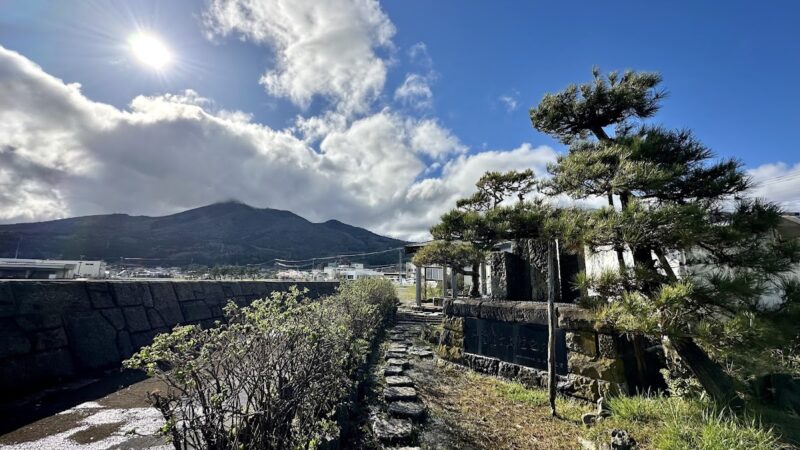
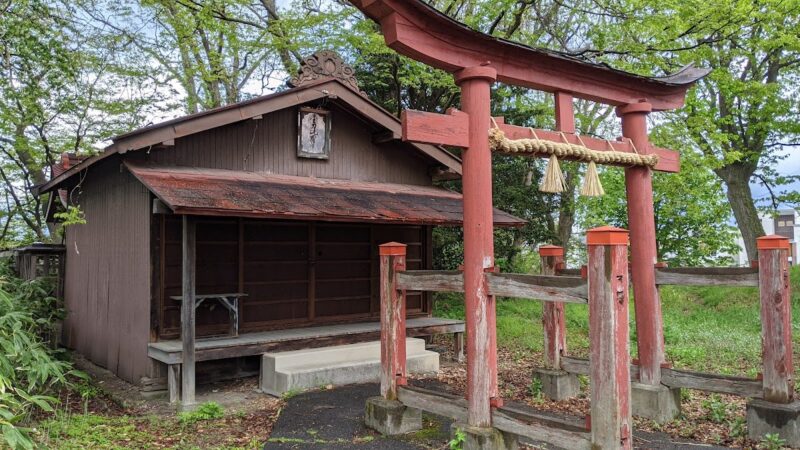
At the heart of the Watoku Castle ruins stands the Watoku Inari Shrine. This shrine is believed to be located on the site of the former castle’s main enclosure and serves as a major landmark when visiting the castle ruins.
Within the shrine grounds is a stone monument erected by local volunteers, commemorating Watoku Castle and indicating that this area was once a castle. Walking through the grounds, one can notice slight elevation changes, allowing one to imagine the layout of the former enclosures.
A river flows behind the shrine, giving a tangible sense of its function as a natural moat. Furthermore, remnants of what appear to be water channels surrounding the shrine grounds offer a glimpse into the castle’s defensive system.
Tsuchibuchi River and Water System
The Tsuchibuchi River, flowing opposite the Watoku Inari Shrine, was an important defensive element of Watoku Castle. This river is thought to have served as a natural outer moat protecting the castle.
Even today, the Tsuchibuchi River flows through Wadoku-cho, providing important clues to understanding the topographical features of the castle ruins. Walking along the river, one can appreciate how skillfully the castle was constructed utilizing water resources.
The arrangement of waterways and rivers suggests that Wadoku Castle was a flatland castle surrounded by a moat. In medieval castles, water was a vital resource not only for defense but also for daily life and agriculture.
Urbanization and Loss of Remains
Unfortunately, most of the remains of Wadoku Castle have been lost due to urban development since the modern era. Clear remains such as earthworks, stone walls, and building foundations no longer exist.
However, by paying attention to subtle topographical undulations, the arrangement of waterways, and the curves of roads, traces of the former castle can still be discerned. From the perspective of castle archaeology, the memory of the Middle Ages is etched into the modern urban landscape.
The town name itself, Wadoku-cho, is evidence that Wadoku Castle once stood in this area. Place names are important elements that convey historical memories, and the continued use of the name Wadoku demonstrates the region’s historical identity.
Access and Tourist Information for Wadoku Castle
This section summarizes practical information for visiting the Wadoku Castle ruins.
Access Methods
Access by Train:
- Approximately 15-20 minutes on foot from JR Hirosaki Station
- Head southeast from the station towards Wadoku-cho
- This is a relatively flat and easy route to walk.
Access by Bus:
- Take a Konan Bus from in front of Hirosaki Station
- Get off at the “Hon-Wadoku Community Center” bus stop and walk for approximately 5 minutes
- Bus services are limited, so it is recommended to check the timetable in advance.
Access by Car:
- Approximately 15 minutes from the Tohoku Expressway “Owani-Hirosaki IC”
- There is some parking space around Wadoku Inari Shrine, but priority is given to worshippers.
- Please also consider using nearby coin parking.
Points to Note When visiting Wadoku Castle Ruins, paying attention to the following points will allow you to feel the history more deeply:
- Wadoku Inari Shrine Grounds: Check the stone monument of the castle ruins and observe the elevation differences of the terrain.
- Tsuchibuchi River: Observe the river opposite the shrine and imagine its role as a natural moat.
- Waterways: Search for waterways around the shrine grounds and confirm traces of the moat.
- Surrounding Topography: Walk around the entire town and infer the topography from the time when the castle existed.
Nearby Tourist Spots
When visiting the Wadoku Castle Ruins, we recommend also visiting other historical spots in Hirosaki City.
Hirosaki Castle:
- A castle built by Oura Tamenobu (later Tsugaru Tamenobu) after the fall of Wadoku Castle.
- A valuable castle with an existing keep, and a nationally designated Important Cultural Property.
- Approximately 30 minutes on foot or 10 minutes by car from Wadoku Castle.
Ishikawa Castle Ruins:
- A castle in the Tsugaru region that existed at the same time as Wadoku Castle.
- One of the castles captured during Oura Tamenobu’s unification of Tsugaru.
Hirosaki City Museum:
- A facility where you can learn about the history of the Tsugaru region.
- Exhibits materials from the medieval to early modern periods.
Notes for Visitors
- Wadoku Inari Shrine is an active religious facility, so please observe proper etiquette as a visitor.
- Since very few remains are left, you will need to use your historical imagination.
- Photography is permitted, but please be considerate of the privacy of local residents.
- The ground may be slippery in rainy weather, so please wear appropriate footwear.
Wadoku Castle and the Medieval History of the Tsugaru Region
To understand the history of Wadoku Castle, it is important to know the medieval history of the entire Tsugaru region.
Powerful Clans of the Tsugaru Region
In the medieval Tsugaru region, several powerful clans vied for power. The Osanai, Ando, and Namioka-Kitabatake clans, among others, each had their own sphere of influence, but were all under the influence of the powerful Nanbu clan.
These clans each established their own castles and governed their regions. Wadoku Castle was one of them, and was the base of the Osanai clan in the Hirosaki area.
Oura Tamenobu’s Unification of Tsugaru
In the latter half of the 16th century, Oura Tamenobu actively pursued military action with the aim of unifying the Tsugaru region. Tamenobu’s strategy involved not only military force, but also diplomacy, stratagems, and marriage alliances—utilizing every means possible.
In 1571 (Genki 2), Tamenobu captured Ishikawa Castle, and subsequently took Wadoku Castle. Furthermore, in 1578 (Tensho 6), he captured Daikoji Castle, and in 1585 (Tensho 13), he captured Namioka Castle, achieving the unification of the Tsugaru region.
In this process, Watoku Castle was a crucial target in the early stages of the Tsugaru unification project. The fall of Watoku Castle was of great significance in establishing Tamenobu’s control over the Hirosaki area.
Succession to Hirosaki Castle
After achieving the unification of Tsugaru, Tamenobu initially used Oura Castle (the predecessor of the later Hirosaki Castle) as his base. However, in 1603 (Keicho 8), during the time of the second Tsugaru Nobuhira, construction of the current Hirosaki Castle began.
Hirosaki Castle is located very close to Watoku Castle and can be considered its successor both geographically and historically. While Watoku Castle was the residence of a medieval powerful family, Hirosaki Castle was built as the residence of a modern daimyo, a larger and more systematically structured castle.
The transition from Watoku Castle to Hirosaki Castle symbolizes the Tsugaru region’s transition from the medieval to the early modern period.
Keno-jiru and the Cultural Heritage of Watoku Castle
The historical value of Watoku Castle extends beyond its role as a military facility. It also possesses a cultural aspect related to the local dish “Keno-jiru.”
The History and Tradition of Keno-jiru
“Keno-jiru” is a representative local dish of the Tsugaru region of Aomori Prefecture. It is traditionally eaten during the Little New Year (January 15th), symbolizing a wish for good health and protection from illness throughout the year.
The ingredients include a wide variety of vegetables and wild plants such as daikon radish, carrots, burdock root, butterbur, bracken, fiddlehead ferns, konjac, fried tofu, and soybeans. These are finely chopped and simmered in miso, resulting in a nutritious and warming dish.
A characteristic of “Keno-jiru” is that the ingredients are chopped very finely. This is said to stem from the consideration that many people can equally enjoy a variety of ingredients.
Legends Related to Wadoku Castle
The legend that Wadoku Castle is the birthplace of “Keno-jiru” (a type of soup) lacks historical evidence, but it holds significant meaning as a part of the region’s cultural identity.
The setting of a meal during a siege demonstrates the ingenuity of using limited ingredients, symbolizing the wisdom of people who survived in the harsh climate and environment of Aomori Prefecture.
This legend positions Wadoku Castle not merely as a historical ruin, but as a living history connected to modern food culture.
“Keno-jiru” in Modern Times
Even today, many families in Aomori Prefecture make “Keno-jiru” during the Little New Year (January 15th). It’s such a deeply rooted local dish that supermarkets sell vegetable sets specifically for “Keno-jiru” around this time.
Some restaurants in Hirosaki City also serve “Keno-jiru,” providing tourists with an opportunity to experience the traditional flavors of Tsugaru. When visiting the Wadoku Castle ruins, we highly recommend trying “Keno-jiru” (a local soup).
Current Status and Challenges of Wadoku Castle Research
Research on Wadoku Castle faces many challenges due to the limitations of historical sources.
Limitations of Historical Sources
Contemporary historical sources concerning Wadoku Castle are extremely scarce. Currently, much of the information regarding the castle’s detailed structure, construction date, and the lineage of its lords relies on later local histories and traditions.
The main historical sources include local histories such as the “Tsugaru Ittōshi,” compiled during the Edo period. However, these also contain hearsay and speculation, and the information that can be definitively confirmed as historical fact is limited.
The Need for Archaeological Investigation
Archaeological excavation is effective in clarifying the actual state of Wadoku Castle, but large-scale investigations are difficult due to ongoing urbanization.
However, there is a possibility that emergency excavation surveys may be conducted in the event of future redevelopment. Such investigations are expected to reveal the castle’s structure and the realities of daily life that cannot be gleaned from historical documents.
Position in Regional History Research
Research on Wadoku Castle holds significant importance as part of the study of medieval history in the Tsugaru region. Understanding the realities of the castles that were conquered is essential for comprehending the process of Oura Tamenobu’s unification of Tsugaru.
In the future, it is expected that the historical position of Wadoku Castle will become clearer as comprehensive research is conducted on castles in the Tsugaru region, including Hirosaki Castle.
Summary
Wadoku Castle was a medieval castle located in Wadoku-cho, Hirosaki City, Aomori Prefecture. Built as the residence of the Koyamauchi clan, it played an important role in the history of the Tsugaru region until it was conquered by Oura Tamenobu during the Genki era.
Currently, almost no remains of the castle exist, but the topography and waterways around Wadoku Inari Shrine evoke the castle’s former appearance. Furthermore, the legend that this is the birthplace of the local dish “Keno-jiru” is an interesting element that connects the castle’s history to modern food culture.
Watoku Castle Ruins are accessible on foot from JR Hirosaki Station and can be visited along with other nearby tourist attractions such as Hirosaki Castle. Although there are few clearly identifiable remains, with a little historical imagination, one can envision the appearance of a medieval Tsugaru clan residence.
For those interested in the history of the Tsugaru region or those traveling to explore medieval Japanese castles, Watoku Castle Ruins is a worthwhile place to visit. When you visit Hirosaki City, be sure to stop by Watoku Inari Shrine and reflect on the castle that once stood on this site.