
Warabi Horikome Castle (Yotsukaido City, Chiba Prefecture) Complete Guide: A Thorough Explanation of History, Remains, and Access
Warabi Horikome Castle, located in Yotsukaido City, Chiba Prefecture, was an important medieval castle in Shimosa Province during the Sengoku period. Although much of the castle grounds have been lost due to urbanization, the remains preserved as the “Horikome Castle Ruins Green Space” offer insights into the castle’s construction techniques and strategic importance. This article provides a detailed explanation of Warabi Horikome Castle, from its historical background to the remaining structures and access methods.
Overview of Warabi Horikome Castle
Warabi Horikome Castle was a flatland castle located in Warabi, Yotsukaido City, Chiba Prefecture. Built on a plateau approximately 26 meters above sea level, it occupied a strategically important location overlooking the surrounding area. The castle’s dimensions are estimated to be approximately 200 meters east-west and 150 meters north-south, a standard size for a medieval local lord’s residence.
Alternative Names and Designations of the Castle
Warabi Horikomi Castle is also known as “Horikomi Castle” or “Warabi Castle.” The place name “Warabi” was formerly written as “Warabi” and is deeply related to the name of the castle’s lord, the Warabi clan. While some documents simply refer to it as “Horikomi Castle,” because there are several Horikomi Castles in Chiba Prefecture, the name “Warabi Horikomi Castle” is now more common.
History of Warabi Horikomi Castle
Construction and the Castle Lord, the Warabi Clan (Warabi Clan)
Warabi Horikomi Castle was built by the Warabi clan (Warabi clan), a branch of the Usui clan. The Usui clan was one of the leading powerful families in Shimosa Province, and their base was Usui Castle (present-day Sakura City). The Warabi clan, a branch of the Usui clan, was granted territory in Warabi and is believed to have built Horikomi Castle to govern this area.
While there are no clear records regarding the exact construction period, archaeological excavations have revealed that the castle was in use from the 14th to the 16th centuries. In particular, many artifacts from the late 15th to early 16th centuries have been unearthed, suggesting that this period was the castle’s peak.
The Conflict Between the Oyumi and Koga Shoguns
An essential aspect of understanding the history of Warabi Horikomi Castle is the conflict between the Oyumi Shogun and the Koga Shogun. During the late Muromachi period, the Ashikaga clan split in the Kanto region, leading to a conflict between the Koga Shogun, based in Koga, and the Oyumi Shogun, based in Oyumi, Shimosa Province (present-day Chuo Ward, Chiba City).
The appearance of Warabi Horikomi Castle in a letter from Ashikaga Yoshiaki, the Oyumi Shogun, to Satomi Yoshimichi indicates that this castle was an important base for the Oyumi Shogun’s forces. At the time, when attacking the Chiba clan of Hon-Sakura Castle, who were allied with the Koga Shogunate, Warabi Horikomi Castle is believed to have functioned as a front-line base for the Oyumi Shogunate forces.
The Defection of the Usui Clan and its Strategic Position
Originally, the Usui clan was subordinate to Ashikaga Takamoto, the Koga Shogunate, and the Sakura Chiba clan. However, in the early 16th century, they defected and joined the emerging Oyumi Shogunate forces. This political shift made Warabi Horikomi Castle an important military base for the Oyumi Shogunate forces when they were conquering the Katsushika district.
The area from Yotsukaido City to Sakura City lies on the border between the spheres of influence of the Koga Shogunate and the Oyumi Shogunate forces, and Warabi Horikomi Castle was right on the front lines. The castle’s location allowed it to monitor the direction of Hon-Sakura Castle, suggesting its crucial role in the military tensions.
The Fall of the Oyumi Shogunate and the Castle’s Future
In 1538 (Tenbun 7), when Ashikaga Yoshiaki, the Oyumi Shogun, was defeated and killed in the First Battle of Kōnodai against Hōjō Ujitsuna, the Oyumi Shogunate’s power rapidly declined. It is believed that this battle caused Warabi Horikomi Castle to gradually lose its strategic importance.
While there are no clear records of the castle’s subsequent history, it is presumed to have been abandoned by the end of the Sengoku period. By the Edo period, it had already lost its function as a castle and appears to have been used as farmland and a settlement.
Excavation Surveys and Archaeological Findings
Surveys from the Showa to Heisei Periods
Academic surveys of Warabi Horikomi Castle were conducted from 1980 (Showa 55) to 1990 (Heisei 2). These ten years of excavation surveys yielded valuable information regarding the castle’s structure and period of use.
The surveys confirmed the discovery of artifacts dating from the 14th to 16th centuries. Of particular note are the earthenware plates (kawarake), ceramic fragments, and iron artifacts, which provide insights into the lifestyle and trade relations of the castle’s inhabitants. The excavated ceramics include pieces from the Seto and Mino wares, as well as Chinese celadon and white porcelain, suggesting that the Warabi clan, the castle’s lords, possessed considerable economic power.
Clarification of the Castle Structure
The archaeological excavation has revealed the basic structure of Warabi Horikomi Castle. The castle cleverly utilized the plateau’s topography, with multiple enclosures arranged around the main enclosure.
A distinctive feature is its defensive structure, consisting of deep dry moats and high earthen ramparts. Some sections of the dry moats reached approximately 10 meters in width and 3-4 meters in depth, indicating a robust defensive structure for a medieval castle. Furthermore, the earthen ramparts are estimated to have reached a maximum height of approximately 3 meters, a structure that effectively prevented enemy intrusion.
Remains Visible Today
Development of Horikomi Castle Ruins Green Space
In 1986 (Showa 61), in response to requests from local residents for the preservation of Horikomi Castle, it was decided to preserve a portion of the castle ruins. Then, in 1991 (Heisei 3), it was officially established as the “Horikomi Castle Ruins Green Space,” and remains so to this day.
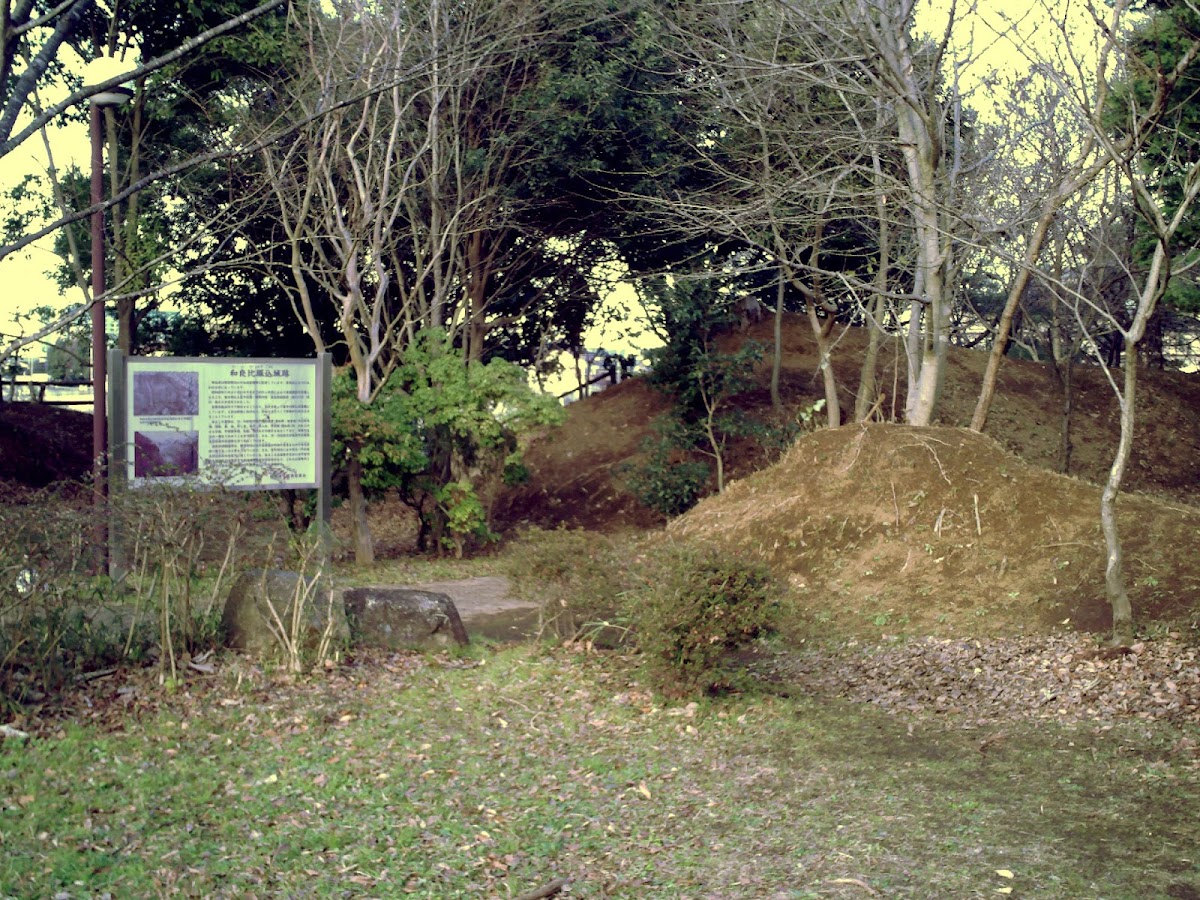
Although most of the castle grounds have been developed into residential areas due to urbanization, the preserved area of the Horikomi Castle Ruins Green Space allows for direct observation of valuable remains of a medieval castle. The green space is also used as a place for local history education and is designated as an important cultural property of Yotsukaido City.
Remains of Earthworks
The most impressive remains at the Horikomi Castle Ruins Green Space are the earthworks. Even today, earthworks approximately 2-3 meters high remain, and their scale demonstrates the high level of castle construction technology of the time. The top of the earthworks is flat, suggesting that it was used as a defensive passage or watchtower.
The earthworks were constructed using the rammed earth method, where layers of soil were compacted to create a strong structure. Observing the cross-section reveals layers of soil of different colors, indicating that planned civil engineering work was carried out.
Remains of the Dry Moat
Alongside the earthworks, the dry moat is another important remains. At the Horikomi Castle Ruins Green Space, a portion of the deep dry moat is well-preserved. The dry moat is approximately 8-10 meters wide and 3 meters deep, a typical medieval castle moat with a V-shaped cross-section.
The bottom of the dry moat is still clearly visible, and the cliffs on both sides (artificially carved steep slopes) are cut at a steep angle. This structure made it extremely difficult for enemies to cross the moat and invade.
Traces of the Unebori Moat
At the Horikomi Castle Ruins Green Space, traces of the Unebori moat can also be partially confirmed. A “unebori” is a special type of moat with ridge-like undulations at the bottom, a sophisticated castle-building technique from the Sengoku period designed to hinder enemy lateral movement. The unebori at Warabi Horikomi Castle is thought to have been influenced by the Odawara Hojo clan, making it a valuable historical site demonstrating the spread of 16th-century castle construction technology.
Layout of Enclosures
The current topography suggests that the castle consisted of a main enclosure and several secondary enclosures. The main enclosure was located at the highest point and was heavily defended by earthworks and dry moats. The secondary enclosures were arranged in a stepped fashion around the main enclosure, forming a multi-layered defensive structure.
Structure and Characteristics of Warabi Horikomi Castle
Location as a Hilltop Castle
Warabi Horikomi Castle is classified as a hilltop castle. A hilltop castle is a castle built on an isolated hill or plateau in a plain. While not as steep as a mountain castle, it possesses terrain that offers greater defensive advantages than a flatland castle.
From Warabi Horikomi Castle, located on a plateau approximately 26 meters above sea level, a wide view of the surrounding plains was possible. It was an excellent location for monitoring the Sakura area to the north and the Chiba area to the west, and it is believed to have functioned as a military intelligence gathering base.
Characteristics of the Castle Layout
The layout (design and arrangement) of Warabi Horikomi Castle exhibits characteristics typical of medieval castles in the Kanto region from the 15th to 16th centuries. Defensive lines are arranged concentrically around the main enclosure, with multiple layers of defense consisting of dry moats and earthen ramparts.
The east and south sides of the castle had relatively gentle slopes, and particularly robust defensive structures were built there. On the other hand, the north and west sides utilized the natural steep slopes, and artificial defensive structures appear to have been relatively simple. This clever use of terrain demonstrates the rational design philosophy of medieval castles.
Water Supply
One of the important elements of a castle is the supply of water. At Warabi Horikomi Castle, it has been suggested that a well may have been dug on the plateau, but no clear remains have been confirmed. However, there are springs in the vicinity of the castle, and it is thought that these were likely utilized.
Historical Background and Related Castles
Relationship with Usui Castle
Understanding Warabi Horikomi Castle is crucial to understanding its relationship with Usui Castle, the base of the main Usui clan. Usui Castle is located in present-day Usui, Sakura City, approximately 8 kilometers northeast of Warabi Horikomi Castle.
Usui Castle was a large fortress built on a plateau overlooking Lake Inba, and is known for repelling attacks by Uesugi Kenshin during the Sengoku period. The Warabi clan, as a branch of the Usui clan, played a role in protecting the southern edge of the Usui clan’s sphere of influence, centered around Usui Castle.
Positional Relationship with Hon-Sakura Castle
Approximately 6 kilometers west of Warabi Horikomi Castle was Hon-Sakura Castle, the base of the Chiba clan, the Shimosa provincial governor. Hon-Sakura Castle was a large fortress spanning present-day Shisui Town and Sakura City, and was the center of power for the Chiba clan.
During the conflict between the Oyumi Shogunate and the Koga Shogunate, the Chiba clan of Hon-Sakura Castle sided with the Koga Shogunate, making them enemies of Warabi Horikomi Castle, which belonged to the Oyumi Shogunate. The distance between the two castles was only about 6 kilometers, clearly indicating the important role Warabi Horikomi Castle played as a front-line base.
Power Structure in Shimosa Province during the Sengoku Period
The first half of the 16th century in Shimosa Province was a period of turmoil, with multiple forces intricately clashing and forming alliances. Many forces, including the Koga Shogunate, the Oyumi Shogunate, the Chiba clan, the Satomi clan, and the Hojo clan who had advanced from Sagami Province, vied for supremacy.
The area where Warabi Horikomi Castle is located lies on the border between these forces, occupying an extremely important political and military position. The Warabi clan, the lords of the castle, are believed to have continuously protected their territory while changing their allegiances in response to the changing times.
Highlights of Warabi Horikomi Castle
Preserved Medieval Civil Engineering Techniques
The greatest highlight of the Horikomi Castle Ruins Green Space is the opportunity to directly observe civil engineering techniques from over 500 years ago. It is astonishing to see the technical skill required to construct such a large-scale earthwork and dry moat using only human power, in an era without modern heavy machinery.
Observing the cross-section of the earthworks, you can see traces of the rammed earth construction method, where different types of soil were layered alternately to increase strength. Furthermore, the angle and shape of the dry moat’s cliffs reveal ingenious designs designed to efficiently prevent enemy intrusion.
Panoramic Views of Yotsukaido City
Because the Horikomi Castle Ruins Green Space is located on a plateau approximately 26 meters above sea level, it offers panoramic views of the surrounding area. In particular, the southern side offers a panoramic view of the city around Yotsukaido Station, providing an interesting landscape where the modern cityscape contrasts with the medieval castle ruins.
On a clear day, you can see as far as Tokyo Bay, giving you a real sense of how strategically important this location was during the Sengoku period (Warring States period). The former castle lords likely monitored the surrounding area from this vantage point.
A Quiet Historical Walking Spot
Horikomi Castle Ruins Green Space is a small park located within a residential area. It’s relatively uncrowded, making it a quiet spot to experience history. In the modern, urbanized city of Yotsukaido, it’s a valuable space that retains traces of the medieval era.
Information boards are installed within the green space, allowing you to learn about the castle’s history and structure. Furthermore, walking paths are maintained, making it safe to observe the remains.
Access Information
Access by Train
The nearest station to Warabi Horikomi Castle Ruins is Yotsukaido Station on the JR Sobu Main Line and Narita Line. Yotsukaido Station is also served by the Sobu Rapid Line, making it easily accessible, approximately 45 minutes from Tokyo Station and 10 minutes from Chiba Station.
It’s about a 5-10 minute walk from the south exit of Yotsukaido Station to the Horikomi Castle Ruins Green Space. Exit the station and head south; after passing through a residential area, you’ll arrive at the green space. The route is somewhat complicated, but using a smartphone map app should allow you to arrive without getting lost.
Access by Car
If you’re visiting by car, it’s about a 10-minute drive from the Yotsukaido Interchange on the Higashi-Kanto Expressway. However, there is no dedicated parking lot at the Horikomi Castle Ruins Green Space, so we recommend using nearby coin-operated parking lots or parking near Yotsukaido Station and walking.
Address and Map Information
Address: Around 254-1 Warabi, Yotsukaido City, Chiba Prefecture
The Horikomi Castle Ruins Green Space is also known as “Warabi Horikomi Castle Ruins Plaza.” Since it’s located in a residential area, first-time visitors should search for “Horikomi Castle Ruins Green Space” or “Warabi Horikomi Castle” on a map app to find it.
Points to Note When Visiting
Visiting Hours
Horikomi Castle Ruins Green Space is open as a park and is generally accessible all day. However, there is no lighting at night, so we recommend visiting during daylight hours.
Clothing and Items to Bring
Since you will be walking through the green space to observe the ruins, we recommend wearing comfortable shoes. Particular caution is needed after rain, as the ground can become slippery.
In summer, there are many insects such as mosquitoes, so insect repellent is recommended. Also, since there is little shade, it is a good idea to bring a hat and sunscreen.
Manners and Rules
Horikomi Castle Ruins Green Space is located in a residential area. Please be quiet during your visit so as not to disturb the nearby residents. Also, to protect the ruins, please refrain from climbing on the earthworks or moats, and from collecting plants.
Please be sure to take your trash with you and visit with an awareness of preserving the historical site.
Nearby Tourist Attractions
Historical and Cultural Facilities in Yotsukaido City
When visiting the Warabi Horikomi Castle Ruins, it’s a good idea to also explore other historical sites in Yotsukaido City. The Yotsukaido City Cultural Center sometimes holds exhibitions on the city’s history.
Castles in Sakura City
If you have time, visiting the castles in the nearby city of Sakura is also recommended. Usui Castle Ruins and Hon-Sakura Castle Ruins have deep historical ties to Warabi Horikomi Castle, and visiting them together will give you a deeper understanding of the situation in Shimosa Province during the Sengoku period.
In particular, Hon-Sakura Castle Ruins are designated as a national historic site, and large-scale remains are well-preserved. It’s about a 15-minute drive from Warabi Horikomi Castle and is a must-see spot for medieval castle enthusiasts.
Sakura Castle Ruins Park
The ruins of Sakura Castle from the Edo period are also a highlight. It has been developed as Sakura Castle Ruins Park, and remains such as earthworks and dry moats remain on the vast grounds. Known as a famous cherry blossom viewing spot in spring, it offers the opportunity to enjoy historical walks and seasonal scenery simultaneously.
Research on Warabi Horikomi Castle and Future Challenges
Unexplained Historical Facts
Many historical facts about Warabi Horikomi Castle remain unexplained. In particular, the details of how the Oyumi Shogunate forces expanded their influence to the area around Warabi Village, and the subsequent fate of the Warabi clan, are unclear due to a lack of historical records.
It is hoped that these mysteries will be solved through the discovery of new historical materials and archaeological investigations in the future.
Balancing Preservation and Utilization
The Horikomi Castle Ruins Green Space is a valuable historical heritage site, but its location in an urban area makes balancing preservation and development a constant challenge. Currently, only a small portion of the entire castle grounds is preserved; while wider preservation is desirable, this is realistically difficult.
On the other hand, utilizing the preserved remains for education and tourism, and enhancing their value as a regional historical resource, is also important. In Yotsukaido City, efforts to utilize the ruins continue, including the installation of explanatory signs and the development of viewing paths.
Digital Restoration
In recent years, the restoration of castles using digital technology has been carried out in various locations. If a project to recreate the appearance of Warabi Horikomi Castle in its heyday using CG and VR, based on excavation data and topographical information, is realized, it will be possible to convey the value of the castle to a wider audience.
Summary: The Historical Value of Warabi Horikomi Castle
Although most of Warabi Horikomi Castle has been lost due to urbanization, the remaining structures are a valuable historical site that allows us to learn about the history of Shimosa Province during the Sengoku period. As the residence of the Warabi clan, a branch of the Usui clan, and as a front-line base for the Oyumi Shogunate forces, this castle played an important role in the history of the region.
The earthworks and dry moats preserved as the Horikomi Castle Ruins Green Space are a valuable legacy that conveys medieval castle construction techniques to the present day. Located within walking distance of Yotsukaido Station, this site offers a tranquil space steeped in history, cherished by local residents and history enthusiasts alike.
Through the history of Warabi Horikomi Castle, one can learn about the historical background of the conflict between the Oyumi and Koga Shogunates, the relationship between the Usui and Chiba clans, and the complex political situation in Shimosa Province during the Sengoku period.
When visiting Chiba Prefecture, we highly recommend a visit to the Warabi Horikomi Castle ruins, where you can reflect on history from over 500 years ago. These medieval remains, preserved amidst the modern cityscape, will surely speak to us across time.
Reference Information and Related Links
For more detailed information about Warabi Horikomi Castle, we recommend consulting cultural property materials published by the Yotsukaido City Board of Education and specialized books on medieval castles in Chiba Prefecture. The Yotsukaido City website also publishes information on cultural properties within the city.
Information about Warabi Horikomi Castle can also be found on specialized castle research websites and organizations such as the Japan Castle Association. Preparing by reading these resources before your visit will make for a more fulfilling experience.
By learning about the historical background surrounding Warabi Horikomi Castle—including the history of Shimosa Province during the Sengoku period, the activities of the Usui and Chiba clans, and the conflict between the Oyumi and Koga Shoguns—you can understand the great historical significance of this small castle site. Warabi Horikomi Castle teaches us the importance of cherishing local history and passing it on to future generations.


