Wakakuri Castle (Kurobe City) Complete Guide: A Flatland Castle in Etchu Province with Legends of a Female Warrior and Remaining Earthworks
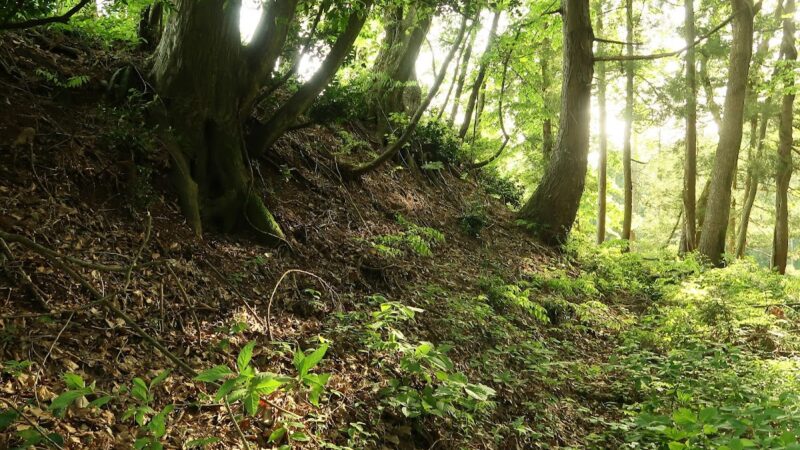
Located in Wakakuri, Kurobe City, Toyama Prefecture, Wakakuri Castle is a flatland castle that functioned as a strategic point in Etchu Province from the Nanboku-cho period to the Sengoku period. Also known as “Yate no Shiro” or “Wakakuri-kan,” it was built at a key transportation hub along the old Hokuriku Highway on the left bank of the Kurobe River. Currently, it is maintained as a park, and the earthworks, reaching approximately 5 meters in height, still convey its original appearance.
History and Lords of Wakakuri Castle
Construction during the Nanboku-cho Period
There are various theories regarding the construction period of Wakakuri Castle, but according to tradition, it was built during the Nanboku-cho period by Fuaku Bonsai Ukyonosuke. Taking advantage of its geographical location on the left bank of the Kurobe River, it functioned as a base for monitoring and defending the Hokuriku Highway.
Excavations have unearthed pottery from Suzu, Echizen, Etchu-Seto, and Imari ware, confirming that the castle was actively used during the Sengoku period (Warring States period). Stone rows used to reinforce the foundations of the earthworks and stone paving related to buildings have also been discovered, providing valuable information about the castle’s structure at the time.
Battles in the Sengoku Period
During the Sengoku period, Wakakuri Castle functioned as an important military base in Etchu Province. Records suggest it was a castle owned by the Jinbo clan, and it is said that Soda Tarozaemon fought against the Uesugi forces as the castle lord and died in battle. However, the specific timing and details of this battle remain unclear due to a lack of historical records.
The Legend of Uesugi Kenshin and a Female Warrior
The Female Warrior Who Catched and Shot Back Arrows
The most famous story surrounding Wakakuri Castle is the legend of a female warrior during Uesugi Kenshin’s invasion of Etchu Province. According to legend, when Uesugi Kenshin attacked Wakakuri Castle, a female warrior, said to be either the wife or daughter of Fuaku Bonsai Ukyosuke, displayed an astonishing skill: she used a bamboo tube made from the castle’s earthworks to catch arrows fired by the Uesugi forces and then shot them back.
This female warrior led the defense of the castle, displaying a miraculous feat of catching incoming arrows by quickly turning them sideways and firing them back the moment they passed through the bamboo tube. It is said that the Uesugi forces were unexpectedly put in a difficult position by this unforeseen resistance.
The Capture and Fall of the Castle Using Sedge Arrows
Upon learning of the female warrior’s exploits, Uesugi Kenshin changed his tactics and launched an attack using sedge arrows, which are faster and more powerful than regular arrows. Even the formidable female warrior could not cope with the speed of the sedge arrows and was ultimately killed in battle.
Upon hearing the news of the female warrior’s death, the castle lord, Fuaku Bonsai Ukyonosuke, realized his defeat and committed suicide, and Wakakuri Castle fell into the hands of the Uesugi forces. While little of this legend can be confirmed as historical fact, it remains a deeply rooted local story that continues to be told.
Structure and Scale of Wakakuri Castle
Basic Structure of the Castle
Wakakuri Castle is a typical flatland castle, with a site approximately 100 meters east-west and 80 meters north-south. The castle’s structure is rectangular, surrounded by a moat and earthen ramparts. The ramparts are arranged in a U-shape, enclosing the castle on the north, west, and south sides, with a distinctive open design on the east side.
This structure takes advantage of the topography on the left bank of the Kurobe River, suggesting that the natural terrain on the east side was used for defense. Furthermore, its location facing the old Hokuriku Highway indicates the castle’s important role in monitoring traffic and managing the distribution of goods.
Characteristics of the Existing Earthworks
The greatest highlight of Wakakuri Castle is the earthworks that still remain today. The surrounding earthworks are massive, approximately 5 meters high and 10-20 meters wide, and are remarkably well-preserved as a defensive structure from the Sengoku period (Warring States period). While some sections are lower, around 2 meters in height, the overall structure retains much of its original appearance.
A row of stones is arranged at the base of the earthworks, which is thought to be a measure to increase the strength of the earthworks. The confirmation of this stone row during archaeological excavations revealed that it was not merely an earthen mound, but a strategically designed defensive structure.
Layout of the Castle and Building Remains
Archaeological excavations have uncovered stone paving related to buildings, indicating that multiple buildings were located within the castle grounds. Based on the excavated pottery, it is presumed that the castle lord’s residence, soldiers’ quarters, and storage facilities for supplies were present.
Unfortunately, an irrigation canal now runs through the center of the castle site, partially destroying it. However, when the site was developed as a park, efforts were made to preserve the castle ruins, and the remains of the earthworks and moats were protected as much as possible.
Current Status and Highlights of Wakakuri Castle Ruins
Development as a Park
Currently, Wakakuri Castle Ruins has been developed as a park and serves as a place of relaxation for local residents. A castle site monument and detailed information boards have been installed, allowing visitors to learn about the castle’s history and structure. Walking paths are maintained within the park, allowing visitors to experience the scale of the castle at the time while walking around the earthworks.
In spring, the cherry blossoms bloom beautifully, making it a popular spot for cherry blossom viewing. The best time to see them is usually from April 10th to April 14th, attracting many tourists and locals. The scenery created by the cherry blossoms and earthworks is a unique charm of Wakakuri Castle Ruins, where history and nature harmonize.
Value as a City-Designated Cultural Property
Wakakuri Castle Ruins were designated as a historical site of Kurobe City on July 11, 1955, and are protected as an important cultural property of the region. Known locally as “Tachinoshiro,” this site is an indispensable location when discussing the history of Kurobe City.
Its cultural value lies not only in the physical aspect of the remaining earthworks, but also in its academic value for understanding the castle structure of the Sengoku period in Etchu Province, and its significance as a place for transmitting regional history and culture, exemplified by the legend of the female warrior.
Points to Note When Visiting Wakakuri Castle Ruins
The following are points to note when visiting Wakakuri Castle Ruins:
- Height and Scale of the Earthworks: The earthworks, approximately 5 meters high and 10-20 meters wide, are impressive. Climbing onto the earthworks allows you to experience the scale of the defensive facilities at the time.
- U-Shaped Arrangement: Examining the arrangement of the earthworks surrounding the castle on the north, west, and south sides, and considering the topography to understand why the east side is open, will deepen your understanding.
- Castle Site Monument and Information Board: Detailed historical information is provided, allowing you to learn about the castle’s history and structure.
- Surrounding Landscape: Understanding its location on the left bank of the Kurobe River and its relationship to the old Hokuriku Highway reveals its importance as a transportation hub.
The visit takes approximately 20-30 minutes, but we recommend allocating more time if you wish to carefully observe the earthworks or explore the surrounding area.
Access and Visiting Information
Access by Public Transportation
Using the Toyama Chihō Railway Main Line
- Nearest Stations: Shizuyama Station or Wakakuri Station
- Approximately 10-minute walk from Shizuyama Station
- Also within walking distance from Wakakuri Station (approximately 10-15 minutes)
The Toyama Chihō Railway Main Line is a convenient route for accessing the Kurobe area from Toyama City. It is also relatively close to Dentetsu Kurobe Station and Shin-Kurobe Station.
If using the Hokuriku Shinkansen
- Located approximately 250 meters from Kurobe-Unazuki Onsen Station, accessible on foot.
- Convenient access from the Shinkansen station makes it easy to visit from outside the prefecture.
Access by Car
If using the Expressway
- Approximately 1 kilometer south from the Kurobe Interchange on the Hokuriku Expressway.
- Travel time: Approximately 5 minutes
- Parking: Parking spaces available around the park (we recommend checking details on-site).
Access from the Kurobe Interchange is excellent, making it convenient to visit by car. Searching for “3737 Wakakuri, Kurobe City, Toyama Prefecture” or “Wakakuri Castle Ruins” on your car navigation system will display the location.
Notes for Visitors
- Admission Fee: Free (Open as a park)
- Visiting Hours: No specific restrictions (Daytime visits are recommended as it is a park)
- Facilities: Castle ruins monument and information boards are installed.
- Best Time to Visit: The spring cherry blossom season (early to mid-April) is especially recommended, but visits are possible throughout the year.
Nearby Tourist Attractions
Chōanji Temple and Chōanji Manor Ruins
Located approximately 400 meters from the Wakakuri Castle ruins, Chōanji Temple is a historical temple, and the Chōanji Manor Ruins remain nearby. It has been suggested that the Chōanji Manor may have been a facility related to Wakakuri Castle, and visiting both together will deepen your understanding of the region’s history.
Zennenji Temple
Zennenji Temple, located further from Chōanji Temple, is also an important temple for understanding the history of the Wakakuri area. It is included in the Wakakuri area cherry blossom viewing course, allowing you to enjoy historical walks and nature appreciation simultaneously.
Matsuzakura-kaku
Located approximately 600 meters from Kurobe-Unazuki Onsen Station, Matsuzakura-kaku is a facility you can stop by on your way to the Wakakuri Castle Ruins. It offers a chance to experience the culture and history of Kurobe City.
Recommended Walking Course
Wakakuri Historical Walking Course (Total distance approximately 2.5 kilometers)
- Kurobe-Unazuki Onsen Station (Start)
- Matsuzakura-kaku (600 meters)
- Wakakuri Castle Ruins (700 meters)
- Chōanji Temple (400 meters)
- Zennenji Temple (Goal)
This course can be completed on foot in approximately 1 to 1.5 hours, allowing you to efficiently experience the history and culture of the Wakakuri area. Especially during cherry blossom season, you can enjoy beautiful cherry blossoms at various locations, making it a popular route to enjoy both historical sightseeing and cherry blossom viewing.
Historical Significance of Wakakuri Castle
A Typical Example of a Flatland Castle in Etchu Province
Wakakuri Castle holds an important position in castle research as a typical example of a flatland castle in Etchu Province. In the medieval period, when mountain castles were dominant, castles built on flat land were designed with an emphasis on economic and administrative functions such as securing transportation routes and accumulating supplies. Wakakuri Castle clearly exhibits these characteristics.
Its location on the left bank of the Kurobe River, its position facing the old Hokuriku Highway, and its rectangular layout make it a valuable example for understanding the functions of flatland castles. The scale and arrangement of the earthworks provide insight into the level of castle construction technology at the time.
Uesugi Kenshin’s Invasion of Etchu and Local History
Uesugi Kenshin’s invasion of Etchu Province is a significant historical event in the Hokuriku region during the Sengoku period. While the legend of a female warrior at Wakakuri Castle has limited historical evidence, it suggests fierce battles between the Uesugi forces and local powers.
This legend is not merely a fictional tale, but rather a testament to the memories of warfare experienced by the local people, passed down through generations. The fact that women participated in the castle’s defense is an interesting element that suggests the realities of castle defense during the Sengoku period (Warring States period).
Local Community and Castle Ruins Preservation
The fact that Wakakuri Castle Ruins have been preserved in such good condition to this day is a testament to the continuous protection efforts of the local community. Since its designation as a city-designated cultural property in 1955, the site has been developed as a park while simultaneously being preserved as a historical heritage site.
Locally, it is affectionately known as “Tachinoshiro” and is a popular place of relaxation for many residents during the cherry blossom season in spring. This example of historical heritage being preserved in harmony with modern life serves as a valuable reference when considering how to protect cultural properties.
How to Enjoy Wakakuri Castle Ruins
Points of Interest for History Enthusiasts
For castle enthusiasts and history researchers, Wakakuri Castle Ruins is an interesting place for the following reasons:
- Structural Analysis of Earthworks: You can actually observe earthworks measuring 5 meters high and 10-20 meters wide, and learn about castle construction techniques.
- Study of the Castle Layout: You can consider the design philosophy of the U-shaped earthwork arrangement and the open east side in conjunction with the topography.
- Comparison with Excavated Artifacts: You can infer the period of use and daily life at the castle from the information on excavated ceramics listed on the information boards.
- Connection with Surrounding Castles: By visiting nearby castle ruins such as Chōanji Castle, you can understand the regional castle network.
How to Enjoy with Family
Wakakuri Castle Ruins is also suitable for family visits:
- Use as a Park: You can safely learn about history on the well-maintained walking paths.
- Cherry Blossom Viewing: In spring, you can enjoy a picnic under the beautiful cherry blossoms.
- Climbing the Earthworks: Children can climb the earthworks and play, naturally experiencing the castle’s structure.
- History Education: This provides an opportunity for parents and children to learn about history using the information boards.
Photography Tips
Wakakuri Castle Ruins are also a suitable place for photography:
- Panoramic View of the Earthworks: Find an angle that shows the height and scale of the earthworks.
- Collaboration of Cherry Blossoms and Earthworks: In spring, you can photograph cherry blossoms and the earthworks together.
- Castle Site Monument: Record the castle site monument as evidence of history.
- Surrounding Scenery: Photographing with the Kurobe River and the surrounding rural landscape is also recommended.
History and Culture of the Wakakuri Area
The Wakakuri area is a region with a rich history and culture, not just the Wakakuri Castle Ruins. It developed as an agricultural area blessed by the Kurobe River and flourished as a transportation hub along the Hokuriku Highway.
Historical temples such as Chōanji and Zennenji are scattered throughout the area, each conveying the history of the region to the present day. Furthermore, Wakakuri Station on the Toyama Chihō Railway Main Line functions as a gateway to the region and maintains its character as a transportation hub even today.
Local information websites such as the Wakakuri Sightseeing Guide introduce local attractions, including the Wakakuri Castle Ruins, allowing for a more fulfilling stroll if checked before visiting. Information on cherry blossom blooming seasons is also provided, which can help you choose the best time to visit.
Summary: The Charm of Wakakuri Castle Ruins
Wakakuri Castle Ruins in Kurobe City, Toyama Prefecture, is a valuable historical site that preserves the appearance of a flatland castle from the Sengoku period. The three main attractions of this castle ruin are the earthen ramparts reaching 5 meters in height, the legend of a female warrior who fought against Uesugi Kenshin, and the beautiful scenery created by the cherry blossoms in spring.
Its easy accessibility, being within walking distance of Kurobe Unazuki Onsen Station and approximately 1 kilometer from the Kurobe Interchange on the Hokuriku Expressway, is another point that makes it easy to visit. Since it is free to visit and accessible year-round, it is a must-see spot when visiting Toyama Prefecture.
For history enthusiasts, it’s a site of interest for castle research; for families, it’s a park where they can enjoy historical learning and nature walks; and for local residents, it’s a place to remember their ancestors’ history. Wakakuri Castle Ruins hold diverse values.
When visiting Kurobe City, why not experience the history of Etchu Province at Wakakuri Castle Ruins, imagine the brave figure of the female warrior, and walk along the earthen ramparts that still stand today? Visiting the nearby Chōanji and Zennenji temples in conjunction with the castle ruins will allow you to experience the region’s history and culture more deeply.