
Ushiku Castle (Ibaraki Prefecture) Complete Guide: The Residence of the Okami Clan and the Remains of Hojo-style Castle Construction Techniques
Located in Jōchū, Ushiku City, Ibaraki Prefecture, Ushiku Castle is a flatland castle that played an important role as a strategic point in southern Hitachi Province during the Sengoku period. Utilizing Lake Ushiku as a natural moat and incorporating Hojo-style castle construction techniques, this castle was the stage for fierce battles between the Okami clan and the Tagaya and Satake clans.
Overview of Ushiku Castle
Ushiku Castle was a Japanese castle located in Jōchū, Ushiku City, Ibaraki Prefecture, built on a plateau jutting out into Lake Ushiku. Surrounded on three sides by the lake, it was a natural stronghold with a large-scale outer defense extending approximately 800 meters east-west and 1 kilometer north-south.
The castle’s location was strategically crucial, situated on the border between the Satake clan’s sphere of influence and the Oda/Hojo clan’s spheres of influence in southern Hitachi Province. Therefore, it is known as a castle where fierce battles were fought throughout the Sengoku period. Although much of the castle site has now been developed into residential land, some remains of the main baileys, such as the main keep, second bailey, and third bailey, as well as dry moats and earthworks, still exist, allowing us to imagine the layout of the castle at the time.
History and Development of Ushiku Castle
Construction History
Ushiku Castle was built in the latter half of the Tenbun era (around 1550) by the Okami clan, a powerful local family. The construction was prompted by the threat posed by the southward advance of the Satake clan, who had been expanding their power from the north.
The Okami clan was a branch of the Oda clan, and the “Oda Ujiharu Allied Land and Advantage Memorandum,” included in the “Uesugi Family Documents” from 1566, records it as the castle of “Okami Yamashiro-no-kami.” This document confirms that Ushiku Castle was the residence of the Okami clan.
Relationship with the Hojo Clan
The Okami clan came under the control of the Hojo clan of Sagami Province and, under their protection, confronted the Tagaya clan (who were allied with the Satake clan) and the Satake clan itself. As part of their expansion of power in the Kanto region, the Hojo clan sought to strengthen their influence over southern Hitachi Province, and Ushiku Castle was an important front-line base for them.
During this period, the Hojo clan dispatched castle guards to protect the border, strengthening Ushiku Castle’s defenses. It is believed that Hojo-style castle construction techniques were incorporated during this time, and the influence of the Hojo clan can be seen in the overall fortifications and complex layout of the baileys.
The Downfall of the Okami Clan and the Transfer of Hojo-Clan Castles
The Okami clan was gradually cornered by fierce attacks from the Tagaya clan (lords of Shimotsuma Castle), who were allied with the Satake clan. A fierce battle raged between the two sides across Ushiku Marsh, plunging the region into the vortex of war.
Ultimately, the Okami clan was destroyed, and Ushiku Castle became entirely under the control of the Hojo clan. The Hojo clan further strengthened the castle’s defenses, maintaining it as a frontline base against the Satake clan’s forces.
Toyotomi Hideyoshi’s Odawara Campaign and Surrender
In 1590 (Tensho 18), Toyotomi Hideyoshi launched the Odawara Campaign, resulting in the downfall of the Hojo clan. It is said that Ushiku Castle surrendered without a battle at this time.
After the fall of the Hojo clan, Yura Kunishige became the lord of Ushiku Castle. Yura Kunishige was a member of the Yura clan, who were lords of Kanayama Castle in Kozuke Province, and under the Toyotomi regime, he came to rule a part of Hitachi Province.
Abandonment of the Castle
In 1623 (Genna 9), Ushiku Castle was abandoned. This was a period when many castles were abandoned due to the “One Castle Per Province” decree in the early Edo period and the establishment of the shogunate system, and Ushiku Castle was no exception.
Subsequently, the Ushiku Jinya (administrative office) was established in this area, serving as the administrative center throughout the Edo period.
Structure of Ushiku Castle
Characteristics of the Castle’s Layout
The most distinctive feature of Ushiku Castle is that it is a flatland castle that utilized Ushiku Marsh as a moat on its southern side. The main baileys, including the Honmaru (main keep), were positioned on a peninsula-shaped plateau surrounded on three sides by the marsh, making it difficult to attack.
The castle as a whole had a comprehensive defensive structure extending approximately 800 meters east-west and 1 kilometer north-south, designed to defend the entire castle town. This comprehensive defensive structure is characteristic of Hojo-style castle construction techniques, indicating a strong influence from the Hojo clan.
Honmaru (Main Keep)
The Honmaru is located at the tip of the plateau that juts out most into Ushiku Marsh. It is surrounded on three sides by the marsh, and a deep dry moat was dug on the northern side, which is connected to the land.
The Honmaru is relatively small in scale, suggesting it served more as a final defensive stronghold than as a residential area. Although the area is now developed into residential land, the topography allows us to infer its appearance in the past.
Second Bailey
The Second Bailey was located north of the Main Bailey. A dry moat separated the Main Bailey and the Second Bailey, and it is presumed that they were connected by an earthen bridge.
The Second Bailey was larger than the Main Bailey and is thought to have housed the lord’s residence and the residences of senior retainers. Even today, some earthworks and terrain undulations remain, allowing us to confirm the boundaries of the bailey.
Third Bailey
The Third Bailey extended further north and was positioned to surround the central part of the castle. It is presumed that the Third Bailey contained the residences of retainers, warehouses, stables, and other facilities.
A moat of the outer fortification surrounded the Third Bailey, creating a structure that defended the entire castle town. This outer fortification is a characteristic structure of Hojo clan castles and serves as evidence that Ushiku Castle incorporated Hojo-style castle construction techniques.
Lower Bailey
Lower baileys were positioned around the Main Bailey and the Second Bailey. The lower enclosures (koshikuruwa) were secondary enclosures designed to defend the main enclosures, serving to attack enemies from the flanks and make it difficult for them to approach the main enclosure.
The lower enclosures of Ushiku Castle were built on slopes facing a marsh, strengthening defenses against attacks from the water’s edge.
Dry Moats and Earthen Bridges
Deep dry moats were dug between each enclosure, restricting movement between them. The dry moats were wide and deep, making them difficult to cross.
Earthen bridges were used for communication between enclosures. These bridges were strategically important defensive points; defending them prevented enemy incursions. Traces of some dry moats and earthen bridges still remain today.
Highlights of Ushiku Castle
Status of the Remains
Nearly 400 years have passed since Ushiku Castle was abandoned, and much of the site has been developed into residential land. Nevertheless, it remains a valuable historical site where the remains of a Sengoku period castle can still be seen.
The area around the main keep, some of the dry moats, and earthworks are relatively well-preserved, allowing visitors to experience the original layout. Visiting the site also deepens your understanding of the relationship between Ushiku Marsh and the castle ruins.
Photo Spots
The following locations are recommended photo spots when visiting Ushiku Castle:
View from Ushiku Marsh: Looking at the castle ruins from the opposite shore of Ushiku Marsh, the strategic location surrounded by the marsh on three sides is clearly evident. The peninsula-shaped terrain where the main keep once stood is particularly visible.
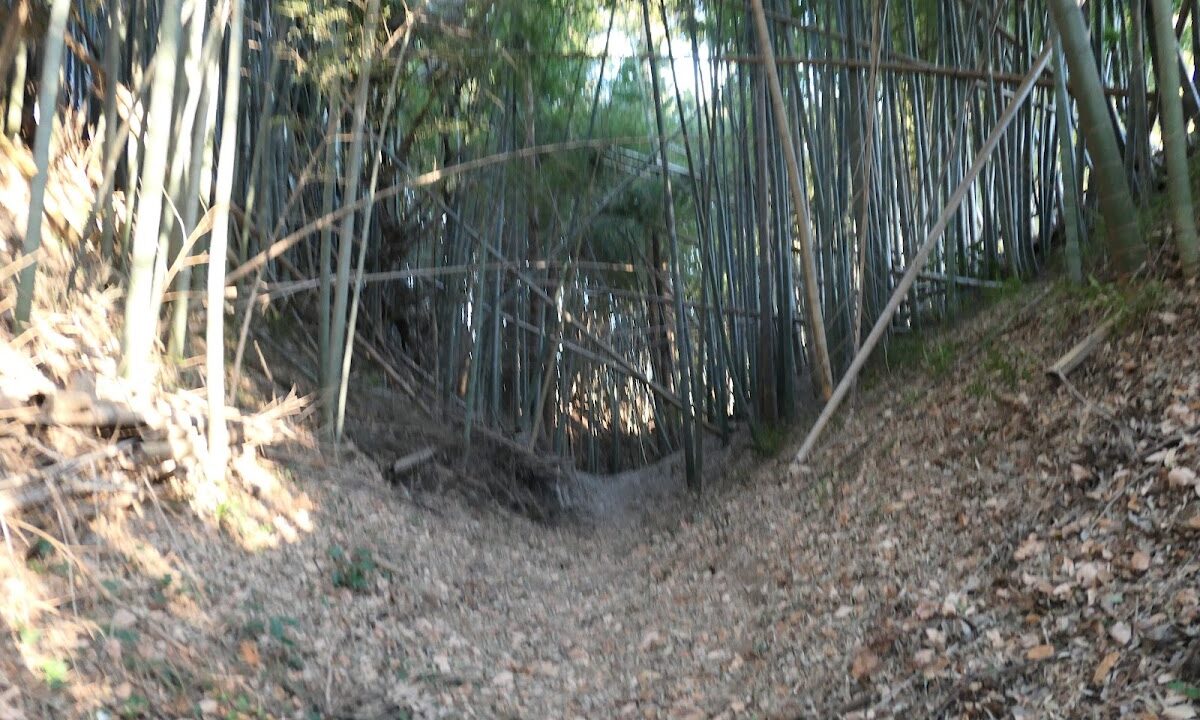
Remains of the Dry Moat: The remaining dry moat is deep and wide, making it an impressive defensive structure for a Sengoku period castle. The height of the earthworks viewed from the bottom of the moat is also a good photo opportunity.
Around the Main Keep: Although now a residential area, the undulating terrain and views of the marsh evoke the castle’s past.
Access and Visiting Information
Ushiku Castle can be accessed on foot or by bus from Ushiku Station on the JR Joban Line. The castle ruins are located within an urban area, making them relatively easy to access.
When visiting, it’s important to be respectful of the surrounding area, as much of the remains are on private land or residential areas. We recommend walking within the areas accessible from public roads, imagining the castle’s layout in its heyday.
Basic Information on Ushiku Castle
Location: Jōchū, Ushiku City, Ibaraki Prefecture
Castle Structure: Hilltop Castle
Year of Construction: Late Tenbun era (around 1550)
Builder: Okami clan
Main Lords: Okami clan, Hojo clan’s castle guard, Yura Kunishige
Year of Abandonment: Genna 9 (1623)
Remains: Enclosures, dry moats, earthworks
Designated Cultural Property: None (No designation as a city historical site, etc.)
Alternate Name: Okami Castle
Historical Background of Ushiku Castle and its Surroundings
Sengoku Period Situation in Southern Hitachi Province
During the Sengoku period, when Ushiku Castle was built, southern Hitachi Province was situated in a complex power dynamic. The Satake clan was expanding its power from the north, while the Oda and Hojo clans exerted influence from the south.
Ushiku Castle was located at the border of these forces, functioning as a frontline castle. The Okami clan, as a branch of the Oda clan and supported by the Hojo clan, resisted the Satake clan’s southward advance.
Conflict with the Tagaya Clan
The conflict with the Tagaya clan, which faced off across Ushiku Marsh, was particularly fierce. The Tagaya clan, based at Shimotsuma Castle, allied with the Satake clan and pressured the Okami clan.
The battles between the two sides across Ushiku Marsh are said to have been intense, including naval battles. Ultimately, the Okami clan was defeated, and Ushiku Castle came under the direct control of the Hojo clan.
The Hojo Clan’s Administration of Hitachi Province
For the Hojo clan, Ushiku Castle was a crucial base for maintaining their influence in Hitachi Province. For the Hojo clan, based in Odawara, Hitachi Province was located at the northern edge of their sphere of influence, and the Satake clan was a powerful adversary.
The Hojo clan dispatched castle guards to Ushiku Castle, and its defenses were strengthened using Hojo-style castle construction techniques. The construction of the outer fortifications is also thought to have taken place during this period.
Ushiku in the Edo Period
After the castle was abandoned, the Ushiku Jinya (administrative office) was established in Ushiku, and the Yamaguchi clan and others ruled throughout the Edo period. The Ushiku Jinya was more of an administrative facility than a castle, and was located in a different place from Ushiku Castle.
During the Edo period, Ushiku developed as a post town on the Mito Highway and became a commercially important area.
Current Status and Challenges of Ushiku Castle Research
Regarding Ushiku Castle, historical documents are limited, and many aspects of its detailed history and structure remain unclear. Further research is needed, especially regarding the exact date of construction and the detailed activities of the Okami clan as castle lords.
Archaeological excavations have only been limited, and the information from excavated artifacts is insufficient. Future investigations related to residential development may yield new insights.
There are also challenges regarding the preservation of the castle site. Much of the area has been developed into residential land, and the preservation of the remains is not always good. The challenge for the future lies in how to preserve and utilize the remaining ruins.
The Significance of Visiting Ushiku Castle
Ushiku Castle was a frontline castle in the power struggles of southern Hitachi Province during the Sengoku period. It was the stage for conflicts between Sengoku daimyo and local clans such as the Okami, Hojo, Satake, and Tagaya clans, and many historical events unfolded there.
Although much of the remains have been lost, the remaining dry moats, earthworks, and the topography of Ushiku Marsh and the plateau allow us to imagine the appearance of the castle during the Sengoku period. In particular, the structure of the outer fortifications, which incorporated Hojo-style castle-building techniques, is a valuable example for understanding Sengoku period castles in the Kanto region.
By visiting Ushiku Castle, you can experience the actual appearance of the castle, which utilized the topography, in a way that cannot be obtained from documents or photographs alone. There is a wealth of information that can only be felt on-site, such as the difference in elevation between the surface of Ushiku Marsh and the plateau, the distance between the baileys, and the depth of the dry moats.
Summary
Ushiku Castle (Ushiku City, Ibaraki Prefecture) is a flatland castle built by the Okami clan in the latter half of the Tenbun era (around 1550). It was a large-scale castle with a comprehensive fortification incorporating the Hojo-style castle-building techniques, utilizing Lake Ushiku as a natural moat.
Throughout the Sengoku period, it served as a frontline castle located on the border between the Satake clan’s forces and the Oda/Hojo clan’s forces, becoming the site of fierce battles. The battles fought between the Okami and Tagaya clans, in particular, are important events in the history of this region.
When the Hojo clan was destroyed in Toyotomi Hideyoshi’s Odawara campaign in 1590, Ushiku Castle surrendered, and Yura Kunishige became its lord. It was subsequently abandoned in 1623, and has remained in ruins for nearly 400 years to this day.
Although much of the Ushiku Castle site has been developed into residential land, some remains such as the main keep, second bailey, third bailey, dry moats, and earthworks still exist, allowing visitors to imagine what the castle looked like during the Sengoku period. For those interested in the Sengoku period history of Ibaraki Prefecture, and for castle enthusiasts, this historical site is well worth a visit.

-800x450.png)

