Complete Guide to Uesato Gusuku (Okinawa Prefecture): Unraveling the History of the Nanzan Kingdom and the Mystery of its Double Structure
Located in Itoman City, Okinawa Prefecture, Uesato Gusuku is a historically significant gusuku (castle) site built during the period of warring states before the unification of the Ryukyu Kingdom. With its distinctive double structure, unlike other gusuku, this castle ruin, which functioned as an important base for the Nanzan Kingdom, still retains much of its original character. This article comprehensively explains everything you need to know before visiting Uesato Gusuku, from its history and structure to its highlights and access methods.
What is Uesato Gusuku?: A Nanzan Sub-Castle Remaining in Itoman City, Okinawa Prefecture
Uesato Gusuku is a Ryukyu-era gusuku site located in Ozato, Itoman City, in the southern part of Okinawa Island. Built on a long, east-west stretching hilly area, this gusuku functioned as an important sub-castle of the Nanzan Kingdom during the Ryukyu Three Kingdoms period (the era when Hokuzan, Chuzan, and Nanzan were separate kingdoms) from the 14th to the 15th centuries.
Features of the Double Structure: Upper Gusuku and Yamashiro Gusuku
The most distinctive feature of Uesato Gusuku lies in its unique double structure. It forms an extremely large gusuku complex, integrating two castles: “Uesato Gusuku (Upper Gusuku),” located on the cliff to the south, and “Yamashiro Gusuku (Lower Gusuku),” located at the foot of the cliff to the north.
Recent archaeological investigations have revealed that these two gusuku were not built separately, but rather as a large-scale defensive facility planned and constructed as a single integrated entity from the beginning. This structure is rarely seen in other gusuku in Okinawa Prefecture, demonstrating the strategic importance of Uesato Gusuku and the advanced military knowledge of its builders.
History of Uesato Anji and the Nanzan Kingdom
Governance and Power of Uesato Anji
Uesato Gusuku is believed to have been built by a powerful local clan known as Uesato Anji. Anji was a title held by local powerful families who ruled various parts of Okinawa from the 12th to the 16th centuries. Each family possessed their own territory and gusuku (castle), and they competed for power.
Uesato Anji is believed to have been one of the powerful Anji of the Nanzan Kingdom, controlling the entire Itoman region. He is praised as “Kikoe Uesato” (famous Uesato) in the Omoro Sōshi, a collection of ancient Ryukyuan songs, indicating that his power and reputation were widely known.
The Ufusato Theory: The King of Nanzan as Seen in Korean Historical Records
Interestingly, the Annals of the Joseon Dynasty, a historical record of the Joseon Dynasty, records a person named “Ufusato” as the King of Nanzan (Southern King) of the Ryukyu Kingdom. The name “Onsado” can also be read as “Ufusato” in the Ryukyuan dialect, leading to the theory that Uesato Anji himself, or a member of his family, may have held the throne of Nanzan.
If this theory is correct, Uesato Gusuku may not have been merely the residence of a local powerful family, but rather the capital of the Nanzan Kingdom, or a similarly important base, at one time. However, this theory is still under academic debate, and no definitive conclusion has been reached.
The Fall of the Nanzan Kingdom and the Aftermath of Uesato Gusuku
In the first half of the 15th century, when Ryukyu was unified by King Sho Hashi of Chuzan, the Nanzan Kingdom fell, and Uesato Gusuku is believed to have lost its function. While detailed records of the gusuku’s subsequent history are scarce, it is possible that it continued to play a certain role as a place of worship and a community center.
Structure and Layout of Kamizato Gusuku
Layout of Kamizato Gusuku (Kami-Gusuku)
Located on a cliff, Kamizato Gusuku is a typical Ryukyuan gusuku with a multi-bailey layout. It consists of three baileys, known as the first, second, and third baileys.
The first bailey is located at the highest elevation and is presumed to have housed the residence of the lord and administrative facilities. Traces of stonework and flat terrain can still be seen today, allowing us to imagine the scale of the buildings at that time.
The second and third baileys are thought to have functioned as defensive structures and residential areas for retainers, forming a tiered defensive line. From the third bailey, one can overlook the first bailey, demonstrating the skillful design that utilized the overall topography of the gusuku.
Role of Yamashiro Gusuku (Shimo-Gusuku)
Located at the foot of the cliff, Yamashiro Gusuku functioned as part of a defensive system integrated with Kamizato Gusuku. It is believed that the cliffs, a natural stronghold, served to prevent intrusion from below.
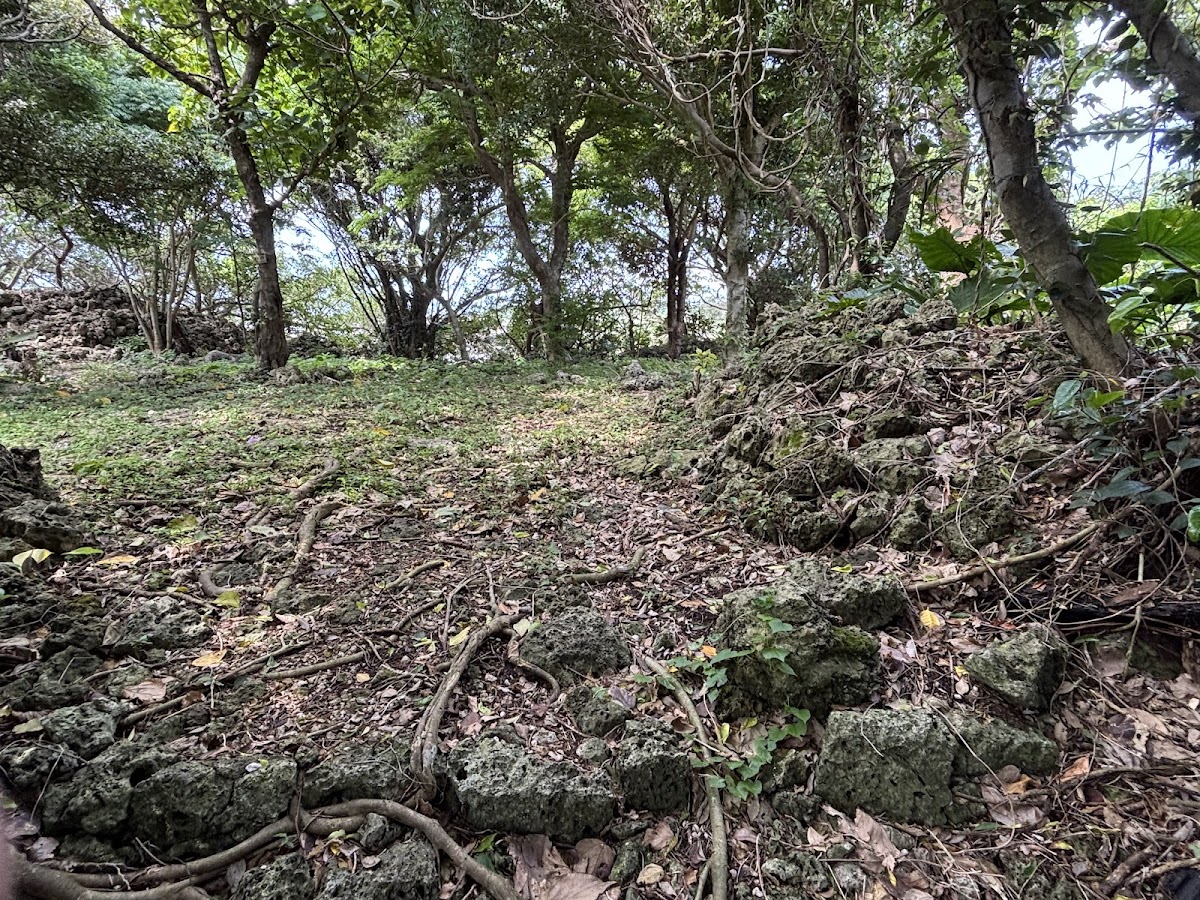
Unfortunately, Yamashiro Gusuku is currently covered in dense jungle, making it extremely difficult to reach. Development is also insufficient, and it is not yet safe for general visitors. However, aerial photographs and surveys are revealing some aspects of its scale and structure.
Stone Masonry Techniques and the Use of Ryukyu Limestone
The stone masonry of Uesato Gusuku was constructed using Ryukyu limestone, which is widely produced in Okinawa. Ryukyu limestone is easy to process and highly resistant to weathering, making it an ideal material for gusuku construction.
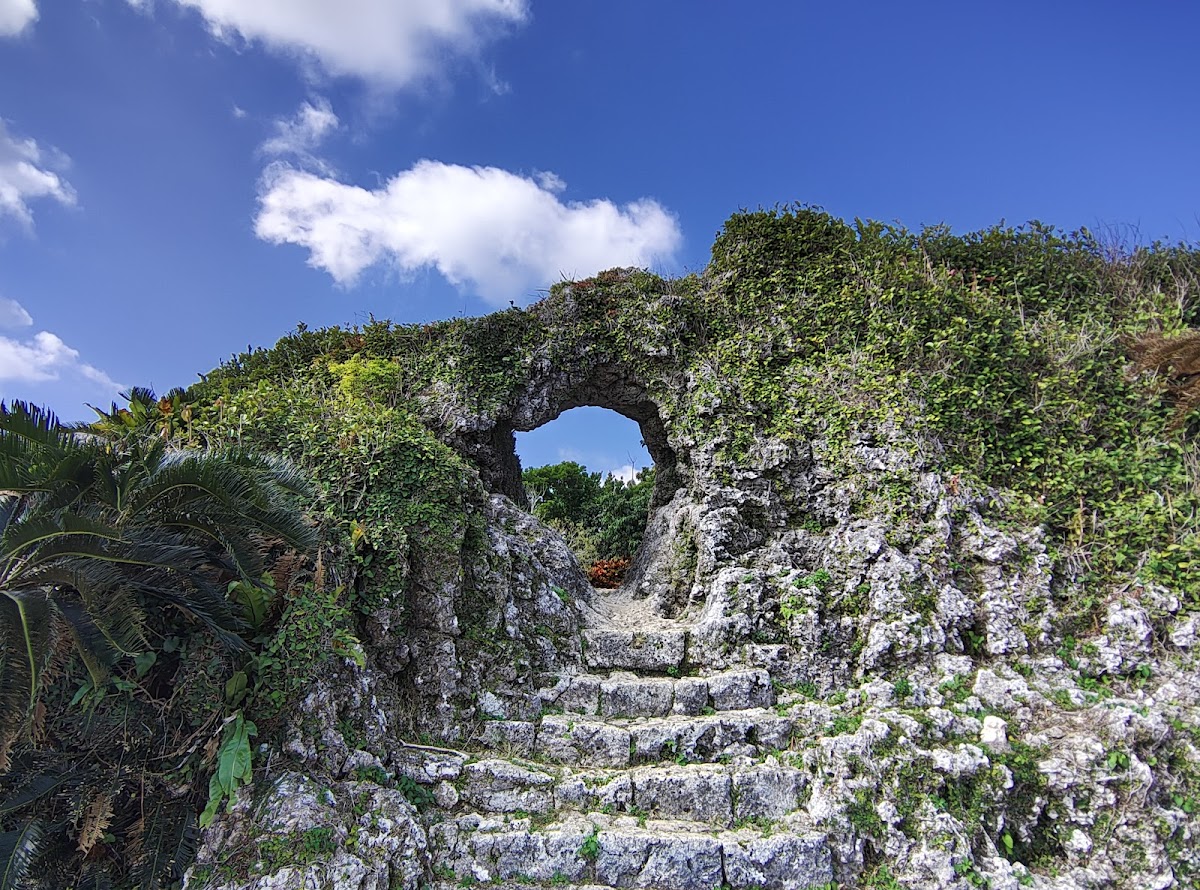
The stone masonry technique primarily employed was the “nozurazumi” method, where natural stones were stacked as they were. By skillfully combining stones, a strong castle wall was achieved without the use of adhesives such as mortar. This technique is a valuable legacy demonstrating the unique stone masonry culture of Ryukyu.
Highlights and Current Status of Kamizato Gusuku
Visitable Areas and Precautions
Currently, Kamizato Gusuku is undeveloped and not a tourist facility. While a portion of Kamizato Gusuku (Kami-Gusuku) on the cliff is barely accessible, there are no clear walking paths or signposts, so caution is advised when visiting.
Please note the following points when visiting:
- Safety underfoot: Due to the undeveloped nature of the site, there are areas with unstable footing. Wearing comfortable walking shoes such as athletic shoes is recommended.
- Overgrown vegetation: Depending on the season, vegetation may grow thickly, obscuring the view of the ruins.
- Potential private property: Some areas may be private property, so consideration is needed when entering.
- Avoiding solo visits: For safety reasons, visiting in groups is recommended whenever possible.
Photo Spot: Viewing the First Enclosure from the Third Enclosure
The most impressive view of Kamizato Gusuku can be enjoyed from the position looking up at the First Enclosure from the Third Enclosure. From this viewpoint, you can grasp the overall structure of the enclosures arranged in stages and the clever use of the natural terrain.
You can appreciate the remaining stonework and the undulations of the hill on which the gusuku was built, allowing you to experience the high level of castle-building technology of the time. For photography, the morning light beautifully illuminates the stonework, making it a particularly recommended time.
Surrounding Views and Geographical Importance
Kamizato Gusuku is located on a high hill, offering a wide view of the surrounding area. This location was ideal as a military observation post, and it is clear that it occupied a strategically important position in protecting the territory of the Nanzan Kingdom.
On a clear day, you can see as far as Itoman city and the East China Sea, allowing you to relive the view that the Ryukyuan lords must have seen.
Access to and Surrounding Information for Uesato Gusuku
Location and Basic Information
Location: Osato, Itoman City, Okinawa Prefecture
Designation: City-designated Historic Site (Itoman City)
Construction Period: 14th-15th Century (Estimated)
Builder: Uesato Anji
Type: Renka-shiki Gusuku (a type of castle)
Remains: Stone walls, remains of enclosures
Access by Car
The most convenient way to access Uesato Gusuku is by private car or rental car. It’s about a 30-minute drive from Naha Airport, heading south on National Route 331, passing through Itoman city center.
However, there is no dedicated parking lot near the entrance to the gusuku, so you will need to use the surrounding roadside space. Please be considerate of local residents when parking.
Access by Public Transportation
If using public transportation, take a bus bound for Itoman from Naha Bus Terminal, get off at the nearest bus stop, and then walk to the site. However, since there is a considerable distance from the bus stop to the gusuku (castle) and few signs, we strongly recommend checking a detailed map beforehand.
Nearby Tourist Attractions
When visiting Uesato Gusuku, we recommend combining it with visits to other historical sites and tourist attractions in Itoman City.
Yonesu Gusuku: Another gusuku site located about 10 minutes by car from Uesato Gusuku. It is also a castle site from the Nanzan Kingdom era.
Gushikami Gusuku: An important base of the Nanzan Kingdom located in Yaese Town. Visiting it together with Uesato Gusuku will give you a real sense of the Nanzan Kingdom’s sphere of influence.
Peace Memorial Park: An important facility where you can learn about the history of the Battle of Okinawa. Located in the southern part of Itoman City, it is about 15 minutes by car from Uesato Gusuku.
Uesato Gusuku and the Gusuku Culture of Ryukyu
What is a Gusuku?: Ryukyu’s Unique Castle Culture
Gusuku refers to the castle ruins built throughout Okinawa during the Old Ryukyu period (12th to 16th centuries). Unlike castles on mainland Japan, they are characterized by their curved stonework using Ryukyu limestone. They served not only as defensive structures but also as sacred sites (Utaki), fulfilling a religious role.
It is estimated that there are 200 to 300 gusuku in Okinawa Prefecture. Of these, five gusuku—Shuri Castle, Nakijin Gusuku, Zakimi Gusuku, Katsuren Gusuku, and Nakagusuku—along with four related sites—Sonohyan Utaki Stone Gate, Tamaudun Mausoleum, Shikinaen Garden, and Seifa Utaki—were registered as a World Cultural Heritage site in 2000 as “Gusuku Sites and Related Properties of the Kingdom of Ryukyu.”
Historical Positioning of Uesato Gusuku
Although Uesato Gusuku is not registered as a World Heritage Site, it is an extremely important historical site for understanding the history of the Nanzan Kingdom. In particular, its unique double-layered layout is attracting attention from researchers as a valuable example of the diversity of Ryukyuan military technology.
Furthermore, if the connection between “Onsado” (a sand path) and the Uesato Anji (local lord) is proven, it could greatly contribute to understanding the political structure of the Nanzan Kingdom, and further research is anticipated.
Challenges of Preservation and Utilization
Currently, Uesato Gusuku remains undeveloped, facing challenges in both the preservation of the remains and their utilization as a tourist resource. There are many issues to be resolved, including deterioration of the remains due to overgrown vegetation, illegal dumping, and ensuring visitor safety.
On the other hand, in response to the recent increase in interest in historical heritage, investigations by local governments and research institutions are gradually progressing. In the future, it is hoped that appropriate development and the establishment of information facilities will create an environment where more people can visit safely.
Practical Guide to Visiting Kamizato Gusuku
Best Season and Time of Day for Visiting
Kamizato Gusuku is an undeveloped outdoor ruin, so choosing the right time to visit is important.
Recommended Season: The dry season from October to April. Rain is scarce, and temperatures are relatively mild, making it ideal for visiting. The rainy season from May to September is best avoided due to overgrown vegetation and slippery ground.
Recommended Time of Day: Early morning (8:00 AM to 10:00 AM) is best. You can visit before the sun gets too strong, and the lighting conditions are ideal for photography.
Equipment and Clothing to Bring
- Clothing: Long sleeves and long pants are recommended. This is to protect against contact with vegetation and insect bites.
- Footwear: Shoes with good grip, such as athletic shoes or trekking shoes, are essential.
- Hat and Sunscreen: To protect yourself from the strong Okinawan sun.
- Drinking Water: There are no vending machines nearby, so please bring a sufficient amount.
- Insect Repellent Spray: This is especially essential during the summer.
- Map/GPS Device: There are no clear signs, so it’s reassuring to bring a way to confirm your current location.
Manners and Precautions
- Protection of Historical Structures: Do not climb on or touch the stone walls. Consideration is needed to preserve these valuable cultural assets for future generations.
- Take Your Trash Home: There are no trash cans nearby. Please take all your trash with you.
- Respect for Private Property: Some areas may be private property. Do not enter areas marked as “No Entry.”
- Consideration for Noise: Some areas are close to residential areas, so please refrain from speaking loudly.
Current Status and Future Prospects of Research on Kamizato Gusuku
Archaeological Findings
In recent years, surveying and excavation surveys have been conducted intermittently at Kamizato Gusuku, gradually revealing its overall structure. A significant achievement is the discovery that Kamizato Gusuku and Yamashiro Gusuku were planned as an integrated defensive system.
Excavated artifacts include fragments of Chinese ceramics and Ryukyuan pottery, estimated to date from the 14th to 15th centuries. Artifacts suggesting trade with Southeast Asia have also been discovered, providing evidence of the Nanzan Kingdom’s international trade network.
Future Development Plans and Expectations
Itoman City positions Kamizato Gusuku as an important historical asset of the region and is considering future development plans. Specifically, the installation of walking paths, the provision of information boards, and the securing of parking facilities are among the challenges identified.
Improving access to Yamashiro Gusuku is also a crucial issue. Currently, it is almost impossible to reach, but with proper maintenance, allowing visitors to experience the entire dual structure, the value of Uesato Gusuku will increase even further.
Balancing Regional Revitalization and Cultural Heritage Preservation
The development of Uesato Gusuku faces the difficult challenge of balancing cultural heritage preservation and regional revitalization. While promoting its use as a tourist resource, care must be taken to avoid damaging the valuable remains.
A major challenge for the future is for local residents, researchers, and the government to cooperate in formulating a sustainable preservation and utilization plan. Each visitor is also required to be mindful of preserving this valuable cultural property for future generations.
Summary: The Charm and Significance of Visiting Uesato Gusuku
Uesato Gusuku, though undeveloped, is a valuable historical site where one can feel the history of Ryukyu firsthand. Its dual structure—the upper gusuku on the cliff and the mountain castle gusuku below—its historical importance as a branch castle of the Nanzan Kingdom, and the mystery of the “Onsado” legend, among other things, hold many charms and research topics.
Compared to the famous castles registered as World Heritage Sites, Uesato Gusuku is less well-known and difficult to visit, but that’s precisely why it’s a precious place to quietly contemplate history. For those interested in Ryukyu history or wanting to visit hidden historical sites in Okinawa, Uesato Gusuku will offer an unforgettable experience.
When visiting, please take full precautions for safety, observe proper etiquette for cultural property preservation, and listen to the stories this precious historical site holds. You will be able to feel the landscape seen by Uesato Anji, the glory of the Nanzan Kingdom, and the turbulent era leading to the unification of Ryukyu.