Tsuyama Castle completion guide | History, light points and transportation explanation
Is this Tsuyama Castle (Kadoyama Castle)?
Tsuyama Castle (Tsuyama-jo) is located in Yamashita-cho, Tsuyama City, Ichiza Yamagata Castle, and is also one of the largest castle forts in Japan. Also known as Kakushan Castle, Jianyu Kaihei, approximately 140 US years of 鹤山之上.
In front of us, Tsuyama Castle is being constructed as “Kakuyama Park”, selected as Japan’s 100 most famous castles (67th place), and Japan’s 100 most famous castles. The fort is designated as a national cultural heritage site, and the production is an important historical site with cultural goods that are guaranteed to be received.
Features of Tsuyama Castle
The special conquest written by Saiaki Tsuyama Castle is the “yagura” of a large number of quantities. At the height of the Dynasty, there were 77 towers in Yanshan City, and a comprehensive outer wall, with 76 seats in Guangdao City and 61 seats in Hegulu City. An old record of the early Meiji period shows a spectacular view of the castle tower on top of the stone wall.
Besides this, its practicality is also its main feature. Yanshan Castle has a stone burial mound with twists and turns, a three-layered defense system with a square castle gate, and a masterpiece of fort construction technology at the time of its development.
History and background of Tsuyama Castle
Medieval Period: Yeoshan Castle Era
The history of Tsuyama Castle was traced back to the Muromachi era. In 1441 (the first year of Kakizu), Tadamasa Yamana, vice-mori of Mimasaka Province, completed the construction of Ichiza Castle fort on Mt. This is the famous fortress of Mimasaka.
However, during the period of turmoil during the Civil War (1467-1477), the fortress was destroyed, and for many years after this, it was in ruins.
Early modern period: Mori Tadamasa’s heavy construction
In the early Jiang Jiang Dynasty, Yongshan Castle was built and is an early modern fort with a large scale as seen in the present day.
In 1603 (8th year of Wucho), Mori Tadamasa was awarded a fief of 186,500 koku in Mimasaka Province due to his achievements during the war. Tadamasa Mori, younger brother and younger brother of Takamaru Mori, and Nobunaga Mori, passed away during the “Honnoji Temple Change” in the middle of the school year.
Built immediately after Tadamasa’s invasion, it was completed in 1616 (Genroku 2). This is a one-step process, completed in 13 years. At this time, the name of the place was changed to “Tsuyama”.
A fort-like construction with a fortification. Others used the mountain-like terrain, built a stone tomb with a height of 45 meters, and finally completed the construction of a three-tiered fort with one seat, a comprehensive castle tower, a two-tiered fort, and a three-tiered fort. The installation distance is 5 km.
Mouri Kazumatsu Taira Tokiyo
In 1697 (Genroku 10)**, the fourth generation of the Mori clan was in power, and the fourth lord of the Mori clan, Chojue, passed away early, had no children under his knees, and died in the area where he was adopted.
After that, Matsudaira Nobutomi was established, and the Matsudaira clan was established for ten generations, the chief of the Tsuyama domain, at the end of the Eko period. The Matsudaira clan is a descendant of Tokugawa Ieyasu’s second son, Yuki Hideyasu, and is a branch of the Echizen Matsudaira clan.
Meiji era and new empress: Joike’s current situation
In 1873 (Meiji 6), the edict was issued to stop the construction of Tsuyama Castle. The main hall, the middle tower (replacement castle tower), the 77th tower tower, the castle gate and other buildings were constructed and removed, and the inner stone chamber of the castle tower was removed.
In 1900 (Meiji 33), Shiroike Park was opened and named Tsuyama Park. It is a place where you can cultivate oak trees, cultivate and cultivate citizens, and have a heated gate for relaxing and releasing pine trees.
In 1963 (Showa 38), The official designation of the national history was approved by the government.
2005 (Heisei 17), Remember the 400th anniversary of the construction of Tsuyama Castle. The next revision is the history of the Edo period, the results of archaeological excavations since the old survey, and the original appearance of the original land.
Tsuyama Castle Ryoten
Yusuke’s Stone Tomb
Tsuyama Castle’s most shocking stone tomb. The castle was built on the top of Yushan Mountain, 45 meters high, 45 meters long, 5 km long.
Various methods of building stone citadels have been shown, how to make coarse stone (nozura-zumi), how to reach uchikomi-hagi (uchikomi-hagi), how to cut clover (kirikomi-hagi) again, and how to understand the performance of citadel building techniques. The reason for this is that the castle tower is surrounded by a stone coffin, the cutting technique of clover clover is used, the finely processed stone coffin is used, and the beautiful line of the gravure is created.
The technique of sandi-zumi used to lay out the square stones in the stone pile is also very refined, and the structure of the rectangular stone can be strengthened and strengthened.
Preparation center after repair
The middle tower is located in the inner part of the castle lord’s basement, and is the function of the castle tower. The construction was completed in 2005, and it has now been released overseas (according to demand).
The interior of the gun tower has a temple hall type living space, a barracks and a rice cellar, and a samurai residence with walls and walls. This is because this is the address of the master’s wife and wife, and the “temple-style gun tower” that has been seen throughout the country.
From the top of the tower, you can enjoy a panoramic view of the mountain city.
Honmaru, Nimaru Wasanmaru
Tsuyama Castle YuThree-tiered Mound Composition.
Honmaru This is the central part of the fort, also the most important area, where the gun tower is located. The original temple is located in the current construction area, but the base stone is still reserved.
Two Maru Honmaru (honmaru), the residence of high-ranking vassals and an important observation tower location.
The outermost layer of the Sannomaru (Third Way Temple), the home of the inner samurai, was the Japanese weapons depot.
The connection is a small passageway with a small wall, which is famous for its square entrance (square gate) defensive construction. This design will prevent the enemy from entering, and the design of the right angle will prevent the enemy from attacking in all directions.
Yeoshan Park: Famous Victory Land
The site of Yansan Castle is a famous award winning place, and is recognized as one of the “Japan’s 100 Great Award Winners”. Approximately 1,000 beetroot flowers have been planted in the garden, and a magnificent view of the beetroots has been created in spring.
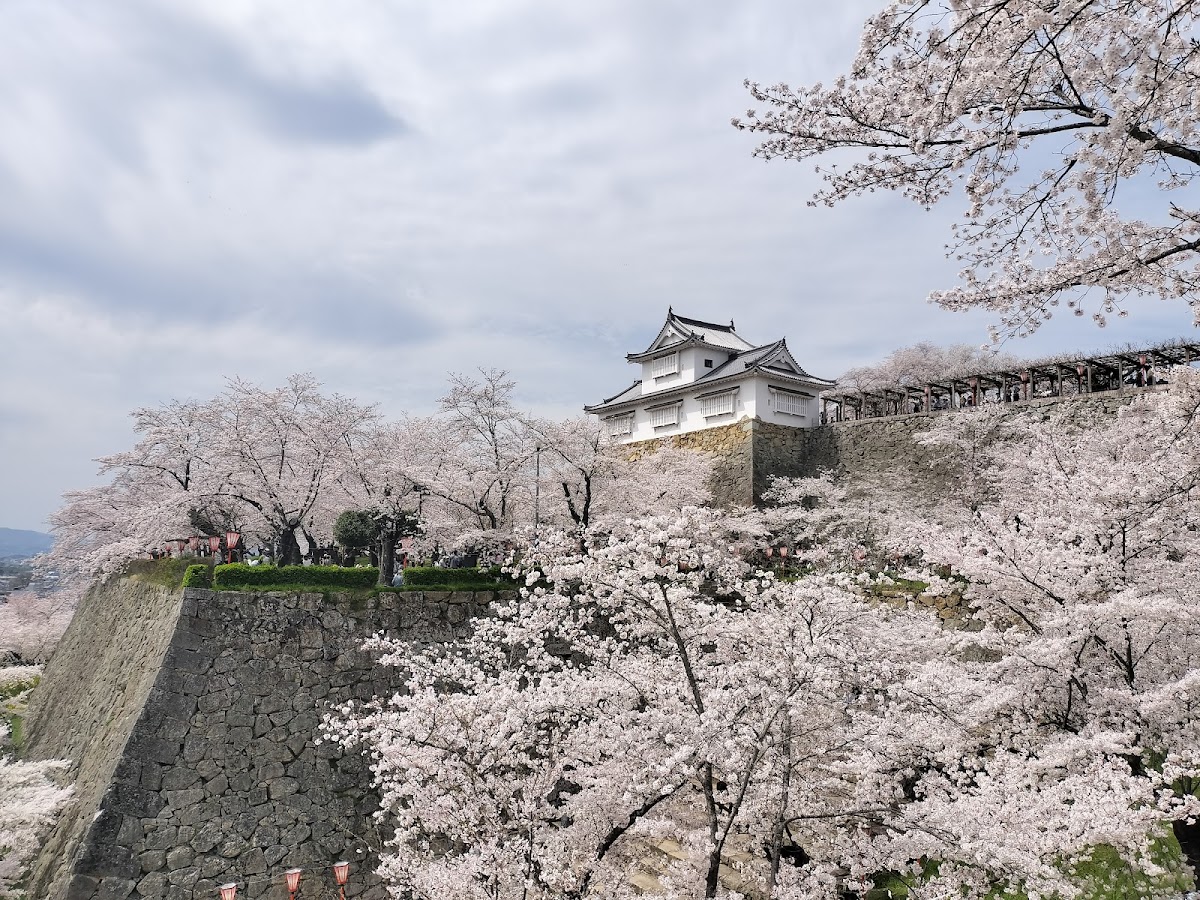
A large number of Somei Yoshino’s products were sold from late March to early April. The stone walls and the flowers are compatible with each other, and the victory is beautiful. At night, the light of the cherry blossoms shines brightly, and the sight of the lost man in the evening when the curtain falls and the cherry blossoms bloom.
The season of lilac flowers blooming, the gathering of “Tsuyama lily flowers”, attracting many visitors.
Wuda Stone Monument Peace Memorial Monument
A stone monument commemorating the association of the Watsuyama clan at Yotsuyama Castle in the park.
- Sculpture of Tadamasa Mori: A statue of one troupe, commemorating the achievements of Tadamasa Mori, the builder of Tsuyama Castle.
- Mori Tadamasa Memorial Monument: Ichiza Memorial Monument, memorial to Mori Tadamasa’s older brother Chomori Tadamasa.
- Memorial monument to the lord of the Kudai domain: Memorial monument to the lord of the Kudai domain from the Kinenmori clan and Wamatsudaira clan.
As you visit the small scenic spots, you will be able to dig deeper into the history of Tsuyama Castle.
Tsuyama Castle’s complete defense system
Triple Defense Line
Tsuyama Castle’s triple defense line structure: Honmaru (main castle), Ninomaru (second road castle), Wasannomaru (third road castle). Every road is separated by a stone wall between the castle walls and the height of the capital, and there are also castle towers and castle gates.
This design is based on the actual military design, and the enemy can quickly break through the castle, and the defense line can be placed under the ground, etc.
复杂’s Masugata cloth station
Masugata is installed on the passage inside the castle. This small defensive construction has been carried out with the road curved and right angle, forming a rectangular space (square shape).
A group of enemies entered the scene, attacked from all sides, and then retreated. The installation of Tsuyama Castle has exceeded 10 squares, and its layout is a nuisance to the attackers.
77 Pound Tower Defense System
Tsuyama Castle’s special conquest was written by the author of the 77 Fire Tower. This is the first castle in Japan to have exceeded the number of gun towers in the castle forts of Japan.
The tower does not have to be used as a watchtower, a military machinery tower, a military station, and other military functions when necessary. The tower on the top of the stone wall has a powerful influence on the enemy.
Tsuyama Castle Planning
The Tsuyama Castle ruins are located in the city of Tsuyama and are currently being used for construction purposes.
Stone protection work
Due to the aging of the earthquake, the stone burial mound was affected by the earthquake, and the regular maintenance work was carried out. At the same time as the archaeological excavations were underway, the technology was also being improved during the time of the ship, and the history of military defense and military defense was reviewed.
Tower repair plan
After repairing the middle tower, other towers were also repaired and under consideration. Special features include repairs to major castle gates such as the central gate and the central gate, as well as a closer look at the interior of the castle and its original appearance.
Numerical technology use
We have just begun to explore the use of augmented reality (AR) and virtual reality (VR) technology, which allows us to visualize the construction of a visually disappearing construction. Desired to travel to the area, the intelligent machine was used in a logical manner, and the appearance of Tsuyama Castle during the Edo era.
Local information and travel guide
Opening time and gate
Opening time
- April to September: 8:40 a.m. – 7:00 p.m.
- October to March: 8:40 am – 5:00 pm
- Bamboo shoot period (early April): 7:30 p.m. – 10:00 p.m.
Key vote
- Adults (high school and junior high school students and above): 310 yen
- Pre-junior high school students and below: Free of charge
- Group ticket (30 or more people) available
Closing date
- December 29th to 31st
Travel time
Approximate demand for visiting Tsuyama Castle Site1 to 1.5 hours. This is the first line, the comprehensive route to the castle tower, and the central tower where you can visit the windshield.
It’s been a long time since I’ve been able to enjoy a mature cherry blossom season or a historical visitor.
Installation information
Tsuyama Castle (Tsuyama Park) interior construction
- Pagoda (heavy construction, internal and external opening tour)
- Rest area
- Automobile sales machine
- Washing room (unimpaired passageway)
Adjacent facilities
- Tsuyama Local History Museum (5 minute walk): Exhibits Tsuyama’s history and culture
- Seongdong Street Scenic Preservation Area (15 minute walk): An important architectural preservation area for the preserved Jiangzhou era streetscape.
- Shuuen (10 minute walk): Tsuyama clan’s feudal lord’s garden
Transportation method
sitting fire car
From JR Tsuyama Station
- Walking: Approximately 15 minutes (approximately 1.2 km)
- Delivery vehicle: Approximately 5 minutes
- Local bus driver: sitting on the East Ring Line, located at the Tsuyama Castle Ruins Station (Yonshan Park) Station.
JR Tsuyama Station is the final station of JR Shinshin Line, JR Inban Line and JR Tsuyama Line.
Demand hours of major city offices
- Departing from Tsuyama Station: JR Tsuyama Line 1 hour 15 minutes
- Departure from Osaka station: New train line (Ziyi Head train) about 2 hours and 30 minutes
- Bird pick-up station departure time: 2 hours from the JR stamp station.
Self-drive route
Used high-speed public roads
- From Chugoku Expressway Tsuyama IC, approximately 15 minutes (approximately 10 km)
- From Chugoku Expressway Innosho IC, approximately 15 minutes (approximately 10 km)
Stop
- Yonshan Park Passenger Car Park: No charge (approximately 30 cars)
- Tsuyama Yu Customer Center Bus Stop: Free (approximately 20 cars)
- Nearby parking lot
During the period of cherry blossoms, the parking lot meeting ratio, the construction of public transportation tools.
Flying aircraft
The most recent airport is the Osama Momotaro Airport (Oyama Airport).
- Arriving at Wushan Airport: Approximately 30 minutes from the airport
- Tsuyama Station to Tsuyama Station: JR Tsuyama Line 1 hour 15 minutes
View points around Tsuyama Castle
Seongdong Street Scenic Preservation Area
It takes about 15 minutes to walk to the Seongdong Street Scenic Preservation Area, which is an important architectural preservation area**. During the Edo era, the commercial chain was established as a townhouse. The white-walled, Japanese-style townhouse with lattice gate is beautiful and beautiful, and is the ideal place for a man’s walk.
Shuyuen
Daimyo Garden Built by Takashi Mori, the second lord of the Yutsuyama domain, it was designated as a nationally famous shrine. This is a walking garden with a pond as the center, and you can enjoy the beautiful scenery of all seasons. Free entry.
Tsuyama Local History Museum
Museum of Tsuyama Castle Ruins, exhibition material of Yotsuyama City and Tsuyama Castle History and Culture Exhibition. You can visit the original model of Tsuyama Castle, and see the original model of Tsuyama Castle, while visiting Tsuyama Castle.
Tsuyama Railway Museum
Museum near JR Tsuyama Station. You can visit the rare car in the middle of the world-shaped machine. If you don’t want to send it to someone who loves the route, you can also enjoy it here.
Tsuyama Castle’s four seasons
Spring (late March to early April)
This is the most beautiful season of Tsuyama Castle. Approximately 1000 flowers and flowers were released at the same time, and the stone walls were mixed and reflected, and the beauty was not won. At the time of delivery, “Tsuyama Sakura Flower Festival”, the place was brightly lit at night. This is the busiest time of the year, attracting a lot of visitors.
Summer (June to August)
This is a naturally beautiful season. The green grass and the stone wall are compatible with each other. The number of visitors is small, and it is possible to travel freely. Unfortunately, the summer weather was very hot, and due to the demand, measures were taken to prevent the heat and reduce the temperature.
Autumn (October to November)
This is the best season for autumn leaves. The scenery of the autumn sun is unique and the colors of the trees and silver trees in the park are different. The weather is mild, and this is the ideal time to walk.
Winter (December to February)
The number of visitors is small, and the season is quiet and quiet. Shimoyuki, Shirayuki’s cover, and Shizuka Mitoku Reito suffocate. Must wear to keep warm when playing.
Yukanzuyama Castle Small Purchaser
Appropriate clothing
Tsuyama Castle is one mountain castle, the main castle where you can reach the talent of climbing stones. We wear shoes that are suitable for casual wear.
Participating guide group
Information provided by the Tsuyama City Tourist Association (pre-demand). As I learned more about the guide, I also learned more about the history of Tsuyama Castle.
Shot point
- City Citadel Viewpoint: This is the best place to see the entire city of Xinjin Mountain.
- The beauty of the arc shape of the stone wall: View of the third city wall, stop looking at the beauty of the arc shape of the stone wall.
- Central pagoda and cherry blossoms: A magnificent scenery that is full of talent and talent.
- Sunset: The setting sun is setting in the west, the stone wall is under the setting sun, and the dream-like image of the sky is rising.
Memorabilia information
Tsuyama local specialties, located near Tsuyama Castle and Tsuyama Station.
- Tsuyama packing shop winter side: Tsuyama local specialty.
- Sakushu Black Beans: Special black beans in the northern part of Kashan.
- Tsuyama Castle Tour: A product designed around Inaritsuyama Castle.
- Local sake: Japanese sake from the Mimasaka area.
Tsuyama Castle Museum
Is there a missing castle tower?
Tsuyama Castle missing castle tower. Tsuyama Castle was built in 1616, and at that time, the `one province, one castle'' law and the `samurai class” restrictions on feudal lords built forts were in place.
Reciprocal, Jianyu Lord’s castle tower inside the main castle tower**. In addition, the central tower is shared by five layers, which corresponds to the tower tower.
Yomori Tomaru series
Mori Tadamasa, the builder of Tsuyama Castle, was the younger brother of Mori Tomaru, and Mori Tomaru was the attendant of Nobunaga Soda. After the death of the “Honnoji no Kano” Chugai, Mori Takamaru and Yoshinaga were together, the Mori family’s successors, Hideyoshi, Tokugawa Ieyasu, and Mori Tadamasa, who were in charge of their military service during the war, were in charge of the confederated country.
A memorial monument to Mori Tamaru, a memorial to the two brothers who visited Tsuyama Castle.
Rare piece of early Meiji period
An old photograph from the early Meiji period preserved in Tsuyama Castle. In the Meiji period, before the fortification order, the original appearance of Tsuyama Castle was recorded, and the envoys received a total of 77 towers, making it a spectacular sight.
It’s very important to read this article and fix it in the middle of the future.
overview
Tsuyama Castle is Japan’s largest plains castle fort, with 77 towers, built in 13th year of the reign of Yumori Tadamasa. During the Meiji era, the castle towers were built under the command of the Meiji era, however, the stone citadel of Hiroya’s inner temple is still perfectly preserved, and has become the pinnacle of early modern fort construction technology.
The building was renovated in 2005, and it is a palace-style architectural style heavenly tower, which is also one of the highlights of Tsuyama Castle. In addition, the central tower is famous for its winnings, and is recognized as one of Japan’s hundred most famous winning places. Every spring, there are about 1,000 cherry blossoms and cherry blossoms competing, and the stone graves are set at points.
Tsuyama Castle is located in the center of Utsuyama City, with convenient transportation. It’s a long history of history. A close look at the monumental stone tomb, an unobstructed image of Ichishita Mori Tadamasa, and then a series of landscapes seen in the current year.