Tachibanayama Castle, Fukuoka | The Full Picture of a Mountain Castle Where a Sengoku Period Strategic Site and Nature Intertwine
What is Tachibanayama Castle?
Tachibanayama Castle (also known as Rikkasanjo) is a large mountain castle built around the summit of Mt. Tachibana, which is 367 meters above sea level, spanning Higashi-ku, Fukuoka City, Fukuoka Prefecture, and Shingu and Hisayama towns in Kasuya District. Also known as Tachibana Castle (also known as Rikkajo), it played an important role as a military stronghold in northern Kyushu from the Nanboku-cho period to the Sengoku period.
This mountain castle, overlooking Hakata Bay, was ideally positioned to monitor key points of land and sea transportation. Its presence from the Genkai Sea also made it a landmark for navigation since ancient times. Today, the castle remains with stone walls and ancient wells, while the primeval camphor tree forest, designated a national special natural monument, spreads above the 6th station, creating a unique landscape where history and nature blend seamlessly.
History and Background of Tachibanayama Castle
Construction and the Birth of the Tachibana Clan
The history of Tachibanayama Castle begins in 1330 (Gentoku 2), when Otomo Sadatoshi, the second son of Otomo Sadamune, the governor of Bungo Province, built a castle on this site. Sadatoshi made Tachibanayama his base and thus came to call himself the “Tachibana clan,” becoming the ancestor of the Tachibana clan. This period coincided with the turbulent Nanboku-cho period, a time of fierce conflict between the Southern and Northern Court forces in Kyushu.
Tachibanayama was developed as a large-scale mountain castle utilizing the entire mountain range consisting of seven peaks of varying sizes. Its scale and fortifications were among the finest in northern Kyushu. Centered around the main keep at the summit, multiple baileys were arranged, and a defensive network was constructed that skillfully utilized the ridges and valleys.
The Battle for Power in the Sengoku Period
During the Sengoku period (Warring States period), Tachibanayama Castle, overlooking the port city of Hakata, became a crucial strategic base and the stage for fierce battles between the Ouchi, Mori, and Otomo clans. Hakata was a thriving international trading port at the time, and controlling this port was extremely important both economically and militarily.
During the Eiroku era (1558-1570), Tachibana Akitoshi, a senior retainer of the Otomo clan, served as the castle lord, but it briefly fell into the hands of the Mori clan due to their offensive. During this period, the Otomo and Mori clans were evenly matched in northern Kyushu, and Tachibanayama Castle played a vital role as the front line.
The Era of Tachibana Dōsetsu and Muneshige
The most famous figure in the history of Tachibanayama Castle is Tachibana Dōsetsu (real name: Totsugi Akitsura), a renowned general of the Otomo clan. Dōsetsu became the lord of Tachibanayama Castle around 1567 and played a key role in the Ōtomo clan’s control of northern Kyushu. He is known as the “Thunder God,” a warrior who, despite being paralyzed from the waist down after being struck by lightning, continued to ride in a palanquin across the battlefield.
Dōsetsu had no biological children, so he adopted Munetora, the eldest son of Takahashi Jōun. This Munetora was none other than Tachibana Muneshige, the renowned general later known as the “Unrivaled General of Western Japan.” After Dōsetsu’s death, Muneshige became the lord of Tachibanayama Castle in 1585.
Battles with the Shimazu Army
In 1586, the Shimazu army, aiming to unify Kyushu, advanced northward and invaded Ōtomo territory. At this time, Muneshige’s real father, Takahashi Shōun, waged a fierce siege at Iwaya Castle (present-day Dazaifu City, Fukuoka Prefecture), fighting valiantly against tens of thousands of Shimazu troops with only 763 men, ultimately perishing in battle.
While time was bought during the Battle of Iwaya Castle, Muneshige holed up in Tachibanayama Castle, preparing for an attack by the Shimazu army. Thanks to Tachibanayama Castle’s strong defenses and Muneshige’s skillful tactics, the Shimazu army was unable to capture it. This siege played a crucial role in buying time until Toyotomi Hideyoshi’s Kyushu conquest army arrived.
Abandonment of the Castle and Conversion to Fukuoka Castle
After Toyotomi Hideyoshi’s conquest of Kyushu, Muneshige was transferred to Yanagawa Castle (present-day Yanagawa City, Fukuoka Prefecture) as a daimyo with a 130,000 koku domain. Later, in the Battle of Sekigahara in 1600, Muneshige sided with the Western Army and was dispossessed of his domain, and Tachibanayama Castle was abandoned. In 1601 (Keicho 6), Kuroda Nagamasa was appointed lord of Fukuoka, Chikuzen Province, with a domain of 520,000 koku, and began construction of Fukuoka Castle. At this time, much of the stonework from Tachibanayama Castle was repurposed for Fukuoka Castle, resulting in very few remaining stone walls at the current Tachibanayama Castle site. This indicates that reusing existing stone materials was common practice in castle construction at the time.
Structure and Remains of Tachibanayama Castle
Layout and Scale
Tachibanayama Castle was a large-scale mountain castle utilizing the entire mountain range centered around Mount Tachibana (367m). The main enclosure, the Honmaru, was located at the summit, with multiple baileys arranged along the ridge from there. It was a very large mountain castle, and it is believed that defensive facilities were spread throughout the entire mountain.
From the Honmaru at the summit, one could see Hakata Bay, Fukuoka city, the Genkai Sea, and even the Munakata area, making it an ideal location for military surveillance. Furthermore, it is possible that a defensive network was constructed in conjunction with the surrounding mountains, such as Mikazukiyama.
Existing Remains
The main remains that can be confirmed at the Tachibanayama Castle site are as follows:
Old Well Remains: The remains of an old well from that time remain near the summit, indicating its important role as a water source during sieges. Securing a water source was a matter of life and death for mountain castles, and the existence of this well made a long-term siege possible.
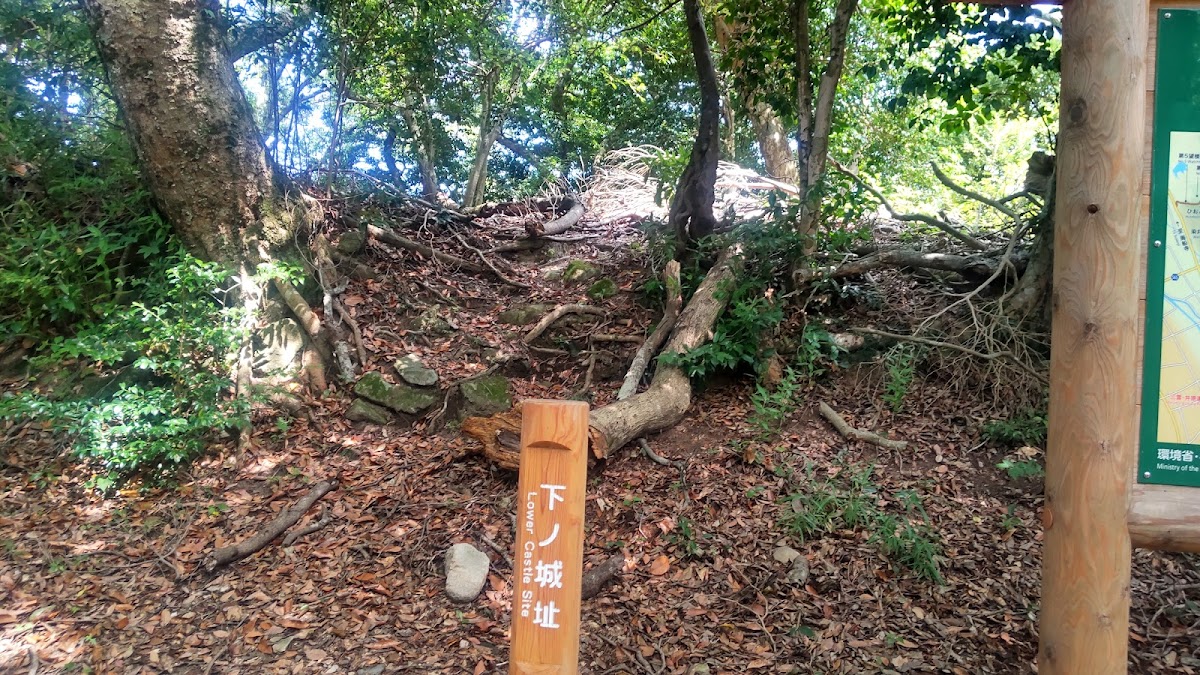
Stone Wall Remains: Many of the stone walls were reused during the construction of Fukuoka Castle, so only a limited number remain. However, traces of stone walls can be seen around the main keep site at the summit. These stone walls are valuable remains that convey the castle-building techniques of that time.
Enclosure Remains: Multiple flat areas can be seen from the summit to the ridgeline, and these are thought to be the remains of enclosures (defensive positions). This allows us to imagine the layout that skillfully utilized the terrain.
Remains of a Moat: Traces of a moat (horikiri) that cut off the ridgeline remain in some areas, showing ingenuity in preventing enemy intrusion.
Natural Environment of Tachibana Mountain
Nationally Designated Special Natural Monument: Virgin Camphor Tree Forest
Above the 6th station of Tachibana Mountain lies Japan’s northernmost virgin camphor tree forest, designated as a National Special Natural Monument. This camphor forest is an extremely valuable example of a concentrated virgin forest formed at this latitude, where camphor trees, which prefer warm climates, have formed.
Many trees are over several hundred years old, and some are enormous, with trunks exceeding 10 meters in circumference. These ancient trees have survived since the time when Tachibana Castle flourished, and can be considered living witnesses to history. The forest is dimly lit and enveloped in a mystical atmosphere, leaving a deep impression on visitors.
Hiking and Nature Observation
Mt. Tachibana, at an elevation of 367 meters, is a relatively low mountain, making it a popular hiking destination suitable for beginners. Hiking trails are well-maintained from Shingu Town, Hisayama Town, and Higashi Ward in Fukuoka City, attracting many hikers throughout the year.
Along the hiking trails, you’ll find evergreen broad-leaved forests including camphor trees, as well as oak, chestnut, and Machilus thunbergii trees, allowing you to enjoy the changing seasons. In spring, you can appreciate the fresh greenery; in summer, the deep shade; in autumn, the vibrant autumn foliage; and in winter, the strength of the evergreen trees.
Furthermore, the mountain boasts abundant wildlife, including wild birds and insects, making it a valuable field for nature observation. The fact that such rich nature remains despite its proximity to urban areas is one of Mt. Tachibana’s greatest attractions.
Views from Mt. Tachibana
Spectacular Views of Hakata Bay and Fukuoka City
The views from the summit of Mt. Tachibana are breathtaking. To the north lies Hakata Bay, offering panoramic views of Fukuoka city, the skyscrapers around Hakata Station, and the Tenjin district. On clear days, the horizon of the Genkai Sea, Nokonoshima Island, and Shikanoshima Island are also visible, providing a 360-degree panoramic view.
The view towards the Kashii district is particularly magnificent, offering a bird’s-eye view of the topography around Kashii Shrine, a historically important transportation hub. It’s likely that warlords of the Sengoku period also monitored enemy movements and ship traffic from this vantage point.
Attractiveness as a Night View Spot
Tachibanayama is one of the “100 Mountains for Night Views in Japan,” making it a popular night view spot. From the summit, you can enjoy a panoramic view of Fukuoka city, with the sea of lights around Hakata Station and the Tenjin district particularly shining brightly.
Despite being a mountain close to the city, it offers a comfortable distance, allowing for an overall panoramic view of the nightscape, making it ideal for photography. Along with Mikazukiyama to the south, it is a mountain popular with locals for enjoying the night view of Fukuoka.
Access and Hiking Information
Main Hiking Routes
There are mainly three routes to access Mt. Tachibana:
Shingu Town Route: From JR Fukuoka Institute of Technology Station, take the Shingu Town Community Bus “Marinx” (Yamaraizu Line) and get off at the Tachibana Elementary School bus stop. From there, walk to the trailhead. This is the most common route, and the trail is well-maintained. It takes approximately 40 minutes to 1 hour to reach the summit.
Hisayama Town Route: Access is also possible from the Hisayama Town side, and there is a well-maintained hiking trail here as well.
Fukuoka City Higashi Ward Route: There are several hiking trails from the Fukuoka City side, which are used by local hikers.
Precautions for Hiking
Tachibana-yama is a relatively low mountain, but there are several points to keep in mind when visiting the castle ruins:
- Clothing and Equipment: Prepare hiking boots or non-slip shoes, comfortable clothing, drinking water, a towel, etc.
- Weather Check: The ground can become slippery in rainy weather, so please check the weather before hiking.
- Time Allocation: Allow approximately 2-3 hours for the round trip, including time spent at the summit.
- Protection of Remains: The castle ruins are valuable cultural assets. Please be careful not to climb on or damage the stone walls, etc.
- Nature Conservation: Please cherish the camphor tree forest, a special natural monument, and be sure to take all your trash with you.
Nearby Tourist Attractions
Kashii-gu Shrine
Located northwest of Tachibana-yama, Kashii-gu Shrine is an ancient shrine dedicated to Emperor Chuai and Empress Jingu, and is a historically significant shrine mentioned in the Nihon Shoki (Chronicles of Japan). Looking down towards Hakata Bay from Tachibanayama Castle, you can see the location of Kashii Shrine and feel the flow of history that has continued since ancient times.
Baigaku-ji Temple
Baigaku-ji Temple, associated with Tachibana Dōsetsu and Tachibana Muneshige, is located at the foot of Tachibanayama Mountain. It houses Dōsetsu’s grave and is an important spot for learning about the history of the Tachibana clan.
Mikazuki-yama Mountain
Mikazuki-yama Mountain, located south of Tachibanayama Mountain, is also known as a night view spot. Many hikers visit both mountains together, and the traverse course between the two mountains is popular.
Shingu Town and Hisayama Town Tourism
Shingu Town and Hisayama Town, spread out at the foot of Tachibanayama Mountain, have hot spring facilities, roadside stations, and direct sales markets for agricultural products, making them ideal for resting after hiking. You can also enjoy dishes made with fresh local ingredients.
Cultural Value of Tachibanayama Castle
Importance of Historical Research
Tachibanayama Castle is an extremely important historical site for understanding the political and military situation in northern Kyushu from the Nanboku-cho period to the Sengoku period. It was the front line of power struggles among Sengoku daimyo such as the Otomo, Mori, and Ouchi clans, and also the stage where famous generals like Tachibana Dōsetsu and Muneshige were active.
In recent years, with the advancement of mountain castle research, new insights are being gained regarding the layout and defensive systems of Tachibanayama Castle. Local researchers and history enthusiasts are actively conducting investigations, and further discoveries are expected in the future.
Regional Symbol
Tachibanayama is located at the border of Shingu Town, Hisayama Town, and Higashi Ward of Fukuoka City, and is a common symbol for these three municipalities. It plays an important role in local history education and tourism promotion, and continues to be loved by the local people.
Every year, local elementary and junior high schools conduct field trips and history lessons to Tachibanayama, functioning as a place for passing on history to the next generation. Furthermore, local residents are actively engaged in conservation activities, such as maintaining hiking trails and holding events.
The Significance of Visiting Tachibanayama Castle
Visiting the ruins of Tachibanayama Castle holds more meaning than mere sightseeing. This is a place where the turbulent history of the Sengoku period (Warring States period) is etched, a place that famous generals risked their lives to defend. Standing on the mountaintop and looking down on Hakata Bay, you can share the view that the warlords of that time must have seen.
Also, the primeval camphor tree forest, a special natural monument, makes you feel the power of nature that has survived for hundreds of years. Tachibanayama, where history and nature merge, is a precious place that teaches us many things in modern times.
Located close to urban areas and easily accessible, the Tachibanayama Castle ruins are perfect for weekend hikes and historical exploration. When you visit Fukuoka, be sure to visit these historic mountain castle ruins and feel the atmosphere of the Sengoku period. The spectacular view of Hakata Bay from the mountaintop and the mystical forest woven by giant camphor trees will surely become an unforgettable memory. ## Summary
Tachibanayama Castle is an important mountain castle built on Mt. Tachibana, which is 367 meters above sea level and spans Higashi-ku, Fukuoka City, Shingu-machi, and Hisayama-machi in Fukuoka Prefecture. It dates from the Nanboku-cho period to the Sengoku period. Beginning with construction by Otomo Sadatsune, it reached its peak during the time of Tachibana Dōsetsu and Muneshige, and was the stage for numerous historical events, including battles with the Shimazu army.
Currently, only a few remains, such as stone walls and old wells, remain. However, combined with the primeval camphor tree forest, a nationally designated special natural monument, it is a unique spot where history and nature harmonize. The view of Hakata Bay from the summit is magnificent, and it is also a popular spot for night views.
Because it is a relatively easy mountain to climb, it is a place that can be enjoyed by a wide range of people, from beginner hikers to history enthusiasts. Please visit the Tachibanayama Castle ruins to experience the history of Fukuoka.