Najima Castle and Kobayakawa Takakage: A Naval Fortress Built in Fukuoka and the Footprints of a Sengoku Strategist
Located in Najima, Higashi-ku, Fukuoka City, Najima Castle is a coastal castle that functioned as an important base for governing Kyushu from the late Sengoku period to the Azuchi-Momoyama period. The era of major renovations and rule by Kobayakawa Takakage was particularly glorious in the castle’s history. This article provides a comprehensive explanation of Najima Castle’s history, its connection to Kobayakawa Takakage, and the remains that still exist today.
The Origins and Location of Najima Castle
As an Outpost of Tachibana Castle
The origins of Najima Castle date back to the Tenbun era (1532-1555). Initially, it functioned as an outpost built by Tachibana Akimasa, the lord of Tachibanayama Castle. Tachibanayama Castle was a mountain castle built on Tachibanayama, 367 meters above sea level, a strategic location overlooking Hakata Bay. Najima Castle was built on a peninsula-like terrain at the foot of the Tatara River estuary, serving as a forward base for Tachibana Castle.
Geographical Characteristics and Strategic Value
Najima Castle was built on a peninsula-like terrain surrounded by the sea on three sides, facing Hakata Bay. This location was ideal for a naval base and possessed strategic value in controlling a key point of maritime traffic. Furthermore, it was located approximately 5 kilometers north of Hakata, providing good access to the political and economic center of Chikuzen Province.
Unlike today, the coastline around Najima at that time extended very close to the castle. It also possessed defensive features utilizing the tidal differences, making it a castle with strong characteristics as a “water castle.”
Kobayakawa Takakage and Najima Castle
About Kobayakawa Takakage
Kobayakawa Takakage (1533-1597) was one of the leading strategists of the Sengoku period. Born as the third son of Mori Motonari, a powerful daimyo of Aki Province during the Sengoku period, he was adopted into the Kobayakawa family. Alongside his father, Motonari, he reigned as a powerful ruler of the Chugoku region and, together with Kikkawa Motoharu, known as the “Two Rivers of Mori,” supported the Mori family.
Takakage’s distinguishing features included not only his military prowess but also his exceptional political acumen and strategic vision. He excelled in naval operations and made a significant contribution to securing control of the Seto Inland Sea. He also played a crucial role in building relationships with Toyotomi Hideyoshi, contributing to the survival of the Mori family.
Circumstances of his appointment as Lord of Chikuzen Province
In 1587, upon the completion of Toyotomi Hideyoshi’s conquest of Kyushu, Kobayakawa Takakage was granted Chikuzen Province (approximately 370,000 koku) and parts of Chikugo and Hizen Provinces in recognition of his achievements. This signified Hideyoshi’s placement of his most trusted retainers as key figures in governing Kyushu.
Several factors contributed to Takakage’s appointment as Lord of Chikuzen Province. Firstly, an experienced and trustworthy individual was needed to serve as an oversight base for the Toyotomi regime in Kyushu. Secondly, Takakage, skilled in naval operations, was capable of managing maritime traffic based in Hakata Bay. Thirdly, he was expected to play a role in keeping powerful Kyushu daimyo such as the Otomo and Shimazu clans in check.
Major Renovation and Establishment of Najima Castle as a Residence
Kobayakawa Takakage, who became the lord of Chikuzen Province, carefully considered his options for a residence. While Tachibanayama Castle offered strong defensive capabilities as a mountain castle, it was inconvenient as a political center. On the other hand, Hakata, while a commercial center, was insufficient as a military base.
Takakage ultimately chose Najima Castle. He sought a castle close to the sea that could serve as a naval base, and envisioned a seaside castle similar to Mihara Castle, which he had built in Aki Province. Around 1588, a major renovation of Najima Castle began, transforming what was once merely an outpost of Tachibana Castle into a fortress befitting the administrative center of Chikuzen Province.
The renovated Najima Castle adopted the form of a modern castle, featuring a main keep, second bailey, and third bailey, and was equipped with stone walls and turrets. Furthermore, Hideyoshi’s residence was established there, and it functioned as a center for supervising Kyushu. The castle town was also developed, and policies were implemented to stimulate economic activity by inviting merchants from Hakata.
Takakage’s Rule and Achievements
Kobayakawa Takakage ruled Chikuzen for approximately 10 years, using Najima Castle as his base. His rule was known as “benevolent rule” and was highly regarded by his people.
Takakage implemented land surveys to improve the land system and established a system for collecting land tax. Furthermore, he dedicated himself to the reconstruction of Hakata, and also developed its function as a supply base during Hideyoshi’s invasion of Korea (the Bunroku-Keicho War). Hakata’s importance as a trading hub with the continent increased, and Najima Castle played a role as its administrative center.
In 1595 (Bunroku 4), Takakage handed over the family headship and Najima Castle to his adopted son, Kobayakawa Hideaki (nephew of Toyotomi Hideyoshi’s wife, Nene), and retired, returning to Mihara Castle in Hiroshima. This was a political decision that reflected Hideyoshi’s wishes, but it was also a result of Takakage’s own advanced age and consideration of succession to the next generation.
The Era of Kobayakawa Hideaki
The Struggles of a Young Castle Lord
Kobayakawa Hideaki (1582-1602) was born as the fifth son of Kinoshita Iesada, the older brother of Toyotomi Hideyoshi’s wife, Nene. After being adopted by Hideyoshi, he inherited the Kobayakawa family as the adopted son of Kobayakawa Takakage, and became the lord of Najima Castle in 1595. He was only 13 years old at the time.
Hideaki’s reign was short, and he is said to have struggled to control his retainers because he lacked the political skills of Takakage. He participated in the Korean campaign (1597-1598), but his military achievements were limited.
Battle of Sekigahara and Transfer of Domain
In the Battle of Sekigahara in 1600, Kobayakawa Hideaki initially belonged to the Western Army, but made the historic decision to switch sides to the Eastern Army during the battle. This “betrayal” is said to have sealed the Eastern Army’s victory.
For this achievement, Hideaki was transferred to Bizen Okayama with an increased domain of 510,000 koku. The rule of Najima Castle, which lasted only four years, came to an end, and Kuroda Nagamasa was appointed to Chikuzen Province with a 520,000 koku domain, having been brought in from Nakatsu in Buzen Province.
Kuroda Nagamasa and the Abandonment of Najima Castle
Kuroda Nagamasa’s Entry into the Domain
Kuroda Nagamasa (1568-1623) was the eldest son of Kuroda Kanbei (Takayoshi), known as a military strategist for Toyotomi Hideyoshi. He played a key role in the Eastern Army’s campaign at the Battle of Sekigahara and was granted a 520,000 koku domain in Chikuzen by Tokugawa Ieyasu.
In 1600, Nagamasa entered Chikuzen and initially made Najima Castle his residence. However, Najima Castle had several problems as a lord’s residence. Firstly, the castle’s size was somewhat small for a daimyo’s residence with a 520,000 koku domain. Secondly, there was limited room for expansion of the castle town. Thirdly, its distance from the city of Hakata made it inconvenient as a base for governing the domain.
Construction of Fukuoka Castle and Demolition of Najima Castle
To solve these problems, Kuroda Nagamasa decided to build a new castle. The chosen location was Fukuzaki, a hilly area in the village of Keigo, west of Hakata. Construction of Fukuoka Castle (Fukuzaki Castle) began in 1601 and was completed after seven years.
With the completion of Fukuoka Castle, Najima Castle was abandoned around 1603. Based on the spirit of the “One Castle Per Province” decree, its function as a castle was completely lost, and many of its structures were relocated to Fukuoka Castle or nearby temples and shrines.
Remains of Najima Castle and Relocated Structures
Najima Castle Ruins Park
Currently, the site of the main keep of Najima Castle is maintained as Najima Castle Ruins Park. Within the park stands a stone monument marking the “Najima Castle Ruins,” a reminder that a castle once stood here. Geographically, the site is a hilly plateau, offering panoramic views of the surrounding area. However, due to land reclamation, the coastline has receded significantly, making it difficult to imagine its former appearance as a “sea castle.”
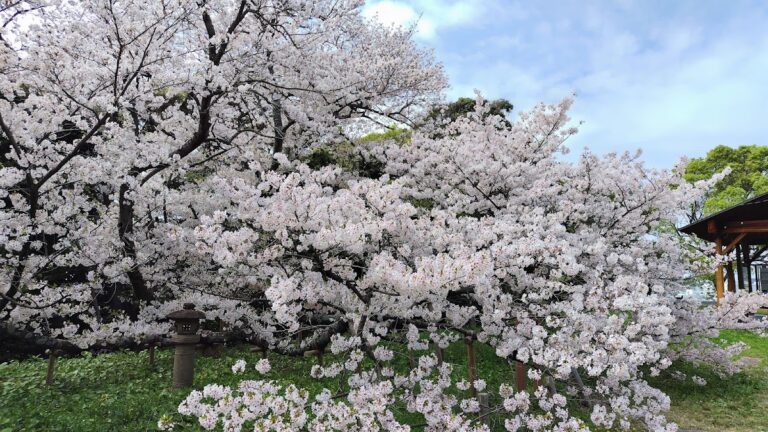
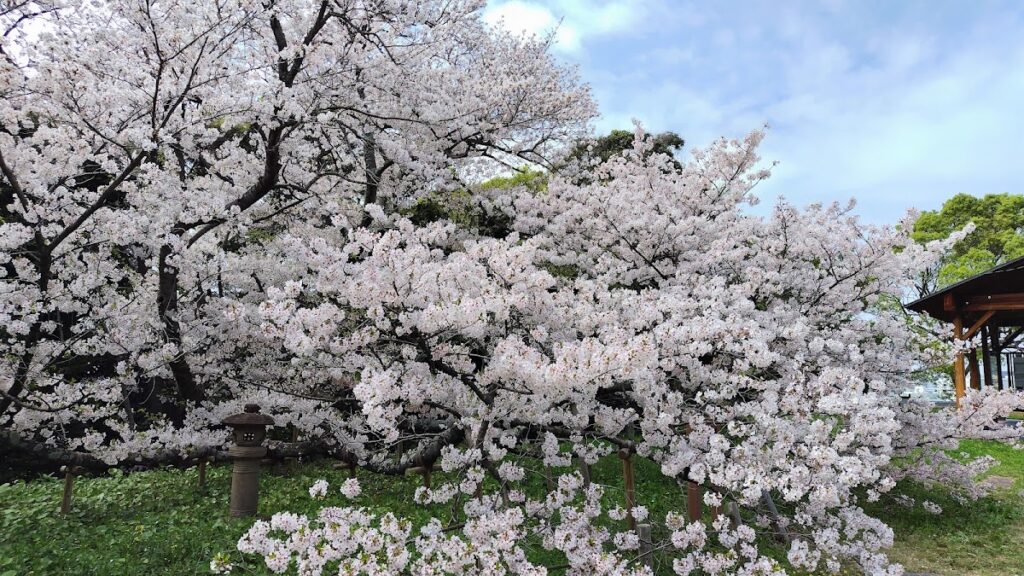
From the castle ruins, a portion of Hakata Bay can be seen, and on clear days, Shikanoshima Island is also visible. In spring, cherry blossoms bloom, making it a popular spot for local residents to relax.
Relationship between Najima Shrine and the Castle
Adjacent to the Najima Castle Ruins is Najima Shrine. This shrine has deep ties to the history of Najima Castle and has been revered as the castle’s guardian deity. From the shrine grounds, one can see the Najima Castle Ruins, fostering a sense of the integrated relationship between the castle and the shrine.
Najima Shrine also displays materials related to the history of Najima Castle, serving to convey its history to visitors. The temple accepts various prayers, including those for Shichi-Go-San (a traditional Japanese rite of passage for children) and Omiyamairi (a ceremony for newborns), and continues to function as a center of local faith.
Structures Relocated to Fukuoka Castle
When Najima Castle was abandoned, many structures were relocated to Fukuoka Castle. The most famous is the “Najima Gate.” This gate, believed to have been the main gate of Najima Castle, was relocated to Fukuoka Castle as a side gate and is now designated as a National Important Cultural Property.
The Najima Gate is a valuable relic that preserves the architectural style of the Momoyama period, and is characterized by its magnificent construction. It is a turret gate with a two-story structure built on top of a stone wall. When visiting the Fukuoka Castle ruins, we highly recommend visiting the Najima Gate.
Structures Relocated to Sofuku-ji Temple
Sofuku-ji Temple, located in Hakata Ward, Fukuoka City, is known as the family temple of the Kuroda clan, and it also houses structures relocated from Najima Castle. The main gate and the Chinese-style gate are examples of this, and the Chinese-style gate in particular is believed to have been relocated from the rear gate (rear gate) of Najima Castle.
This Chinese-style gate is a Momoyama-style building with elaborate carvings and is designated as a cultural property of Fukuoka Prefecture. Furthermore, the grounds of Sofuku-ji Temple also contain the tomb of Kobayakawa Takakage, making it an important place to reflect on the history of Najima Castle.
The Main Gate of Sosei-ji Temple
Sosei-ji Temple in Higashi-ku, Fukuoka City, also has a main gate believed to have been relocated from the rear gate of Najima Castle. This temple is associated with Kobayakawa Takakage, and a memorial tower for Takakage is erected on the temple grounds. The main gate, though simple, is sturdily built and retains a strong sense of its function as a castle gate.
The Historical Significance of Najima Castle
As a Base for the Governance of Kyushu
Najima Castle occupied an extremely important position in the governing system after Toyotomi Hideyoshi’s conquest of Kyushu. The placement of Kobayakawa Takakage, Hideyoshi’s most trusted retainer, to oversee the daimyo of Kyushu was a crucial element of his Kyushu policy.
Using Najima Castle as his base, Takakage monitored the activities of clans such as the Shimazu and Otomo, and confirmed their loyalty to the Toyotomi regime. It also functioned as a logistical base during the Korean campaigns, demonstrating its importance as a frontline base for continental policy.
Function as a Naval Base
Another important aspect of Najima Castle was its function as a naval base. Kobayakawa Takakage had experience controlling the navy of the Seto Inland Sea, and he utilized this knowledge and experience in the management of Najima Castle.
Taking advantage of its location facing Hakata Bay, he stationed a fleet of naval ships there, ensuring the safety and monitoring of maritime traffic. This also contributed to the protection of maritime trade centered on Hakata, playing a vital economic role.
Transitional Period to Early Modern Castles
Najima Castle occupies an important position in castle history as a castle that represents the transitional period from medieval mountain castles to early modern flatland castles and hill castles. While incorporating elements of early modern castles such as stone walls and turrets, it also maintained its unique characteristics as a coastal castle.
The castle design philosophy attempted by Kobayakawa Takakage at Najima Castle is thought to have influenced the later construction of Fukuoka Castle. Kuroda Nagamasa analyzed the advantages and disadvantages of Najima Castle and built the more complete Fukuoka Castle.
Profile and Evaluation of Kobayakawa Takakage
Evaluation as a Strategist
Kobayakawa Takakage is highly regarded as a leading strategist of the Sengoku period. He demonstrated exceptional skill not only in military matters but also in diplomacy, politics, and economics.
In particular, his contributions to the survival and development of the Mori family are immeasurable. Takakage’s diplomatic skills in building relationships with two powerful figures, Oda Nobunaga and Toyotomi Hideyoshi, saved the Mori family from destruction. Even during the chaotic period following the Honnoji Incident, he calmly protected the Mori family’s position.
Skills as a Domestic Administrator
Takakage’s strengths extended beyond military affairs to domestic administration. He achieved success in all aspects of domain management, including the construction of Mihara Castle and Najima Castle, the development of their surrounding towns, land surveys, and the promotion of commerce.
In particular, he possessed progressive ideas in commercial policy, implementing policies to protect and nurture Hakata merchants. This was carried on during the later Kuroda era and formed the foundation for Fukuoka’s economic development.
Aspects of Character
Takakage was respected not only as a military commander but also as a person of character. He showed compassion for his subordinates and subjects, and governed with a focus on “benevolent rule.”
Even after handing over the family headship to Hideaki in his later years, Takakage continued to support Hideaki as an advisor. In 1597 (Keicho 2), he passed away at Mihara Castle at the age of 65, and his death was mourned by many.
Najima Castle in Modern Times
Access and Visiting
Najima Castle Ruins are approximately a 10-15 minute walk from Chihaya Station on the JR Kagoshima Main Line or Najima Station on the Nishitetsu Kaizuka Line. By car, it is about a 5-minute drive from the Kashiihama exit of the Fukuoka Urban Expressway.
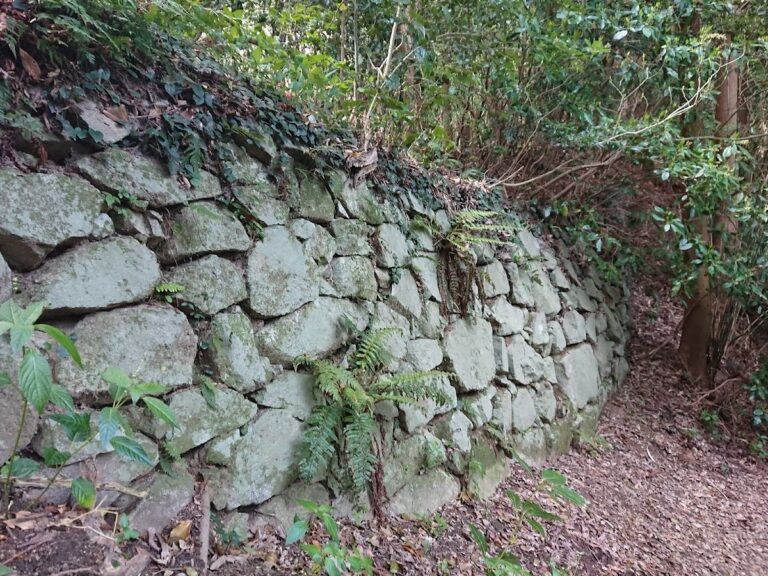
Najima Castle Ruins Park is always open and can be freely visited. However, very few castle remains remain; the site is mostly reminiscent of its past through stone monuments and the surrounding topography. For a more detailed understanding of Najima Castle’s history, a visit to the adjacent Najima Shrine is recommended.
Historical Walking Tour Around Najima Castle
To gain a deeper understanding of Najima Castle’s history, a historical walking tour of related historical sites is recommended.
- Najima Castle Ruins Park: First, visit the site of the main keep to understand the castle’s location and topography.
- Najima Shrine: Learn about the castle’s history and understand the relationship between the castle and the shrine.
- Fukuoka Castle Ruins: Visit relocated structures, including the Najima Gate, to experience the architecture of Najima Castle.
- Sofuku-ji Temple: Pay respects at the grave of Kobayakawa Takakage and view relocated structures such as the Karamon Gate.
- Sosei-ji Temple: Visit a temple associated with Takakage and see another relocated gate.
This course allows you to experience the overall picture of Najima Castle and relive the footsteps of Kobayakawa Takakage.
Value as a Historical Heritage Site in the Region
Najima Castle Ruins are positioned as an important historical heritage site in Fukuoka City. Currently designated as a city historical site, it is also used as a place for local history education.
Local elementary schools conduct local history lessons on the history of Najima Castle, giving children an opportunity to take pride in their region’s history. Najima Shrine also regularly holds history lectures, continuing its activities to deepen citizens’ understanding of history.
Summary
Najima Castle existed for only a short period of about 50 years, from the late Sengoku period to the early Edo period, but its historical significance was immense.
Najima Castle, developed as a naval base and functioned as the administrative center of Chikuzen Province by Kobayakawa Takakage, a leading strategist of the Sengoku period, was a key point in the Toyotomi regime’s rule of Kyushu. Takakage’s reign is remembered by the people as a “benevolent rule,” laying the foundation for the subsequent development of Chikuzen.
Currently, almost no castle structures remain, but the gates relocated to Fukuoka Castle, Sofuku-ji Temple, and Sosei-ji Temple are valuable relics that convey the former appearance of Najima Castle. Visiting Najima Castle Ruins Park and Najima Shrine allows you to truly appreciate the magnificent sea castle that once stood on this site, a stage that shaped the history of Kyushu.
Najima Castle and Kobayakawa Takakage are indispensable when discussing the history of Fukuoka. I hope this article sparks your interest in the history of Najima Castle and inspires you to visit the historical site. I hope you will reflect on the lives of the people who lived during the transition from the Sengoku period to the early modern period, and feel the depth of Fukuoka’s history.