Suwahara Castle Complete Guide | The Masterpiece of Takeda-style Castle Construction and the Mountain Castle That Tokugawa Ieyasu Fell in Love With
What is Suwahara Castle?
Suwahara Castle is a Sengoku period mountain castle located at the northern end of the Makinohara Plateau in Kanaya, Shimada City, Shizuoka Prefecture. Built on a plateau at an altitude of 212m to 220m, this castle was a base for Takeda Katsuyori’s invasion of Tōtōmi Province, constructed in 1573, and is known as a strategic stronghold that embodies the pinnacle of Takeda-style castle construction.
The castle was named “Suwahara Castle” because it housed the Suwa Daimyōjin shrine, and was later renamed “Makino Castle” when Tokugawa Ieyasu seized it. Currently, it is preserved as a nationally designated historical site and was selected as one of the “Continued Top 100 Japanese Castles” in 2017, recognizing its high historical value.
Location and Strategic Importance of Suwahara Castle
Suwahara Castle is located at a strategic point on the Tokaido Road, with the Tokaido passing just south of the castle. To the east lies the Oi River after descending Kanaya Slope, and to the west is a vital transportation hub leading from Kikugawa Slope through Sayo-no-Nakayama towards Kakegawa.
The eastern slope of the main enclosure is a sheer cliff, and because the Oi River flowed along the Makinohara Plateau at the time, it possessed an ideal defensive structure, a “fortified rear castle,” protected by the natural terrain. This geographical advantage is why the Takeda clan chose this location as a base for their invasion of Totomi Province.
History of Suwahara Castle
From Fort to Castle in the Time of Takeda Shingen
The history of Suwahara Castle begins with the construction of a fort by Takeda Shingen. Shingen, anticipating his invasion of Totomi Province, established a simple defensive structure at this strategically important location. However, the castle’s full-scale development was realized after Shingen’s death, during the time of Takeda Katsuyori.
Construction in 1573
In 1573, Takeda Katsuyori ordered his retainers, Baba (Minonokami) Nobuharu and Takeda Nobutoyo, to begin the full-scale construction of Suwahara Castle. Baba Nobuharu was a renowned general known as one of the Twenty-Four Generals of the Takeda clan, and is said to have possessed excellent castle-building skills.
The enshrinement of Suwa Daimyojin within the castle is related to the Takeda clan’s ancestry to the Suwa clan. It is believed that the intention was to boost the morale of the Takeda army by making Suwa worship the guardian deity of the castle.
Fierce Battles Between the Takeda and Tokugawa Clans
After its construction, Suwahara Castle functioned as a base for the Takeda clan’s invasion of Totomi Province and became an important defense against the Tokugawa clan. However, the situation changed dramatically after the Takeda army suffered a crushing defeat at the Battle of Nagashino in 1575.
In the same year, Tokugawa Ieyasu launched an attack on Suwahara Castle. The Takeda commander was Imafuku Jōkansai Tomokiyo, but the castle fell to the fierce Tokugawa assault. While there are various accounts of the details of this battle, Tokugawa records indicate that many of the castle’s defenders were killed.
Renovation and Renaming to Makino Castle by Tokugawa Ieyasu
After acquiring Suwahara Castle, Tokugawa Ieyasu renamed it “Makinohara Castle” and appointed Matsudaira Yasuchika as its commander. Ieyasu valued this castle because of its superior defensive structure. He was particularly impressed by the design of the circular outworks, a technique employed by the Takeda school of castle construction, and this is said to have influenced Ieyasu’s later castle strategies.
From 1578 onward, Matsudaira Ietada and others repeatedly renovated the castle, strengthening its provisions and defenses. Ietada’s diary contains many entries about Suwahara Castle, making it a valuable historical document for understanding the castle’s state at the time.
Abandonment and its Aftermath
In 1590, when Tokugawa Ieyasu was transferred to the Kanto region, Suwahara Castle lost its strategic importance and was abandoned. Although it existed for only a short period of 17 years, this castle was the stage for battles between the two major powers, the Takeda and Tokugawa clans, and played a crucial role on the Tokaido road during the Sengoku period.
After its abandonment, the site was used for farmland, but the castle’s remains were relatively well preserved. In 1975, it was designated a national historic site, and full-scale archaeological excavations were conducted from 2009 to 2015.
Structure and Features of Suwahara Castle
A Masterpiece of Takeda-Style Castle Construction
The most distinctive feature of Suwahara Castle lies in its defensive structure, which embodies the pinnacle of Takeda-style castle construction. The Takeda clan was known as masters of mountain castle construction, building numerous strong castles that skillfully utilized the terrain. Suwahara Castle is a culmination of this expertise.
A Masterpiece of Maru-umadashi (Circular Outwork)
The most noteworthy remains at Suwahara Castle are the “Maru-umadashi.” A Maru-umadashi is a defensive structure built in front of the castle’s entrance (koguchi), preventing enemy intrusion while also serving as a base for allied attacks.
Two large Maru-umadashi remain at Suwahara Castle, and their scale and state of preservation are among the best in the country. In particular, the Maru-umadashi in the second enclosure has a diameter of approximately 50 meters and is surrounded by a deep dry moat. This circular outwork has the following features:
- Semicircular projection: A structure that allows attacks on the enemy from three sides.
- Deep dry moat: Surrounds the outwork, making it difficult for the enemy to approach.
- Crescent-shaped moat: A moat further constructed outside the circular outwork, forming a double line of defense.
- Warrior’s walkway: A passageway inside the outwork, facilitating the movement of soldiers.
This circular outwork design embodies the Takeda clan’s philosophy of “offensive defense.” It’s not simply designed to defend against the enemy, but also to allow for proactive offensives.
Arrangement of the Enclosures
Suwahara Castle is composed of multiple enclosures:
Main Enclosure: The central part of the castle, believed to be the location of the lord’s residence. The eastern side is a sheer cliff, making it a natural stronghold.
Second Enclosure: Located west of the main enclosure, it is the largest enclosure. A large circular outwork was constructed, capable of accommodating many soldiers. Archaeological excavations have uncovered the remains of a building foundation and a well.
Third Enclosure: This enclosure, located further west, served as an outer defense.
These enclosures are separated by a series of dry moats, designed to function as independent defensive strongholds.
Dry Moats and Earthworks
The massive dry moats and earthworks play a crucial role in Suwahara Castle’s defense system. The dry moats reach depths of over 10 meters in some places, their scale truly impressive.
The earthworks were constructed by piling up the excavated soil from the dry moats, reaching heights of over 5 meters. Attacking the enemy from atop these earthworks enhanced the defensive effectiveness.
Even today, the dry moats and earthworks remain remarkably well-preserved, allowing visitors to experience the magnificent scale of the castle at that time. The dry moats around the second enclosure, in particular, are overwhelming in their depth and width.
A Castle with a Strong Rear
As mentioned above, Suwahara Castle was designed as a “fortress with a strong rear.” The eastern side of the main enclosure faces a sheer cliff overlooking the Oi River, making attacks from this direction virtually impossible.
On the other hand, the western side is a gentle slope, so defensive structures were concentrated on this side. Major defensive structures such as circular outworks, dry moats, and earthworks are all located on the western side, limiting enemy incursion routes.
This design philosophy of “being protected from the rear by natural terrain and concentrating artificial defensive structures in the front” is fundamental to mountain castle construction, and Suwahara Castle can be considered an ideal example.
Excavation Survey and Results of Suwahara Castle Ruins
Full-Scale Survey from 2009 to 2015
Shimada City conducted a full-scale excavation survey of the Suwahara Castle ruins from 2009 to 2015. This survey revealed the actual state of the castle, which could not be understood from historical documents alone. ### Main Excavation Findings
Discovery of Building Remains: Numerous foundation stone buildings and post-and-beam buildings were discovered, primarily in the second enclosure. These are believed to have been used as barracks or warehouses.
Well Remains: Multiple wells used within the castle were identified, revealing the castle’s water supply system.
Excavated Artifacts: A variety of artifacts related to life and warfare during the Sengoku period were unearthed, including pottery, musket balls, sword fragments, and horse tack. The discovery of musket balls, in particular, is important evidence indicating that actual battles took place at this castle.
Structure of the Entrance: The detailed structure of the entrance connecting to the circular outwork was revealed, clarifying the technical characteristics of the Takeda-style castle construction.
Traces of Stone Walls: The foundations of stone walls were discovered in some areas, suggesting the possibility that stone walls were used in parts of this mountain castle, despite it being primarily an earthen structure.
These excavation results indicate that Suwahara Castle was not merely a military facility, but a comprehensive center where many people lived and managed supplies.
Development and Public Access
Based on the results of the excavation, Shimada City has proceeded with the development of the Suwahara Castle ruins. The dry moats and earthworks have been cleared of weeds and trees, making the remains easier to view. Furthermore, explanatory signs and guideposts have been installed to help visitors understand the castle’s structure.
In 2017, the Suwahara Castle Visitor Center was opened, featuring exhibits of excavated artifacts, explanations of the castle’s history, and diorama displays.
Highlights of Suwahara Castle
Large-Scale Maru-Umadashi (Circular Barbican)
A must-see when visiting Suwahara Castle is the Maru-Umadashi in the second enclosure. The enormous Maru-Umadashi, with a diameter of approximately 50 meters, is truly awe-inspiring when you stand there.
The dry moat surrounding the circular outwork is also deep, with a height difference of over 15 meters from the bottom of the moat to the top of the earthen rampart. Looking up from the bottom of the moat, you can truly appreciate the castle’s formidable construction.
Magnificent Dry Moat and Earthen Rampart
The dry moat of Suwahara Castle is one of the largest among Japanese mountain castles. In particular, the dry moat separating the second and third baileys is approximately 20 meters wide and 10 meters deep, creating a truly impressive sight.
It is possible to walk along the bottom of the dry moat, so we recommend actually entering it to experience its depth and width. The view from the top of the earthen rampart is also magnificent, allowing you to grasp the overall structure of the castle.
View from the Main Bailey
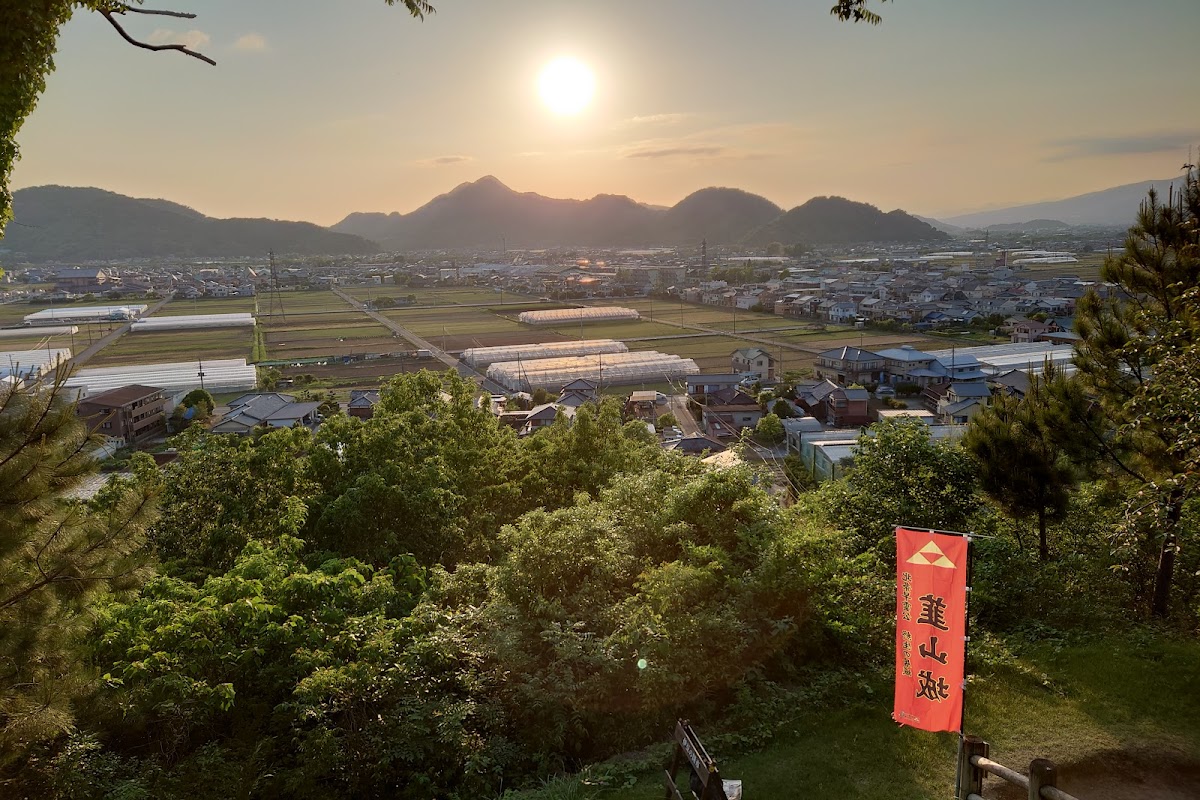
Standing on the main bailey, you can see the flow of the Oi River and the city of Shimada below, and Mount Fuji in the distance (weather permitting). This view speaks volumes about why Suwahara Castle was a strategically important location.
Located in a position overlooking the Tokaido Road and the crossing point of the Oi River, it was an ideal location for monitoring enemy movements.
Crescent Moat
The crescent-shaped moat built outside the circular outwork is also a highlight. This crescent moat functioned as a double line of defense, making it even more difficult to approach the circular outwork.
The shape of the crescent moat is beautiful and demonstrates the refined techniques of the Takeda-style castle construction.
Suwahara Castle Visitor Center
Before visiting the castle ruins, we recommend stopping by the Suwahara Castle Visitor Center first. The following exhibits and information are available here:
- Castle History Explanation Panels: Detailed explanations of the castle’s history from its construction to its abandonment.
- Diorama Model: An elaborate model that allows for a three-dimensional understanding of the castle’s overall structure.
- Exhibition of Excavated Artifacts: Actual artifacts such as ceramics, musket balls, and swords unearthed during archaeological excavations.
- Video Materials: Videos introducing the charm of Suwahara Castle.
- Pamphlets and Walking Maps: Materials for efficiently touring the castle ruins.
The visitor center staff are knowledgeable about Suwahara Castle and will answer your questions carefully.
Activities of the Suwahara Castle Support Team
To support the preservation and utilization of Suwahara Castle, a local volunteer group, the “Suwahara Castle Support Team,” is active. The support team engages in the following activities:
- Weeding and Cleaning Activities: Regularly mowing and cleaning the castle ruins to maintain easy access to the remains.
- Guiding Activities: Volunteer guides provide information on the castle’s history and highlights.
- Event Organization: Planning and managing lectures and workshops related to the castle.
- Information Dissemination: Promoting the appeal of Suwahara Castle through social media and websites.
Thanks to the support team’s activities, the Suwahara Castle ruins are well-preserved and enjoyed by many people.
Selection as one of the Continued Top 100 Japanese Castles
In 2017, Suwahara Castle was selected as one of the “Continued Top 100 Japanese Castles” by the Japan Castle Association. This is a list of castles of high historical and cultural value, following the “Top 100 Japanese Castles” selected in 2006.
The selection of Suwahara Castle as one of the Continued Top 100 Japanese Castles was based on the following characteristics:
- It is one of the finest examples of Takeda-style castle construction.
- Its distinctive remains, such as the circular outwork, are well-preserved.
- Its strategic importance on the Tokaido road during the Sengoku period.
- Its well-maintained environment for visitors, thanks to archaeological excavations and restoration work.
This selection has led to a significant increase in the castle’s popularity, attracting castle enthusiasts from all over Japan.
Castle Stamps and Goods
Castle Stamp Sales
Suwahara Castle sells “castle stamps” as a memento of your castle visit. These stamps can be purchased at the Suwahara Castle Visitor Center and the Shimada City Museum.
The Suwahara Castle stamps feature designs of the castle’s distinctive circular outwork and motifs related to the Takeda and Tokugawa clans, making them popular among collectors.
Original Goods
In 2021 (Reiwa 3), new Suwahara Castle T-shirts and happi coats were introduced. These goods were designed with the involvement of the Suwahara Castle Support Team and are items that widely promote the castle’s charm.
In addition, various other original goods such as clear files, badges, and tenugui (hand towels) are sold and are popular as souvenirs and mementos of visits.
Access Information
Access by Public Transportation
From JR Tokaido Main Line “Kanaya Station”:
- Approximately 8 minutes by taxi
- Take the Shizutetsu Justline route bus from “Kanaya Station Entrance,” get off at “Old Tokaido Stone Pavement Entrance,” and walk for approximately 15 minutes.
If using the Shinkansen (bullet train):
- Get off at JR Tokaido Shinkansen “Kakegawa Station” or “Shizuoka Station,” transfer to a local train, and go to Kanaya Station.
Access by Car
From Tomei Expressway “Sagara Makinohara IC”: Approximately 15 minutes
From Shin-Tomei Expressway “Shimada Kanaya IC”: Approximately 10 minutes
Parking: There is free parking at Suwahara Castle Ruins (approximately 20 regular cars). There is also parking space in front of the Visitor Center.
Location
3965-3 Kanaya, Shimada City, Shizuoka Prefecture (Suwahara Castle Visitor Center)
Visitor Information
Opening Hours and Closing Days
Suwahara Castle Ruins: Always open for viewing (free admission)
Suwahara Castle Visitor Center:
- Opening Hours: 9:30 AM – 4:00 PM
- Closing Days: Mondays (or the following day if Monday is a public holiday), New Year holidays
- Admission Fee: Free
Estimated Visiting Time
If you plan to visit thoroughly, including preparation at the visitor center, allow approximately 2-3 hours. If you only plan to visit the main remains, approximately 1 hour is sufficient.
Clothing and Items to Bring
- Comfortable Walking Shoes: The castle ruins have uneven terrain, and you may need to walk on the bottom of the dry moat, so comfortable walking shoes such as sneakers are essential.
- Hat and Drinks: The sun is strong in the summer, so bring a hat and drinks to stay hydrated.
- Insect Repellent: As it is a place rich in nature, insect repellent is recommended.
- Rain Gear: Bring rain gear in case of unstable weather.
Nearby Tourist Attractions
Shimada City Museum
Located about 15 minutes by car from Suwahara Castle, the Shimada City Museum has extensive exhibits on the history of the Oi River and the Tokaido Road. Materials related to Suwahara Castle are also on display, and visiting both will deepen your understanding.
Kanaya Slope Stone Pavement
Approximately 430 meters of Edo-period stone pavement remain on Kanaya Slope, part of the old Tokaido Road. It is a valuable historical site where you can feel the atmosphere of the Tokaido Road that passed south of Suwahara Castle.
Tea Plantations on the Makinohara Plateau
The Makinohara Plateau, where Suwahara Castle is located, is known as one of Japan’s leading tea-producing regions. The scenery of the vast tea plantations is breathtaking, and there are facilities where you can experience tea picking.
Oigawa Railway
The Oigawa Railway, famous for its steam locomotive trains, starts at Kanaya Station. After visiting Suwahara Castle, we recommend enjoying a ride on the retro steam locomotive train.
Summary
Suwahara Castle is a mountain castle of high historical value, considered the masterpiece of Takeda-style castle construction and an important strategic base on the Tokaido road during the Sengoku period. The large circular outworks and magnificent dry moats, in particular, are truly impressive when seen in person.
Selected as a National Historic Site and one of the Continued Top 100 Japanese Castles, and with ongoing excavation and restoration work, the Suwahara Castle ruins are attracting attention from castle enthusiasts nationwide. Be sure to experience the excellent defensive structure that Tokugawa Ieyasu was so impressed with. Starting with some preparation at the Suwahara Castle Visitor Center, and then touring the Maruumadashi, Karabori, and Honkuruwa in order, you’ll be able to truly feel the history of the Sengoku period, when the Takeda and Tokugawa clans clashed. When you visit Shizuoka Prefecture, be sure to add Suwahara Castle ruins to your list of places to visit.