Sunomata Castle: The Truth Behind the Legend of Toyotomi Hideyoshi’s One-Night Castle and a Historical Examination [Complete Guide]
Sunomata Castle, located in Sunomata-cho, Ogaki City, Gifu Prefecture, is a Sengoku period castle known as “Sunomata One-Night Castle.” The legend that Kinoshita Tokichiro (later Toyotomi Hideyoshi) built it in a single night is one of the most famous rags-to-riches stories in Japanese history. However, recent historical research has raised various debates about the veracity of this legend. This article comprehensively explains the historical background of Sunomata Castle, the truthfulness of the castle-building legend, its actual appearance based on historical materials, and its current state.
Geographical and Strategic Importance of Sumomata Castle
Sumomata as a Transportation Hub
The area of Sumomata, located near the confluence of the Nagara, Ibi, and Kiso Rivers, has long been known as a strategically important transportation hub. Situated on the border between Owari and Mino Provinces, it was a crucial base connecting the two provinces during the Sengoku period, occupying an extremely important position both militarily and economically.
As the place name Sumomata (Sunomata) on the west bank of the Nagara River suggests, this region was characterized by river sandbars and low-lying wetlands. While highly convenient for water transport, it also presented technical difficulties for castle construction. Even before the Sengoku period, this region was frequently the site of battles, demonstrating its high military value.
Strategic Position in the Conquest of Mino
The area of Sumomata held extremely important significance for Oda Nobunaga’s conquest of Mino Province. To capture Inabayama Castle (later Gifu Castle), the base of the Saito clan of Mino Province, a forward base was necessary. Sunomata was ideally located for this purpose, and it was expected that a castle built there would function as a bridgehead for the invasion of Mino.
Looking northeast from the current Sunomata Castle (historical museum), Gifu Castle (Inabayama Castle) can be seen. This geographical relationship is one of the factors supporting the idea that Sunomata Castle was conceived as a forward base for the conquest of Inabayama Castle.
Overview of the Legend of the One-Night Construction of Sunomata Castle
The Selection of Kinoshita Tokichiro
According to legend, in 1566, Oda Nobunaga planned to build a castle in Sunomata as a forward base for the conquest of Mino. However, this area was close to the Saito clan’s territory, making it a high-risk location for enemy attacks during construction. In fact, several attempts to build the castle had been made in the past, but all ended in failure.
The person who volunteered for this difficult task was Kinoshita Tokichiro (later Toyotomi Hideyoshi), who was still a low-ranking samurai at the time. Tokichiro is said to have promised Nobunaga that he would solve this difficult problem with his innovative ideas and skillful strategies.
The Method of Building the One-Night Castle
The method of construction in the legend was extremely original. Tokichiro processed the timber to be used for the castle in the upper reaches of the Kiso River beforehand, assembled it into rafts, and floated them down the river. Using the materials that reached Sunomata, he is said to have quickly assembled the castle according to a pre-planned procedure, completing the castle’s shape overnight.
This expression, “built overnight,” is not interpreted as literally being completed within 24 hours, but rather as referring to the dramatic effect of completing the construction in a short period of time without being noticed by the enemy, making it appear as if the castle had appeared overnight.
Collaborators Who Supported the Castle’s Construction
In legend, figures such as Hachisuka Koroku (Hachisuka Masakatsu) and Maeno Nagayasu are mentioned as those who supported Fujikichiro’s castle construction. Hachisuka Koroku, in particular, led a group of water transporters and samurai from the Kiso River basin known as the Kawanami-shu, and their cooperation is said to have been key to the castle’s success.
Furthermore, Fujikichiro’s younger brother, Kinoshita Hidenaga (later Toyotomi Hidenaga), is also said to have participated in the construction. The story of the brothers working together to accomplish this difficult task is an important part of Hideyoshi’s later rise to power.
The True Image of Sumomata Castle in Historical Records
Absence of Contemporary Historical Records
The biggest problem regarding the construction of Sumomata Castle is the lack of reliable contemporary historical records. The “Shinchō Kōki,” a record of Oda Nobunaga’s achievements, contains no clear description of the construction of Sumomata Castle. This is the main reason to question the credibility of the Sumomata Castle legend. Many historians point out that the existence of Sunomata Castle cannot be definitively confirmed based solely on existing historical materials. In particular, the prevailing opinion is that the dramatic method of construction—a castle built overnight—is highly likely to have been fabricated and embellished in later military chronicles and storytelling.
Descriptions in Military Chronicles
Detailed descriptions of Sunomata Castle’s construction are mainly found in military chronicles written during the Edo period. Works such as “Taiko-ki” and “Ehon Taiko-ki” dramatically depict Fujikichiro’s construction of Sunomata Castle, and these are the origins of the legend of Sunomata’s overnight castle.
However, these military chronicles are literary works written primarily to entertain readers rather than to record historical facts. Therefore, they contain a mixture of historical fact and fiction, and must be treated cautiously as primary sources for historical research.
Various Theories Regarding the Construction Period
There are also multiple theories regarding the construction period of Sunomata Castle. The main theories regarding the construction of the castle are 1561 (Eiroku 4) and 1566 (Eiroku 9), but neither has conclusive evidence.
The 1561 theory coincides with the period when Oda Nobunaga began his full-scale conquest of Mino Province, but no clear records of a castle being built at Sunomata during this time have been found. On the other hand, the 1566 theory is adopted by many military chronicles, but it has been suggested that this may also be a later fabrication.
Archaeological Investigation Results
Archaeological investigations at the Sunomata Castle site have been limited, but several excavations have been conducted. However, no definitive evidence clearly indicating the remains of a castle from the Sengoku period has been found.
It has also been suggested that the topography may have changed significantly due to flooding of the Nagara River and changes in its course. Even if Sunomata Castle did exist, its remains may have already been lost or be buried deep beneath the surface.
Arguments Against the Existence of Sunomata Castle
Arguments Supporting its Existence
Researchers who support the existence of Sunomata Castle cite the following arguments:
First, there is no doubt that the area of Sunomata was strategically important, and it is quite possible that Oda Nobunaga established some kind of military base there during his conquest of Mino Province. The argument is that just because it is not explicitly mentioned in the *Shinchō Kōki* (Chronicle of Lord Nobunaga) does not necessarily mean that it did not exist.
Furthermore, other historical sources support the fact that Kinoshita Tōkichirō (Hideyoshi) played an important role in Nobunaga’s conquest of Mino. It is also plausible to interpret that Hideyoshi gained Nobunaga’s trust and rose through the ranks precisely because of his concrete achievement of building Sunomata Castle.
In addition, even if the expression “castle built overnight” is an exaggeration, there is also the theory that a simple fort was built in a short period of time. During the Sengoku period, there were many temporary forts (outposts) that were built quickly and abandoned once their purpose was served. It has been suggested that Sunomata Castle may have been a facility of a similar nature.
Grounds for Denial
On the other hand, researchers who deny or are skeptical of the existence of Sunomata Castle point out the following from the perspective of historical source criticism:
The most important point is the fact that there is no mention of the construction of Sunomata Castle in reliable contemporary historical sources. In particular, the *Shinchō Kōki* (Chronicle of Lord Nobunaga) meticulously records the achievements of Oda Nobunaga, and it is argued that if the construction of Sunomata Castle was an important event, its absence from the record is unnatural.
Furthermore, descriptions of Sunomata Castle mainly appear in Edo period military chronicles and storytelling, and these are considered highly likely to be fictionalized stories created to heroize Hideyoshi. The dramatic element of a “castle built overnight” is especially suspected to be an embellishment to make the story more interesting.
The absence of archaeological evidence also supports the denial. Even with modern excavation techniques, the lack of clear remains of Sunomata Castle reduces the possibility of a large-scale castle existing.
Evaluation in Modern Historiography
In modern historiography, the prevailing view is that the existence of Sumomata Castle cannot be definitively confirmed. While its existence cannot be completely denied, a cautious stance is taken, as existing historical materials alone cannot prove its existence.
Many researchers acknowledge the possibility that some kind of military base existed in Sumomata, but believe that the dramatic construction method of the “castle built overnight” and the story that it was a decisive factor in Hideyoshi’s rise to power are likely later fabrications and embellishments.
Future discoveries of historical materials or advancements in archaeological investigations could change the evaluation. Historical research is constantly evolving, and it is necessary to pay attention to the latest research findings regarding Sumomata Castle.
Sumomata Castle in Literary Works
War Chronicles of the Edo Period
The story of the construction of Sumomata Castle became widely known largely due to war chronicles of the Edo period. The *Taiko-ki* (or *Taiko Sōsei-ki*) is a representative work depicting the life of Toyotomi Hideyoshi, and it includes a detailed account of the construction of Sunomata Castle.
The *Ehon Taiko-ki* (Illustrated Taiko-ki) is an illustrated storybook created in the late Edo period, and it visually depicts the construction of Sunomata Castle in a striking way. Through these works, the story of the one-night construction of Sunomata Castle became widely known among the common people.
Literary Works in the Modern Era
Even after the Meiji era, the story of the construction of Sunomata Castle has been featured in many historical novels and biographies. In particular, the theme of rising to prominence resonated with the values of modern Japan, and it has been repeatedly told as Hideyoshi’s success story.
Many authors, including Ryotaro Shiba in *Shinshi Taiko-ki*, have depicted the construction of Sunomata Castle. These works balance historical fact with fiction, emphasizing Fujikichiro (Hideyoshi)’s wit and courage.
Influence on Popular Culture
The story of Sumata One-Night Castle has been incorporated into various popular culture works, including movies, television dramas, manga, and games. In NHK’s historical dramas, the construction of Sumata Castle is almost always depicted in works featuring Hideyoshi as the protagonist.
Through these popular culture works, the story of Sumata One-Night Castle remains widely known today and is deeply etched in the hearts of the Japanese people as a symbol of Hideyoshi’s rise to power.
Modern Sumata Castle (Ogaki City Sumata Historical Museum)
Construction of Sumata One-Night Castle (Historical Museum)
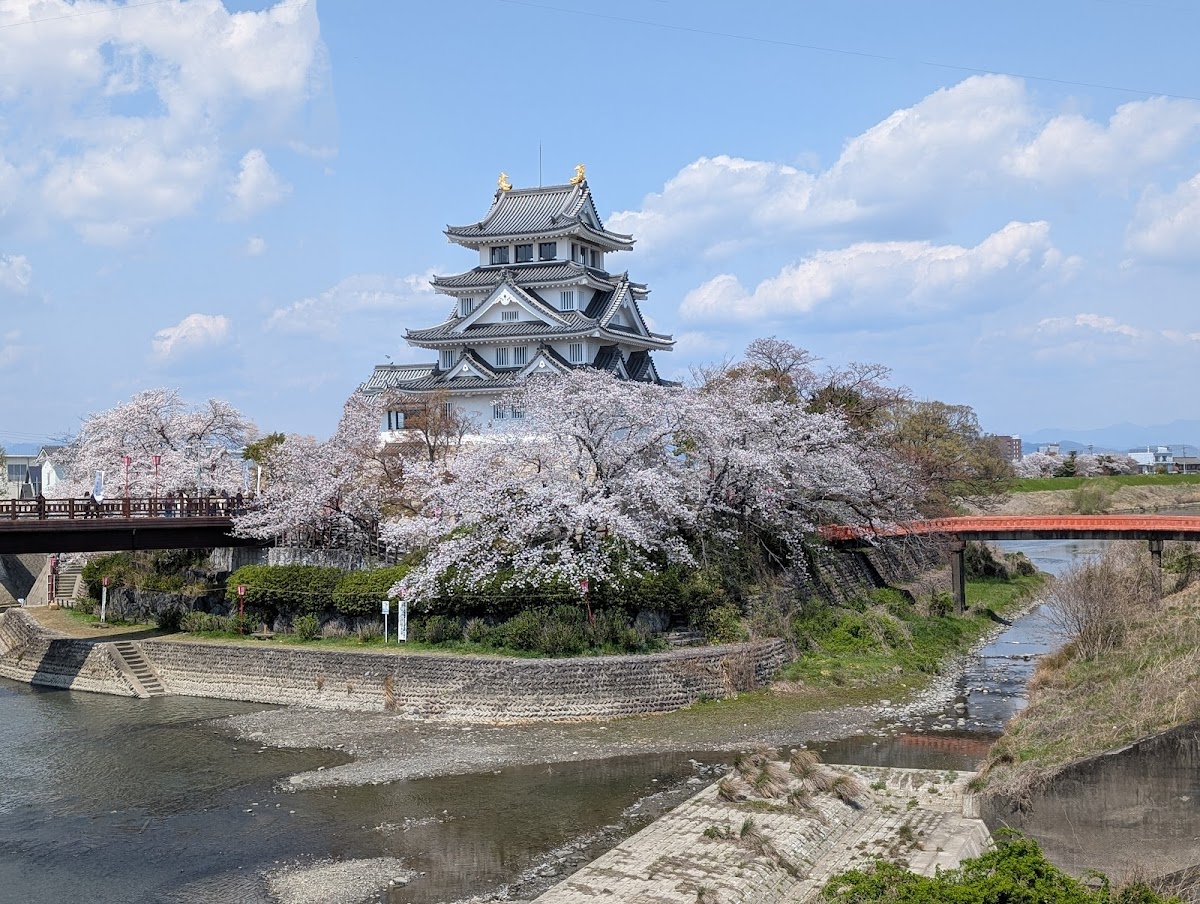
Currently, a building modeled after the style of a castle keep stands on the site believed to be the Sumata Castle ruins. This is the “Ogaki City Sumata Historical Museum,” which opened in April 1991, and is commonly known as “Sumata One-Night Castle.”
This building is not a reconstruction of the actual Sumata Castle from the Sengoku period, nor is it a simple fort-like castle of that time. Instead, it was constructed as a historical museum with the appearance of a castle keep. The exterior is a magnificent three-story, four-tiered castle keep, designed with an emphasis on its function as a tourist facility.
Exhibits and Highlights
The historical museum features exhibits focusing on the construction of Sumata Castle and the life of Toyotomi Hideyoshi. The main exhibits are as follows:
The 1st Floor Exhibition Room explains the history and methods of Sumata Castle’s construction using models and diagrams. The reconstructed model of Sumata One-Night Castle from 1566 is a valuable resource for imagining what the castle looked like at that time.
The 2nd Floor Exhibition Room introduces Hideyoshi’s rise to power. This exhibit traces the life of Fujikichiro, born the son of a farmer, from his successful construction of Sumomata Castle, which earned him Nobunaga’s trust, to his eventual rise to power as the ruler of Japan. The exhibit includes a timeline and related materials.
The 3rd-floor exhibition room features exhibits on Hideyoshi’s achievements after unifying Japan and on Momoyama culture.
The 4th-floor observation room offers panoramic views of the Nagara River and the surrounding scenery. On clear days, you can see Gifu Castle (Inabayama Castle) to the northeast, giving you a real sense of the strategic location at the time.
Surrounding Area Development and Tourist Facilities
The area around Sumomata Ichiyajo Castle is developed as a park, allowing visitors to enjoy the beauty of nature throughout the seasons. The cherry blossom trees in spring are particularly beautiful, attracting many tourists as a famous cherry blossom viewing spot.
A promenade along the Nagara River is also maintained, allowing visitors to enjoy a stroll while admiring the river’s flow. Nearby, there are also cherry blossom trees along the Sai River embankment, creating a magnificent tunnel of cherry blossoms in spring.
Parts of the townscape of Sumimata-juku have been preserved, allowing visitors to experience the atmosphere of an Edo-period post town. Visiting both the townscape and the historical museum will provide a deeper understanding of Sumimata’s history.
Access and Visitor Information
Location: 1742-1 Sumimata-cho, Ogaki City, Gifu Prefecture
Transportation Access:
- Approximately 20 minutes by Meihan Kintetsu Bus bound for “Sumimata” from JR Tokaido Main Line “Ogaki Station,” then approximately 10 minutes on foot from “Sumimata” bus stop.
- Approximately 20 minutes by car from Meishin Expressway “Gifu-Hashima IC”
- Approximately 15 minutes by car from Tokai-Kanjo Expressway “Ogaki-Nishi IC”
Opening Hours: 9:00 AM – 5:00 PM (Last entry at 4:30 PM)
Closed Days: Mondays (or the following day if Monday is a public holiday), the day after public holidays, and during the New Year holidays
Admission Fee: 200 yen for adults, free for those under 18 (as of 2024)
Parking: Free parking available (approximately 50 spaces for regular cars)
Annual Events and Festivals
Sumomata Ichiyajo Castle hosts various events throughout the year. During the spring cherry blossom festival, the castle is illuminated at night, allowing visitors to enjoy the fantastical collaboration of cherry blossoms and the castle.
In autumn, the “Sunomata Hideyoshi Success Festival” is held, featuring warrior processions and historical parades. This is a handcrafted event by local residents, offering a valuable opportunity to experience the atmosphere of the Sengoku period.
Sumomata Castle and Surrounding Sengoku Historical Sites
Relationship with Gifu Castle (Inabayama Castle)
An essential aspect of discussing Sumomata Castle is its relationship with Gifu Castle (Inabayama Castle). Sumomata Castle is believed to have been conceived as a forward base for the attack on Inabayama Castle.
Inabayama Castle was the residence of the Saito clan, the deputy governors of Mino Province, and was known as an impregnable fortress. Oda Nobunaga struggled for many years to capture this castle, but in 1567, he finally captured Inabayama Castle and pacified Mino Province.
If Sumata Castle actually existed and functioned as a forward base, it may have played an important role in the capture of Inabayama Castle. The current Gifu Castle is about a 30-minute drive from Sumata Ichiyajo Castle, and visiting both allows for a deeper understanding of the overall picture of Nobunaga’s conquest of Mino.
Connection to Ogaki Castle
Ogaki Castle is located about 5 km west of Sumata. Ogaki Castle is known for being a base for the Western Army during the Battle of Sekigahara (1600).
From the late Sengoku period to the Edo period, the Sumata area served as an outer perimeter of Ogaki Castle and was under the control of the Ogaki Domain. Sumimata-juku developed as a post town on the Mino Road, a side route of the Nakasendo highway, and maintained its importance as a transportation hub.
Other Surrounding Historical Sites
There are other historical sites from the Sengoku and Edo periods scattered around Sumimata.
Sakura Trees along the Sai River: Along the Sai River, which flows south of Sumimata Ichiyajo Castle, there is a cherry tree-lined avenue stretching approximately 3.7 km, and it has been selected as one of “Japan’s Top 100 Cherry Blossom Viewing Spots.”
Sumimata-juku Honjin Site: This historical site retains the atmosphere of an Edo-period post town, and the site of the honjin (main inn) where daimyo processions stayed is preserved.
Entsuji Temple: An ancient temple in Sumimata, known for its connection to Hideyoshi.
Visiting these historical sites will allow you to understand the history of Sumimata in a more comprehensive way.
Learning a Historical Perspective from Sumomata Castle
Distinguishing Between Legend and Historical Fact
The case of Sumomata Castle teaches us the importance of distinguishing between “legend” and “historical fact” in history. Many historical events are embellished and turned into narratives over time.
When studying history, it is important to check what kind of historical sources the information is based on, what the nature of the sources is (contemporary records or later creations), and whether there is archaeological evidence to support them.
In the case of Sumomata Castle, the dramatic story of the “castle built overnight” is appealing, but instead of uncritically accepting it as historical fact, a critical examination is required.
Advances in Historical Research
Historical research is constantly evolving. The discovery of new historical sources, advances in archaeological investigations, and innovations in research methods can overturn established theories.
Regarding Sumomata Castle, if new discoveries are made in the future, its evaluation may change. Our understanding of history is always provisional, and it is important to continue paying attention to the latest research findings.
The Significance of Historical Tourism
Facilities like the Sumata One-Night Castle (Historical Museum), even if the building is not an exact reconstruction of a historical structure, hold significant importance as a place to learn about history and exercise one’s imagination.
By actually visiting the site, observing the topography, and learning at the museum, a three-dimensional understanding of history that cannot be obtained from textbooks alone becomes possible. Standing on the land of Sumata, gazing at the flow of the Nagara River, and looking towards Gifu Castle, one can truly feel the strategic challenges faced by the warlords of the Sengoku period.
Summary: The Historical Significance of Sumata Castle
Sumata Castle (Sumata One-Night Castle) holds an extremely important position in the story of Toyotomi Hideyoshi’s rise to power. The legend of the castle being built in one night has been passed down from the Edo period to the present day as a story symbolizing Hideyoshi’s resourcefulness and decisiveness.
However, from a historical perspective, there is no definitive evidence regarding the existence or construction details of Sumomata Castle, and it has been suggested that much of it is likely a later fabrication or embellishment. Due to the lack of descriptions in reliable contemporary historical sources and insufficient archaeological evidence, a cautious assessment is prevalent in modern historical circles.
Nevertheless, it is quite plausible that Sumomata was strategically important, that some kind of military base existed there during Oda Nobunaga’s conquest of Mino Province, and that Kinoshita Tokichiro (Hideyoshi) gained Nobunaga’s trust through his activities in this region.
The current Sumomata Ichiyajo (Sumomata Historical Museum, Ogaki City) is a valuable place to learn about history and reflect on the Sengoku period. Sumomata Castle teaches us the importance of understanding both historical facts and legends, and approaching history with critical thinking.
When you visit Gifu Prefecture, be sure to stop by Sumata Ichiyajo Castle and experience the historical romance of the Sengoku period at the site that was the stage for Hideyoshi’s rise to power. Along with the beautiful scenery of each season—cherry blossoms in spring, lush greenery in summer, colorful leaves in autumn, and snowscapes in winter—you will be able to experience the profound depth of history.