Sugaya-yakata (Saitama Prefecture) Complete Guide | The Charm of Historic Sites Associated with Hatakeyama Shigetada and the Continued Top 100 Japanese Castles
What is Sugaya-yakata?
Sugaya-yakata is a medieval castle site located in Ranzan-machi, Hiki-gun, Saitama Prefecture. Also known as Sugaya-jo, it is a valuable historical site that transformed from a samurai residence of the Kamakura period to a castle of the Sengoku period. It was designated a national historic site in 1973. In 2017, it was certified as one of the “Continued Top 100 Japanese Castles” by the Japan Castle Association, and along with Oshi Castle (Gyoda City) and Sugiyama Castle (Ranzan-machi), it is attracting attention as one of Saitama Prefecture’s representative castles.
Currently, the Saitama Prefectural Ranzan Historical Site Museum is located on the site, making it a valuable place to learn about the life of Kamakura samurai and the history of Musashi Province in the Middle Ages. The vast grounds of the site preserve earthworks and dry moats in excellent condition, making it a top-class example of an “earthen castle” in Saitama Prefecture.
History and Background of Sugaya Castle
Kamakura Period: The Residence of Hatakeyama Shigetada
Sugaya Castle first appears in historical records in 1187 (Bunji 3). The historical chronicle “Azuma Kagami,” compiled by the Kamakura Shogunate, records that Hatakeyama Shigetada, suspected of rebellion, secluded himself in “Sugaya Castle in Musashi Province” to plead his innocence.
Hatakeyama Shigetada was a powerful retainer of the Kamakura Shogunate and was hailed as a “model of a Kamakura samurai.” Known for his bravery and loyalty, and highly trusted by Minamoto no Yoritomo, Shigetada is believed to have ruled the Hiki district from this Sugaya base. During the Kamakura period, Sugaya-kan (the Sugaya residence) was primarily a “mansion,” a place for the daily life of samurai, and is presumed to have presented a different appearance from the defensive castle facilities seen today.
Sengoku Period: Transformation into Sugaya Castle
As time progressed and the Sengoku period began, Sugaya-kan transformed into a military fortress known as “Sugaya Castle.” During this period, the Later Hojo clan, the Yamanouchi Uesugi clan, and the Ogigayatsu Uesugi clan vied for supremacy in the Kanto region, and the Sugaya area increased in importance as a strategic point.
Of particular note is the period when Ota Sukeyasu, a vassal of the Yamanouchi Uesugi clan, served as the castle lord. Ota Sukeyasu strengthened Sugaya Castle as a countermeasure against Kawagoe Castle (Kawagoe-jo), a stronghold of the Ogigayatsu Uesugi clan, and extensively constructed defensive facilities such as earthworks and dry moats. Many of the remains of Sugaya-kan that can be seen today are thought to have been constructed during this Sengoku period.
Modern Era: Preservation and Utilization as a Historic Site
In 1929 (Showa 4), a statue of Hatakeyama Shigetada was erected on the earthen rampart of the second enclosure of the castle site. This statue, unusually constructed from bamboo-reinforced concrete, was designated a cultural property of Ranzan Town in 2011 (Heisei 23).
Following its designation as a national historic site in 1973 (Showa 48), the Saitama Prefectural Ranzan Historic Site Museum opened in 1980 (Showa 55). The museum displays artifacts excavated from the Sugaya Castle site, materials related to Hatakeyama Shigetada, and exhibits introducing the history of Musashi Province in the Middle Ages.
On April 6, 2017 (Heisei 29), “Castle Day,” it was designated as one of the Continued Top 100 Japanese Castles, and its value as a historic site attracting attention from castle enthusiasts and history fans is being re-evaluated.
Location and Structure of Sugaya Castle
Geographical Location
Sugaya Castle is located on a plateau between the Tokigawa and Tsukigawa rivers in Hiki District, Musashi Province (present-day Ranzan Town, Hiki District, Saitama Prefecture). This location was a strategic stronghold, combining convenient water transport with defensive advantages.
National Route 254 (part of the Kamakura Kaido Upper Road) runs along the south side of the castle, facing an important transportation route connecting Kamakura and Kozuke Province (Gunma Prefecture). The Kamakura Kaido was a major artery for politics, military affairs, and economics in the medieval period, and the fact that Sugaya Castle was built along this road speaks to its importance.
Characteristics of the Castle Structure
The most distinctive feature of Sugaya Castle lies in its excellent structure as an “earthen castle.” The layout, composed solely of earthworks and dry moats without the use of stone walls, demonstrates the pinnacle of castle construction technology in the Kanto region during the Sengoku period.
The castle ruins consist of the main enclosure (Hon-kuruwa), surrounded by other enclosures such as the second, third, and western enclosures, covering a total area of approximately 130,000 square meters. Each enclosure is surrounded by earthen ramparts 3 to 5 meters high, and enclosed by dry moats 3 to 6 meters deep.
Particularly noteworthy are the defensive techniques found throughout, such as double earthen ramparts and flanking fire positions. These were ingenious designs to hinder enemy intrusion and enable advantageous combat for the defenders, demonstrating the sophisticated design philosophy of a castle from the Sengoku period.
Cross-sectional investigations of the earthen ramparts have revealed the use of a technique called rammed earth construction, indicating a high level of technical skill in building robust defensive structures.
Arrangement and Function of Each Enclosure
The main enclosure is located in the center of the castle and is thought to have been the residence and administrative center of the lord. It measures approximately 100 meters east-west and 80 meters north-south, and is surrounded by high earthen ramparts.
Ninokuruwa is located adjacent to the east side of the main enclosure and is known as the site where the statue of Hatakeyama Shigetada stands. It is presumed to have functioned as the residences of senior retainers and a garrison for soldiers.
Sanokuruwa and Nishi-no-kuruwa served as the front lines of defense, playing a crucial role in preventing enemy incursions. Nishi-no-kuruwa, in particular, faced the Kamakura Road, occupying a vital location at a key transportation hub.
Saitama Prefectural Ranzan Historical Site Museum
Museum Overview and Mission
The Saitama Prefectural Ranzan Historical Site Museum is a prefectural history museum that opened in 1980. Located within the valuable historical site of Sugaya-kan, it features exhibits on medieval Musashi samurai and castles, as well as ancient and medieval transportation routes such as the Kamakura Road and the Higashiyama Road.
The museum’s mission is to preserve and utilize the Sugaya-kan site, to conduct research on the history and culture of medieval Musashi Province, and to widely share the results with the people of the prefecture. In particular, it possesses a rich collection of materials related to the lives and culture of Kamakura samurai, including Hatakeyama Shigetada, and the medieval history of the Hiki region.
Permanent Exhibition Contents
The permanent exhibition introduces the history of Sugaya-kan and medieval Musashi Province through the following themes:
The Hatakeyama Shigetada and Kamakura Samurai section displays the life of Shigetada, as well as the armor and daily life tools of Kamakura samurai. A reconstructed model of armor believed to have been used by Shigetada and dioramas recreating the daily life of samurai at the time are popular exhibits.
The Changes at the Sugaya-kan Site section displays ceramics, armor, and architectural materials unearthed during archaeological excavations, providing a detailed explanation of the transition from a Kamakura-period mansion to a Sengoku-period castle.
The Medieval Hiki Region section explores the medieval history of Musashi Province, centered around Hiki County, examining its relationship to transportation routes such as the Kamakura Road and Higashiyama Road, and surrounding castle ruins.
Special Exhibitions and History Lectures
The museum holds special exhibitions with changing themes each year. In the 2019 fiscal year, exhibitions have covered the Sengoku period in the Hiki region, medieval armor and martial arts, and the history of the Kamakura Road.
The museum also regularly holds history lectures and events open to participants. Lectures by experts and on-site tours where visitors can learn by walking around the castle ruins are particularly popular. Special events are sometimes planned for Castle Opening Day.
Highlights of the Sugaya Castle Ruins
Well-Preserved Earthworks and Dry Moats
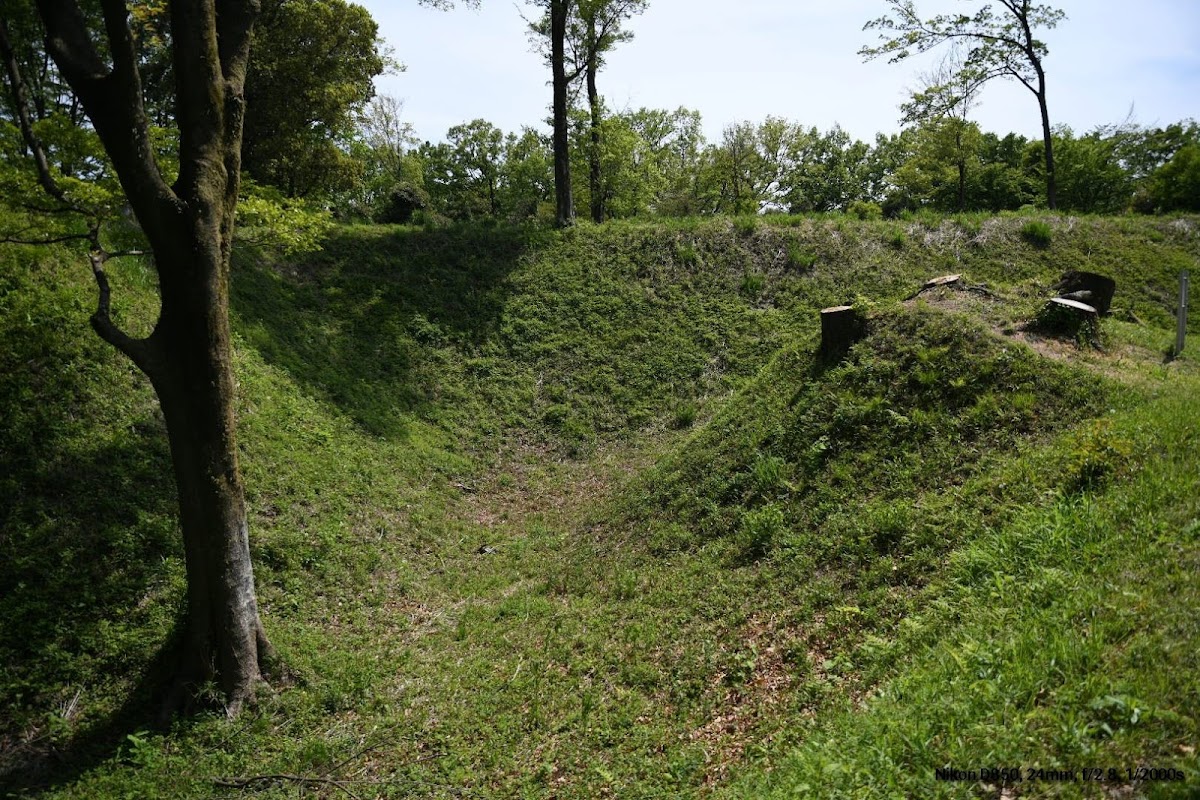
The greatest highlight of the Sugaya Castle Ruins is undoubtedly the well-preserved earthworks and dry moats. The earthworks, 3 to 5 meters high, retain their imposing presence even more than 400 years after their construction.
The earthen ramparts surrounding the second enclosure are particularly impressive, and you can walk along them. The depth of the dry moat viewed from atop the ramparts is breathtaking, giving you a real sense of the formidable defensive structure of the time. In spring, cherry blossoms bloom along the ramparts, making it a popular spot for enjoying both historical sightseeing and cherry blossom viewing.
Statue of Hatakeyama Shigetada
The statue of Hatakeyama Shigetada, standing on the earthen ramparts of the second enclosure, is a rare bamboo-reinforced concrete statue erected in 1929. Standing approximately 3 meters tall, the statue depicts Shigetada in armor, gazing into the distance, conveying the dignity of Shigetada, who was hailed as a “model of a Kamakura samurai.”
Designated as a cultural property of Arashiyama Town in 2011, this statue is a symbolic presence at the Sugaya-kan ruins and a popular spot for many visitors to take commemorative photos.
Restored Wooden Bridge and Entrance
Based on archaeological excavations, a wooden bridge and entrance (koguchi) have been restored in part of the castle ruins. Crossing the wooden bridge over the dry moat offers a valuable opportunity to relive the experience of entering a castle during the Sengoku period.
The structure of the entrance features a clever design to prevent enemy intrusion, allowing for close observation of the ingenuity of castle architecture.
Rich Natural Environment
The Sugaya Castle Ruins are preserved as a vast green space of approximately 130,000 square meters, offering a place to enjoy nature throughout the seasons. From cherry blossoms in spring, fresh greenery in early summer, autumn leaves, to the tranquility of winter, the castle ruins display different expressions with each season, making it a valuable spot to enjoy historical walks and nature observation simultaneously.
Various wildflowers and trees grow on the slopes of the earthworks and dry moats, maintaining a rich ecosystem despite its proximity to an urban area. It is also known as a birdwatching spot, attracting many visitors who enjoy birdwatching.
Sugaya Castle as one of the Continued Top 100 Japanese Castles
On April 6, 2017, Sugaya Castle was designated one of the “Continued Top 100 Japanese Castles” by the Japan Castle Association. This selection, along with Oshi Castle (Gyoda City) and Sugiyama Castle (Ranzan Town), is from Saitama Prefecture, signifying the nationwide recognition of Sugaya Castle’s historical and cultural value.
The stamp for the Continued Top 100 Japanese Castles can be obtained at the Saitama Prefectural Ranzan Historical Site Museum. Castle stamps are also available for purchase at the museum, and are popular among castle enthusiasts as souvenirs of their castle tours.
Sugaya Castle, as a representative example of an “earthen castle,” is a historical site where you can fully appreciate the charm of a medieval castle, distinct from the stone-walled castles of the early modern period. Visiting it together with Sugiyama Castle allows you to understand the castle system of the Hiki region during the Sengoku period.
Location and Access Information
Location
Sugaya-kan Ruins / Saitama Prefectural Ranzan Historical Site Museum
757 Sugaya, Ranzan-machi, Hiki-gun, Saitama Prefecture 355-0221
The ruins of the castle are located south of Ranzan Town Sugaya Elementary and Junior High Schools, adjacent to National Route 254. It is a vast green forest, popular with locals, and you can see people enjoying walks and jogging there.
Access by Train
Musashi-Ranzan Station on the Tobu Tojo Line is the nearest station. You can access the ruins from the station using the following methods:
- Walking: Approximately 1.5 kilometers, about 20 minutes
- Bus: Get off at the Eagle Bus “Sugaya-kan Ruins” bus stop (buses are infrequent, so checking in advance is recommended)
- Taxi: Approximately 5 minutes
The route from Musashi-Ranzan Station to the museum is well-marked and relatively easy to follow. There is a tourist information center near the station where you can obtain maps.
Access by Car
It’s approximately 10 minutes from the Higashimatsuyama IC on the Kan-Etsu Expressway, or approximately 5 minutes from the Arashiyama-Ogawa IC.
Heading towards Yorii on National Route 254, turn left at the road before the entrance to Otsuma Arashiyama High School to enter the parking lot of the Saitama Prefectural Arashiyama Historical Site Museum. Parking is free and has space for approximately 50 regular-sized cars.
If using a car navigation system, searching for “Saitama Prefectural Arashiyama Historical Site Museum” or its phone number is recommended.
Opening Hours and Closing Days
Saitama Prefectural Ranzan Historical Site Museum
- Opening Hours: 9:00 AM – 4:30 PM (Last entry at 4:00 PM)
- Closing Days: Mondays (Open on national holidays and substitute holidays, closed the following day), New Year’s holidays (December 29th – January 3rd)
- Admission Fee: General 100 yen, High school students and university students 50 yen, Junior high school students and younger, and those 65 years and older are free
*Special fees may apply during special exhibitions
The site itself is always open, and you can stroll around even outside of the museum’s opening hours. However, to obtain stamps, castle seals, and view the exhibits, you must visit during the museum’s opening hours.
Nearby Tourist Attractions
Sugiyama Castle Ruins
Sugiyama Castle Ruins, also selected as one of the Continued Top 100 Japanese Castles, is located in Ranzan Town, about a 10-minute drive away. Sugiyama Castle, often called a “textbook of castle construction” and a “masterpiece of Sengoku period castles,” is known for its complex layout and ingenious defensive structures. Visiting it together with Sugaya-kan offers a valuable understanding of the development of castle architecture from the medieval to the Sengoku period.
Kamakura Road and Surrounding Historical Sites
Around Sugaya-kan, numerous remains of the Kamakura Road (Upper Route) and related historical sites are scattered. A popular historical walk follows the Kamakura Road, a major transportation route in the medieval period, visiting milestones, mileposts, and battlefield sites.
National Women’s Education Center and Arashiyama Valley
Arashiyama Valley, the origin of the town’s name, is a beautiful valley with scenery similar to Arashiyama in Kyoto. It is particularly popular with tourists during the autumn foliage season. The National Women’s Education Center (NUEC) also hosts various training programs and exhibitions.
Points to Note When Visiting Sugaya Castle
Estimated Visit Time
It’s recommended to allow 2-3 hours for both visiting the museum exhibits and exploring the castle ruins. To carefully observe the earthworks and moats, and to contemplate the medieval castle while touring the various enclosures, we recommend visiting with ample time.
Clothing and Items to Bring
Since the castle ruins are a vast open-air historical site, the following preparations will make your visit more comfortable.
- Comfortable shoes: Sneakers or trekking shoes are ideal for walking on the earthworks and along the edges of the dry moats.
- Seasonal clothing: The sun is strong in summer and the wind is cold in winter, so bring a hat and warm clothing.
- Insect repellent: Especially in summer, there are many mosquitoes and gnats, so it’s essential to have some on hand.
- Drinks: There are no vending machines within the castle grounds, so it’s best to bring your own.
Photo Spots
- Statue of Hatakeyama Shigetada: Located on the earthworks of the second enclosure, it’s perfect for commemorative photos with the blue sky as a backdrop.
- Earthworks and Dry Moat: An angle that allows you to appreciate the view from the earthworks around the main enclosure and the depth of the dry moat.
- Wooden Bridge: The combination of the restored wooden bridge and dry moat is a popular spot that gives a sense of the atmosphere of a medieval castle.
- Cherry Blossoms in Spring: The row of cherry trees along the earthworks is a beautiful photo spot where history and nature harmonize.
Utilizing the Museum
Before visiting the castle ruins, we recommend first viewing the exhibits at the museum to learn about the history and structure of Sugaya Castle. The museum distributes free visitor maps, which will help you understand the relative locations of each enclosure and structure as you explore the ruins.
Curator explanations and volunteer guided tours (advance reservations required) may also be available, so those who wish to learn more should inquire at the museum.
Cultural Value of Sugaya Castle
The Sugaya Castle ruins possess high cultural value in the following respects:
Witness to Historical Change
This is a valuable historical site where the process of transformation from a samurai residence of the Kamakura period to a castle of the Sengoku period can be gleaned from the remains. This historical transition illustrates the changes in the social structure of medieval Japan, particularly the development of samurai residences into castles as military facilities.
Representative Example of an Earthen Castle
As an “earthen castle” that does not use stone walls, it represents the pinnacle of medieval castle construction technology in the Kanto region. The defensive system, constructed solely of earthworks and dry moats, is a testament to a design philosophy that skillfully utilizes the terrain and the culmination of advanced civil engineering techniques.
Connection to the Historical Figure Hatakeyama Shigetada
As the site of the residence of Hatakeyama Shigetada, hailed as a “model of a Kamakura samurai,” this is an important historical site for understanding the samurai culture of the Kamakura period. Shigetada is remembered for his exceptional loyalty and martial prowess, and his residence, Sugaya-kan, is significant as a place to explore the origins of the samurai spirit.
Importance in Regional History
As a core site of the castles and fortifications along the Kamakura Road in the Hiki region, this is an indispensable historical site for understanding the history of Musashi Province. The network of castles and fortifications in the Hiki region, centered around Sugaya-kan, holds the key to unraveling the political and military structure of medieval Kanto.
Summary
Sugaya-kan (Ranzan-machi, Hiki-gun, Saitama Prefecture) is a nationally designated historic site known as the residence of Hatakeyama Shigetada, a samurai from the Kamakura period. During the Sengoku period, it developed into a military fortress known as Sugaya Castle. Its historical and cultural value has been widely recognized since its designation as a national historic site in 1973 and its inclusion in the Continued Top 100 Japanese Castles in 2017.
The well-preserved earthworks and dry moats are considered among the best examples of “earthen castles” in Saitama Prefecture, offering insights into the techniques and design philosophy of medieval castle architecture. The Saitama Prefectural Ranzan Historical Site Museum, located on the site, features extensive exhibits on Hatakeyama Shigetada and the history of Musashi Province during the medieval period. Visitors can learn more through permanent exhibitions, special exhibitions, and history lectures.
Located approximately 20 minutes on foot from Musashi-Arashiyama Station on the Tobu Tojo Line and about 10 minutes by car from the Higashimatsuyama Interchange on the Kan-Etsu Expressway, Sugaya Castle Ruins boasts excellent accessibility and offers free parking. A visit to the museum beforehand will allow for a more enriching historical experience.
Enjoying the seasonal beauty of Sugaya Castle Ruins—cherry blossoms in spring, lush greenery in early summer, and vibrant autumn leaves—makes it a recommended spot not only for history buffs but also for nature lovers. You can also obtain stamps for the Continued Top 100 Japanese Castles and castle seals at the museum, making them perfect souvenirs of your castle tour.
Sugaya Castle offers a chance to experience Japanese medieval history, spanning from the Kamakura period to the Sengoku period, through actual ruins. Be sure to visit and feel the footsteps of Hatakeyama Shigetada, the “model Kamakura samurai,” and the charm of this earthen castle.