Suemori Castle (Hodatsushimizu Town, Ishikawa Prefecture): A thorough explanation of the site of the Battle of Suemori, which laid the foundation for the Kaga domain’s million-koku power.
What is Suemori Castle?
Suemori Castle is a medieval to early modern mountain castle site located in Takenono, Hodatsushimizu Town, Hakui District, Ishikawa Prefecture. Built around the summit of Mount Suemori (138.8 meters above sea level, a third-order triangulation point), the castle, also referred to as “Suemori” or “Suemori” in historical records, played an important role as a strategic military point bordering the three provinces of Kaga, Noto, and Etchu.
Currently, the Suemori Castle site is protected as a designated historical site of Ishikawa Prefecture. The castle’s baileys are scattered throughout the mountain, covering a total area of approximately 30,000 square meters. It possesses a typical structure of a multi-bailey mountain castle, with the main bailey, second bailey, Wakamiya bailey, and third bailey arranged in a stepped pattern, making it a valuable cultural asset that conveys the appearance of a Sengoku period mountain castle.
History of Suemori Castle
Construction and Early History
The exact year of construction of Suemori Castle is unknown, but it is believed to have existed since the Sengoku period. It is thought to have been initially built by Doi Chikazane, a vassal of the Hatakeyama clan, the shugo daimyo of Noto Province, and a local administrator.
By 1577 (Tensho 5), the castle lord, Doi Chikazane, had already become a vassal of the Uesugi clan. In the same year, when Uesugi Kenshin of Echigo attacked Nanao Castle in Noto, Doi Chikazane is believed to have cooperated with the Uesugi. During this period, Suemori Castle functioned as one of the important bases in the Uesugi clan’s control of Noto.
Oda Nobunaga’s Conquest of Noto and the Doi Clan
In 1580 (Tensho 8), when Oda Nobunaga conquered Noto, the Doi clan surrendered to the Oda clan. Nanao Castle was commanded by Sugaya Nagayori, a close confidant of Oda Nobunaga, and Doi Chikamasa came under his command. During this period, the Doi clan was involved in securing the land holdings of the Keta Taisha Shrine and repairing the shrine grounds, contributing to the governance of the region.
Later, it is said that Doi Chikamasa was killed in the Battle of Shizugatake. After the Doi clan, Suemori Castle came under the control of the Maeda clan, and Okumura Nagatomi, a general of the Maeda side, became the castle’s commander.
The Battle of Suemori in 1584
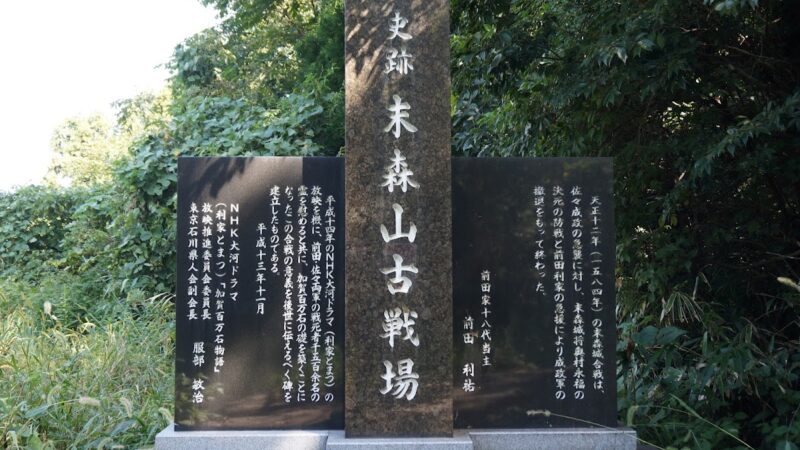
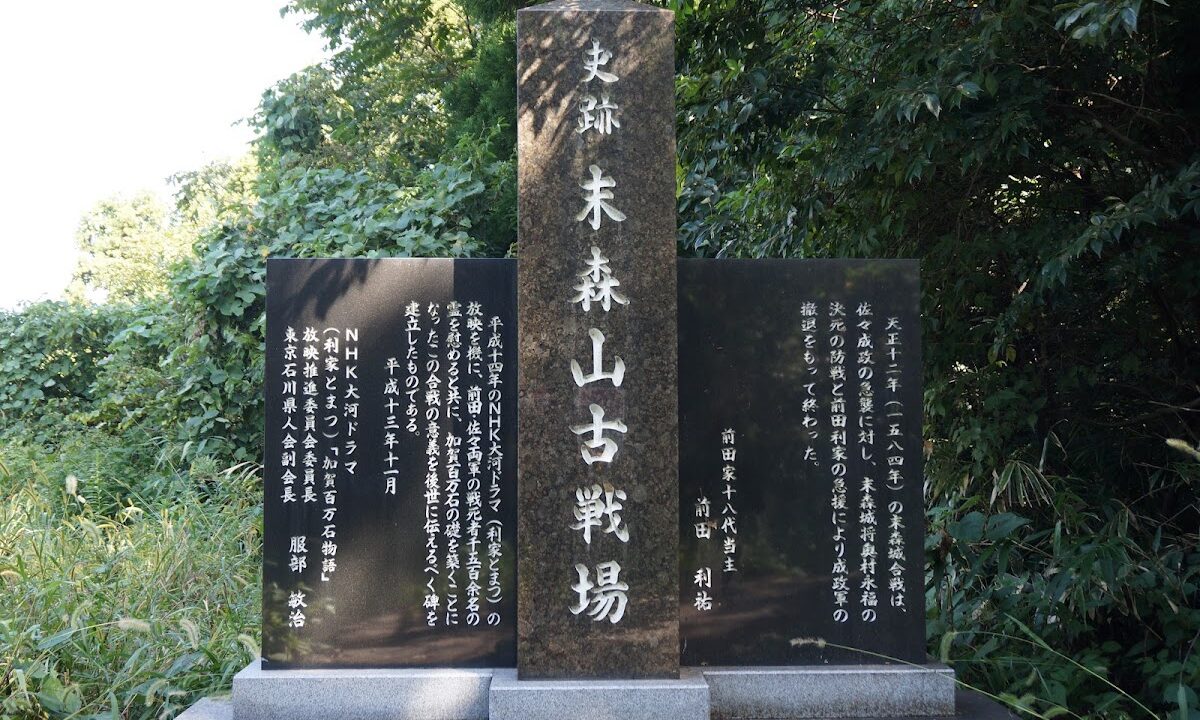
The most important event that etched the name of Suemori Castle into history was the “Battle of Suemori,” which took place in September of 1584. This battle was extremely important for the Maeda family, who are said to have laid the foundation for the Kaga domain’s million-koku rule.
Sasa Narimasa, lord of Toyama Castle in Etchu Province, led a large army of approximately 15,000 men to attack Suemori Castle. Sasa Narimasa’s aim was to divide the territories of Maeda Toshiie, namely Kaga and Noto, and weaken the Maeda family’s power. Suemori Castle was a strategically important location on the border of Kaga, Noto, and Etchu provinces, and he sought to gain a strategic advantage by capturing it.
The castle lord, Okumura Nagafuku, defended the castle with a small force against Sasa’s fierce attack. Despite the overwhelming numerical disadvantage, Okumura Nagafuku and his samurai held out until reinforcements from Maeda Toshiie arrived. When the reinforcements, led by Maeda Toshiie himself, arrived, the tide turned, and Sasa’s army was forced to retreat.
This victory at the Battle of Suemori solidified the Maeda family’s control over Noto and paved the way for their later expansion into Etchu. This battle truly laid the foundation for Kaga’s million-koku domain, and Okumura Nagafuku’s achievements were highly regarded within the Maeda family.
Until the Castle’s Demolition
Even after the Battle of Suemori, Suemori Castle continued to function as an important branch castle of the Maeda family. However, it was demolished in 1615 due to the “One Castle Per Province Decree of Genna.” This decree, issued by the Edo Shogunate, ordered each domain to retain only one castle and demolish all others. Suemori Castle’s role ended under this policy, and it subsequently disappeared from the stage of history.
Structure and Remains of Suemori Castle
Castle Layout
Suemori Castle is a multi-bailey mountain castle built on Mount Suemori, which is 138.8 meters above sea level. The main bailey is located at the summit, and surrounding it are other baileys such as the second bailey, Wakamiya bailey, and third bailey arranged in a stepped (staircase) pattern. This layout is excellent for defense, as it allows for flanking attacks from each bailey when an enemy attacks.
The main bailey is the central part of the castle and is located at the highest point. From here, the surrounding terrain could be seen in its entirety, allowing for early detection of enemy movements. The second bailey, Wakamiya bailey, and third bailey each functioned as defensive positions protecting the main bailey, forming a vast castle area totaling approximately 30,000 square meters.
Defensive Structures
Suemori Castle had numerous dry moats (karabori). Dry moats are moats that do not hold water and are a common defensive structure in mountain castles. These dry moats were positioned between baileys and served to hinder enemy advances.
Even today, visitors to the castle ruins can see the remains of these dry moats. While some parts have been filled in over the long years, many sections remain clearly visible, making them valuable remains for understanding the castle’s structure at the time.
Current State
Currently, the Suemori Castle ruins are overgrown with trees, and no clear historical structures such as buildings remain. However, the layout of the baileys and topographical features such as the dry moats are well preserved, and information boards have been installed. The Hodatsushimizu Town Board of Education is also continuously conducting investigations, making progress in clarifying the castle’s boundaries, structure, and purpose.
The “Hodatsushimizu Town Suemori Castle and Other Castle Sites Survey,” conducted from 2005 to 2006, included detailed investigations not only of Suemori Castle itself but also of related facilities in the surrounding area. In particular, historical records remain regarding the location believed to have been used as the headquarters by Sasa Narimasa during the Battle of Suemori, contributing to a better understanding of the battle’s events.
Access and Tourist Information for Suemori Castle
Basic Information
Location: Takenono, Hodatsushimizu-cho, Hakui-gun, Ishikawa Prefecture
Elevation: 138.8 meters (Third-order triangulation point)
Designation: Ishikawa Prefecture Designated Historic Site
Castle Type: Concentric mountain castle
Year of Construction: Unknown (Sengoku period)
Main Lords: Doi Chikamasa, Okumura Nagafuku
Year of Abandonment: Genna 1 (1615)
Transportation Access
Using Public Transportation: Get off at JR Nanao Line “Hodatsu Station,” approximately 40 minutes on foot. Since there is an uphill slope from the station to the castle ruins, comfortable walking shoes are recommended.
Using a Car: Approximately 15 minutes from Noto Toll Road “Imahama IC.” There is parking space near the castle ruins, but you will need to drive up a mountain path, so please drive carefully.
Points to Note When visiting Suemori Castle Ruins, paying attention to the following points will allow you to feel the history more deeply:
- Layout of Enclosures: You can actually walk and experience the stepped layout from the main enclosure to the third enclosure.
- Remains of Dry Moats: You can see the remains of the defensive facilities from that time.
- View: From the mountaintop, you can see the three provinces of Kaga, Noto, and Etchu, helping you understand why this castle was a strategic point.
- Information Boards: Detailed explanations about the castle’s history and structure are available.
Precautions When Visiting
- As it is a mountain castle, comfortable clothing and shoes are essential.
- Don’t forget insect repellent in the summer.
- Prepare drinking water in advance.
- Be careful as the ground can be slippery in rainy weather or after rain.
- In winter, climbing the castle may be difficult due to snow.
Tourist Spots Around Suemori Castle
Mount Hodatsu
Hodatsushimizu Town is home to Mount Hodatsu (637 meters above sea level), the highest peak in the Noto region. Visiting it in conjunction with Suemori Castle will allow you to gain a deeper understanding of the region’s geographical features.
Keta Taisha Shrine
Keta Taisha Shrine, known as the Ichinomiya (first-ranked shrine) of Noto Province, is a historically significant shrine where Doi Chikamasa, the lord of Suemori Castle, was involved in securing and restoring the shrine’s land. Located about 30 minutes by car from Suemori Castle, you can visit the shrine while feeling its historical connection.
Historical and Cultural Facilities in Hodatsushimizu Town
Hodatsushimizu Town also has facilities exhibiting materials related to Suemori Castle. The town’s Board of Education’s Cultural Properties Office offers opportunities to view the results of castle surveys and excavated artifacts, so it is recommended to inquire in advance.
Noto in the Sengoku Period as Told by Suemori Castle
Suemori Castle was not merely a military facility, but a political, military, and cultural hub in the Noto region during the Sengoku period. The castle served as the stage for conflicts between prominent warlords of the Sengoku period, such as Uesugi Kenshin, Oda Nobunaga, Maeda Toshiie, and Sasa Narimasa, playing a significant role in shaping the region’s history.
In particular, the Battle of Suemori in 1584 (Tensho 12) was a crucial victory for the Maeda family on their path to becoming the Kaga domain of one million koku. The combination of Okumura Nagafuku’s desperate defense with a small force and Maeda Toshiie’s swift reinforcements demonstrated the Maeda family’s unity and strategic judgment, laying the foundation for their later prosperity.
Currently, the Suemori Castle ruins are located in a quiet mountain area, but the topography and remains evoke the spirit of the Sengoku period. Protected as a designated historical site of Ishikawa Prefecture, this castle site is a valuable place for learning about local history and experiencing Noto during the Sengoku period, and is popular with many history enthusiasts and tourists.
Summary
Suemori Castle is a Sengoku period mountain castle ruin remaining in Hodatsushimizu Town, Ishikawa Prefecture, and holds historical significance as the stage of the Battle of Suemori, which laid the foundation for the Kaga domain of one million koku. From the history of its lords, spanning from Doi Chikamasa to Okumura Nagafuku, to the battle with Sasa Narimasa in 1584, and its eventual abandonment due to the “One Castle Per Province” decree of the Genna era, this castle is a valuable historical site that tells the story of the Sengoku period in the Noto region.
The structure of this mountain castle, built on Mt. Suemori at an altitude of 138.8 meters, features a multi-bailey design, and the layout of the main bailey, second bailey, Wakamiya bailey, and third bailey, as well as the dry moats used as defensive structures, the remaining remains convey the castle-building techniques and strategic thinking of the time.
When visiting Hodatsushimizu Town, be sure to visit the Suemori Castle ruins and experience the view that Sengoku warlords saw from the mountaintop overlooking the three provinces of Kaga, Noto, and Etchu. This place, where the weight of history and the beauty of nature merge, is sure to leave a profound impression on visitors.