Tawaramoto Jinya Ruins (Tawaramoto Town, Shiki District) | A Thorough Explanation of the Historical Heritage of the Nara Basin Ruled by the Hirano Clan
Located in the heart of Tawaramoto Town, Shiki District, Nara Prefecture, the Tawaramoto Jinya Ruins are the site of a jinya (fortified residence) ruled by the Hirano clan during the Edo period. While the original buildings no longer exist, and the site is now used as the Tawaramoto Town Hall and a town hall, the surrounding area retains traces of history with its Edo-period town layout and related historical sites. This article provides a detailed explanation of the historical background, current situation, and surrounding attractions of the Tawaramoto Jinya Ruins.
Basic Information on the Tawaramoto Jinya Ruins
The Tawaramoto Jinya Ruins are a historical site located at 890-1 Tawaramoto Town, Shiki District, Nara Prefecture. Also known as the “Hirano Clan Jinya,” it was the location of the Tawaramoto Domain’s administrative office during the Edo period.
Location: 890-1 Tawaramoto-cho, Shiki-gun, Nara Prefecture (around Tawaramoto Town Hall)
Construction Date: Kan’ei 12 (1635)
Builder: Hirano Nagakatsu
Classification: Jinya (fortified residence)
Current Status: Tawaramoto Town Hall, Town Hall, residential area
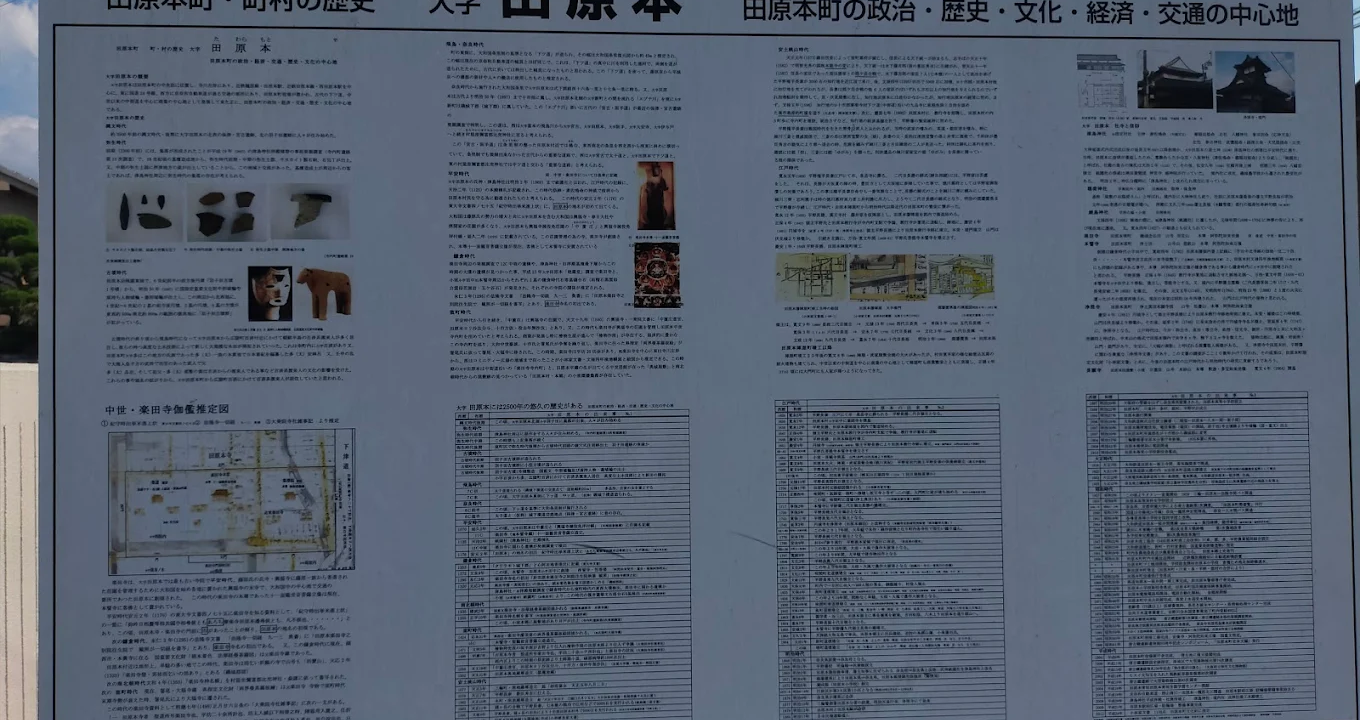
Although the Jinya buildings no longer exist, explanatory signs are installed in the parking lot west of the town hall and the parking lot of the town hall, allowing visitors to learn about the former Jinya.
Historical Background of Tawaramoto Jinya
The Hirano Clan and the Establishment of the Tawaramoto Domain
The history of the Tawaramoto Jinya dates back to the time of Toyotomi Hideyoshi. In Bunroku 4 (1595), Hirano Nagayasu, known as one of the Seven Spears of Shizugatake, was granted land in seven villages near Tawaramoto. This marked the origin of the Tawaramoto Domain.
Hirano Nagayasu was a samurai who served under Toyotomi Hideyoshi and was a renowned general, counted among the “Seven Spears” for his achievements at the Battle of Shizugatake. However, he sided with the Western Army at the Battle of Sekigahara and temporarily lost his territory.
Construction of the Jinya and Hirano Nagakatsu
During the Edo period, the Hirano clan served the Tokugawa shogunate, and in 1635, Hirano Nagakatsu built a jinya (fortified residence) in Tawaramoto. Nagakatsu was Nagayasu’s grandson and was responsible for restoring relations with the Tokugawa family and recovering their territory.
The Tawaramoto jinya was built on a flat area almost in the center of the Nara Basin, with the Hatsuse River to the east and the Asuka River to the west. This location was a strategic point for transportation and offered a panoramic view of the Nara Basin.
The History of the Tawaramoto Domain
The Tawaramoto Domain was a small domain with a 10,000 koku (unit of rice production) yield, but the Hirano clan served as its lords for 12 generations until the end of the Edo period. Despite its small size, the domain continued to function as an important base in the Nara Basin.
After the Meiji Restoration, the Tawaramoto Domain was abolished due to the abolition of the feudal domains and the establishment of prefectures, and the domain’s headquarters ceased to function. Subsequently, the site of the headquarters developed into the town center, leading to the construction of the current Tawaramoto Town Hall.
Current Status of the Tawaramoto Domain Headquarters Site
Preservation Status of Remains
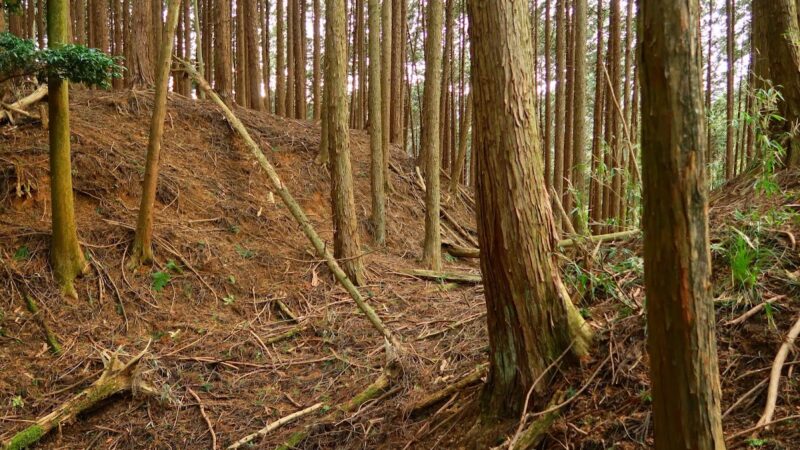
Unfortunately, the buildings of the Tawaramoto Domain Headquarters no longer exist. The current Tawaramoto Town Hall, town hall, and surrounding residential areas correspond to the site of the domain headquarters. However, not all remains have been completely lost, and several traces can still be seen.
The Inari Shrine, which was located in the northeast corner of the headquarters, still exists and provides a clue to understanding the boundaries of the headquarters at that time. Furthermore, the Edo-period town layout remains relatively well-preserved on the west side of the Jinya (fortified residence), allowing visitors to experience the atmosphere of the townscape at that time.
Information Board and Guide
An information board about the Tawaramoto Jinya site is installed in the parking lot of the Tawaramoto Town Hall’s community hall. This board contains information about the history of the Jinya and the Hirano clan, allowing visitors to learn about its history.
The board also includes a layout map of the Jinya and photographs of illustrations depicting the site at the time, allowing visitors to visually understand the overall layout of the Jinya.
Access
The Tawaramoto Jinya site is approximately a 5-minute walk from Kintetsu Tawaramoto Line’s “Nishi-Tawaramoto Station” or approximately a 10-minute walk from Kintetsu Kashihara Line’s “Tawaramoto Station.” By car, it is approximately 15 minutes from the Nishi-Meihan Expressway’s “Horyuji IC.”
While Tawaramoto Town Hall has a parking lot for visitors, it is recommended to avoid long-term parking for historical site visits and instead use nearby coin-operated parking lots.
Nearby Historical Attractions
Joshoji Temple’s Relocated Gate from Fushimi Castle
Joshoji Temple, located within walking distance of the Tawaramoto Jinya (fortified residence) site, houses a Korean-style gate said to have been relocated from Fushimi Castle. This gate is a valuable cultural asset that preserves the architectural style of the early Edo period and is indispensable when discussing the history of Tawaramoto Town.
The Korean-style gate is a dignified gate composed of two main pillars and two supporting pillars, and was used as the main gate of samurai residences and castles. The gate at Joshoji Temple is noteworthy as a relic that demonstrates the deep relationship between the Hirano clan and the Toyotomi family.
Edo Period Town Layout
To the west of the Tawaramoto Jinya, the town layout from the Edo period is well-preserved. The grid-like street layout and scattered buildings that retain the appearance of merchant houses from that time make it an ideal area for historical walks.
In particular, the structure of the castle town centered around the Jinya remains clearly visible, allowing you to see the division between the samurai residence area and the merchant area. The long-established shops and old townhouses that still exist today tell the story of the town’s prosperity at the time.
Historical and Cultural Resources of Tawaramoto Town
Besides the ruins of the jinya (fortified residence), Tawaramoto Town possesses many other historical and cultural resources. According to the Nara Prefecture Historical and Cultural Resources Database “Ikasu Nara,” Tawaramoto Town is also known as a place associated with Prince Shotoku and is a region with a multi-layered history spanning from ancient times to the medieval and early modern periods.
Within the town, there is also the Karako-Kagi Ruins, a large-scale settlement site from the Yayoi period, making it a valuable place to learn about Japanese history in a comprehensive manner.
Evaluation and Historical Significance of the Tawaramoto Jinya Ruins
Position in Castle History
The Tawaramoto Jinya had a typical form as a jinya of a small domain during the Edo period. Unlike large castles, jinya were facilities centered on administrative functions, with limited defensive capabilities.
Many of the jinya that existed throughout Japan were demolished after the Meiji Restoration, and very few remains today. The Tawaramoto Jinya (fortified residence) is similar in that the surrounding town layout and related historical sites remain, making it a valuable example that allows us to infer what it was like at the time.
Importance in Local History
The Tawaramoto Jinya site is an important historical site that shows the reality of regional governance in the Nara Basin during the Edo period. While Nara Prefecture also has large castles such as Yamato-Koriyama Castle, the history of the Tawaramoto Domain, which governed closely with the local community as a small domain’s fortified residence, is indispensable for understanding the formation process of the local community.
The Hirano clan’s rule over the domain for 12 generations greatly contributed to the stability and development of the region. The current Tawaramoto Town’s development as a central town in the Nara Basin is rooted in its foundation as a fortified residence town during the Edo period.
Visiting Guide to the Tawaramoto Jinya Site
Points to Note When visiting the Tawaramoto Jinya site, paying attention to the following points will allow you to understand the history more deeply.
- Information Board in the Town Hall Parking Lot: First, get an overview of the fortified residence from this information board.
- Inari Shrine at the Northeast Corner of the Jinya (fortified residence): This is an important surviving structure that indicates the boundaries of the Jinya.
- Town Layout on the West Side: You can feel the atmosphere of an Edo period townscape.
- Kōraimon Gate of Jōshōji Temple: This is a valuable surviving structure that shows the relationship between the Hirano clan and the Toyotomi family.
- Around the Tawaramoto Town Hall: You can realize that the modern administrative center was once the site of the Jinya.
Best Time to Visit
The Tawaramoto Jinya Site is an outdoor historical site and can be visited year-round. However, for exploring the surrounding area, the best time is during the mild weather of spring (March-May) or autumn (October-November).
Tawaramoto Town hosts various historical and cultural events throughout the year. Visiting in conjunction with these events will provide a more fulfilling experience.
Estimated Time Required
If you only plan to visit the Tawaramoto Jinya Ruins, it will take about 30 minutes. However, if you also want to explore the surrounding area, including Joshoji Temple and the Edo-period town layout, you should allow 1-2 hours.
If you plan to visit other historical sites in Tawaramoto Town, such as the Karako-Kagi Ruins, we recommend allocating half a day to a full day.
History and Culture of Tawaramoto Town
Transition from Ancient to Early Modern Periods
The history of Tawaramoto Town begins with the Karako-Kagi Ruins of the Yayoi period. These ruins boast one of the largest scales of a moated settlement in Japan and are extremely important for understanding the social structure of the Yayoi period.
In ancient times, it was known as a place associated with Prince Shotoku, and many temples were built there. In the Middle Ages, temples and shrines exerted strong influence, and during the Sengoku period, it was ruled by various warlords.
In the early modern period, it developed as a jinya town under the rule of the Hirano clan and prospered as a transportation hub in the Nara Basin. The foundation of the town formed during this period forms the basis of present-day Tawaramoto Town.
Modern Tawaramoto Town
Present-day Tawaramoto Town is a town with a population of approximately 30,000, and continues to develop as a transportation hub located in the center of the Nara Basin. The Kintetsu Tawaramoto Line and Kashihara Line intersect here, providing excellent access to surrounding municipalities.
The town is focusing on town development that utilizes its historical and cultural resources, aiming for “Tawaramoto, a town where everyone, from children to the elderly, can enjoy a vibrant life.”
Summary
Although no buildings remain, the Tawaramoto Jinya (fortified residence) site is an important historical site that tells the history of Tawaramoto Town, Shiki District, Nara Prefecture. As the fortified residence of a small domain ruled by the Hirano clan for 12 generations, it played a significant role in the formation of the local community.
While the site of the fortified residence is now the Tawaramoto Town Hall, related historical sites such as the Edo period town layout and the relocated gate of Joshoji Temple from Fushimi Castle are scattered around the area. Visiting these sites allows you to experience the atmosphere of a jinya town from the Edo period.
When visiting Nara Prefecture, why not explore not only Nara City and the Asuka region, but also Tawaramoto Town, located in the center of the Nara Basin, and learn about the history of the jinya town ruled by the Hirano clan? With its layered history spanning from ancient to early modern times, Tawaramoto Town is a valuable place for understanding Japanese history from a holistic perspective.
By visiting the Tawaramoto Jinya ruins, you can learn about the realities of governance by a small, locally-focused domain, which differed from large-scale castles. It is a hidden historical heritage of Nara Prefecture that you should definitely visit.