Complete Guide to Shinori Castle: History, Remains, and Access Information for the Twelve Castles of Southern Hokkaido
What is Shinori Castle?
Shinori Castle (also known as Shinoridate) is the site of a medieval castle located in Shinori-cho, Hakodate City, Hokkaido. It is one of the twelve castles of Southern Hokkaido built by the Wajin (Japanese from Honshu) who advanced into the Oshima Peninsula between the 14th and 15th centuries, and is known as an important castle located at the easternmost point of these castles.
Currently designated as a national historic site, it is also selected as one of the Continued Top 100 Japanese Castles (No. 101). Its convenient location, approximately 2 kilometers from Hakodate Airport, makes it easily accessible for castle enthusiasts and history buffs.
The Position of Shinori Castle within the Twelve Castles of Southern Hokkaido
What are the Twelve Castles of Southern Hokkaido?
The Twelve Castles of Southern Hokkaido are a collective term for the castles built by the Wajin in the southern part of the Oshima Peninsula, as described in the historical record “Shinra no Kiroku,” which records the history of the Matsumae Domain. These fortresses were built between the late 14th and 15th centuries by Japanese immigrants who came from Honshu to Ezo (present-day Hokkaido) as centers for trade and governance with the Ainu people.
Shinori Castle is the easternmost of these twelve fortresses in southern Hokkaido, built in a strategically important location overlooking Hakodate Bay. Other well-known fortresses include Mobetsu Castle, Nakano Castle, Wakimoto Castle, Onnai Castle, Haraguchi Castle, Hishi Castle, Nebota Castle, Atsuya Castle, Hanazawa Castle, Odachi Castle, and Kobayashi Castle.
Strategic Importance of Shinori Castle
Shinori Castle was built on a hill overlooking the sea, making it an extremely important location for monitoring and controlling maritime traffic in Hakodate Bay. The Japanese at the time transported marine products such as kelp and salmon to Honshu through trade with the Ainu people, and Shinori Castle is thought to have functioned as a key point on this trade route.
History of Shinori Castle
Construction and Early History
Shinori Castle is believed to have been built by the Kobayashi clan. According to the “Shinra no Kiroku” (Records of Shinra), Kobayashi Yoshikage resided there as the castle’s lord. The exact construction date is unclear, but it is estimated to be sometime between the late 14th and early 15th centuries.
At that time, the Japanese gained economic benefits through trade with the Ainu people, but gradually, oppression and exploitation of the Ainu intensified, and relations between the two sides became increasingly tense.
Koshamain’s Rebellion and the First Fall
In 1456 (Kōshō 2), the first major turning point in the history of Shinori Castle occurred. In this year, a large-scale uprising centered around the Ainu chief Koshamain took place. This event is known as “Koshamain’s Rebellion.”
The background to this uprising included unfair trade practices by Japanese merchants and discriminatory treatment of the Ainu people. The enraged Ainu people attacked the twelve forts of southern Hokkaido one after another, and Shinori Castle also fell to their attack.
The Koshamain Rebellion was ultimately suppressed through the efforts of Takeda Nobuhiro (later the ancestor of the Kakizaki and Matsumae clans), but many of the twelve forts of southern Hokkaido suffered significant damage, leaving deep scars on relations between the Japanese and the Ainu people.
Reconstruction and Second Fall
After the Koshamain Rebellion, Shinori Castle was rebuilt by the Kobayashi clan, and a lord once again resided there. However, the tension between the Japanese and the Ainu people was not completely resolved, and tragedy struck again half a century later.
In 1512 (Eisho 9), a second uprising by the Ainu people occurred. Shinori Castle fell again in this attack, and it is said that the lord, Kobayashi Yataro Yoshisada, was killed. Following this second fall, Shinori Castle was abandoned and never rebuilt.
History After the Castle’s Demise
After its fall in 1512, Shinori Castle became a ruin and was buried in the earth over many years. However, its remains were preserved in relatively good condition, and its historical value was re-recognized in modern times.
In 1936 (Showa 11), the Shinori Castle site was designated a national historic site, and since then, archaeological excavations and preservation work have been carried out. Currently, it is protected as an important cultural property of Hakodate City and as a valuable historical site for understanding the medieval history of Hokkaido.
Structure and Remains of Shinori Castle
Overall Layout
Shinori Castle is a flatland castle (castle) built on the flat surface of a hill facing the sea. Its basic structure is a single-enclosure layout surrounded by earthen ramparts, exhibiting a roughly rectangular shape.
The site of the castle measures approximately 70-80 meters east-west and 50-65 meters north-south, with an area of approximately 4,100 square meters within the enclosure surrounded by earthworks. The enclosure is a flat area with a gentle slope from north to south, suggesting that buildings were located there.
Features of the Earthworks
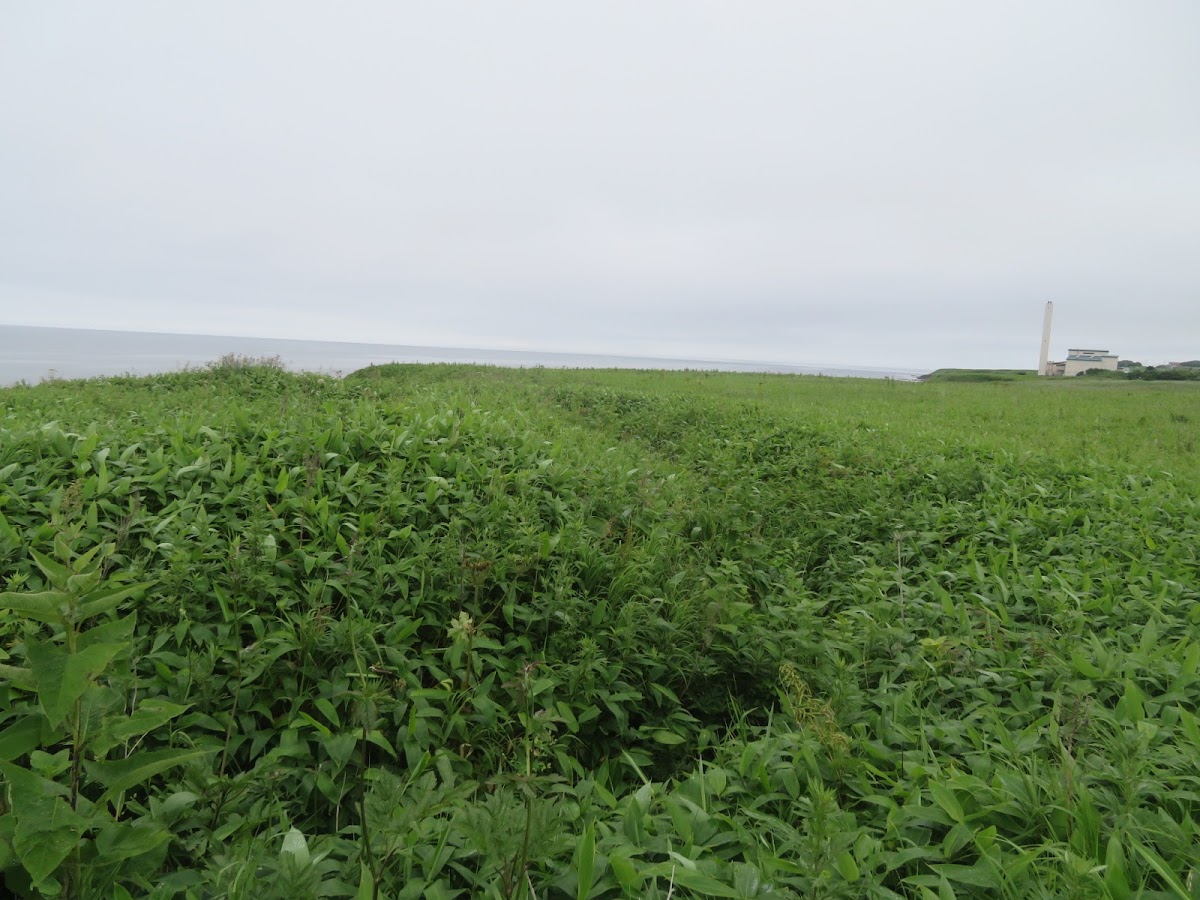
The most prominent remains of the Shinoi Castle are the earthworks surrounding all four sides. These earthworks are still clearly visible today, and while their height varies depending on the location, the highest point remains at approximately 2 meters.
Particularly noteworthy is the earthwork on the west side, which has a double-layered structure. It is believed that the double earthworks were constructed to strengthen defenses, as the west side needed to be prepared for attacks from the land. A passageway runs through the center of these double earthworks, and this is presumed to have been the main entrance to the castle.
Dry Moats
Outside the earthworks, particularly the outer moat on the west side and the outer moat on the north side, dry moats have been dug. These trenches were cleverly constructed, utilizing the natural valley terrain, demonstrating ingenuity in both enhancing defensive capabilities and reducing construction labor.
Even today, traces of the trenches can be seen in the topography, offering insights into the fortification techniques of the time.
Archaeological Findings
Several archaeological excavations have been conducted at Shinori Castle, yielding numerous important artifacts.
The unearthed artifacts include Chinese and Japanese copper coins (such as Eiraku Tsuho), ceramic fragments, iron objects, and bone and antler tools. Many of these artifacts date to the 15th to early 16th centuries, consistent with historical documents.
The discovery of copper coins, in particular, provides important evidence that Shinori Castle functioned as a trading hub at the time. Artifacts related to Ainu culture have also been unearthed, illustrating the history of interaction and conflict between the Japanese and Ainu people.
Highlights of Shinori Castle
Well-Preserved Earthworks
The biggest highlight of a visit to Shinori Castle is the remarkably well-preserved earthworks, dating back over 500 years. The double earthworks on the west side, in particular, are extremely valuable remains for understanding the defensive structure of medieval castles.
You can walk along the top of the earthworks, experiencing the scale and shape of the castle at that time. From the top of the earthworks, you can also enjoy views of Hakodate Bay and Mount Hakodate, giving you a real sense of why the castle was built in this location.
Spectacular Ocean Views
Because Shinori Castle is located on a hill overlooking the sea, you can enjoy beautiful views of Hakodate Bay from the castle ruins. On a clear day, you can even see Mount Hakodate and the scenery on the opposite shore, allowing you to imagine the castle’s owners gazing upon this same view.
Stamp for the Continued Top 100 Japanese Castles
Shinori Castle is selected as one of the Continued Top 100 Japanese Castles, making it an important point for castle enthusiasts participating in the stamp rally. The stamp is located at the “Blue Sky” shop on the second floor of Hakodate Airport, and can be stamped during business hours.
Information Boards and Signs
At the site of the Shinoi Castle, there are information boards explaining the history and structure of the castle. In addition, there are signs at the main remains, making it easy for first-time visitors to understand the location and significance of the remains.
Access and Visiting Information
Location
〒042-0922 Shinori-cho, Hakodate City, Hokkaido
Transportation Access
From Hakodate Airport
- Walking: Approximately 25 minutes (approximately 2 km)
- Taxi: Approximately 5 minutes
By Hakodate Bus
- Take Hakodate Bus “Route 96 (bound for Hiyoshi Bus Depot)” or “Route 100 (bound for Toi)” from Hakodate Station or Hakodate Airport
- Get off at the “Shinori” bus stop, approximately 5 minutes on foot
By Car
- Approximately 5 minutes from Hakodate Airport
- Approximately 20 minutes from Hakodate city center via National Route 278
- Parking: Several spaces available near the entrance to the historical site (free)
Visiting Information
- Visiting Hours: Always open (24-hour visits possible)
- Admission Fee: Free
- Estimated Time Required: Approximately 30 minutes to 1 hour
- Restrooms: There are no restrooms within the historical site. We recommend using the facilities at Hakodate Airport.
Points to Note During Your Visit
- Watch Your Step: The earthworks and enclosures are grassy and can become slippery after rain. We recommend wearing comfortable walking shoes.
- Insect Repellent: Mosquitoes and other insects are abundant in the summer, so we recommend carrying insect repellent spray.
- Winter Visits: Snowfall makes the ruins difficult to see in winter. Visiting from spring to autumn after the snow melts is recommended.
- Protection of Ruins: As this is a national historical site, damaging the earthworks or digging up the ruins is strictly prohibited.
Nearby Tourist Attractions
Hakodate Airport
This is the closest facility to Shinori Castle and is within walking distance. It is also a stamp location for the Continued Top 100 Japanese Castles, and has shops selling Hokkaido specialties and restaurants.
Shiryokaku
Another castle ruin located in Hakodate City, this Western-style fortress was built during the late Edo period. It is approximately a 20-minute drive from Shinori Castle.
Goryokaku
A representative tourist attraction of Hakodate, this star-shaped fortress is also selected as one of Japan’s 100 Famous Castles. It is approximately a 30-minute drive from Shinori Castle.
Mount Hakodate
Mount Hakodate, famous for its night view of Hakodate, is also accessible in about 30 minutes by car from Shinori Castle.
Historical Significance of Shinori Castle and the Twelve Fortresses of Southern Hokkaido
History of Contact Between the Japanese and Ainu People
The Twelve Fortresses of Southern Hokkaido, including Shinori Castle, are valuable historical sites from an era when the Japanese and Ainu people had significant contact, experiencing both exchange and conflict. These fortresses were not merely military facilities, but also trading posts, settlements, and places of cultural contact.
The two fall of Shinori Castle tells the history of the Ainu people’s resistance to Japanese encroachment. This history had a significant impact on the subsequent history of Hokkaido, ultimately leading to the establishment of the Matsumae Domain.
Value in Medieval Castle Research
Shinori Castle, with its unique characteristics distinct from medieval castles on Honshu, holds an important position in castle research. Its location and structure, different from mountain and flatland castles on Honshu, reflect the differences in the region’s climate, topography, and the targets of its defense (battles against the Ainu people).
Archaeological Value
The artifacts unearthed through excavations are valuable resources for understanding the material culture of Hokkaido from the 15th to the early 16th centuries. In particular, the discovery of Chinese and Japanese copper coins and ceramics indicates the extent of the trade network at that time.
Significance of Visiting Shinori Castle
Shinori Castle is an important historical site indispensable for understanding the medieval history of Hokkaido. Its proximity to Hakodate Airport and easy access make it a must-visit location when visiting Hokkaido.
The landscape, with its earthworks still standing from over 500 years ago, evokes a sense of historical romance. Furthermore, its location on a hill overlooking the sea allows us to imagine how the Japanese people of that time viewed Ezo (Hokkaido).
For castle enthusiasts enjoying the stamp rally for the Continued Top 100 Castles of Japan, as well as those interested in Hokkaido’s history and medieval castles, Shinori Castle is a must-see historical site. When sightseeing in Hakodate, why not visit this quiet historical site in addition to Goryokaku and Mount Hakodate?
Summary
Shinori Castle is a medieval castle site located at the eastern end of the Twelve Castles of Southern Hokkaido, and is a valuable historical site that conveys the history of contact and conflict between the Japanese and the Ainu people. Despite its tragic history of two falls in 1456 and 1512, its remains are well-preserved and it is a national historical site and one of the Continued Top 100 Castles of Japan, beloved by many.
Its convenient location within walking distance of Hakodate Airport and free admission make it an easy stop when visiting Hokkaido. The remains of earthworks and moats, the breathtaking ocean views, and the time spent reflecting on history from over 500 years ago will surely leave a deep impression on visitors.
If you are interested in the history of Hokkaido, medieval castles, or the relationship between the Japanese and Ainu people, be sure to visit Shinori Castle and experience its history and remains.