Complete Guide to Shimoakasaka Castle (Osaka Prefecture): A Historic Site Showcasing Kusunoki Masashige’s Ingenious Strategies and One of Japan’s Top 100 Terraced Rice Fields
Located in Chihayaakasaka Village, Minamikawachi District, Osaka Prefecture, Shimoakasaka Castle is a historical site where the brilliant strategist Kusunoki Masashige fought against the Kamakura Shogunate army from the late Kamakura period to the Nanboku-cho period. Currently designated a national historic site, the castle ruins are surrounded by beautiful terraced rice fields, selected as one of “Japan’s Top 100 Terraced Rice Fields,” making it a popular spot not only for history buffs but also for nature-loving tourists.
Historical Background of Shimoakasaka Castle
Construction History and Kusunoki Masashige
The exact construction date of Shimoakasaka Castle is unclear, but it is believed that in 1331, during the late Kamakura period, when Emperor Go-Daigo put his plan to overthrow the shogunate into action and raised an army at Kasagiyama, Kusunoki Masashige hastily constructed the castle in response. Kusunoki Masashige was a local lord of Kawachi Province (present-day southeastern Osaka Prefecture) and a key military commander who participated in Emperor Go-Daigo’s movement to overthrow the shogunate.
Masashige positioned Shimo-Akasaka Castle as a vanguard fortress, and Kami-Akasaka Castle, located across the Chihaya River, as his main castle. These two castles formed the core of the seven Kusunoki castles, strategically coordinating to serve as a base against the Kamakura shogunate forces.
The Genkō War and the Battle of Shimo-Akasaka Castle
In 1331, in response to Emperor Go-Daigo’s uprising, Kusunoki Masashige holed up in Shimo-Akasaka Castle to confront the Kamakura shogunate forces. Although the shogunate army boasted overwhelming numbers, Masashige employed a series of ingenious tactics, utilizing the terrain to his advantage, and outmaneuvered the larger army with a smaller force.
Masashige’s tactics were original, employing guerrilla warfare techniques such as luring enemies into the castle and using traps like pitfalls and rolling logs, as well as dousing them with boiling water and excrement. These ingenious tactics are described in detail in the *Taiheiki* (The Chronicle of Great Peace) and are recounted as battles symbolizing Masashige’s strategic brilliance.
However, faced with an overwhelming difference in troop numbers, Shimoakasaka Castle ultimately fell. Masashige abandoned the castle and fled, faking his death to evade the pursuit of the shogunate army. After this, Masashige attempted a comeback, once again causing trouble for the shogunate army in the siege of Chihaya Castle.
The Nanboku-cho Period and its Aftermath
After the Genkō War, the Kenmu Restoration began, but this eventually escalated into the Nanboku-cho period of turmoil. Kusunoki Masashige was an important general on the Southern Court side and remained loyal to Emperor Go-Daigo until his death in the Battle of Minatogawa in 1336.
It is believed that Shimo-Akasaka Castle was used by the Kusunoki family throughout the Nanboku-cho period, but detailed records do not remain. After the Sengoku period, it was abandoned, and to this day, almost no remains exist.
Structure and Remains of Shimo-Akasaka Castle
Castle Location and Topography
Shimo-Akasaka Castle is a mountain castle built on Mount Kotori (elevation 185.7 meters), with a relative height of approximately 61.4 meters. It is located opposite Kami-Akasaka Castle across the Chihaya River, a strategic positioning that allowed the two castles to cooperate in defense.
Although relatively low in elevation for a mountain castle, it is characterized by its cleverly utilized surrounding terrain. It is believed that the castle’s structure utilized steep slopes and valleys as natural defensive lines, allowing for effective defense even with limited forces.
Location of the Main Enclosure (Honmaru)
The main enclosure (Honmaru) is estimated to have been located near the back of the current Chihayaakasaka Village Office. This area is relatively flat and is thought to have functioned as the central part of the castle. However, the terrain has been altered over many years, and no clear remains can be confirmed.
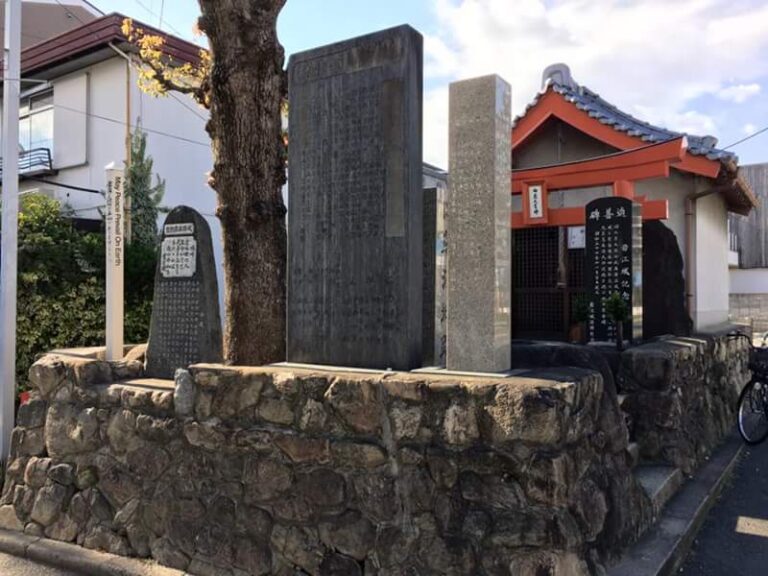
Behind Chihayaakasaka Junior High School stands a stone monument inscribed with “Shimoakasaka Castle Site,” one of the few remaining landmarks indicating the castle’s location. The view from around this monument is magnificent, with beautiful terraced rice fields stretching out below.
Existing Remains
Unfortunately, very few remains of Shimoakasaka Castle remain. Typical castle remains such as stone walls, earthworks, and moats cannot be confirmed, making it difficult to determine the castle’s exact layout and scale. This is likely due to the castle’s relatively short lifespan and the significant changes in the terrain resulting from subsequent development and agricultural conversion.
However, a detailed examination of the surrounding topography reveals characteristics of a natural stronghold suitable for defense. The steep slopes and valleys suggest the defensive lines of the time, allowing us to imagine how Kusunoki Masashige utilized the terrain in his battles.
Designation as a National Historic Site: Akasaka Castle Ruins
Shimo-Akasaka Castle was designated a National Historic Site as “Akasaka Castle Ruins” on March 13, 1934. This designation recognized the historical importance of Kusunoki Masashige and the role of Shimo-Akasaka Castle in the Genkō War.
With the designation as a National Historic Site, the entire castle site is protected, playing a role in passing on its historical value to future generations. It is currently managed appropriately by Chihaya-Akasaka Village and utilized for historical education and as a tourist resource.
Japan’s Top 100 Terraced Rice Fields and the Shimo-Akasaka Terraced Rice Fields
Beautiful Terraced Rice Field Scenery
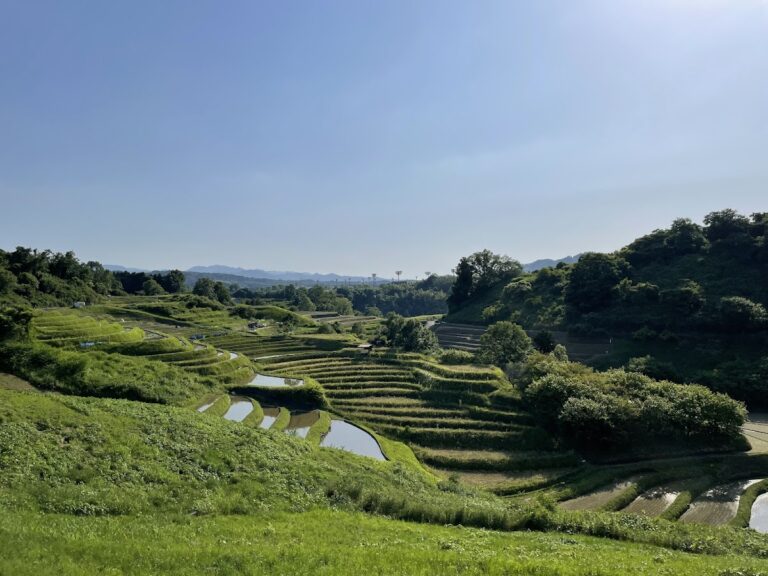
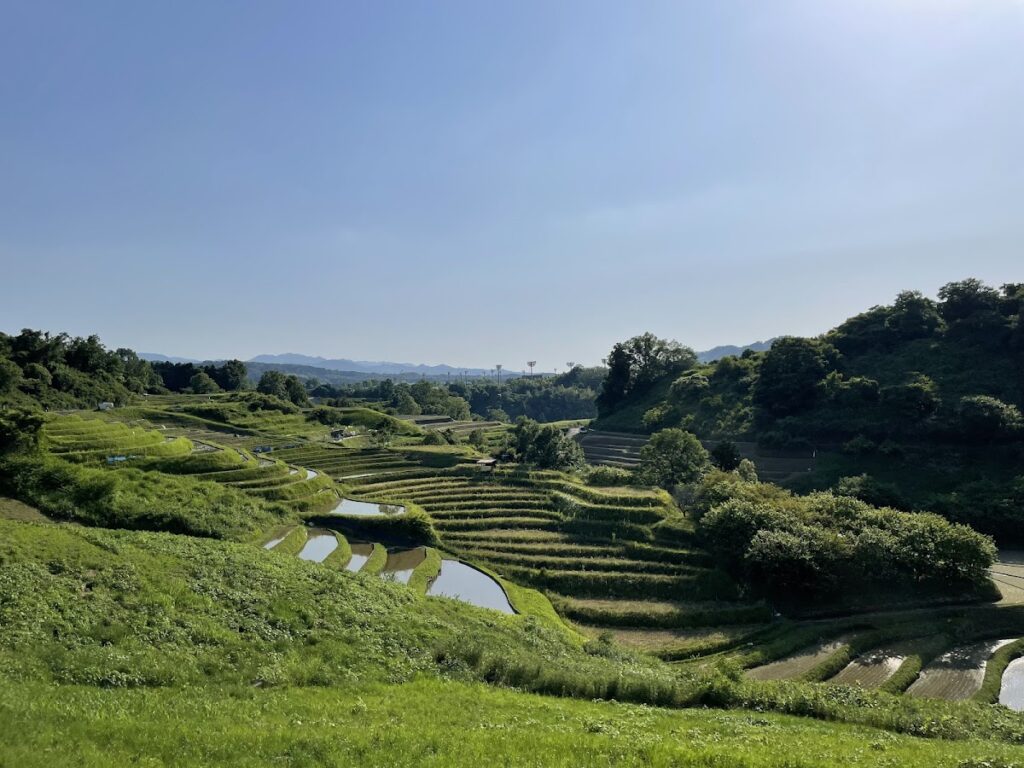
One of the greatest attractions of the Shimo-Akasaka Castle Ruins is the beautiful landscape of terraced rice fields spread out below. These terraced rice fields have been selected as one of “Japan’s Top 100 Terraced Rice Fields,” and are the only one in Osaka Prefecture to receive this designation.
The terraced rice fields spread out below the castle ruins, displaying different appearances with each season. In spring, the water-filled fields reflect the sky like a mirror; in early summer, the green rice stalks sway in the wind; in autumn, the golden rice ears ripen; and in winter, a tranquil landscape covered in snow unfolds. This seasonal change captivates many photography enthusiasts and tourists.
The Fusion of Terraced Rice Fields and History
The Shimo-Akasaka terraced rice fields are not merely a beautiful landscape, but also have a deep connection to history. Agriculture in this area, which has continued since the Kamakura period, is believed to have been practiced even during the time of Kusunoki Masashige, and served as the economic foundation supporting the castle.
The current landscape of terraced rice paddies is the culmination of human activities dating back to the Middle Ages, making it a valuable cultural landscape where history and nature harmonize. Viewing the terraced rice paddies from the castle ruins allows one to not only learn about history but also to experience the lives of the people who lived in this land.
Efforts to Preserve Terraced Rice Paddies
Chihayaakasaka Village is actively working on the preservation and utilization of its terraced rice paddies. Maintaining terraced rice paddies requires considerable effort, leading to challenges such as a shortage of successors and an aging workforce. However, preservation activities by local residents and volunteers continue.
Furthermore, a terraced rice paddy ownership program and experiential events are implemented, providing participants from urban areas with opportunities to learn about the value of terraced rice paddies through farm work. These initiatives aim to achieve both sustainable preservation of terraced rice paddies and regional revitalization.
The Positioning of the Seven Kusunoki Castles and Shimoakasaka Castle
Kusunoki Masashige built several castles in addition to Shimoakasaka Castle, and they cooperated to resist the Kamakura Shogunate army. These are collectively known as the “Seven Kusunoki Castles,” and include the following castles:
- Shimo-Akasaka Castle – A vanguard castle that fought on the front lines.
- Kami-Akasaka Castle – The main castle of Kusunoki Masashige.
- Chihaya Castle – An impregnable castle where the most famous siege took place.
- Kongosan Castle – A mountain castle built near the summit of Mount Kongo.
- Eboshigata Castle – A castle located in Kawachinagano City.
- Ryusenji Castle – A castle located in Tondabayashi City.
- Kidera Castle – A castle built on Mount Kidera.
These castles communicated with each other, functioning as a network where reinforcements could be sent from other castles when one was attacked. Shimo-Akasaka Castle was located on the front lines and played a crucial role in protecting Kami-Akasaka Castle and Chihaya Castle.
Access to Shimo-Akasaka Castle
Using Public Transportation
Shimo-Akasaka Castle ruins can be accessed by public transportation. The nearest station is Tondabayashi Station on the Kintetsu Nagano Line.
Access Method:
- Get off at Tondabayashi Station on the Kintetsu Nagano Line.
- Take the Kongo Bus from Tondabayashi Station (approximately 20 minutes).
- Get off at the Moriya bus stop and walk approximately 5 minutes to reach the castle ruins monument.
Since bus services are limited, it is recommended to check the timetable in advance. Especially on holidays, buses are infrequent, so careful planning is necessary.
Access by Car
Access by car is also possible.
Main Routes:
- Approximately 30 minutes from the Mihara Rotary on the Hanshin Expressway via National Route 309.
- Approximately 20 minutes from the Taishi IC on the Minami-Hanna Expressway.
There is parking space around the Chihayaakasaka Village Office, but it is limited, so caution is advised during busy times. Also, the roads around the terraced rice fields are narrow, so please drive with caution.
Nearby Attractions and Tourist Spots
Kami-Akasaka Castle Ruins
Kami-Akasaka Castle, a counterpart to Shimo-Akasaka Castle, is known as the main castle of Kusunoki Masashige. Designated as a national historic site as “Kusunoki Castle Ruins (Kami-Akasaka Castle Ruins),” visiting both Shimo-Akasaka Castle and Kami-Akasaka Castle will provide a deeper understanding of Kusunoki Masashige’s castle network.
Kami-Akasaka Castle has better-preserved remains than Shimo-Akasaka Castle, allowing visitors to see the remains of earthworks and baileys. While accessible on foot, it requires climbing a mountain path, so comfortable shoes and ample time are recommended.
Chihaya Castle Ruins
Chihaya Castle, the most famous of the seven Kusunoki castles, is located about a 10-minute drive from Shimo-Akasaka Castle. In 1332, Kusunoki Masashige regrouped and defended this legendary castle, holding out for over 100 days against tens of thousands of shogunate troops with only a few hundred soldiers.
Even today, remnants of stone steps and fortifications remain, and the view from the mountaintop is magnificent. Chihaya Shrine is also located nearby, and visitors come to worship at the shrine dedicated to Kusunoki Masashige.
Takemikumari Shrine
Takemikumari Shrine, located in Chihayaakasaka Village, is known as a shrine associated with Kusunoki Masashige. The main hall, designated a National Important Cultural Property, is a valuable structure that preserves the architectural style of the Muromachi period.
The shrine grounds are enveloped in a tranquil atmosphere, making it an ideal resting spot during a historical walk. Cherry blossoms are beautiful in spring, and autumn leaves are stunning, displaying different scenery with each season.
Mount Kongo
Mount Kongo (elevation 1,125 meters), located on the border of Osaka and Nara prefectures, is a representative hiking spot in the Kansai region. Kusunoki Masashige also built a castle (Kongosan Castle) on Mount Kongo, considering it a strategically important location.
Currently, hiking trails are well-maintained, offering several courses suitable for beginners to advanced hikers. From the summit, you can enjoy a panoramic view of the Osaka Plain, and on clear days, you can even see Osaka Bay and Awaji Island.
Points of Interest at Shimoakasaka Castle
Castle Ruins Monument and Surroundings
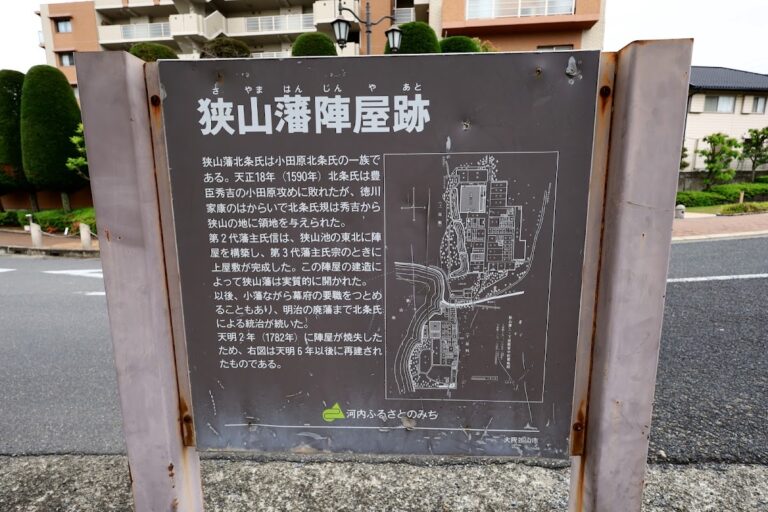
The “Shimoakasaka Castle Ruins” monument, located behind Chihayaakasaka Junior High School, is a must-see as proof of your visit to the castle ruins. The area around the monument is well-maintained, and an explanatory sign is provided, allowing you to learn about the castle’s history.
The view from the monument is magnificent, and the terraced rice fields stretching out below make it an excellent spot for photography. Especially at sunset, the rice fields are bathed in a golden glow, creating a magical atmosphere.
Around Chihayaakasaka Village Office
The area behind the village office is believed to be the site of the main enclosure (honmaru), and exploring this area allows you to imagine the scale of the castle. Although the area is now residential and farmland, the undulating terrain still hints at the castle’s former appearance.
The village office sometimes has materials related to Shimoakasaka Castle and Kusunoki Masashige available for viewing; those seeking more detailed information should consider visiting.
Walking Paths in the Terraced Rice Fields
Walking paths are maintained between the terraced rice fields, allowing visitors to enjoy the scenery at a leisurely pace. During farming season, you can even witness rice planting and harvesting, experiencing rural life firsthand.
When strolling, please be careful not to trespass on private property and avoid interfering with farm work. Also, please be sure to take your trash with you to help preserve the beautiful landscape.
Best Season to Visit
Shimoakasaka Castle Ruins and the terraced rice fields offer different charms depending on the season.
Spring (April-May)
The water-filled terraced rice fields reflect the sky like mirrors, and preparations for rice planting are underway. The fresh greenery is beautiful, making for a pleasant stroll in the refreshing weather. Early Summer (June-July)
The green rice plants grow, covering the terraced rice fields in vibrant green. During breaks in the rainy season, a fresh and vibrant landscape unfolds.
Autumn (September-October)
The rice stalks ripen to a golden color, making this the most beautiful season for the terraced rice fields. You can also witness the rice harvest, experiencing the joy of the harvest. The autumn leaves begin to change color, and the surrounding mountains become colorful.
Winter (December-February)
Snow sometimes falls, and the snow-covered terraced rice fields present a fantastical beauty. The air is clear, allowing for expansive views, and a landscape enveloped in silence unfolds.
Historical Evaluation of Shimoakasaka Castle and Kusunoki Masashige
Kusunoki Masashige is highly regarded as one of the most brilliant generals in Japanese history. The Battle of Shimo-Akasaka Castle, in particular, is famous for its numerous ingenious tactics, in which a small force outmaneuvered a much larger army. These tactics are detailed in the *Taiheiki* (The Chronicle of Great Peace) and have been studied by military scholars in later generations.
During the Edo period, Kusunoki Masashige was praised by Confucian scholars as a model of loyalty, and in the Meiji era, he was deified as “Dainanko” (Great Kusunoki). Shrines dedicated to Masashige, such as Minatogawa Shrine and Kusunoki Shrine, were built throughout Japan, solidifying his status as a national hero.
After World War II, his reputation temporarily declined due to his association with militarism, but now, with the advancement of objective historical research, his reputation as a brilliant tactician and strategist is firmly established. Shimo-Akasaka Castle, as a historical stage symbolizing Kusunoki Masashige’s wisdom and intellect, continues to attract many visitors.
Castle Stamps and Souvenirs
Shimo-Akasaka Castle sells castle stamps. These stamps are popular as souvenirs of visits to the castle and are highly sought after by collectors. The castle stamp for Shimo-Akasaka Castle comes in multiple designs, and limited-edition versions are also issued.
The castle stamp can be purchased at designated locations within Chihaya-Akasaka Village. Limited editions are sometimes sold during events such as the “Kansai Castle Summit,” so it’s recommended to check event information.
Also, tourist facilities within the village sell goods related to Kusunoki Masashige and local specialties, which can be purchased as souvenirs.
Points to Note When Visiting Shimo-Akasaka Castle
Clothing and Equipment
Since the castle ruins are located in a mountainous area, comfortable walking shoes and clothing are recommended. Especially if you plan to visit other nearby castle ruins such as Kami-Akasaka Castle and Chihaya Castle, full-fledged mountaineering equipment is necessary.
Clothing and equipment appropriate for the season are also important. In summer, the sun is strong, so prepare a hat and sunscreen; in winter, prepare warm clothing.
Opening Hours and Closing Days
The castle ruins themselves are outdoors, so they can be visited at any time. However, it is recommended to avoid visiting at night or in the early morning and visit during daylight hours.
Chihayaakasaka Village Office and surrounding facilities have opening hours, so please check in advance if you wish to view materials or purchase castle stamps.
Manners and Consideration
The area around the castle ruins is adjacent to residential areas and farmland. Please be quiet during your visit and refrain from trespassing on private property, so as not to disturb the lives and farming activities of local residents.
Please take all your trash with you and cooperate in the preservation of the natural environment. Also, when walking along the paths between the rice terraces, please be careful not to step on the rice plants.
Summary: Shimoakasaka Castle, Where History and Nature Harmonize
Shimoakasaka Castle is a historical stage where the wisdom of Kusunoki Masashige shines, and at the same time, a valuable spot where you can enjoy the beautiful scenery selected as one of Japan’s Top 100 Rice Terraces. Although there are almost no remains left, you can feel the history and activities of the people of the Middle Ages from the stone monuments, explanatory signs, and the landscape of rice terraces spreading out below.
Chihayaakasaka Village, the only village in Osaka Prefecture, is rich in historical resources as a place associated with Kusunoki Masashige. Visitors can enjoy historical walks starting from Shimo-Akasaka Castle, visiting nearby historical sites such as Kami-Akasaka Castle, Chihaya Castle, and Mount Kongo.
The terraced rice paddies, still carefully preserved by local residents, are not merely a tourist attraction, but a testament to the lives of people that have continued since the Middle Ages. When visiting, please remember to show respect for history and consideration for nature, and strive to help pass on this precious cultural landscape to future generations.
The scenery of Shimo-Akasaka Castle ruins and terraced rice paddies, which changes with the seasons, offers new discoveries and inspiration with every visit. It’s a place that history buffs and nature lovers alike should definitely visit at least once.