Shimasoe-Ōzato Gusuku (Okinawa Prefecture): The Complete Picture of the Massive Gusuku that Shō Hashi Used as a Base for Unifying Ryukyu
Shimasoe-Ōzato Gusuku is a castle ruin from the Ryukyu Kingdom era located in Ōzato, Nanjō City, Okinawa Prefecture. Also known as Shimasoe-Ōzato Castle, Ōzato Gusuku, and Ufuzato Gusuku, it is a historically important gusuku that served as the residence of Shō Hashi, a hero known for unifying the Ryukyu Kingdom. Built on the eastern edge of a Ryukyu limestone hill approximately 150m above sea level, this castle boasts one of the five largest scales among Okinawan gusuku and left a significant mark on Ryukyu history as a base for the unification of the three kingdoms.
Historical Background of Shimasoe-Ōzato Gusuku
Residence of Shimasoe-Ōzato Aji during the Three Kingdoms Period
Shimasoe-Ōzato Gusuku was built around the 14th century by Shimasoe-Ōzato Aji, a warlord who ruled the Shimajiri region at the time. During the Three Kingdoms period, Ryukyu was divided into three powers: Hokuzan, Chuzan, and Nanzan. The Shimazoe-Ozato Anji, a powerful local lord belonging to the Nanzan King, governed this region.
Known as the “Lord of the Lower World,” the Shimazoe-Ozato Anji engaged in tributary trade with China, achieving great economic and cultural prosperity. Built on a hill 155 meters above sea level, this gusuku (castle) served as a strategic stronghold and a symbol of control over the surrounding region.
Conquest by Sho Hashi and the Base for Ryukyu Unification
In 1402, Sho Hashi, then the Sashiki Anji, defeated the Shimazoe-Ozato Anji and captured this gusuku. This marked a crucial first step in Sho Hashi’s unification of Ryukyu. Having seized Shimazoe-Ozato Gusuku, Sho Hashi used it as a new base to further expand his power.
For approximately four years, until 1406 when Sho Hashi and his father, Sho Shisho, moved their base to Shuri Castle, Shimazoe-Ozato Gusuku served as the headquarters of the Sho clan. This short period was a crucial turning point in the birth of the Ryukyu Kingdom.
Role and Prosperity as a Detached Palace
After the unification of the three kingdoms, Shimazoe-Ozato Gusuku was used as a detached palace, with a main hall built on the second largest scale after Shuri Gusuku. From the first half to the mid-15th century, it functioned as a villa for royalty and high-ranking officials, and archaeological excavations have unearthed a large number of artifacts from the first half of the 15th century.
The diverse unearthed items, including Chinese porcelain, Southeast Asian pottery, and trade goods from mainland Japan, indicate that Shimazoe-Ozato Gusuku benefited from international trade at that time. It is believed that its function as a detached palace continued until the mid-15th century, after which it gradually fell into disuse.
Structure and Scale of Shimazoe Osato Gusuku
A Massive Gusuku with Double Walls
Shimazoe Osato Gusuku boasts a vast site measuring approximately 210m north-south and 270m east-west, covering an area exceeding 30,000 square meters, making it one of the largest gusuku (castles) in Okinawa Prefecture. The castle complex consists of double walls (outer and inner baileys), featuring a robust defensive structure constructed from stacked Ryukyu limestone.
The outer bailey encircled the entire hillside, while the inner bailey was located near the summit. This double structure enhanced defensive capabilities and allowed for functional divisions within the gusuku. The main hall was built in the center of the inner bailey, at the highest point, and functioned as a symbol of authority.
Site of the Main Hall and Utinchiji (Place of Worship)
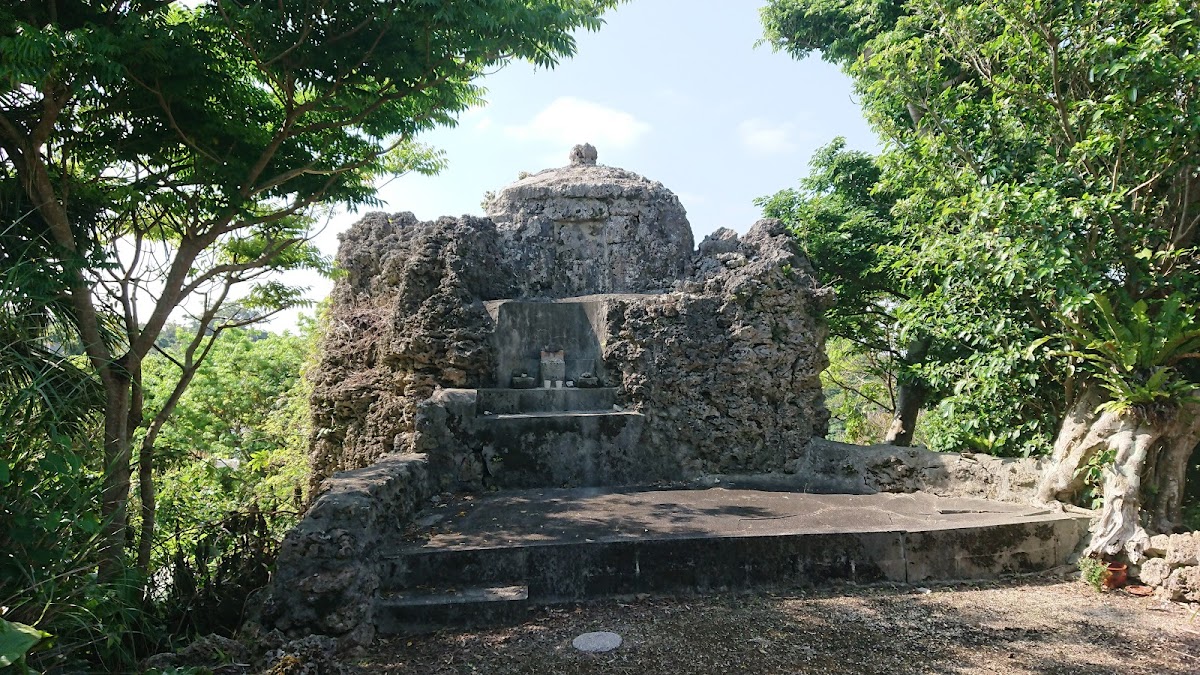
A place of worship (Utinchiji) remains at the highest point of the gusuku and is still cherished as a place of local faith. The site of the main hall is believed to be slightly lower than Utinchiji on the east side, and it is estimated that a magnificent building, second only in size to Shuri Castle, once stood here.
At the site of the main hall, traces of foundation stones and paving stones have been confirmed, providing clues to the size and layout of the building. Excavations have also uncovered fragments of red roof tiles and traces of building materials, giving a glimpse into the splendor of the building in its heyday.
Strategic Value of the Outpost (Miigusuku)
On the eastern edge of the hill overlooking Shimazoe Ozato Gusuku lies an outpost called “Miigusuku.” This outpost boasts an excellent location overlooking Nakagusuku Bay and served as a lookout post.
From Miigusuku, one can see major Ryukyu gusuku castles such as Katsuren Gusuku, Nakagusuku Gusuku, and Sashikiue Gusuku to the east, and Shuri Castle to the north. This excellent view is thought to have served not only as a military surveillance function but also as a signal fire station. The location, which allowed for monitoring Nakagusuku Bay, a crucial point for maritime traffic, held extremely important significance for both trade and military purposes.
Current Status and Preservation of Shimazoe-Ozato Gusuku
Damage from the Battle of Okinawa and Post-War Reconstruction
Unfortunately, much of the remains of Shimazoe-Ozato Gusuku were lost or altered due to the Battle of Okinawa and post-war reconstruction. In Okinawa, the site of fierce ground battles, many historical buildings were destroyed, and Shimazoe-Ozato Gusuku was no exception.
During the post-war reconstruction period, land use around the gusuku progressed, and parts of the castle walls and remains were lost due to the development of farmland, residential areas, and road construction. The remains visible today are only a part of the once magnificent gusuku, and it had long been in a dilapidated state due to various forms of destruction.
National Historic Site Designation and Development Project
In January 2012, Shimazoe-Ozato Gusuku was designated a national historic site, and efforts for preservation and development began in earnest. Nanjo City is developing the Ozato Castle Ruins Park, promoting a plan that balances the protection and utilization of the ruins.
Excavation surveys are ongoing, and new discoveries are being made one after another. Based on these survey results, efforts are underway to clarify the overall structure of the gusuku (castle) and to consider appropriate preservation and utilization methods. The development project includes the construction of walking paths and the installation of explanatory signs to ensure that visitors can safely observe the ruins.
Ozato Castle Ruins Exchange Center
At the foot of the gusuku is the Ozato Castle Ruins Exchange Center, where visitors can learn about the history and culture of Shimazoe Ozato Gusuku. The center has a parking lot for the convenience of visitors. In the exhibition room, visitors can understand the historical value of the gusuku through replicas of excavated artifacts and explanatory panels.
Highlights of Shimazoe Ozato Gusuku
Stunning Views
From the top of the Ryukyu limestone hill at an altitude of 150m, a 360-degree panoramic view unfolds. On a clear day, you can see major Ryukyu castles such as Shuri Castle, Nakagusuku Castle, and Katsuren Castle in the distance, giving you a real sense of the former Ryukyu Kingdom’s sphere of influence.
To the east lies the Pacific Ocean, offering a panoramic view of the beautiful coastline of Nakagusuku Bay. This view is one of the reasons why Shimazoe Ozato Castle was considered a strategically important location. It is likely that Sho Hashi gazed upon this scenery while dreaming of unifying Ryukyu.
Remaining Stone Structures
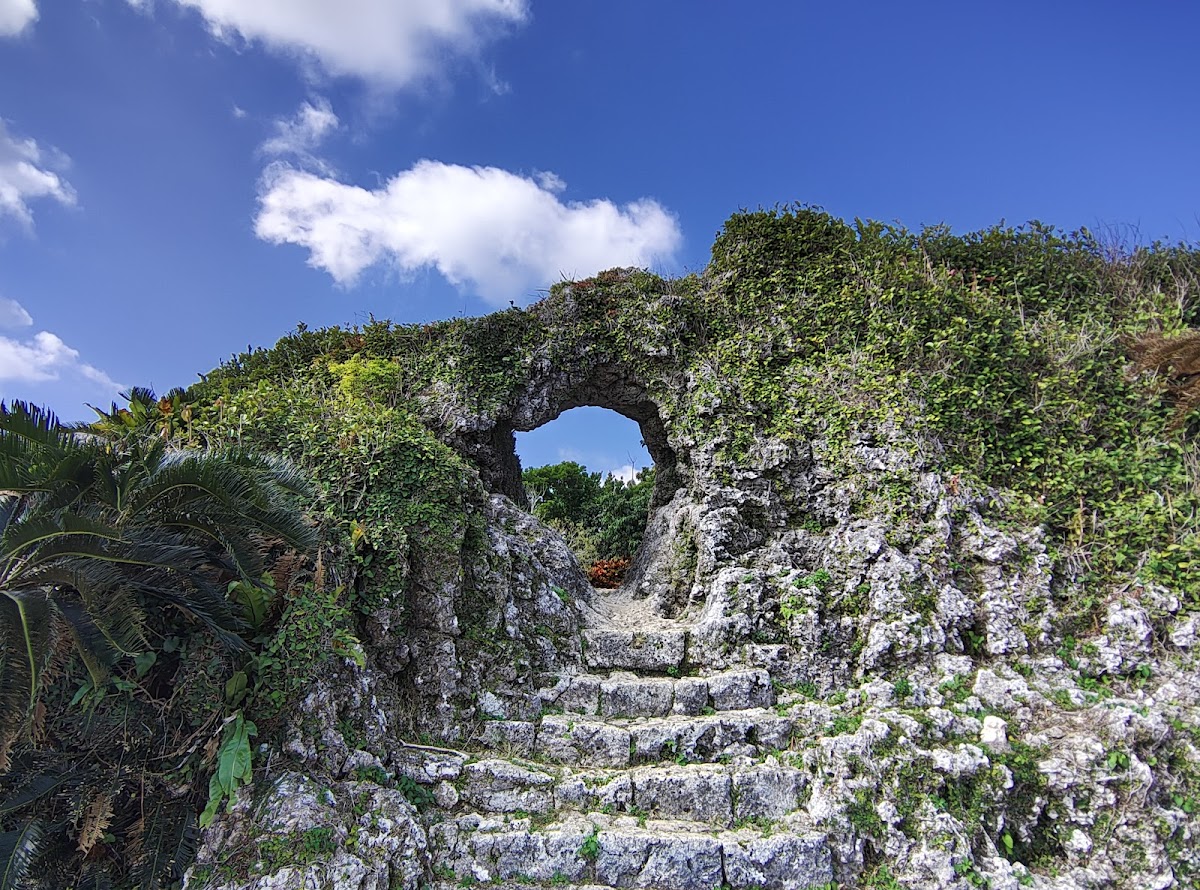
The parts of the castle walls and stone structures that escaped destruction demonstrate the high level of Ryukyu’s castle construction techniques. The stone walls, skillfully constructed from Ryukyu limestone, were built using the “nozurazumi” technique, which does not use mortar or other adhesives, resulting in beautiful curves that utilize the natural shapes of the stones.
These stone structures are evidence of having withstood hundreds of years of wind and rain, and speak to the exceptional skills of the Ryukyu stonemasons. The remaining stone walls, particularly those on the outer perimeter, are valuable historical relics that allow us to imagine the scale of the castle at the time.
Places of Worship
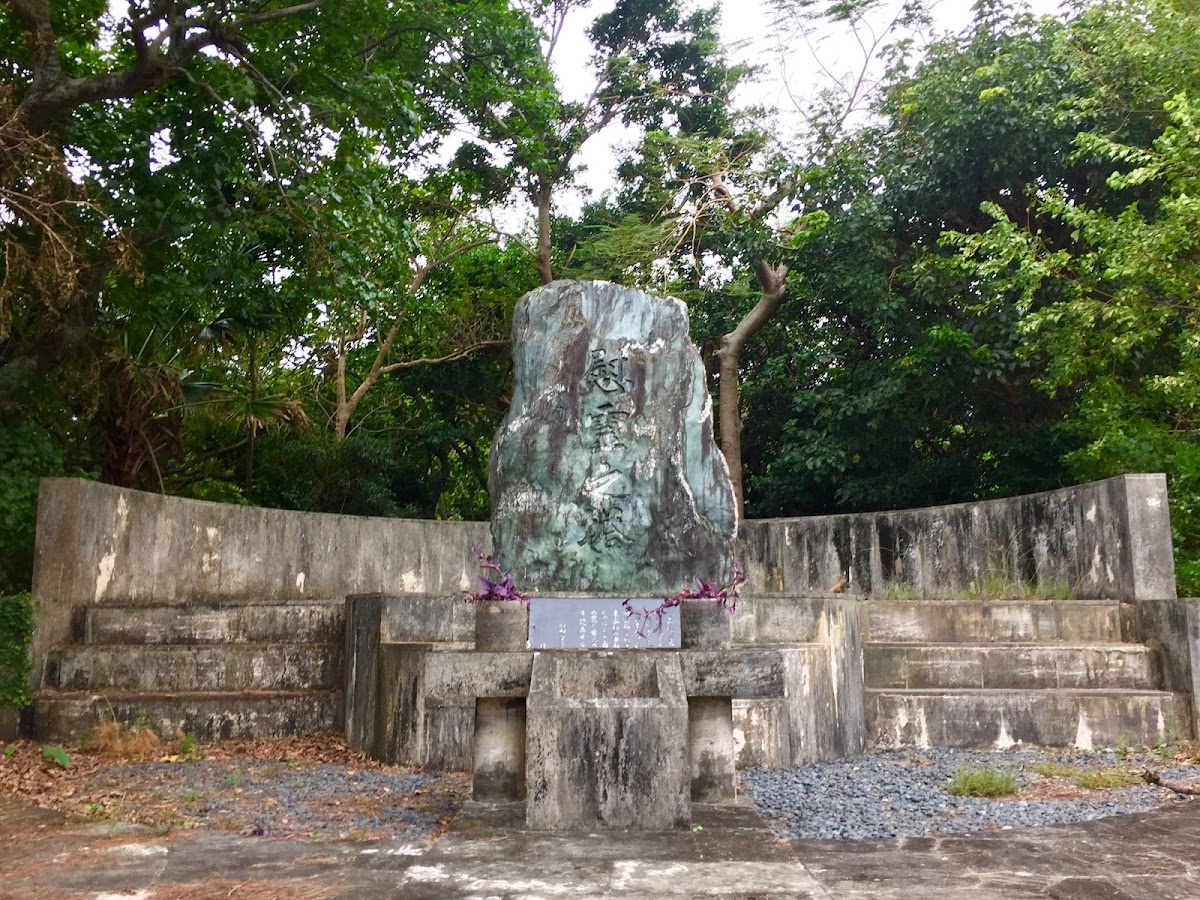
Shimazoe Oosato Gusuku still has several places of worship (uganju) that are visited by local people. These places, including Utinchiji at the highest point, are valuable cultural heritage sites that convey the traditional forms of Ryukyuan worship.
Local residents visit these places of worship for annual events and personal prayers. This is an important element demonstrating that the gusuku was not merely a military facility, but also an object of worship. Visitors are asked to respect these places of worship and observe them quietly.
Access and Visiting Information
Location and Basic Information
Location: Ozato, Nanjo City, Okinawa Prefecture
Designation: National Historic Site (Designated January 2012)
Other Names: Shimazoe Ozato Castle, Ozato Gusuku, Ufuzato Gusuku
Elevation: Approximately 150m
Relative Height: Approximately 100m
Size: Approximately 210m north-south, approximately 270m east-west, area over 30,000㎡
Access by Car
Approximately 40 minutes by car from Naha Airport, and approximately 30 minutes from Naha city center via National Route 329. It’s easiest to aim for the Nanjo City Hall Ozato Branch. Parking is available free of charge at the Ozato Castle Ruins Exchange Center. It takes about 15-20 minutes on foot from the parking lot to the top of the castle.
If using a car navigation system, it’s best to search for “Ozato Castle Ruins Exchange Center” or “Nanjo City Ozato Gusuku.” While the roads are well-maintained, the interior of the gusuku (castle) is a mountain path, so comfortable walking shoes are recommended.
Access by Public Transportation
If using public transportation, take the Toyo Bus No. 38 “Shikiya Line” or No. 51 “Hyakuna Line” from Naha Bus Terminal and get off at the “Ozato” bus stop. The gusuku is approximately a 15-minute walk from the bus stop. However, bus services are limited, so it’s recommended to check the timetable in advance.
The nearest Yui Rail (Okinawa Urban Monorail) station is “Asahibashi Station,” but the gusuku is about 15km away, making rental cars or taxis a more practical option.
Notes for Visitors
Shimazoe Ozato Gusuku is still under development, and access may be restricted in some areas. Please note the following points when visiting:
- Wear comfortable clothing and non-slip shoes as you will be walking on mountain paths.
- Bring a hat, sunscreen, and drinking water as the sun is strong in the summer.
- Be careful as the ground can be slippery during and after rain.
- The sacred sites are places of worship, so please view them quietly and with respect.
- Take all your trash with you and be careful not to damage the ruins.
- Be aware of dangerous creatures such as venomous snakes (habu) and do not carelessly enter grassy areas.
The estimated time required for a thorough visit is 1-2 hours. Gathering information at the Osato Castle Ruins Exchange Center beforehand will allow for a deeper understanding.
Nearby Tourist Spots
Sashiki Gusuku (Sashiki Kami Gusuku)
Located about 10 minutes by car from Shimazoe Osato Gusuku, Sashiki Gusuku is known as the castle where Sho Hashi was born and raised. This historical site was the base of operations for Sho Hashi before he conquered Shimazoe-Ozato Gusuku, and the starting point for the unification of Ryukyu. Visiting both gusuku allows you to trace the footsteps of Sho Hashi.
Seifa Utaki
Seifa Utaki, one of the constituent sites of the World Heritage Site “Gusuku Sites and Related Properties of the Kingdom of Ryukyu,” is approximately a 15-minute drive from Shimazoe-Ozato Gusuku. As the most sacred site of the Ryukyu Kingdom, it was a place where royalty and priestesses (noro) offered prayers, and is an essential site for understanding Ryukyu’s spiritual culture.
Chinen Castle Ruins
Chinen Castle Ruins is another gusuku built around the same time as Shimazoe-Ozato Gusuku, and is also approximately a 15-minute drive away. The castle walls, made of Ryukyu limestone, are well-preserved, allowing for close observation of the characteristics of gusuku architecture. The Chinen area is a region where many sacred sites of the Ryukyu Kingdom are concentrated, making it a historically and culturally important area.
Okinawa World & Gyokusendo Cave
Located about a 15-minute drive from Shimazoe Ozato Gusuku, Okinawa World is a comprehensive theme park where you can experience Okinawan culture and nature. Gyokusendo Cave, in particular, is considered one of the most beautiful limestone caves in the Orient, allowing you to explore a mysterious underground world. Visiting it in conjunction with a visit to the gusuku (castle) will allow you to enjoy the diverse charms of Okinawa.
Cultural Value of Shimazoe Ozato Gusuku
Importance in Ryukyu History
Shimazoe Ozato Gusuku is a castle ruin that played a central role in the historical turning point of the unification of the Ryukyu Kingdom. The unification of the three kingdoms by Sho Hashi laid the foundation for the Ryukyu Kingdom, which lasted for approximately 450 years, and Shimazoe Ozato Gusuku was a crucial stage in this.
The history of the gusuku, which continued to function while changing its role with the times—as a political and military base during the transition from the three kingdoms to the unified dynasty, and as a detached palace after unification—is an indispensable element in understanding Ryukyu history.
Archaeological Value
The artifacts unearthed during the excavation, dating from the first half of the 15th century, are invaluable materials illustrating the state of international trade in Ryukyu at that time. Imports from diverse regions, including celadon and white porcelain from China, Thai and Vietnamese pottery from Southeast Asia, and Seto and Bizen ware from mainland Japan, demonstrate Ryukyu’s function as a “bridge to the world.”
Furthermore, the unearthed building materials and daily life tools provide insights into the lifestyle and construction techniques of the gusuku (castle) at that time. These archaeological materials are extremely important sources of information in the study of Ryukyu history, where written historical sources are limited.
Architectural Historical Value
The stonework techniques and castle structure of Shimazoe Osato Gusuku are important examples for understanding the development process of Ryukyu gusuku architecture. The double-wall structure, the layout utilizing the natural terrain, and the rough-hewn stone masonry technique using Ryukyu limestone demonstrate the unique characteristics of Ryukyu castle architecture.
As it is believed to have had a main hall second only in size to Shuri Castle, it is a valuable historical site for studying the architectural style of palaces in the Ryukyu Kingdom. Further excavations are expected to reveal more detailed architectural structures.
Future Prospects for Shimazoe-Ozato Gusuku
Development Plan and Utilization Policy
Nanjo City is proceeding with a development plan to utilize Shimazoe-Ozato Gusuku as a local historical and cultural resource. While prioritizing the preservation of the remains, the aim is to create an environment where visitors can learn about history safely and comfortably.
Specifically, plans include the development of walking paths, the enhancement of explanatory signs, and the installation of rest facilities. Furthermore, the use of VR (virtual reality) technology to recreate the site’s appearance in its heyday and the provision of audio guides via smartphone apps are also being considered, promising modern ways to experience history.
Potential for World Heritage Registration
Currently, Okinawa Prefecture is working towards the additional registration of “Gusuku Sites and Related Properties of the Ryukyu Kingdom,” and Shimazoe-Ozato Gusuku is attracting attention as one of the candidates. Due to its historical significance as the base for Sho Hashi’s unification of Ryukyu, its large scale, and its high archaeological value, it is considered to have sufficient value as a World Heritage Site.
If World Heritage registration is achieved, it is expected that international recognition will increase, and the introduction of funding and expertise for preservation and utilization will be promoted. At the same time, its value as a tourist resource will increase, and it will contribute to regional development.
Collaboration with the Community and Educational Use
Shimazoe Osato Gusuku plays an important role as a place for local history education. Elementary and junior high schools in Nanjo City provide opportunities for children to visit the gusuku as part of their local history studies, making it a place where they can learn about the history and culture of the region.
In the future, methods of utilization that deepen collaboration with the local community are being considered, such as training local residents to lead guide activities and holding historical events at the gusuku. The challenges are fostering regional identity through historical heritage and creating a sustainable preservation and utilization system.
Summary
Shimazoe Osato Gusuku (Okinawa Prefecture) is a historically significant gusuku (castle) that served as the base of operations for Sho Hashi, the hero of the unification of the Ryukyu Kingdom. Built on a hill 150 meters above sea level, this massive castle with double walls functioned as the political and military center from the Three Kingdoms period to the unification of the Ryukyu Kingdom.
Although many remains were lost during the Battle of Okinawa and post-war reconstruction, preservation and development efforts have been underway since its designation as a national historical site in 2012. There are many points of interest, including the remaining stone structures, magnificent views, and places of worship.
Shimazoe Osato Gusuku, indispensable for understanding Ryukyu history and culture, is a historical spot you should definitely visit when visiting Nanjo City. By following in Sho Hashi’s footsteps and standing on the stage of the birth of the Ryukyu Kingdom, you can experience Okinawan history more deeply. Visiting nearby Sashiki Gusuku and Seifa Utaki will further enhance your understanding of the profound history and culture of Ryukyu.