Shigisan Castle: The Complete Picture of Nara Prefecture’s Largest Mountain Castle, the Site of Matsunaga Hisahide’s Final Moments
Shigisan Castle is a Sengoku period mountain castle located on the summit of Mt. Shigi, straddling Heguri and Sango towns in Ikoma district, Nara Prefecture. Centered around the 437m-high Mt. Shigi, the castle complex, spanning approximately 700m north-south and 550m east-west, is the largest in Nara Prefecture. Known as the castle where Matsunaga Hisahide, considered one of the three greatest villains of the Sengoku period, met his end, its dramatic history continues to fascinate many history enthusiasts.
History and Development of Shigisan Castle
Early Days: The Era of Kizawa Nagamasa
The history of Shigisan Castle begins in 1536 (Tenbun 5), when it was built by Kizawa Nagamasa, the deputy governor of Kawachi Province. Kizawa Nagamasa, a powerful warlord in Kawachi Province, expanded his influence and built a castle on Mount Shigi, located on the border between Yamato and Kawachi, in order to strengthen his influence in Yamato Province.
Mount Shigi, belonging to the Ikoma mountain range, was a strategically important location overlooking the Shigi Pass, a road connecting Yamato and Kawachi. Due to this geographical advantage, Shigi Castle played a crucial role as a base for controlling Yamato. By building a castle in this strategically important location, Kizawa Nagamasa sought to solidify his power base in Yamato Province.
However, Kizawa Nagamasa’s ambitions did not last long. In 1542, Kizawa Nagamasa was defeated and killed in the Battle of Taiheiji by a coalition army led by Hosokawa Harumoto. It is believed that Shigi Castle was destroyed by fire during this battle and temporarily abandoned.
Restoration and Major Renovation by Matsunaga Hisahide
Shigisan Castle reappears on the historical stage during the time of Matsunaga Hisahide. Matsunaga Hisahide (1508-1577) rose through the ranks serving Miyoshi Nagayoshi, and around 1559, upon entering Yamato Province, he began a large-scale renovation of Shigisan Castle.
Hisahide significantly expanded the existing castle grounds, transforming it into a massive fortress measuring 880m north-south and 600m east-west. This renovation transformed Shigisan Castle into the largest medieval castle in Nara Prefecture, boasting over 110 baileys.
Matsunaga Hisahide also built Tamon-yama Castle (present-day Nara City) on the plains alongside Shigisan Castle, and used these two castles as bases to rule Yamato Province. Shigisan Castle served as a fortified stronghold in times of emergency, while Tamon-yama Castle functioned as the political and administrative center, establishing a dual system of rule.
Matsunaga Hisahide’s Rebellion and the Fall of Shigisan Castle
Even after submitting to Oda Nobunaga, Matsunaga Hisahide could not abandon his ambition. In August of Tensho 5 (1577), Hisahide, in coordination with Uesugi Kenshin and Ishiyama Honganji, raised the banner of rebellion against Nobunaga. This was Hisahide’s second rebellion.
Nobunaga immediately dispatched a large army and besieged Shigisan Castle. The Oda army, with Oda Nobutada as its commander-in-chief, began its full-scale attack on October 1st. Faced with an overwhelming difference in troop numbers, Shigisan Castle’s defenses were breached one after another.
On October 10th, Shigisan Castle finally fell. It is said that at this time, Matsunaga Hisahide set fire to the castle keep and committed suicide amid the flames. A well-known anecdote tells of Hisahide smashing his prized tea kettle, the “Hiragumo Chagama,” before committing suicide. However, recent research suggests this story is likely a later fabrication.
In any case, with Matsunaga Hisahide’s tragic end, Shigisan Castle disappeared from the stage of history and became a ruined fortress.
Castle Structure of Shigisan Castle
Overall Layout and Scale
Shigisan Castle is a mountain castle spread across a vast area of approximately 700m north-south and 550m east-west, centered around Mount Shigisan’s Odake (elevation 437m). Its castle grounds are the largest in Nara Prefecture, with over 110 confirmed baileys.
The castle is primarily constructed of earth, with very little stonework. This is a typical characteristic of mountain castles from the Sengoku period and makes it a valuable historical site for understanding the castle-building techniques of the time.
The layout of Shigisan Castle skillfully utilizes the topography of Mount Shigi. The main section is located on the summit of Mount Otake, with residential facilities arranged along the main ridge to the north. There is also a peak called Mount Metake to the south, where defensive facilities were also established.
Main Enclosure on the Summit of Mount Otake
The heart of Shigisan Castle is the main enclosure located on the summit of Mount Otake. It is believed that a small keep (takayagura) stood at the highest point. Some theories suggest this keep had a four-story structure, potentially making it an advanced architectural design for its time.
Interestingly, there is a theory that the keep built by Matsunaga Hisahide at Shigisan Castle served as a reference for the keep architecture later adopted by Oda Nobunaga at Azuchi Castle and other locations. Hisahide was also known as a man of culture, with a deep knowledge of tea ceremony and architecture, giving this theory some credibility.
The summit area features multiple enclosures arranged in a stepped pattern, each demarcated by earthen ramparts. These enclosures contain sections where building foundations remain buried, indicating the presence of numerous structures in the past.
Matsunaga Residence on the Northern Ridge
On the main ridge extending north from the summit of Mt. Otake, there was a residential facility equipped with earthworks and a gate. Old maps and other documents refer to it as “Matsunaga Residence,” suggesting it was the living space of Matsunaga Hisahide.
This section of the Matsunaga Residence is thought to have served more as a living space than a defensive structure. The fact that it provided a certain level of habitability despite being a mountain castle is one of the characteristics of Shigisan Castle.
Mt. Metake and Defensive Facilities on the South
At the southern end of Shigisan Castle is a peak called Mt. Metake, where castle facilities also existed. Around Mt. Metake, remnants strongly resembling a castle can be seen, with defensive facilities such as moats and earthworks well-preserved.
This southern defensive line was an important facility for preparing for attacks from the Yamato side. Multiple baileys are arranged in a continuous pattern, creating a structure designed to gradually halt enemy advances.
Remains of Moats, Earthworks, and Gates
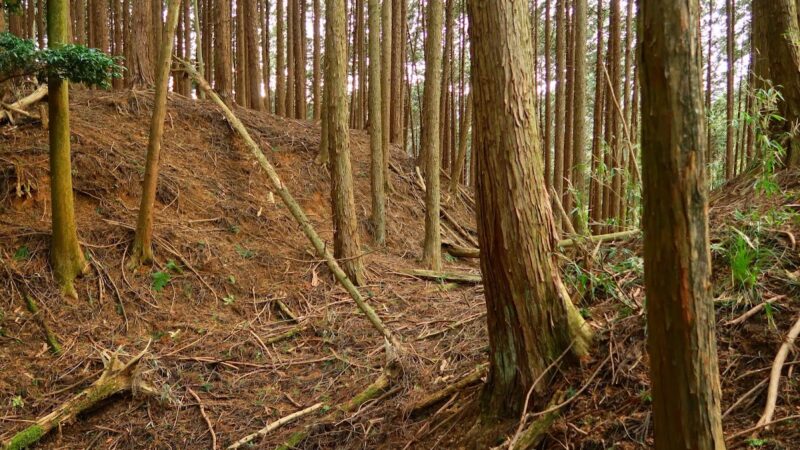
Although no buildings remain at Shigisan Castle, the moats, earthworks, gates, and numerous leveled areas (baileys) are almost completely intact, allowing for a complete understanding of the castle’s layout.
Particularly noteworthy is that, because it was used as the grounds of Shigisan Chogosonshi-ji Temple, it escaped destruction due to later development. Therefore, it is a valuable historical site that conveys the appearance of a mountain castle from the Sengoku period.
Moats were constructed in various places as trenches that divided the ridge. These trenches served to prevent enemy advances and also demarcate the castle grounds. The earthworks surrounded the baileys, enhancing defensive capabilities and are thought to have functioned as foundations for buildings.
The Strategic Importance of Shigisan Castle
A Key Point Connecting Yamato and Kawachi
Shigisan, where Shigisan Castle was built, is located on the border between Yamato and Kawachi provinces, overlooking the Shigi Pass, a strategically important location connecting the two provinces. This geographical location gave Shigisan Castle a crucial role in controlling transportation routes.
The Shigi Pass was one of the main transportation routes connecting Yamato and Kawachi, frequently used for transporting goods and moving troops. Controlling this route meant controlling exchanges between the two provinces, giving it significant strategic value.
As a Base for Controlling Yamato
For Matsunaga Hisahide, Shigisan Castle was a crucial base for controlling Yamato. While Tamon-yama Castle on the plains served as the political and administrative center, Shigisan Castle functioned as a military base.
Its mountainous location offered high defensive capabilities against enemy attacks. Furthermore, the mountaintop provided a wide vantage point, allowing for early detection of enemy movements. This military superiority made Shigisan Castle a crucial pillar supporting Hisahide’s rule.
Role in the Nobunaga Encirclement
When Matsunaga Hisahide launched his second rebellion, Shigisan Castle became a key base in the Nobunaga encirclement. In the strategy to surround Oda Nobunaga in cooperation with Uesugi Kenshin, Ishiyama Honganji, and the Mori clan, Shigisan Castle was positioned as an important stronghold of anti-Nobunaga forces in the Kinai region.
However, ultimately, Shigisan Castle succumbed to the overwhelming military power of the Oda army and fell. This fall became one of the events symbolizing the collapse of the Nobunaga encirclement.
Episodes Related to Shigisan Castle
The Legend of the Hiragumo Teapot
The most famous episode related to Shigisan Castle concerns the “Hiragumo Teapot,” a famous tea utensil owned by Matsunaga Hisahide. According to legend, when Nobunaga urged Hisahide to surrender, he offered to spare his life if he handed over the Hiragumo tea kettle.
However, Hisahide refused, saying, “I will not hand over this masterpiece to someone like Nobunaga,” and smashed the kettle, exploding with the shards. This anecdote has been widely known as a story symbolizing Hisahide’s rebellious spirit and aesthetic sense.
However, recent research suggests that this story is likely a fabrication from the Edo period or later. Contemporary historical records do not mention the smashing of the kettle; only records of Hisahide setting fire to the castle keep and committing suicide remain. Nevertheless, this legend enhanced Hisahide’s appeal and played a significant role in making Shigisan Castle famous.
Tea Ceremony in the Castle
Matsunaga Hisahide was known not only as a Sengoku period warlord but also as a man of culture. He was deeply knowledgeable about the tea ceremony and famous for collecting many masterpieces.
It is believed that tea ceremonies were held within Shigisan Castle, indicating that, despite being a military facility, it also functioned as a venue for cultural activities. This demonstrates Hisahide’s multifaceted character, suggesting that he was not merely a rough and tumble Sengoku warlord, but also a refined man of culture.
The act of enjoying tea at a castle on a mountaintop is, even from our modern perspective, extremely refined and reflects the richness of the spiritual world of the warlords of the Sengoku period.
Maps of Shigisan Castle
Several old maps of Shigisan Castle remain. These maps show the layout of the castle and the names of facilities such as “Matsunaga Residence,” making them valuable historical materials for understanding the castle’s appearance at the time.
Particularly interesting are the depictions of the keep. Some maps depict a tall building on the mountaintop, supporting the idea that a keep actually existed. However, the depictions in these maps are not always accurate and may contain some degree of exaggeration or stylization.
Nevertheless, these illustrations serve as an important source of information, complementing documentary sources and archaeological investigations, and greatly contribute to the study of Shigisan Castle.
Current Status and Preservation of Shigisan Castle
Designated as a Nara Prefecture Historic Site
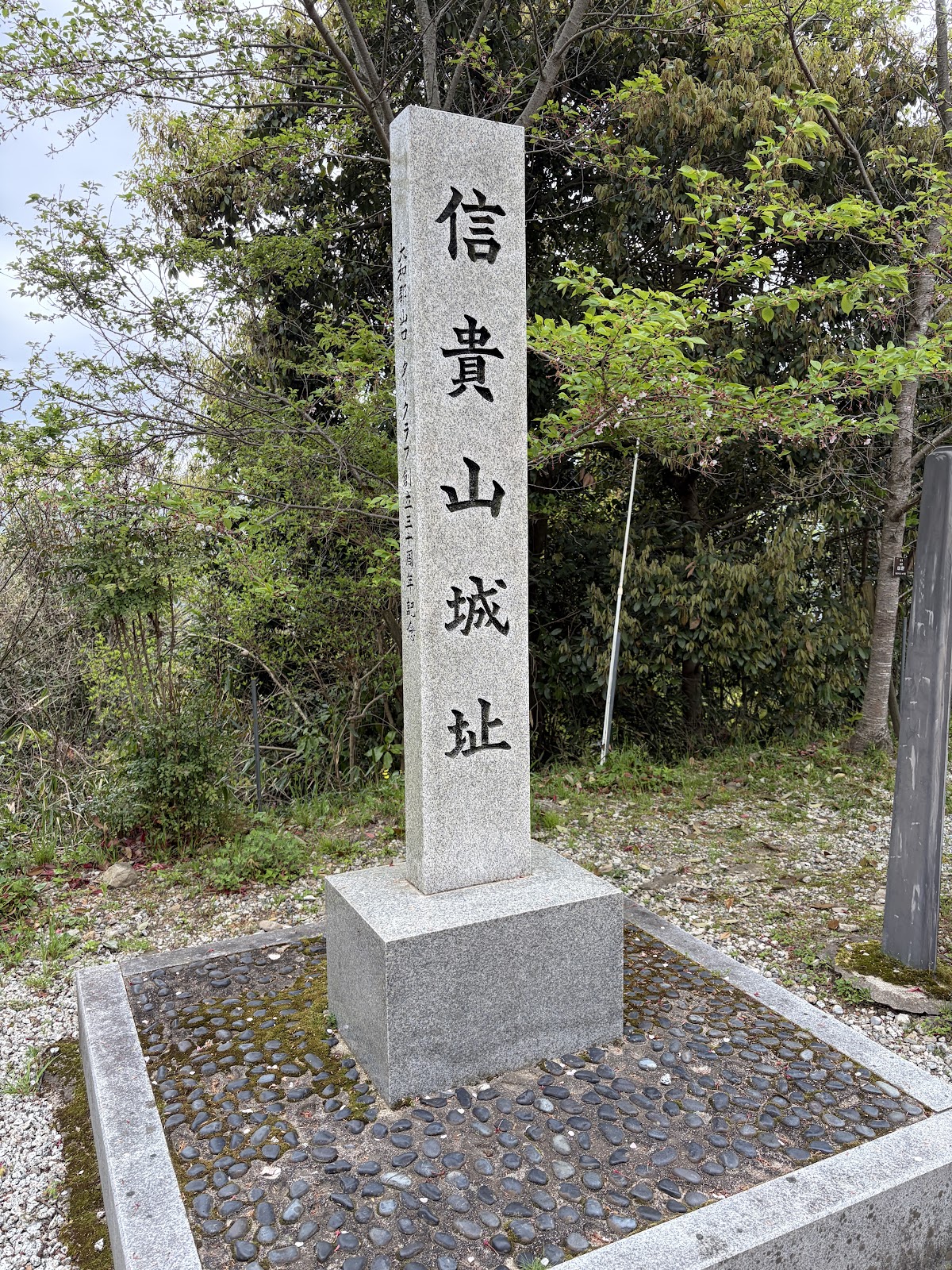
The Shigisan Castle ruins have been designated as a Nara Prefecture Historic Site, recognized for their historical and academic value. It is the largest medieval castle in Nara Prefecture and is protected as an extremely important site for understanding the structure of mountain castles during the Sengoku period.
Notably, because it was used as the grounds of Shigisan Chogosonshi-ji Temple, it escaped destruction by later development. Therefore, remains such as moats, earthworks, and baileys are well-preserved, making it a valuable example for confirming the entire layout of the castle.
Overwhelming Scale
Visiting the Shigisan Castle ruins in person is astonishing due to its overwhelming scale. The vast castle grounds, approximately 700m north-south and 550m east-west, require considerable time just to walk around.
The sight of over 110 baileys spread across the mountainside is spectacular, demonstrating the high level of castle-building technology and the immense labor force mobilized at the time. Matsunaga Hisahide’s construction of such a large-scale castle speaks volumes about his power and ambition.
Visiting Shigisan Castle
The easiest route to access the Shigisan Castle ruins is via Shigisan Chogosonshi-ji Temple. Chogosonshi-ji Temple is an ancient temple located on the slopes of Mount Shigi, known as a place of worship with Bishamonten as its principal deity.
After passing through the temple grounds and climbing the mountain path, the remains of the castle begin to appear. Continuing along, observing the leveled baileys, traces of earthworks, and moats, you reach the main bailey at the summit of Mount Otake. From the summit, you can enjoy a panoramic view of the Yamato Basin and the Kawachi Plain, truly appreciating the strategic location of Shigisan Castle.
Extending your trip to the southern side towards Mt. Me-dake reveals ruins with a more castle-like atmosphere. However, the castle grounds are vast, and exploring the entire site requires considerable time and stamina.
When visiting, it is recommended to wear comfortable clothing and shoes and bring drinking water. Also, be aware that some mountain paths can be slippery.
A Beloved Figure Alongside Matsunaga Hisahide
What Shigisan Castle Means to the Local People
Shigisan Castle is more than just a historical site to the local people. It continues to be cherished as the final resting place of the unique Sengoku period warlord Matsunaga Hisahide, and as a symbol of the region’s history.
In Heguri Town and Misato Town, Shigisan Castle is positioned as a valuable local historical resource, and efforts are being made to preserve and utilize it. Local history enthusiasts and tourism volunteers conduct guided tours, and efforts continue to convey the castle’s history and charm to visitors.
A Holy Site for History Fans
For castle enthusiasts and Sengoku period history lovers nationwide, Shigisan Castle is one of those “holy sites” they want to visit at least once. This is because it is the final stage of the fascinating figure Matsunaga Hisahide, the largest mountain castle in Nara Prefecture, and the castle ruins are remarkably well-preserved.
Especially in recent years, Shigisan Castle’s popularity has steadily increased thanks to information dissemination on castle information websites such as “Kojodan” and on social media. On weekends, many castle enthusiasts can be seen visiting, observing the ruins and taking photographs.
Access to Shigisan Castle
Access by Public Transportation
The nearest station to Shigisan Castle ruins is Shigisanshita Station on the Kintetsu Ikoma Line. From the station, take the Nara Kotsu bus bound for “Shigisanmon” and get off at the “Shigisanmon” bus stop. From there, you will walk to the castle ruins via Shigisan Chogosonshi-ji Temple.
It’s a good idea to allow about 40 minutes to an hour for a leisurely walk from the bus stop to the main citadel of the castle ruins. Including time to visit the grounds of Chogosonshi-ji Temple along the way will add to the total time.
Access by Car
By car, it’s about 30 minutes from the Horyuji IC or Kashiba IC on the Nishimeihan Expressway. You can use the parking lot at Shigisan Chogosonshi-ji Temple. However, it can get crowded during peak seasons and weekends, so it’s recommended to visit with plenty of time to spare.
Related Historical Resources
Tamon-yama Castle Ruins
Tamon-yama Castle is another important castle built by Matsunaga Hisahide. Located in what is now Nara City, this castle served as a political and administrative center as a residence on flat land. Tamon-yama Castle is known as the first castle in Japan to feature a “Tamon-yagura” (a type of watchtower), and it had a significant influence on later castle architecture.
Currently, the Tamon-yama Castle ruins are the site of Wakakusa Junior High School, and very few remains are left, but a stone monument and explanatory sign have been erected. Visiting Shigisan Castle and Chogosonshi-ji Temple together will give you a deeper understanding of Matsunaga Hisahide’s system of rule.
Shigisan Chogosonshi-ji Temple
Shigisan Chogosonshi-ji Temple is an ancient temple located on the slopes of Mount Shigi, and is known as a center of Bishamonten worship. The temple has a long history, and there is a legend that Prince Shotoku prayed to Bishamonten here when he was suppressing Mononobe no Moriya.
A giant papier-mâché tiger is installed on the temple grounds, becoming a symbol of Mount Shigi. It also houses the national treasure “Shigisan Engi Emaki” (currently on loan to the Nara National Museum), which is known as an important work in the history of Japanese painting.
When visiting the Shigisan Castle ruins, you can also enjoy visiting Chogosonshi-ji Temple.
Summary
Shigisan Castle is the largest Sengoku period mountain castle in Nara Prefecture, built on the 437m-high peak of Mount Shigi. Built in 1536 by Kizawa Nagamasa, Shigisan Castle was later extensively renovated by Matsunaga Hisahide, becoming an important base for his control of Yamato Province.
Spanning approximately 700m north-south and 550m east-west, with over 110 baileys, this magnificent castle complex remains a quintessential example of a Sengoku period mountain castle and continues to fascinate many as the final stage of the unique Sengoku warlord, Matsunaga Hisahide.
The well-preserved remains, with clearly visible moats, earthworks, and baileys, make it a valuable historical site for castle research. Designated a historical site by Nara Prefecture, it continues to be cherished as an important regional historical resource and a pilgrimage site for history enthusiasts.
Visiting the Shigisan Castle ruins allows you to feel the spirit of the Sengoku period and trace the footsteps of the fascinating figure of Matsunaga Hisahide. Along with the panoramic view of the Yamato Basin from the mountaintop, it’s a place where you can fully savor the romance of history.